

The secret to picking the right accounting software isn't about finding the one with the most bells and whistles. It’s about starting with an honest look at your biggest operational headaches. Are you losing hours every week to manual invoicing? Is your stock management a constant source of stress? A proper needs assessment is your first, most crucial step, especially if you're running a Shopify or WooCommerce store where things can get complicated fast.
Building Your Software Selection Blueprint
Before you even glance at a vendor’s website, map out your current workflows. Get granular. Think about everything from how an invoice is created and sent to how you reconcile your stock levels at the end of the month.
Make sure to include all your eCommerce touchpoints, like how your Shopify sales data flows (or doesn't flow) into your books, or the manual workarounds you use to sync WooCommerce orders. This simple inventory-taking exercise is incredibly revealing.
What you're really doing is building a case for change by pinpointing exactly where the problems are. You'll quickly be able to:
- Identify the time-sucking manual tasks that are costing you hours every week.
- Uncover the frustrating integration gaps between your sales channels (like Shopify or WooCommerce) and your accounting system.
- Highlight the specific inventory tracking issues that lead to stockouts or overstocking in your warehouse.
- Pinpoint the blind spots in your financial reporting that leave you guessing about your true performance.
Many of these issues can be solved by moving to the right cloud-based tools, which seriously improve both accuracy and team collaboration. If you want to dive deeper into that, you can learn more about how cloud computing for small businesses can make a difference.
A targeted needs audit saves, on average, 30% of implementation time simply by helping you avoid features you don't actually need.
Prioritise Your Critical Features
Once you know your pain points, you can start ranking potential features. This is where you separate the 'must-haves' from the 'nice-to-haves'. It’s a simple but powerful exercise that prevents you from getting distracted by flashy demos.
This process is more important than ever. With so many SMEs making the digital shift, the Australia Accounting Software Market is projected to grow at a compound annual growth rate of 6.7% between 2025 and 2031. That means more options, more complexity, and more need for a clear plan.
Your Business Needs Assessment Checklist
To get you started, here’s a simple checklist framework. Use it to identify and prioritise your essential accounting software requirements across your key operational areas. Be honest about what's really holding you back.
| Business Function | Must-Have Feature | Nice-to-Have Feature | Current Pain Point |
|---|---|---|---|
| Invoicing | Automated recurring invoices | Custom invoice templates | Manual email and follow-ups |
| Inventory | Real-time stock levels | Batch tracking | Stockouts and overstocks |
| Reporting | Real-time dashboards | Drill-down analytics | Delayed month-end reports |
| Integration | Shopify and WooCommerce connectors | API toolkit for custom apps | Manual data exports |
Having this table drawn up gives you a massive advantage when you start comparing solutions like Odoo. You’re no longer just listening to a sales pitch; you’re measuring each platform against your specific needs.
Practical Case: We've seen this work time and time again. One of our retail clients in Sydney managed to slash their manual invoice errors by a whopping 40% just by forcing vendors to demo features directly from their priority list. In another case, a manufacturer in Adelaide used their blueprint to uncover a critical Bill of Materials (BOM) integration they needed before they started looking, saving them countless hours of rework down the line.
This blueprint becomes your guide, helping you steer conversations with a potential Odoo partner in Sydney or Adelaide.
Always align vendor demos with your own scorecard. It’s the best way to avoid nasty surprises during implementation.
Of course, the software is only part of the puzzle. Implementing sound financial practices is just as important for long-term success. For some great foundational knowledge, it's worth exploring these accounting tips for small business.
Beyond the Feature List: Finding What Truly Matters for Growth
Let's be honest, vendor websites are designed to overwhelm. They throw a wall of features at you, hoping something will stick. But when you’re learning how to choose accounting software, the real skill is cutting through that noise to find the capabilities that will genuinely solve your biggest headaches.
Every system will have a general ledger—that’s a given. The game-changers are the features that kill your most tedious manual tasks and finally connect the dots across your entire operation. That’s where you’ll see the real return on investment.
Integration Is Not an Optional Extra
For any business selling online, seamless integration isn’t just a nice-to-have; it's the foundation of an efficient business. Picture this: every sale from your Shopify or WooCommerce store instantly creates a sales order, generates an invoice, and updates inventory levels in real time, all without anyone lifting a finger.
This is about more than just saving a few hours. It’s about building a business on accurate data. A well-executed Shopify implementation or WooCommerce integration with your accounting system wipes out the human error that’s inevitable with manual data entry. You get a trustworthy, up-to-the-minute view of your financial health. If you're wondering how to turn all that data into something you can actually use, our guide on business dashboards and reports is a great place to start.
The same logic applies to your other critical tools. Your accounting software needs to be the central hub, talking effortlessly to your CRM, payment gateways, and shipping providers to create a single, reliable source of truth.
Can It Grow With You? Thinking Beyond Today
One of the most common pitfalls I see is businesses choosing software that perfectly solves today's problems but has no room for tomorrow's growth. Your system should be a launchpad, not a cage.
A truly scalable system, like Odoo, is designed to grow alongside you. It can handle your first hundred invoices and your ten-thousandth without a sweat, saving you from a costly and painful migration down the track.
Practical Case: Think about a manufacturer based in Adelaide. A generic, off-the-shelf accounting package just won't cut it. They need a system that speaks their language, with specialised features like:
- Bill of Materials (BOM) Management: To track every single component, its cost, and the labour involved in producing a finished product.
- Production Orders: For managing the entire manufacturing workflow from start to finish.
- Real-time Inventory Costing: To get a true cost of goods sold as material prices change.
This is exactly why a customisable ERP is so often the right move. A proper Odoo implementation can be configured to manage these complex manufacturing needs straight out of the box, linking what’s happening on the factory floor directly to your financial reports. An expert Odoo partner in Adelaide can make this process seamless.
A Real-World Example: The Power of a Connected System
Practical Case: The difference a fully integrated system makes is huge. We worked with a logistics company that was drowning in disconnected software. Their warehouse ran on one platform, their accounts team on another, and nothing talked to each other across their Sydney and Adelaide operations.
It was organised chaos. The accounting team was burning dozens of hours every month, manually matching shipping manifests to invoices. Mistakes were inevitable, leading to incorrect bills, unhappy customers, and a completely skewed view of which routes were actually profitable.
By engaging an Odoo partner in Sydney, we replaced their entire patchwork of systems with a single, unified Odoo platform. This wasn't just an accounting project; it was a full software development Sydney initiative.
The change was immediate and dramatic. A dispatch from the warehouse now automatically triggers an invoice. Inventory levels are always spot-on. Best of all, the leadership team can finally see real-time profitability per client, per route, and even per vehicle. They estimate this one project saves them over 400 hours of admin work a year and has practically eliminated billing errors. This kind of modern solution is explored in-depth in this excellent guide to paperless accounting software.
Ultimately, choosing software isn't about ticking off the most boxes on a feature list. It’s about finding a partner that understands your operational reality and can deliver a solution that connects your entire business for real, measurable growth.
Ready to find a technology solution that truly fits your operations? Contact Wistec today for a free consultation. We’ll help you decode the features you actually need to drive your business forward.
Looking Beyond the Price Tag: Vendors and the True Cost of Ownership
That sticker price you see on a software vendor’s website? That’s just the opening act. The real investment, what we call the Total Cost of Ownership (TCO), is a much bigger story. It’s a story that includes implementation, training, support, customisation, and all those other costs that have a nasty habit of creeping in later.
Getting this part of the evaluation right is what separates a smart, long-term investment from a costly mistake.
It's tempting to grab a simple, off-the-shelf solution. It seems easy and cheap. But I've seen this backfire too many times. While it might patch a hole today, it often builds a low ceiling that your business will eventually hit, forcing a painful and expensive migration down the track. This is precisely where a more adaptable platform like Odoo gives you a massive strategic advantage.
A flexible ERP gives you a solid foundation you can build on, not one you'll eventually have to tear down and replace.
The Hidden Costs Lurking Under the Subscription Fee
When you’re learning how to choose accounting software, it’s so easy to get tunnel vision on that monthly or annual fee. But the truth is, the full TCO is often two to five times the initial software cost over its lifespan. You have to dig a lot deeper.
Make sure you ask every potential vendor for a detailed breakdown of all potential costs. Get them to put it in writing. This should include:
- Implementation and Setup: This is where your data gets moved over, the system is configured, and workflows are customised. For a complex Odoo implementation, this is where the real magic happens.
- Training Fees: How much will it cost to get your team genuinely comfortable with the new system? Is it a flat fee, per person, per session, or part of a package?
- Ongoing Support: What are the different support tiers? What do they actually cover, and what do they cost? If you run a 24/7 operation, you need to know if they’ll be there for you at 2 AM.
- Customisation and Integration: What are the real costs for plugging into your other essential systems, like Shopify or WooCommerce? Will you need custom software development in Sydney or Adelaide to make it fit your unique business processes?
- Upgrade and Maintenance Fees: Are major version upgrades included, or is that going to be another big bill in a few years?
Practical Case: I once worked with a retail client in Sydney who chose a 'cheaper' off-the-shelf system to save a few dollars upfront. Fast forward two years, and they were completely trapped. Their inventory system couldn't keep up with their growth, and it refused to talk to their new eCommerce platform. They ended up spending over double their initial budget on a gut-wrenching migration over to Odoo. It was a hard lesson learned.
Why Your Implementation Partner Is Your Biggest Asset
For any system more advanced than basic bookkeeping software, the vendor is only half of the equation. The other half—and I’d argue it's the more important half—is the implementation partner you choose to work with. This is especially true for a powerful and endlessly customisable platform like Odoo.
Picking an experienced Odoo partner in Sydney or an Odoo partner in Adelaide isn’t a luxury; it’s an absolute non-negotiable for a successful outcome. A great partner does so much more than just install software. They take the time to really get under the hood of your business, challenge your assumptions, and configure the system to actively solve your biggest headaches. Think of them as your guide, your technical expert, and your long-term strategic advisor. Their expertise is what ensures the system works for you, not the other way around.
The importance of this decision is clear when you look at the wider Australian market. The accounting services industry, a key user of this software, hit a market size of $33.3 billion in 2025. Even with economic ups and downs, the sector's resilience shows that businesses are committed to investing in effective financial tools and the expert services needed to manage them. You can discover more about the Australian accounting services market to see these trends for yourself.
Questions You Must Ask Every Potential Partner
Before you even think about signing a contract, you need to sit down with potential partners and ask some tough questions. Their answers will tell you everything you need to know about their experience, their process, and whether they’re the right fit.
- "Can you show us case studies of businesses like ours, in our industry?" You don’t want to be their guinea pig. You need a partner who has solved your kind of problems before.
- "What does your data migration process actually look like?" This is often the trickiest, most nerve-wracking part of the whole project. A good partner will have a rock-solid, proven methodology they can walk you through.
- "How do you handle project management and communication?" You're looking for transparency, regular check-ins, and a dedicated person you can call.
- "What is your support structure after we go live?" The relationship doesn't end when the switch is flipped. You need to know they'll have your back for the long haul.
- "How do you approach customisations for platforms like Shopify or WooCommerce?" Don't settle for a vague answer. Ask for specific examples of a Shopify implementation or other eCommerce integrations they’ve personally managed.
Finding the right partner is a critical step. A skilled team transforms a simple software purchase into a powerful, business-building asset. When you're searching for that perfect fit, it really helps to understand what makes different software development firms in Australia tick.
Ready to evaluate your options with a team that puts your business goals first? Contact Wistec for a no-obligation consultation, and let's have a real conversation about the true cost and incredible potential of the right accounting solution for you.
Your Go-Live Roadmap: From Plan to Reality
Picking the right software is a huge win, but it’s the rollout that determines whether you sink or swim. A fantastic choice can easily be torpedoed by a messy, disorganised launch. Drawing on years of hands-on software development in Sydney and Adelaide, I've put together a practical roadmap to help you navigate a smooth transition and see a return on your investment from day one.
The real work starts the moment you sign the contract. Getting from that point to a fully operational system is a delicate process involving your data, system setup, and—most importantly—your team. Success isn't about flipping a switch; it's about executing a well-managed plan.
Getting Your Data Across Cleanly
The first big challenge is always data migration—moving your financial history from the old system to the new one. This is where most projects hit a wall, but with a bit of foresight, it doesn't have to be a nightmare. A clean migration is all about planning, not panic.
Before you even think about moving a single record, you need to get these things sorted:
- Scrub Your Data: This is your golden opportunity to finally clean up your records. Get rid of those duplicate customer entries, ditch the outdated vendor details, and untangle that messy chart of accounts. Remember: garbage in, garbage out.
- Set a Hard Cut-Off Date: Decide on the exact day you'll stop using the old system and start using the new one. This creates a clear, non-negotiable line in the sand for the entire company.
- Insist on a Test Run: Any good implementation partner will perform a trial migration. This is non-negotiable. It lets you spot errors and check that all your data is intact in a safe, controlled environment before the final switch.
Practical Case: An expert-led data migration prevents the kind of chaos that derails projects. We recently handled an Odoo implementation for a professional services firm in Adelaide, and our detailed migration plan saved them from what would have been over 40 hours of painful post-launch data correction. This was handled by our expert software development Adelaide team.
This isn't just about the sticker price of the software; the real cost and effort lie in getting it set up right.
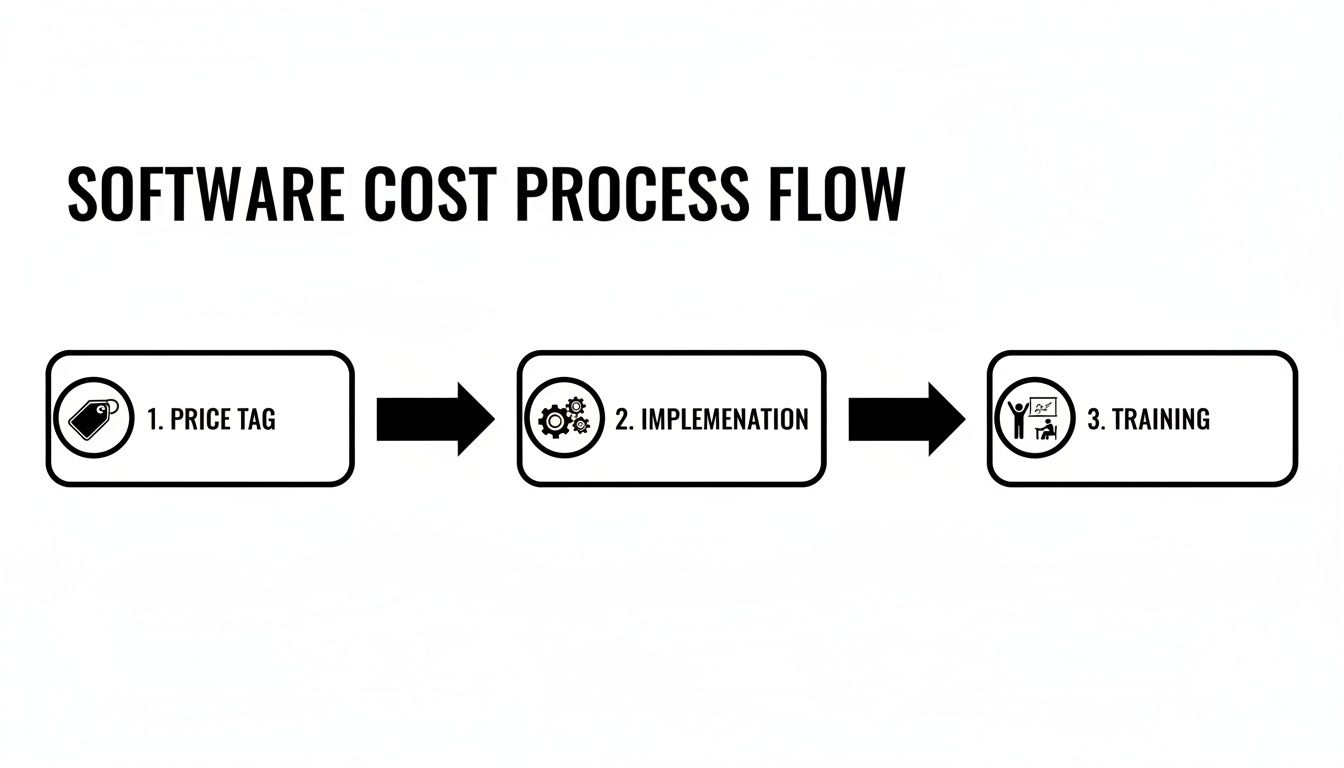
As you can see, the initial purchase is just the start. The true value is unlocked through a proper implementation and making sure your team is fully trained and confident.
Tuning the Software to Your Workflows
With your data ready to go, the next step is to configure the software to match how your business actually operates. This is a critical point. You shouldn't be forcing your team to change their processes to fit the software; a good system should adapt to them. This is where an experienced Odoo partner in Sydney or Adelaide really proves their worth.
Practical Case: Think about a business running on WooCommerce. A generic, out-of-the-box setup simply won't do the job. Their system needs to be specifically configured to handle their unique shipping rules, intricate tax calculations, and payment gateway reconciliations automatically and flawlessly. A successful WooCommerce integration is key.
Don't Forget the People
Honestly, the technology is the easy part. The single biggest obstacle to a successful launch is often the people who have to use it. Change is hard, and if your team isn't on board, their resistance can quietly sabotage the whole project. This is why a smart change management strategy isn't just nice to have—it's essential.
Practical Case: I remember a client who was genuinely worried about user adoption for their new Odoo implementation. We worked with them to identify a few tech-savvy employees and designated them as 'System Champions'. These champions got extra, in-depth training and became the go-to experts for their colleagues. They built excitement from the inside out and helped smooth over the learning curve. It was a simple trick that made a massive difference.
You might also want to consider a phased rollout. Instead of a 'big bang' launch where everything goes live at once, you could start with the core accounting modules. Once everyone is comfortable, you can introduce inventory or CRM a few weeks later. This approach gives your team breathing room to adjust and build confidence.
At the end of the day, a successful implementation isn't a technical exercise—it’s a carefully managed business transformation.
Ready to plan a software rollout that actually works and minimises disruption? Talk to Wistec today, and let our experts guide you through a seamless implementation process.
The Final Check: Choosing a Partner, Not Just a Platform
Alright, you've done the hard yards. You’ve scrutinised your workflows, compared countless features, and looked past the initial sticker price. Now, it's time to make the final call. But let's be clear: choosing your accounting software isn't the finish line. It's the starting gun for a new partnership that will shape your efficiency and your capacity for growth for years to come.
This decision is about more than just the software itself. You're committing to an entire ecosystem—a solution and a support crew—that needs to grow with you. The right software is a powerful tool, no doubt. But the right partner? They’re the ones who show you how to truly wield it.
The Undeniable Value of a Local Expert
When you invest in a system as comprehensive as Odoo, you're not just buying a login. You're getting a powerful, flexible platform that needs to be expertly moulded to the unique contours of your business. This is where the difference between a simple software vendor and a dedicated technology partner really hits home.
Working with an experienced Odoo partner in Sydney or Adelaide gives you an immediate home-ground advantage. They get the local landscape, from the intricacies of GST compliance to the specific quirks of Australian supply chains. Most importantly, they provide the hands-on, practical guidance needed to turn your business ambitions into smooth, functional software workflows.
This is about strategic alignment, not just tech support.
- They can spot potential roadblocks in your Odoo implementation and steer you around them before they become expensive headaches.
- They’ve got a proven track record with complex Shopify implementation and WooCommerce integrations, ensuring your sales channels and financials are always perfectly in sync.
- They provide accessible, local support. You're a valued client, not just another ticket number in an overseas queue.
Think of a local partner as your insurance policy, making sure the significant investment you're about to make actually pays off.
Your Final Gut Check
Before you sign that contract, pull out the blueprint you made at the start. Run your final choice through this last filter. Does it confidently tick these three non-negotiable boxes?
- Scalability: Will this platform solve today's problems without boxing you in tomorrow? Can it handle a future software development project in Sydney or Adelaide if you need a custom-built solution for a unique challenge?
- Integration: Does it pull everything together? Will it become the central hub for your business, connecting seamlessly with your eCommerce store, CRM, and other vital tools?
- Partnership: Do you trust the implementation partner? Have they shown you they genuinely understand your industry and have a clear, proven plan to get you from here to there?
The best technology partnership isn’t about the initial transaction; it’s about the long-term relationship. It's about having an expert in your corner who is just as invested in your success as you are.
The push towards integrated, automated systems is gathering serious momentum across Australia. Just look at the billing software market—a core part of any accounting system. It's projected to explode from AUD 121.09 million in 2025 to AUD 525.04 million by 2035, growing at a huge 15.80% CAGR. Read the full research about Australian billing software market trends. This isn't just a random statistic; it’s a clear signal that businesses are desperate for systems that automate financial tasks and improve accuracy—exactly what a well-implemented ERP delivers.
A Real-World Example: Why Partnership Pays
Practical Case: Imagine a Sydney-based retail business running on Shopify. They’d settled on Odoo but were caught between a cheap overseas implementer and a local Odoo partner in Sydney. On paper, the overseas option looked like a bargain.
Luckily, they went with the local team. The Sydney partner immediately spotted a critical flaw in the proposed Shopify implementation plan—one that would have caused catastrophic inventory sync failures right in the middle of their busiest sales periods.
By investing a little more upfront, the business dodged a bullet that would have crippled them during the holiday rush. The local partner’s on-site presence and deep understanding of Australian retail logistics were invaluable. That’s the real-world difference an expert partner makes. They don't just install software; they protect your business.
This is the final, most crucial piece of the puzzle in learning how to choose accounting software. It's about looking beyond the feature list and seeing the bigger picture. Are you ready to find not just a technology solution, but a partner that will genuinely fuel your future?
If you're ready to have a chat about your specific needs, contact Wistec today. Let’s build a solution that drives real results.
Got Questions? We've Got Answers
Choosing the right accounting software can feel overwhelming, and it's natural to have a few questions bubbling up. Here are some of the most common ones we hear from business owners who are in your exact position, from figuring out the right time to switch to understanding why a local partner matters.
How Do I Know It's Time to Ditch My Current Software?
The signs are usually glaringly obvious once you know what to look for. Is your team drowning in complex spreadsheets just to close out the month? That's a huge red flag.
Another dead giveaway is when you can't get a clear, real-time picture of your company's financial health. If your essential tools, like your Shopify or WooCommerce store, aren't syncing smoothly with your books, you're creating unnecessary work and risking costly errors. If manual data entry is stealing hours every week, you've definitely outgrown your current setup.
What's the Real Difference Between Accounting Software and an ERP?
It's a great question. Think of it like this: dedicated accounting software is a specialist that only handles your financials—invoicing, expenses, and reporting. An Enterprise Resource Planning (ERP) system, on the other hand, is the general manager of your entire business.
An ERP like Odoo brings all your critical functions—accounting, CRM, inventory, manufacturing, HR—under one roof. For any business that's scaling up, especially one managing different sales channels like Shopify and WooCommerce, or physical stock, an ERP breaks down the data silos and gives everyone a single source of truth to work from.
Why Does Having a Local Odoo Partner Matter?
Working with a local Odoo partner in Sydney or Adelaide offers real-world advantages that a provider on the other side of the world just can't. A local team lives and breathes the Australian business environment. They intimately understand everything from our specific GST compliance rules to the nuances of the local market and supply chain hurdles.
Practical Case: The benefits are immense. Being in the same time zone alone makes every conversation, support ticket, and training session incredibly straightforward. Plus, a local partner can be on-site when you need them for a complex software development Sydney project or Shopify implementation, fostering a genuine, face-to-face relationship that ensures your system is perfectly aligned with how you actually operate.
How Long Does an Odoo Implementation Actually Take?
Honestly, it depends entirely on the complexity of your business. There’s no one-size-fits-all answer. For a small business needing a straightforward setup with basic accounting and CRM, you could be up and running in just a few weeks.
But for a more complex operation, like a manufacturing company with custom workflows and a tricky Shopify implementation, the project could take anywhere from three to nine months. A trustworthy partner will always lay out a transparent project plan with clear, achievable milestones. You should never have to guess what's coming next.
Ready to stop wrestling with software that holds you back and start building a system that fuels your growth? The team at Wistec has the hands-on expertise to guide you through every step. We specialise in custom Odoo implementations, seamless eCommerce integrations with Shopify and WooCommerce, and strategic software development designed to deliver real-world results in Sydney and Adelaide.