

Let’s be blunt: the core difference between ERP and CRM is straightforward. ERP systems are all about what’s happening inside your business, while CRM systems are focused outside, on your customers.
Think of an ERP as your company’s central nervous system. It’s the backbone connecting everything from finance and inventory to HR and your supply chain, all with the goal of making you more efficient and cutting down on costs.
A CRM? That’s your revenue engine. It’s purpose-built to chase down leads, manage your sales pipeline, and keep your customers happy, ultimately driving growth.
Defining Your Core Business Challenge
Choosing between an Enterprise Resource Planning (ERP) and a Customer Relationship Management (CRM) system can feel like a huge decision, but it really comes down to one thing: what’s your biggest headache right now?
Are you bogged down by chaotic internal processes? Think messy inventory, disjointed financial reporting, or supply chain nightmares. Or is your main struggle finding new customers and keeping the ones you have? Answering that question is the key to figuring out which system will give you the most immediate bang for your buck.
A practical case is a growing eCommerce business on a platform like Shopify or WooCommerce. It will almost certainly benefit from a CRM first. It helps them track customer data and nail their marketing. But once the orders start flying in, the real pain shifts to managing stock levels and juggling suppliers. That’s the classic signal that it’s time for an ERP, where a strategic Odoo implementation in Sydney can bring all those operations under one roof.
On the flip side, a professional services firm in Adelaide—like an accounting or law practice—will likely need a CRM far sooner. Their priority is tracking every client interaction and managing a long sales funnel, long before their internal admin becomes a major problem.
ERP vs CRM At a Glance
To really spell it out, I’ve put together a table that cuts through the noise. It breaks down the main differences between an ERP and a CRM, showing you exactly where they focus and the kind of impact you can expect from each.
| Aspect | ERP (Enterprise Resource Planning) | CRM (Customer Relationship Management) |
|---|---|---|
| Primary Goal | Streamline and automate internal business processes to cut operational costs. | Manage and improve customer interactions to increase sales and retention. |
| Main Focus | Back-office operations (finance, inventory, HR, supply chain). | Front-office activities (sales, marketing, customer service). |
| Key Users | Finance, operations, and manufacturing teams. | Sales, marketing, and customer support teams. |
| Data Type | Transactional data (orders, invoices, stock levels, financial records). | Relational data (customer contacts, communication history, sales funnels). |
| Business Impact | Boosts efficiency, improves data accuracy, and gives you a clear financial picture. | Drives revenue, shortens sales cycles, and improves customer satisfaction. |
Getting these core distinctions right is the first step. The best choice for you depends entirely on where your business is today and what you’re trying to achieve tomorrow.
Ready to figure out which system is the right fit for your unique needs? Our experts in software development in Adelaide can analyse your operations and map out the perfect solution. Contact us today for a free consultation.
Understanding ERP: The Backbone of Your Operations
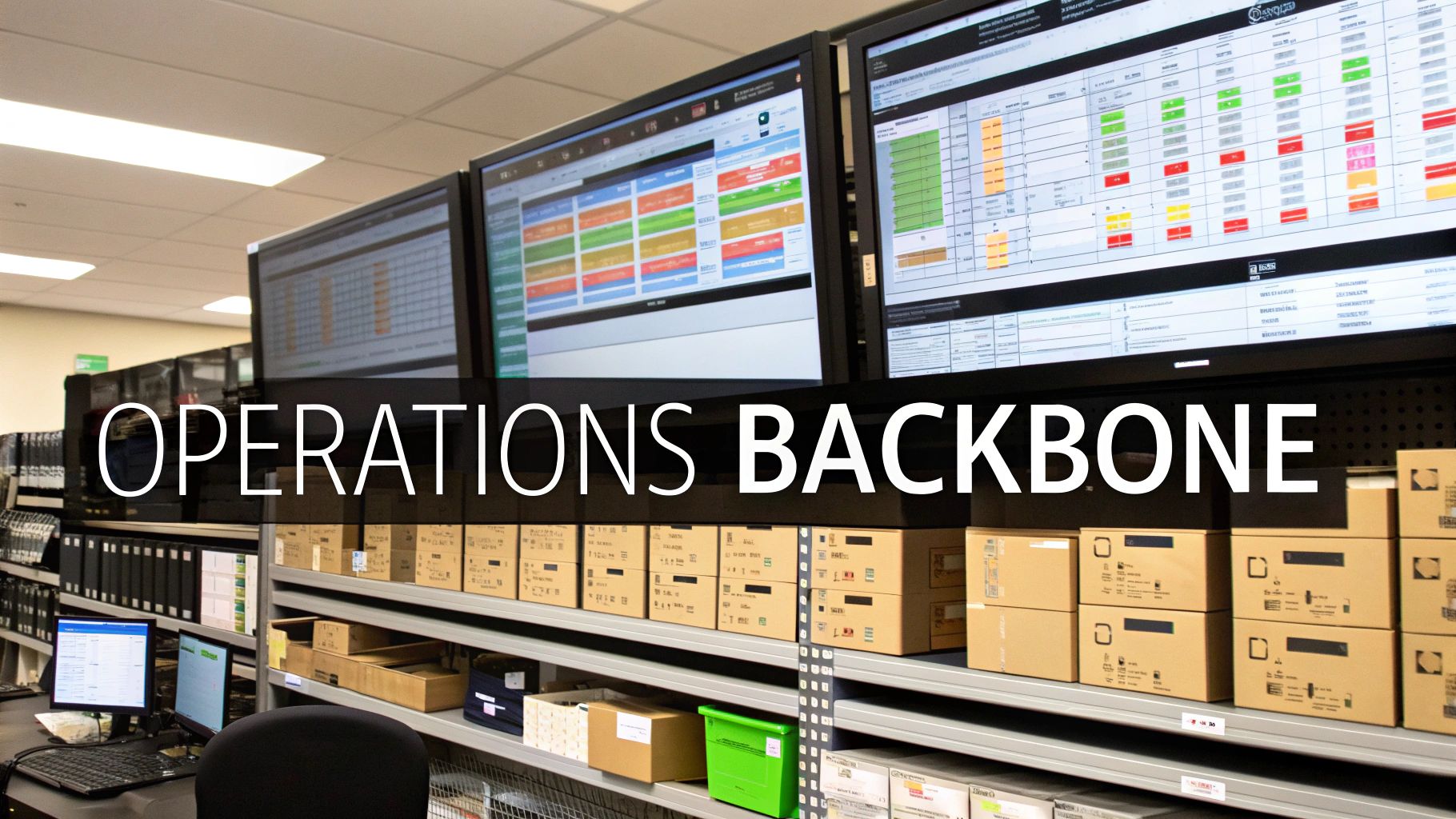
Think of an Enterprise Resource Planning (ERP) system as your business’s central nervous system. It’s the single source of truth that connects and drives all your critical back-office functions, from the warehouse floor right through to the finance department. At its heart, an ERP is designed to create serious efficiency by knocking down the walls that traditionally separate different parts of your company.
It achieves this by pulling essential processes like accounting, human resources, manufacturing, and supply chain management into one unified platform. This integration demolishes the data silos that cause so many headaches, giving you a complete, real-time picture of your business’s health. Suddenly, you have total visibility over every moving part of your operation.
Unifying Your Core Processes
The real magic of an ERP is how it links workflows that would otherwise be completely separate. This connectivity lets data flow smoothly from one department to another, which means no more manual data entry and a huge reduction in the risk of costly mistakes.
Once your processes are unified, the strategic benefits become impossible to ignore. Your business will see improvements like:
- Rock-Solid Data Accuracy: When everyone is working from the same dataset—from sales orders to inventory counts—your reporting becomes far more reliable and trustworthy.
- Smarter Workflows: By automating routine jobs like invoicing, payroll, and generating purchase orders, you free up your team to focus on work that actually grows the business.
- Simplified Regulatory Compliance: An ERP organises your financial records and operational data in a way that makes audits and meeting compliance standards much less painful.
This need for an operational command centre is precisely why the Australian ERP software market is booming. It was valued at approximately USD 930.2 million in 2024 and is expected to climb to USD 1,170.6 million by 2030. As Aussie businesses invest more in their IT infrastructure, ERP adoption is rising to meet the demand for better operational control and real-time insights. You can find more details in this report on Australian ERP market trends.
A Practical Case for an ERP
Picture a manufacturing company based in Sydney, trying to manage stock across multiple warehouses. Before their ERP, the teams were wrestling with separate spreadsheets. This chaos led to constant stock discrepancies, production hold-ups, and ultimately, unhappy customers. After a local Odoo implementation in Sydney, they gained a live, unified view of their entire inventory.
Now, when a salesperson confirms an order, the system instantly allocates the stock, sends a notification to the warehouse, and updates the finance team’s records. This single, automated action stops them from overselling and guarantees the production schedule is always based on accurate, up-to-the-minute data.
This move toward flexible, cloud-based ERP solutions gives growing businesses in cities like Sydney and Adelaide the ability to scale like never before. Whether you’re dealing with a complex supply chain or need a Shopify implementation or WooCommerce integration, a modern ERP provides the powerful backbone required for today’s complex operations.
Ultimately, while the ERP vs CRM debate comes down to your most pressing challenges, it’s vital to understand an ERP’s role. It’s the system you need when internal chaos starts getting in the way of delivering on your promises to customers.
Ready to bring order to your operations? Our experts in software development in Adelaide and Sydney can design a solution that fits your business perfectly. Get in touch with us to discuss your ERP needs.
Understanding CRM: Your Engine for Revenue Growth
If an ERP is the internal backbone of your operations, then a Customer Relationship Management (CRM) system is the powerful, outward-facing engine built to drive revenue. It’s the dedicated technology for managing every single interaction your business has with current and potential customers. Think of it as the system designed to answer the most critical questions about your sales pipeline, marketing efforts, and customer relationships.
At its heart, a CRM centralises all customer-related information. This gives your sales, marketing, and service teams a single, unified view of every lead and client, preventing vital details from getting lost in spreadsheets or siloed in individual inboxes. It creates one source of truth for all customer-facing activities.
Fuelling Your Sales and Marketing Teams
A CRM is so much more than a digital address book; it’s an active tool for growth. It organises and automates the very processes that turn a curious prospect into a loyal customer, making it absolutely essential for any business serious about scaling its revenue.
Its primary functions are laser-focused on the entire customer journey:
- Sales Pipeline Management: This is about tracking leads as they move from initial contact to a closed deal. It gives you a clear, predictable forecast of future revenue and helps you spot and fix bottlenecks in your process.
- Marketing Automation: You can run targeted email campaigns, segment your audience based on their behaviour, and nurture leads with personalised content. It’s all about sending the right message to the right person at exactly the right time.
- Customer Service Tracking: Every support ticket, phone call, and interaction gets logged. This ensures you deliver a consistent, high-quality customer experience, because resolving issues quickly is a proven way to keep customers coming back.
This customer-first approach explains why Australian businesses are pouring money into this technology. The local CRM software market is projected to hit USD 1.67 billion in 2025—a figure that actually surpasses the ERP market. This trend points to a clear strategic shift: companies now see customer experience as their main competitive advantage. You can dive deeper into the data on Australia’s growing CRM market to see the full picture.
A Real-World Case for a CRM
A practical case is a professional services firm in Adelaide struggling to manage new business enquiries. Leads were trickling in from their website, referrals, and networking events, but follow-ups were haphazard and inconsistent. Good opportunities were simply falling through the cracks because no one had a clear view of who was meant to do what.
After implementing a CRM, every new lead is automatically captured and assigned to a sales rep. The system sends automated follow-up reminders, tracks all email communications, and gives the managing partner a real-time dashboard of the entire sales pipeline. A simple change like this can dramatically shorten the sales cycle and boost client acquisition.
Whether you’re an eCommerce brand using Shopify or WooCommerce, or a firm needing expert software development Sydney Adelaide, a CRM empowers your team to deliver personalised experiences at scale. It directly connects to tangible business outcomes, like higher customer lifetime value and better retention rates. In the ERP vs CRM debate, the CRM is your non-negotiable tool when the biggest challenge is finding, winning, and keeping customers.
Is your sales funnel leaking? Are you struggling to deliver a consistent customer experience? Our team can help you implement a CRM solution that plugs the gaps and fuels your growth. Contact us for a no-obligation consultation today.
How ERP and CRM Tackle Different Business Functions
When you move past the textbook definitions, the real daylight between ERP and CRM appears in how they handle day-to-day business operations. It really boils down to a classic case of internal efficiency versus external growth. Think of it this way: an ERP is built to perfect what you do, while a CRM is designed to expand who you do it for.
Their entire approach to data is fundamentally different. An ERP lives and breathes transactional data—the hard numbers like purchase orders, invoices, inventory levels, and financial statements. Its mission is to make sure every internal process is logged with precision, giving you a crystal-clear financial and operational snapshot at any moment.
A CRM, on the other hand, is all about relational data. It meticulously tracks every email, phone call, meeting note, and social media interaction you have with a customer or potential lead. The goal here is to build a rich, detailed history of the relationship to drive more sales and keep customers coming back.
Data Focus: Transactional vs. Relational
The kind of data each system cares about dictates its core purpose. An ERP, with its transactional data, is there to answer questions like, “What’s our current inventory worth?” or “Are we profitable on this particular product line?” These are inward-looking questions, all aimed at tightening up operations and cutting costs. Naturally, its heaviest users are in the finance, operations, and logistics departments.
Meanwhile, a CRM uses its deep well of relational data to answer questions like, “Which of our leads are most likely to convert this month?” or “Why are customers leaving us?” These are outward-looking questions, focused squarely on increasing revenue and market share. This is why you’ll find sales, marketing, and customer service teams living inside their CRM all day.
An ERP tracks a product’s journey from a pile of raw materials to a finished item sitting on a warehouse shelf. A CRM tracks a person’s journey from their first click on your website to becoming a loyal, repeat customer.
This distinction is everything. Trying to manage your sales pipeline in an ERP is like trying to run a factory using your phone’s contact list—it’s just not built for that job.
The infographic below does a great job of visualising the core functions of a CRM. You can see how its sales, marketing, and service modules are all interconnected to manage the entire customer lifecycle.
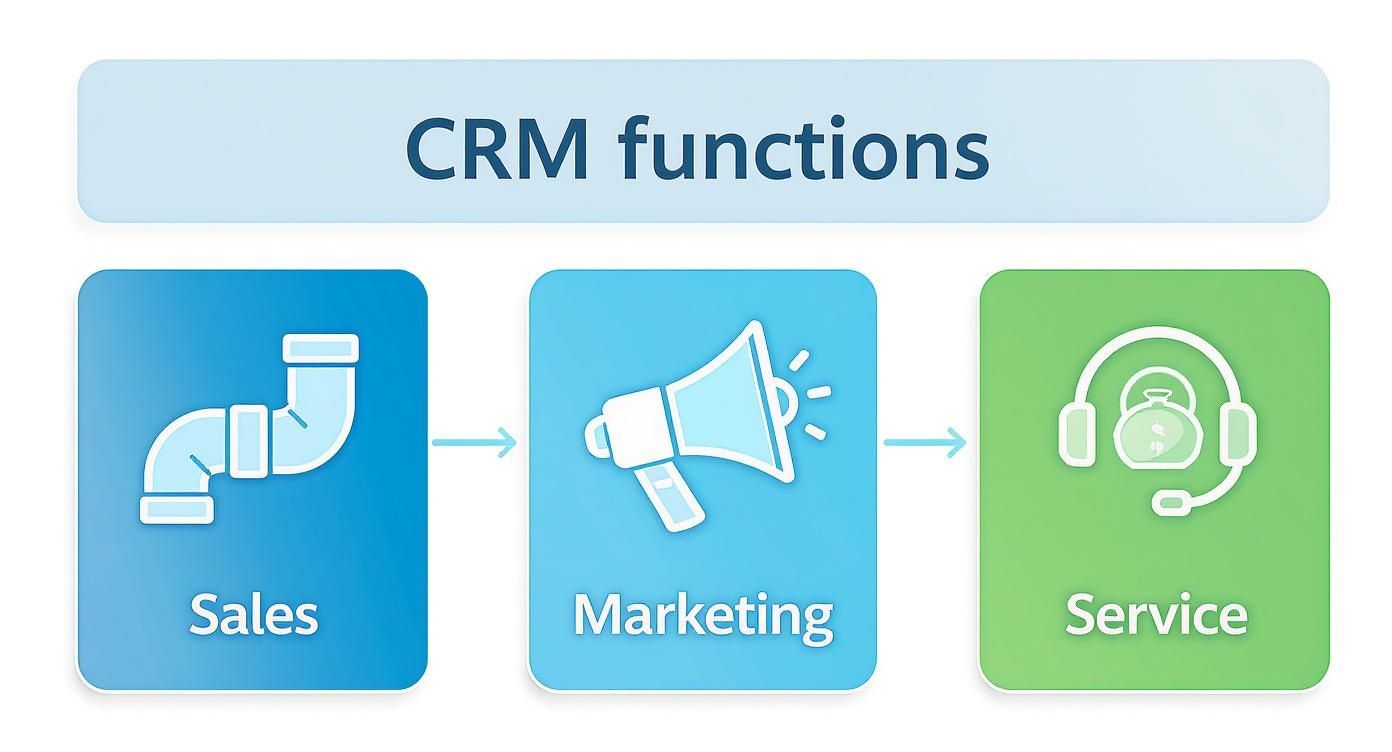
As the visual shows, every part of a CRM is customer-centric, from finding new leads to solving support tickets, all with the aim of fuelling business growth.
Functional Showdown ERP vs CRM
To make this even clearer, let’s break down how each system approaches common business functions. An ERP sees the world through the lens of internal process, while a CRM views everything through the eyes of the customer.
| Business Function | ERP Approach (Internal Process Focus) | CRM Approach (External Customer Focus) |
|---|---|---|
| Sales | Manages order processing, invoicing, and revenue recognition after a sale is made. | Manages the entire pre-sale journey: lead generation, pipeline tracking, and sales forecasting. |
| Finance | Core function. Manages general ledger, accounts payable/receivable, and financial reporting. | Tracks revenue per customer, campaign ROI, and customer lifetime value (CLV). |
| Inventory | Tracks stock levels, manages warehousing, and automates reordering to prevent stockouts. | Provides sales reps with real-time product availability to inform customers and close deals. |
| Customer Service | Manages post-sale logistics like returns, repairs, and warranty claims (RMAs). | Manages customer interactions, support tickets, and knowledge bases to improve satisfaction. |
| Marketing | Tracks marketing budget spend and links it to overall financial performance. | Manages marketing campaigns, email automation, lead scoring, and measures campaign effectiveness. |
| Reporting | Focuses on operational efficiency, profitability reports, and supply chain performance. | Focuses on sales funnels, customer churn rates, and marketing campaign engagement. |
This table really highlights the different philosophies. While there’s some overlap, they are designed to solve fundamentally different problems for your business.
A Practical Functional Showdown
Let’s ground this in reality with a practical case. Imagine an eCommerce business running on Shopify or WooCommerce. In the beginning, their biggest headache is getting noticed and acquiring customers. A CRM is non-negotiable here; it’s essential for managing marketing campaigns and nurturing every single lead.
But once the orders start flooding in, the focus has to shift. Suddenly, the problems are logistical—managing stock across multiple locations, fulfilling orders without errors, and handling returns efficiently. This is where an ERP, perhaps a custom Odoo implementation in Sydney, becomes absolutely critical. The ERP takes control of the back-end chaos, making sure products are in stock and shipped on time. A successful Shopify implementation isn’t just about a pretty storefront; it’s about the robust back-end that an ERP provides.
Now, consider a services firm, like an accounting practice in Adelaide. They’ll probably never need complex inventory management. For them, the most valuable asset is their client relationships. A CRM is their mission control, letting them track new leads, manage client communications, and spot opportunities for upselling. An ERP might be a consideration down the line, but the CRM is the immediate priority.
Choosing the right system starts with an honest look at your business’s main functions and biggest bottlenecks. Is operational chaos holding you back, or is a leaky sales funnel the more urgent problem?
If your challenges are internal and process-driven, you need an ERP. If they’re external and customer-focused, a CRM is your answer. Let our experts in software development Sydney Adelaide help you diagnose your needs. Schedule a free consultation today to find the right functional fit for your business.
When to Pick ERP vs. CRM: Real-World Scenarios
Theory is one thing, but making the right call between an ERP and a CRM really comes down to what’s causing the most headaches in your business day-to-day. The choice becomes crystal clear when you look at it through the lens of real-world problems.
So, let’s ditch the jargon and walk through a few common business situations. This will help you see exactly where each system shines and which one is built to solve your specific challenges.
The Manufacturer Drowning in Supply Chain Chaos
Here’s a practical case: picture a mid-sized manufacturing firm in Sydney. They make brilliant custom parts, but their success has turned their logistics into a complete mess. You’ve got one team using a spreadsheet for raw materials, another for production schedules, and a third for finished goods. The result? Total communication breakdown.
This internal chaos creates two massive problems. First, they constantly run out of essential materials, which brings production to a grinding halt. Second, they have no real idea what each job actually costs to produce, making their profit margins a complete guess. Deadlines are missed, customers are getting frustrated, and it’s clear the issue isn’t a lack of sales—it’s operational inefficiency. This is a textbook ERP problem.
An Odoo implementation in Sydney would bring all of this under one roof.
- Smarter Inventory: The system would keep an eye on stock levels and automatically generate purchase orders before anything runs out, preventing those costly production stoppages.
- True Job Costing: Every single resource, from a bolt to an hour of labour, gets logged against a specific job. Suddenly, they have a precise, undeniable view of profitability.
- Financial Clarity: The finance team gets a live look at cash flow, payables, and receivables, all tied directly to what’s happening on the factory floor.
The ERP becomes the company’s single source of truth. It brings order to the supply chain and gives the leadership the hard data they need to make intelligent, cost-saving decisions.
The Professional Services Firm Looking to Grow Smarter
Now, for another practical case, let’s consider a growing accounting practice in Adelaide. Their internal operations are pretty straightforward—no physical inventory, no complex supply chain. Their biggest hurdle is managing a constant flow of new business enquiries and keeping their existing clients happy.
Leads are flooding in from their website, referrals, and networking events, but the follow-up is all over the place. Promising opportunities are slipping through the cracks simply because no one has a clear view of the sales pipeline. This is a classic CRM problem. The pain is all external and customer-facing.
A CRM implementation completely changes the game for their client acquisition.
Every new enquiry gets captured automatically and assigned to a partner. The system then nudges them with reminders, logs every call and email, and displays a clean dashboard showing exactly where each prospect is in the sales cycle.
This organised approach means no lead gets left behind and they can finally create predictable revenue forecasts. It becomes the engine that drives and organises their growth—a job an ERP was never designed to do.
The eCommerce Brand Hitting a Growth Wall
Lastly, think about a booming eCommerce brand built on a platform like Shopify or WooCommerce. When they were starting out, a CRM was their best friend. It helped them manage customer lists, send out targeted marketing emails, and handle support tickets. Their world revolved around winning and keeping customers.
But as the orders started piling up, a whole new set of problems appeared. Juggling stock levels across multiple warehouses became a daily nightmare, and they started overselling popular items. Just getting orders out the door accurately and handling returns was becoming a massive time-drain. The very success their CRM helped them achieve had exposed a huge weakness in their back-end operations.
This is the classic tipping point where a business needs more than just a CRM. While the CRM is still crucial for managing customer relationships, an ERP is needed to wrangle the growing operational beast behind the scenes. An Odoo implementation can sync directly with their Shopify implementation or WooCommerce store, automating everything from processing orders and updating inventory to reconciling the financials.
As these practical cases show, choosing between ERP and CRM isn’t about which software is fundamentally “better.” It’s about being honest about your biggest business challenge and picking the right tool for that specific job.
Are you fighting internal process fires, or are you struggling to build and manage your customer pipeline? Our experts in software development Sydney Adelaide can help you pinpoint your core needs and find the perfect fit. Contact us today for a complimentary business analysis.
How to Choose the Right System for Your Business
The whole ERP vs CRM debate really comes down to one simple question: where does your business hurt the most? Forget the jargon for a moment and take an honest look at your biggest bottleneck. Is it a leaky sales funnel that’s costing you customers, or are clunky internal processes strangling your team’s ability to deliver?
Start by asking some tough questions. Are you wrestling with inventory levels and messy supply chains? Or is the real headache trying to keep track of customer conversations and nurture leads effectively? Your answer is your roadmap.
If your problems are external and customer-facing, a CRM is where you need to focus your immediate attention. But if internal chaos is the real enemy of your growth, an ERP is the tool built to restore order.
Matching the System to Your Growth Stage
The size of your business and where you’re heading next are massive factors here. For most startups and small businesses, the game is all about winning customers and getting revenue in the door. In this early stage, a CRM isn’t just a good idea—it’s almost always the right first step.
But as a business grows, its needs change completely. A distributor that’s rapidly scaling, for instance, will quickly find that managing complex stock, logistics, and financials becomes a much bigger fire to put out than finding new leads. At that point, the priority flips, and an ERP becomes non-negotiable for survival.
We see this pattern playing out across the Australian market. While CRM adoption is strong in customer-centric sectors like retail, it’s telling that around 92% of high-performing Australian SMBs either use or plan to use an ERP system to get their internal operations in order. It shows that as businesses mature, streamlining finance, supply chain, and workforce management becomes critical. You can read more about the latest Australian business software adoption trends to see the data for yourself.
The Power of a Unified Platform
The classic debate often forces you into a corner, making you choose one system over the other. But today’s technology offers a much smarter path forward. Unified platforms completely sidestep the “either/or” problem by combining the strengths of both systems into one integrated solution.
This unified approach avoids the classic traps of disconnected data silos and the nightmare of complex, costly integrations. Instead of juggling two systems that don’t talk to each other, you get one platform where customer information flows seamlessly into your operational and financial workflows.
A fantastic example of this is Odoo, which provides a suite of powerful, interconnected modules for both CRM and ERP functions.
- A practical case for eCommerce on Shopify or WooCommerce: You can manage your sales pipeline with Odoo’s CRM while your inventory and accounting are handled perfectly by its ERP modules, all in the same place.
- A practical case for a manufacturer: A customer order captured in the CRM can automatically kick off production planning and procurement processes within the ERP modules, without anyone lifting a finger.
This integrated model is future-proof. It lets you start with just the modules you need right now and simply switch on others as your business expands. It’s exactly why a strategic Odoo implementation in Adelaide or Sydney has become such a go-to choice for businesses that want to scale without the integration headaches.
Your Next Step Is Clear
At the end of the day, choosing between an ERP and a CRM is less about the software itself and more about aligning technology with your most critical business goals. By diagnosing your primary challenges and being honest about your growth stage, you can make a strategic decision that delivers real, measurable results.
Ready to move from thinking to doing? Whether your priority is to tighten up operations or to light a fire under your sales team, we can help you build the right foundation for growth.
Our experts in software development Sydney Adelaide are on hand to assess your unique needs and design a solution that’s a perfect fit. Whether that’s a dedicated CRM, a comprehensive ERP, or a unified platform like Odoo, we build technology that solves real-world problems.
Clearing Up the ERP vs CRM Confusion
Choosing between these systems often brings up the same set of questions. Let’s tackle the most common ones business owners ask when they’re at this crossroads. These answers come from years of helping businesses navigate this exact decision.
Can I Just Use My ERP to Manage Customers?
It’s a fair question. Many ERPs do have a place to store customer data, but it’s usually limited to transactional details like past orders, invoices, and payment history. It’s a record of what’s happened, not what could happen.
They just don’t have the specialised tools a CRM offers for managing the entire customer journey—from nurturing a new lead and tracking sales pipeline progress to running targeted marketing campaigns. If you’re serious about building relationships and driving growth, a dedicated CRM is almost always the right tool for the job.
We’re a Small Business. Which One Do We Get First?
For almost every startup or small business, the answer is CRM. Your number one priority is finding customers and bringing in revenue, and that’s precisely what a CRM is designed to help you do.
Think about it this way: an ERP is what you’ll need when you’re so successful that you can’t keep up with the complexity. It solves problems related to inventory, complex finances, and supply chain logistics that arise from growth. You have to create the growth first.
A practical case we see all the time is with booming eCommerce stores on platforms like Shopify or WooCommerce. They start with a great CRM to power their sales engine. But eventually, the sheer volume of orders creates back-end chaos, and that’s when an ERP becomes essential to manage everything efficiently after a successful Shopify implementation.
How Difficult Is It to Integrate an ERP and a CRM?
Honestly, it can be a real headache. While many modern cloud systems have pre-built connectors or APIs, getting two separate, complex systems to talk to each other seamlessly can quickly become a complicated and expensive project. This is especially true if you’re dealing with older, on-premise software or have highly customised setups.
This integration challenge is a huge reason why all-in-one platforms are gaining so much traction.
For example, a solution like an Odoo implementation in Adelaide gives you powerful ERP and CRM modules that are already built to work together. This completely sidesteps the integration problem, giving you one unified source of information for your internal operations and your customer-facing activities. Working with an expert in software development Sydney Adelaide ensures the platform is shaped perfectly around your unique business processes from day one.
Are ERPs Always More Expensive Than CRMs?
As a general rule, yes. ERP projects are typically a much bigger undertaking. They touch almost every department in your business and have to manage complex processes like manufacturing, warehousing, and multi-layered financials. That wider scope naturally means higher costs for the software itself, the implementation, and training your team.
CRM software, on the other hand, is often priced per user and has a tighter focus on sales, marketing, and service teams. This makes it a much more accessible and affordable starting point for businesses focused on growth.
Ready to stop guessing and start growing? Whether you need to streamline your operations or supercharge your sales, we deliver practical technology solutions that drive real business results. We specialise in custom Odoo implementation Sydney Adelaide, eCommerce development for Shopify and WooCommerce, and expert software development Sydney Adelaide to solve your biggest challenges. Let’s discuss your project today!