

Are disconnected spreadsheets and manual data entry slowing your business down? Many Australian businesses reach a point where their current tools simply can't keep up with their growth. The solution lies in a unified Enterprise Resource Planning (ERP) system, but choosing the right one can feel overwhelming. This guide cuts through the noise with practical erp systems examples tailored for the AU market.
We will explore seven real-world platforms, breaking down their core functions, target industries, and strategic benefits. Discover how a tailored ERP implementation, whether for manufacturing automation or integrating your Shopify and WooCommerce stores, can revolutionise your operations. One critical area where these systems excel is in helping businesses achieve efficiency and accuracy, and a key part of that is mastering automated invoice processing.
This listicle moves beyond generic descriptions to provide strategic analysis and actionable takeaways for each option. We'll examine real-world cases, showing you how engaging a dedicated software development and Odoo partner in Sydney or Adelaide can deliver a solution that fits your unique business needs, reduces costs, and sets you up for scalable success. Let's find the right system to drive your growth.
1. Odoo in Australia – Wis Technology ERP and CRM Services
When searching for robust erp systems examples, the combination of Odoo’s flexible, all-in-one platform with the localised expertise of an implementation partner like Wis Technology (Wistec) stands out as a premier choice for Australian businesses. Wistec leverages Odoo to deliver a unified business management backbone, replacing fragmented software with a single, integrated system. This solution connects critical functions like CRM, invoicing, inventory, accounting, and manufacturing into one cohesive ecosystem, eliminating the operational drag caused by disparate data and manual processes.
The core strength of this offering lies in its modularity and scalability. Unlike rigid, monolithic ERPs, Odoo allows businesses to start with only the applications they need and add more as they grow. This “start-small” approach makes it a financially accessible and practical solution for SMEs looking to streamline operations without committing to a massive, disruptive overhaul.
Strategic Analysis: The Power of Localised Implementation
The true differentiator is the partnership with a local expert like Wistec. While Odoo provides the powerful software foundation, Wistec provides the crucial implementation, customisation, and ongoing support tailored to the Australian market. This local advantage ensures the system is configured to fit a company’s unique workflows, not the other way around.
- Local Expertise: Wistec, an Odoo partner in Sydney and Adelaide, understands local business compliance, industry standards, and market dynamics.
- Tailored Development: They offer custom software development in Sydney and Adelaide, ensuring the ERP can handle specific operational requirements, from unique manufacturing processes to complex inventory rules.
- Seamless Integration: Expertise in Shopify implementation and WooCommerce integration means eCommerce businesses can unify their online storefronts with back-end operations like inventory, accounting, and CRM.
Practical Case Example: Streamlining a Manufacturing Workflow
Consider an Australian manufacturer struggling with disconnected systems. Orders from their WooCommerce site are manually entered into a separate accounting program, while inventory is tracked on spreadsheets. This leads to stockouts, delayed invoicing, and poor visibility into production costs.
By implementing Odoo with Wistec, they could integrate a Bill of Materials (BOM) with the Manufacturing and Inventory apps. When a sales order is confirmed, the system automatically checks stock levels, generates a manufacturing order if needed, allocates raw materials, and updates inventory in real-time. The transaction is simultaneously posted to the accounting ledger, creating a seamless flow from sales to production to finance.
Actionable Takeaway
For businesses that need more than an off-the-shelf solution, engaging with a specialised implementation partner is critical. Wistec transforms Odoo from a powerful tool into a strategic asset by aligning its flexible modules with your specific business goals.
If your business is struggling with operational bottlenecks and disconnected data, exploring a tailored Odoo implementation with a local expert could unlock significant efficiency gains. Contact Wistec to discuss how a customised ERP solution can drive your growth.
Website: https://wistec.com.au/odoo/
2. Odoo
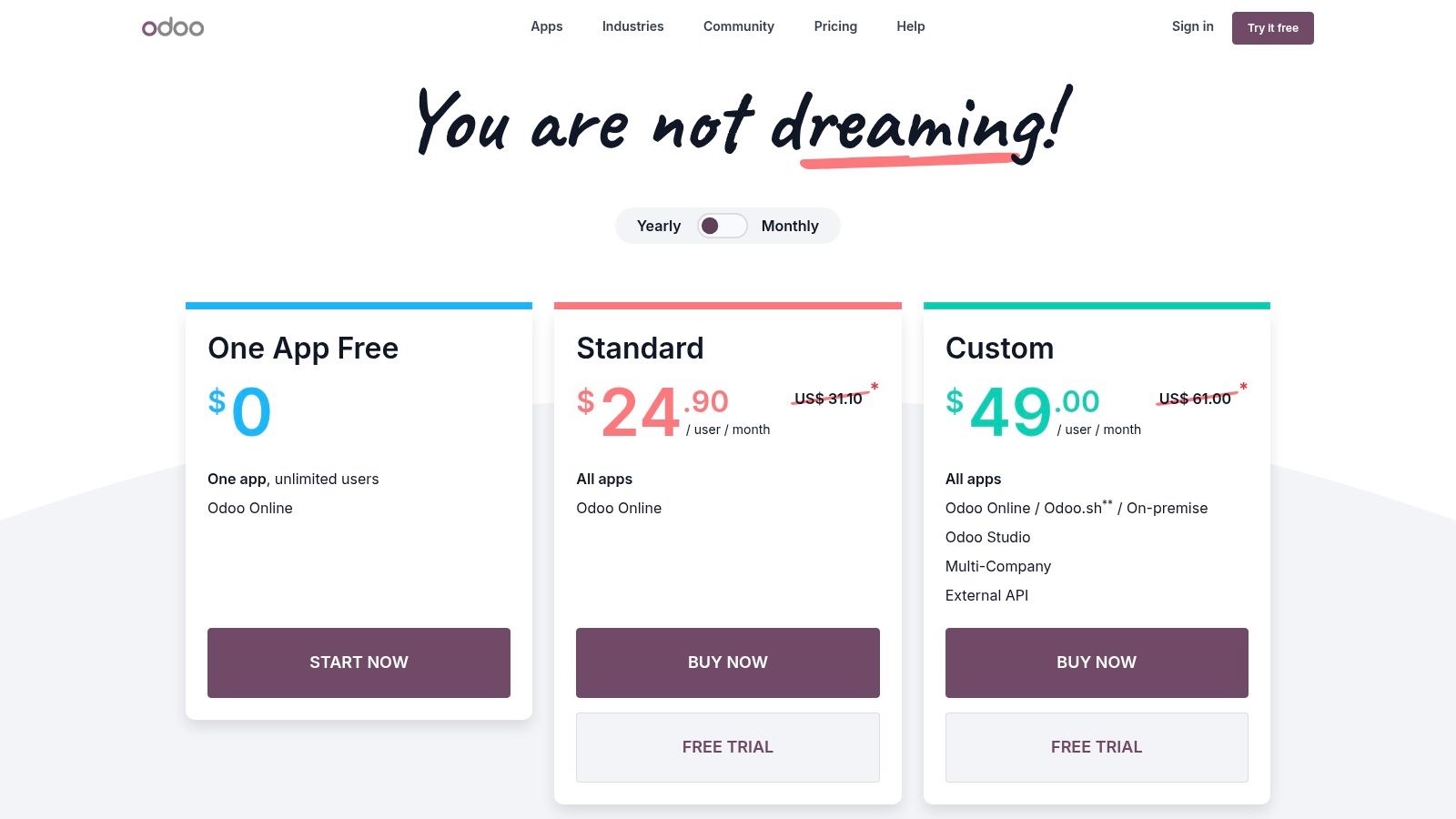
Odoo stands out as a uniquely flexible and scalable ERP platform, making it a powerful choice for small to medium-sized Australian businesses. Its modular approach is its greatest strength; you can start with a single application for free, like CRM or Accounting, and then activate more modules as your business grows. This "pay for what you need" model makes it one of the most accessible erp systems examples for companies transitioning from basic software.
Unlike many monolithic systems, Odoo provides a fully integrated suite covering everything from inventory and manufacturing to eCommerce (including powerful Shopify and WooCommerce integrations) and project management. This eliminates the data silos and disjointed workflows that plague businesses using multiple disconnected apps. While it offers a lower entry cost than many competitors, unlocking its full potential often requires expert configuration. That's why partnering with an official Odoo partner in Sydney or Adelaide is crucial for tailored software development and a smooth implementation.
Strategic Breakdown & Actionable Takeaways
- Start Small, Scale Smart: Begin with the "One App Free" tier to solve your most pressing business need, whether it's managing customer relationships (CRM) or streamlining your books (Accounting). This allows you to prove the concept and gain internal buy-in before committing to a larger rollout.
- Prioritise Integration: The real power of Odoo is its all-in-one nature. Plan your implementation roadmap to connect key business functions. For instance, integrate the Inventory and Sales apps with a Shopify implementation to automate stock updates and order fulfilment.
- Leverage Local Expertise: To customise workflows or build specific features, engage a local implementation partner. They can provide specialised software development in Sydney or Adelaide to ensure the platform perfectly aligns with your unique operational requirements.
Practical Case: A mid-sized Australian distributor was struggling with manual order processing from their WooCommerce store and disconnected inventory records. By engaging an Odoo partner in Adelaide, they implemented Odoo's integrated Sales, Inventory, and Accounting modules. This Odoo implementation automated the entire order-to-cash cycle, reducing fulfilment errors by over 40% and providing real-time visibility into stock levels, transforming their operational efficiency.
For businesses weighing their options against popular accounting tools, understanding the core differences is key. You can explore a detailed comparison to see how a true ERP like Odoo stacks up against systems like Xero or MYOB. Ready to see how Odoo can be customised for your business? Contact Wistec today for a personalised consultation.
3. NetSuite Australia
NetSuite is a powerhouse in the cloud ERP space, positioned as a comprehensive, all-in-one solution for growing and established businesses. It excels in managing complex operations, particularly for Australian companies with multi-entity, multi-currency, or international ambitions. Its unified platform integrates financials, inventory management, CRM, and eCommerce, providing a single source of truth across the entire organisation.
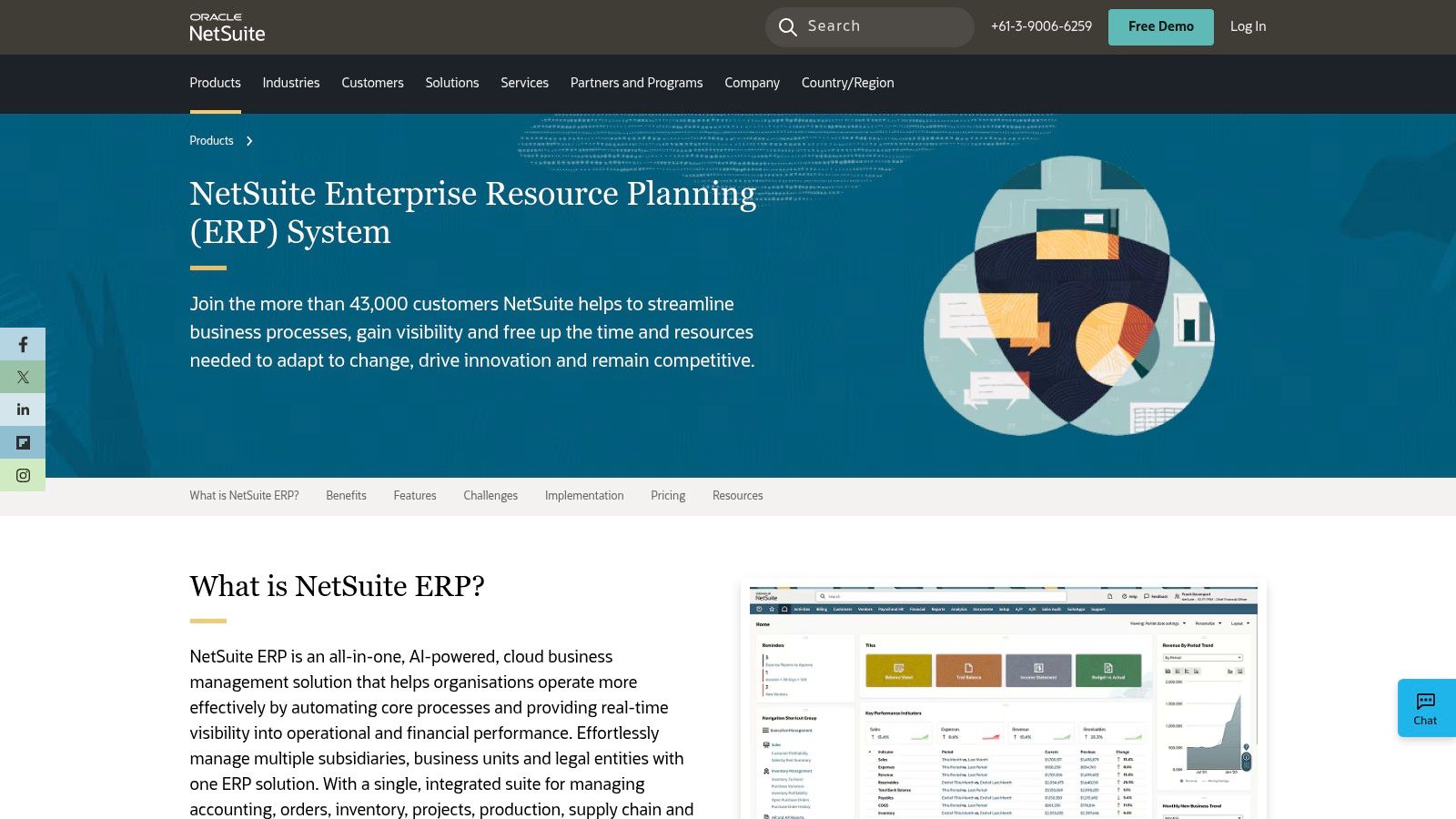
As one of the most mature erp systems examples, NetSuite offers industry-specific editions through its "SuiteSuccess" methodology, which provides pre-configured workflows and leading practices. This can accelerate implementation for sectors like wholesale distribution, retail, and manufacturing. While its robust feature set and scalability are major advantages, the total cost of ownership is typically higher than more modular systems. The pricing is quote-based and depends heavily on the required modules, user count, and implementation scope, making it a significant but powerful investment.
Strategic Breakdown & Actionable Takeaways
- Plan for Multi-Entity Growth: If your business operates multiple legal entities or deals in various currencies, NetSuite's OneWorld module is a key differentiator. Plan your financial structure from the outset to leverage its powerful global consolidation and inter-company transaction capabilities.
- Leverage SuiteSuccess for Faster ROI: When evaluating NetSuite, investigate the SuiteSuccess edition for your industry. This pre-packaged solution includes role-based dashboards and KPIs, which can significantly reduce implementation time and help you see a return on investment sooner.
- Prepare for a Structured Evaluation: NetSuite’s sales process is thorough. Before engaging, clearly document your business processes and pain points. This preparation will enable you to get a more accurate quote and a solution that truly fits your needs. Recognising the signs your business needs an ERP system is the crucial first step.
Practical Case: An Australian wholesale distributor with subsidiaries in New Zealand and Singapore was unable to get a consolidated view of inventory and financials. By implementing NetSuite OneWorld, they unified their operations onto a single platform. This provided real-time visibility into group-wide stock levels and automated financial consolidation, reducing their monthly close process from ten days to just two.
While NetSuite is a formidable platform, businesses should also evaluate flexible alternatives like Odoo, which can be tailored by an expert Odoo partner in Sydney or Adelaide for a more customised fit. For a detailed analysis of your specific needs, contact Wistec for a personalised consultation.
4. Microsoft Dynamics 365 Business Central (AU)
Microsoft Dynamics 365 Business Central is a comprehensive ERP solution designed for small to medium-sized Australian businesses, offering a powerful alternative in the landscape of erp systems examples. Its core advantage lies in its deep, native integration with the Microsoft ecosystem, connecting finance, sales, purchasing, and inventory directly with familiar tools like Outlook, Excel, Teams, and Power BI. This seamless connectivity streamlines workflows and significantly reduces the learning curve for teams already using Microsoft 365.
Business Central is a cloud-based SaaS platform with transparent Australian pricing and a 30-day free trial, making it accessible for evaluation. Its tiered structure (Essentials vs. Premium) allows businesses to choose the right level of functionality, with Premium unlocking advanced manufacturing and service management modules. While its user experience is intuitive, successful implementation and data migration often require specialist partner services to configure the system for specific business processes, much like customising an Odoo environment.
Strategic Breakdown & Actionable Takeaways
- Maximise Microsoft 365 Synergy: If your team lives in Outlook and Excel, leverage this native strength. Configure the system to manage sales quotes directly from Outlook or export and manipulate financial data in Excel with live data connections, eliminating manual data entry.
- Plan Your Tier and Add-ons: Start by mapping your core operational needs. If you only need finance, supply chain, and CRM, the Essentials tier is sufficient. If advanced manufacturing or field service is on your roadmap, factor in the Premium tier from the start to avoid a complex future upgrade.
- Embrace a Partner for Implementation: While a trial is easy to start, don't underestimate the complexity of a full rollout. A partner can manage data migration, customise workflows, and integrate third-party apps, ensuring you get the most value from your investment.
Practical Case: A professional services firm in Sydney was using disconnected spreadsheets and a basic accounting package, leading to poor project visibility and inefficient invoicing. While evaluating Microsoft Dynamics 365, they realised their complex project accounting needs required specific customisation. They ultimately chose an Odoo implementation with a local Odoo partner in Sydney. This provided a more flexible and cost-effective platform to build custom project management and billing workflows, integrating timesheets and expenses into a single system for real-time profitability tracking.
For businesses looking for ultimate flexibility and customisation without being tied to a single software ecosystem, exploring an open-source alternative is often a strategic move. See how a platform like Odoo can be tailored to your exact needs. Contact Wistec today for a personalised consultation.
5. MYOB Acumatica (formerly MYOB Advanced)
MYOB Acumatica serves the Australian mid-market as a powerful, localised cloud ERP solution. Built on the globally recognised Acumatica platform, it’s specifically tailored for AU/NZ compliance, handling GST, BAS, and Single Touch Payroll (STP) natively. This makes it a strong contender for established businesses in manufacturing, distribution, and construction that require robust, industry-specific functionality without the compliance workarounds needed in other systems. It is one of the more comprehensive erp systems examples for companies scaling beyond basic accounting software.
Unlike entry-level systems, MYOB Acumatica is designed for complexity, offering dedicated editions for different sectors. Its key advantage is the blend of a flexible, customisable framework with strong local support from the MYOB partner network. Pricing is quote-based and requires engaging with MYOB or a certified partner for scoping, reflecting its focus on tailored implementations rather than an off-the-shelf product. While this means a higher barrier to entry, it ensures the solution is precisely configured to a business's unique operational needs from day one.
Strategic Breakdown & Actionable Takeaways
- Prioritise Local Compliance: If your business operates primarily in Australia or New Zealand, leveraging an ERP with built-in compliance for GST/BAS and STP is a significant strategic advantage. This reduces administrative overhead and compliance risk from the outset.
- Invest in a Scoped Solution: Don't view the quote-based pricing as a negative. Use the mandatory scoping process with an MYOB partner to deeply analyse your workflows. This ensures you pay only for the required modules and receive a system that genuinely fits your business, avoiding the feature bloat of other platforms.
- Plan for Customisation: The Acumatica framework is highly adaptable. Identify unique processes that give your business a competitive edge and plan to customise the ERP to support them. Engaging an expert for software development in Sydney or Adelaide can turn the platform into a true business asset.
Practical Case: An Australian manufacturing company was hampered by disconnected systems for inventory, production scheduling, and financials. By implementing MYOB Acumatica’s Manufacturing Edition, they unified their operations onto a single platform. The solution provided real-time visibility into the shop floor and automated inventory replenishment based on production orders, leading to a 25% reduction in stock-outs and a 15% improvement in on-time delivery.
For companies in the industrial sector, choosing the right platform is critical. You can explore a deeper dive into dedicated ERP solutions for manufacturing to compare capabilities. If you’re considering a highly flexible and scalable alternative, contact Wistec today to see how Odoo can be tailored to your needs.
6. Pronto Software (Pronto Xi)
As a long-standing Australian vendor, Pronto Software offers an end-to-end solution designed specifically for the local market. Its flagship product, Pronto Xi, is a comprehensive and modular ERP system that appeals to established mid-market to larger organisations wanting a robust, single-vendor platform. This makes it a noteworthy entry among erp systems examples for businesses seeking deep functionality across finance, distribution, and manufacturing, all backed by local support.
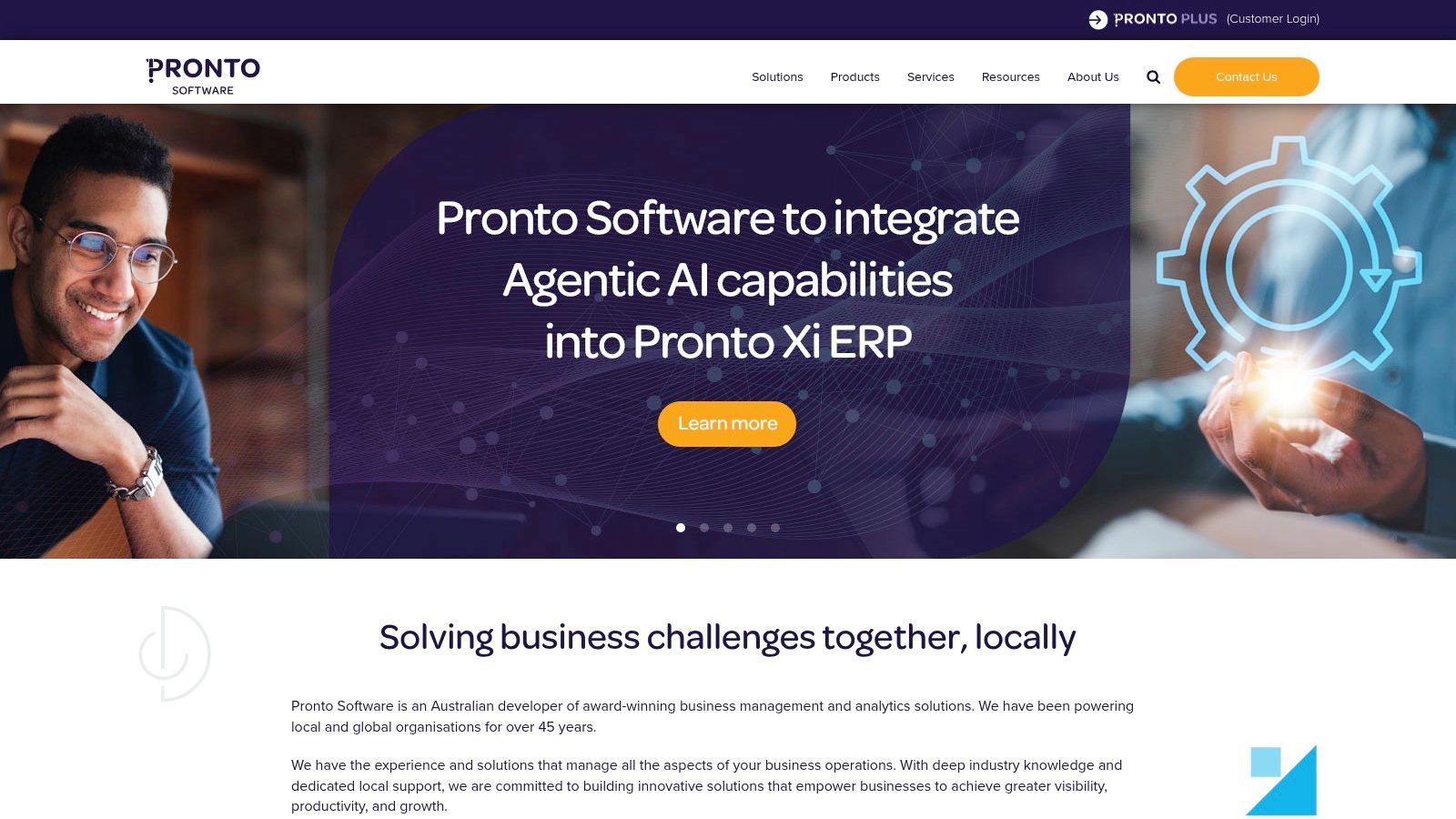
Pronto Xi covers a vast range of business operations, including asset maintenance, retail/POS, and integrated business intelligence. Its "True Cloud" offering ensures Australian data residency, a critical factor for many local companies. While it presents a powerful, all-in-one alternative to global mega-vendors, its pricing is entirely quote-based and requires detailed scoping. Furthermore, its ecosystem is smaller, which can make finding third-party integrations for platforms like Shopify or WooCommerce more challenging compared to more open-source systems like Odoo.
Strategic Breakdown & Actionable Takeaways
- Assess Total Cost of Ownership: Since pricing is bespoke, engage with their team to get a detailed scope and quote. Factor in not just the initial licence and implementation, but also ongoing support and potential customisation costs to understand the full investment.
- Prioritise Local Support Needs: If having an Australian-based support and implementation team is a top priority for your business, Pronto Xi is a strong contender. This is a key differentiator against many global ERPs where support can be offshore.
- Evaluate Integration Capabilities: For businesses heavily reliant on specific third-party applications (e.g., advanced eCommerce or marketing automation), carefully vet Pronto Xi's integration capabilities. An open, API-friendly platform like Odoo, supported by an expert Odoo partner in Sydney or Adelaide, often provides greater flexibility for connecting diverse systems.
Practical Case: An Australian manufacturing company with complex asset maintenance schedules used disparate systems for production planning and equipment servicing. This led to unscheduled downtime and poor visibility. While they could consider a system like Pronto Xi, an alternative approach using Odoo's Manufacturing, Maintenance, and IoT modules would offer a highly integrated, cost-effective solution. A specialist in software development in Adelaide could connect machinery sensors directly to the ERP, automating maintenance requests based on real-time usage data and dramatically improving operational uptime.
For businesses looking for a more agile and customisable platform that scales from the ground up, exploring flexible ERP alternatives is a crucial step. Ready to see how a modern ERP can be tailored to your precise needs? Contact Wistec today for a personalised consultation.
7. Capterra Australia – ERP Systems Directory
When embarking on your research journey, a neutral third-party marketplace is an invaluable starting point. Capterra Australia’s dedicated ERP directory serves as a comprehensive research hub, allowing businesses to compare hundreds of solutions side-by-side. It provides a broad overview of the market, making it an excellent first stop for gathering erp systems examples and understanding the available options before diving deeper.
Capterra excels at helping you create a preliminary shortlist. Its powerful filtering tools let you narrow down options by industry (like manufacturing or retail), required features (CRM, inventory management), deployment type (cloud or on-premise), and company size. The platform’s greatest asset is its wealth of verified user reviews, which provide unfiltered insights into the real-world performance, usability, and customer support of various systems. While sponsored listings can affect visibility, the transparent review methodology offers a trustworthy perspective.
Strategic Breakdown & Actionable Takeaways
- Filter with Purpose: Don't just browse. Use the filters to zero in on solutions built for your specific industry and operational scale. This ensures the systems you evaluate are genuinely relevant to your business needs, saving you significant research time.
- Analyse User Reviews: Look beyond the star ratings. Read detailed reviews from companies of a similar size and industry to yours. Pay close attention to comments about implementation challenges, customer support quality, and the ease of integrating modules like Shopify or WooCommerce.
- Validate on Vendor Sites: Use Capterra for initial discovery and comparison, but always click through to the official vendor website to verify features, pricing, and capabilities. This is also where you can identify official implementation partners, such as an Odoo partner in Sydney or Adelaide, who can provide specialised services.
Practical Case: An Adelaide-based manufacturing firm used Capterra to identify ERPs with strong production and inventory modules. The user reviews consistently highlighted Odoo's flexibility and value. This led them to contact Wistec, a local Odoo partner in Adelaide, who demonstrated how their Odoo implementation could be customised for their specific make-to-order workflow. The initial research on Capterra gave them the confidence to engage an expert for a tailored solution, resulting in a 25% reduction in production lead times.
While comparison sites provide a great overview, achieving a perfect fit requires expert guidance. To see how a top-rated system like Odoo can be adapted to your unique challenges, contact Wistec for a personalised consultation.
Top 7 ERP Systems — Quick Comparison
| Solution | 🔄 Implementation Complexity | ⚡ Resource Requirements | 📊 Expected Outcomes | 💡 Ideal Use Cases | ⭐ Key Advantages |
|---|---|---|---|---|---|
| Odoo in Australia – Wis Technology ERP and CRM Services | Medium — partner‑led modular setup and customisation | Moderate — local implementation, development and training effort | Unified CRM/finance/inventory workflows; reduced reconciliation | Australian SMBs and growing enterprises needing local support | Local expertise, affordable customisation, scalable modular approach |
| Odoo | Low–Medium — self‑serve start, partner help for broader rollouts | Low entry (one app free); increases with modules/custom dev | Faster time‑to‑value with integrated apps | Organisations wanting flexible app catalog and multiple deployments | Broad app ecosystem, trials, flexible deployment options |
| NetSuite Australia | High — enterprise configuration and multi‑entity setup | High — quoted licensing, implementation and partner services | Unified financials, global consolidation, advanced supply chain | Multi‑entity/multi‑currency mid‑market to enterprise | Mature ecosystem, SuiteSuccess industry editions, strong global features |
| Microsoft Dynamics 365 Business Central (AU) | Medium — tiered features; integrations and migration work | Moderate — subscription, partner implementation; published pricing | Connected Microsoft UX, better reporting and Power Platform integration | SMB/mid‑market needing MS365/Teams/Power BI integration | Familiar UX, published AU pricing, tight Microsoft ecosystem links |
| MYOB Acumatica (formerly MYOB Advanced) | Medium — platform configuration and industry scoping | Moderate–High — partner‑led demos, compliance setup, customisation | AU/NZ‑compliant finance, payroll and industry workflows | Businesses requiring AU/NZ compliance and industry editions | Purpose‑built for local compliance, strong partner network |
| Pronto Software (Pronto Xi) | Medium — modular implementation with local scoping | Moderate — local delivery, analytics and mobility setup | End‑to‑end Australian ERP with integrated BI and mobility | Organisations seeking an Australian vendor and data residency | Strong local support, integrated suite, Australian footprint |
| Capterra Australia – ERP Systems Directory | Low — research and shortlist process (no implementation) | Low — free marketplace use; time to evaluate vendors | Rapid vendor comparison, verified user feedback, shortlist creation | Buyers researching ERP options, comparing features and vendors | Extensive listings, filters, verified reviews and vendor links |
Your Next Step: From Examples to Implementation
We've explored a diverse landscape of ERP systems examples, moving from the all-in-one flexibility of Odoo to established platforms like NetSuite and Microsoft Dynamics 365. The recurring theme isn't about finding a single "best" software, but identifying the right strategic fit for your unique operational DNA. Each case study, whether in retail, manufacturing, or professional services, underscores a critical truth: a successful ERP is less about the technology itself and more about the transformational strategy that guides it.
The journey from outdated, siloed processes to a unified, efficient business hub is a significant undertaking. As you consider your next steps, understanding foundational concepts like business automation and SaaS integration is crucial for making an informed decision that aligns with modern cloud-based ecosystems. This knowledge ensures you can evaluate not just what a system does today, but how it will scale and connect with other critical tools tomorrow.
Key Strategic Takeaways
Reflecting on the examples provided, several core principles stand out for any Australian business considering an ERP implementation:
- Process First, Technology Second: The most successful projects begin with a deep analysis of current workflows, identifying bottlenecks and opportunities for improvement before selecting a tool. The software should be chosen to solve your specific problems, not the other way around.
- Modularity is Your Ally: You don't need to implement everything at once. Starting with core modules like Accounting, Inventory, or CRM provides immediate value and a solid foundation. This phased approach, common in Odoo implementations, minimises disruption and allows for agile adjustments.
- Integration is Non-Negotiable: Modern businesses rely on a suite of tools. Your ERP must act as the central nervous system, seamlessly connecting with your eCommerce platform (like Shopify implementation or WooCommerce), payment gateways, and other third-party applications. This is where a skilled implementation partner becomes invaluable.
Turning Insight into Action
The path forward requires a clear, actionable plan. Rather than getting lost in feature lists, focus on these practical steps:
- Define Your Core Challenge: What is the single biggest operational headache you need to solve? Is it inaccurate inventory data, disconnected sales and accounting, or inefficient production scheduling? Start there.
- Map Your Essential Workflows: Document how information and tasks flow through your organisation. This map will be your guide for customisation and module selection.
- Find the Right Partner: The success of your project heavily depends on the expertise of your implementation team. Look for a partner with proven experience in your industry and a deep understanding of platforms like Odoo. A local Odoo Partner in Sydney or Adelaide can provide the hands-on support and custom software development needed to tailor the system perfectly to your Australian business requirements.
Ultimately, the power of these ERP systems examples lies in their demonstration of what's possible. They show how a well-chosen and expertly implemented ERP can become the engine for growth, efficiency, and a superior customer experience. The right system, supported by the right team, doesn't just manage your business; it transforms it.
Ready to move from examples to execution? Wistec specialises in custom Odoo ERP implementation and software development for Australian businesses. As a dedicated Odoo Partner for Sydney and Adelaide, we translate your unique operational needs into a powerful, unified system that drives real results. Visit Wistec to book a free consultation and discover your path to operational excellence.