

Ever felt like your business departments are speaking different languages? Sales has one set of numbers, accounts has another, and inventory seems to be operating in a parallel universe. It’s a common problem, and it’s exactly what an ERP system like Odoo is designed to solve.
Think of it as the central nervous system for your entire operation. It connects every part of your business—from the first customer interaction to the final delivery and invoicing—into a single, intelligent platform. No more data silos, no more chasing information. Just one unified source of truth.
What Is Odoo and Why Is It Different?
Let’s stick with the orchestra analogy for a moment. If your business is an orchestra, each department—sales, manufacturing, HR, accounts—is a section of musicians. When they’re all playing from different sheet music, you get chaos. That’s what it feels like working with disconnected spreadsheets and clunky, separate software.
An Enterprise Resource Planning (ERP) system is the conductor, making sure everyone plays in perfect harmony. But Odoo is a very different kind of conductor.
Traditional ERP systems are often rigid and monolithic. They hand you a massive, complex score and expect you to play every single note, whether it fits your business or not. Odoo, on the other hand, lets you choose the instruments. Its all-in-one, modular design is what truly sets it apart.
- Start small, grow big: A startup retailer in Adelaide can kick things off with just the Inventory, Sales, and Point of Sale apps. As they grow into eCommerce with a Shopify implementation, they can simply add the website and marketing modules. No big-bang implementation, just seamless evolution.
- Everything just works together: The real magic is in the integration. A sale made on your WooCommerce store instantly updates stock levels, creates an invoice in your accounting app, and logs the customer details in your CRM. It’s a completely connected ecosystem.
- Open-source freedom: Under the hood, Odoo is open-source. This gives businesses incredible power to customise the software to fit their unique workflows, not the other way around.
A Modern Approach to Business Management
This modularity is Odoo’s secret sauce. It frees you from the hefty price tags and unnecessary complexity of old-school systems. You’re not paying for a bloated suite of tools you’ll never touch. Instead, you build a lean, powerful system that mirrors how you actually work.
This makes it an incredibly practical choice for businesses looking for expert Odoo implementation Sydney or custom software development Adelaide that aligns with their specific goals.
Take a look at Odoo’s CRM module. It’s clean, visual, and intuitive. Teams can see their entire sales pipeline at a glance, dragging and dropping opportunities as they progress.
There’s no need to dig through spreadsheets or complicated reports. The visual clarity helps your team spot bottlenecks instantly and focus their energy on what matters: closing deals.
Odoo ERP vs Traditional ERP Systems at a Glance
To put it in perspective, let’s quickly compare Odoo’s modern approach to the old way of doing things.
| Feature | Odoo ERP System | Traditional ERP Systems |
|---|---|---|
| Architecture | Modular (pay for what you need) | Monolithic (buy the whole suite) |
| Flexibility | Highly customisable (open-source core) | Rigid, difficult to customise |
| Implementation | Phased, scalable implementation | Lengthy, “big bang” implementation |
| Cost | Lower entry cost, predictable pricing | High upfront licensing and hidden fees |
| User Interface | Modern, intuitive, and user-friendly | Often complex, dated, and requires extensive training |
This table really highlights the shift. Odoo offers a dynamic, agile platform built for growth, while traditional systems often lock businesses into a rigid and expensive framework.
Meeting the Needs of Australian Businesses
The demand for this kind of adaptable ERP is exploding right here in Australia. The local ERP software market was valued at around AUD 1.4 billion in 2024 and is on track to hit AUD 1.7 billion by 2030.
Why the growth? Aussie businesses are ditching old on-premise servers for cloud solutions that can be tailored to our specific needs—like integrating with local accounting platforms and handling GST and Single Touch Payroll (STP) compliance effortlessly. Odoo’s cost-effective, flexible nature is perfectly suited to meet this demand. You can find out more about the Australian ERP market trends.
Whether you’re connecting your online store on Shopify or WooCommerce, or managing a complex manufacturing floor, Odoo is more than just software. It’s a strategic platform designed to centralise your operations and fuel your growth.
Ready to see how an ERP system from Odoo can bring harmony to your business? Contact Wistec today for a personalised consultation and discover a solution built for your success.
Exploring the Core Odoo Modules That Run Your Business
An ERP system from Odoo is more than just another piece of software; it’s the central nervous system for your entire business. Instead of thinking of it as a single program, picture it as a suite of specialised tools, all engineered to work together perfectly. Each module is built to master a specific part of your operation, whether that’s nurturing customer relationships or tracking every last item in your warehouse.
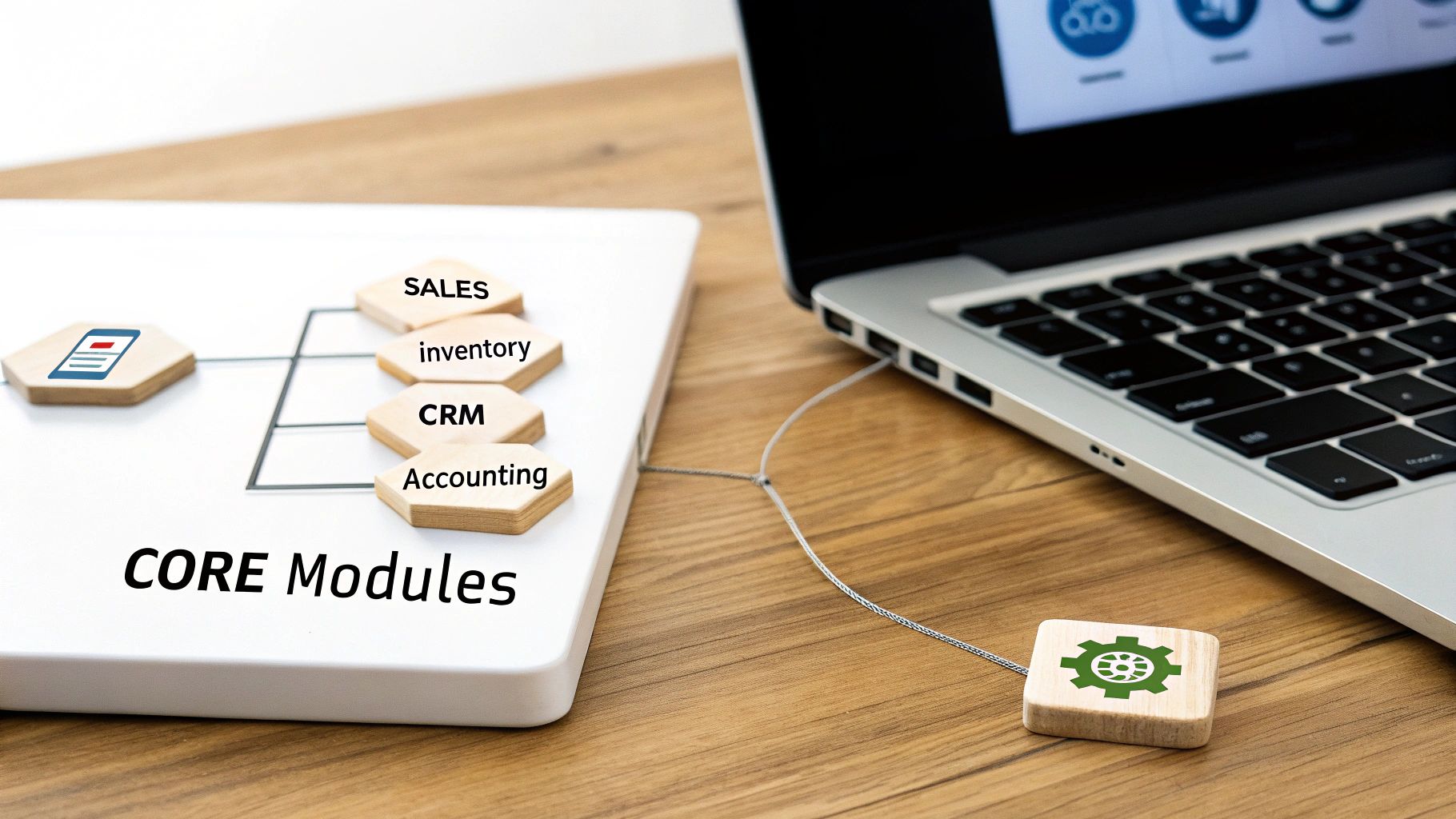
The real magic, though, isn’t in any one module. It’s in the way they all talk to each other. When your sales team, warehouse managers, and accountants are all drawing from the exact same real-time data, you slash errors, accelerate workflows, and make much smarter decisions. This is what transforms a collection of separate departments into one cohesive, high-performing machine.
Nurturing Leads with Sales and CRM
Every business starts with its customers. Odoo’s Sales and CRM (Customer Relationship Management) modules are your command centre for managing that entire journey, from a potential lead’s first hello to closing the deal and fostering long-term loyalty. The CRM gives your team a clear, visual pipeline to track leads, set follow-ups, and forecast revenue with impressive accuracy.
Practical Case: A growing professional services firm in Sydney used the CRM to revolutionise their lead management. By creating automated follow-up sequences and a visual pipeline, they could track every client interaction. This visibility allowed them to reduce their average lead response time by 40% and increase conversions, all without clumsy data re-entry.
Streamlining the Supply Chain with Inventory and Manufacturing
If you deal with physical products, you know that having a tight grip on your supply chain is everything. This is where Odoo’s Inventory and Manufacturing modules come in, giving you the deep visibility and control you need to keep things running like clockwork. The Inventory app offers real-time stock tracking across multiple locations, sets up automated replenishment rules, and delivers powerful reporting.
Practical Case: A manufacturing firm in Adelaide used Odoo’s Manufacturing module to map out complex bills of materials (BOMs). As soon as a sales order is confirmed, the system kicks into gear:
- A manufacturing order is automatically created.
- It instantly checks stock levels for every required component.
- If any parts are low, it queues up purchase orders.
This automated workflow stopped production delays dead in their tracks and ensured they could hit customer deadlines without fail. This is the kind of intelligent setup that requires expert software development Sydney Adelaide teams to fine-tune for maximum benefit.
The real game-changer in Odoo’s modular design is its ability to create a single source of truth. When your inventory count is instantly updated by a sale from your website, a return at a physical store, or materials used on the factory floor, you achieve total operational clarity.
Connecting Your Sales Channels Seamlessly
Today, your customers are everywhere, and your business needs to be too. Odoo acts as the central hub that pulls all your sales channels together, including hugely popular eCommerce platforms. With expert Shopify implementation or native connectors for tools like WooCommerce, every online sale feeds directly into your Odoo system.
This means an order placed on your Shopify store can automatically update inventory levels, trigger a delivery order, and create an invoice in the Accounting module. This deep integration eliminates the tedious manual task of reconciling sales from different platforms, freeing your team up to focus on what actually matters: growing the business.
For any company serious about building a connected and powerful operational backbone, a professional Odoo implementation Sydney or Adelaide is the next logical step. Are you ready to stop juggling disconnected systems? It’s time to run your business on a single, intelligent platform. Speak with a Wistec expert today to map out your path to total business integration.
Odoo in Action: Real Stories from Australian Businesses
Theory is great, but there’s nothing more convincing than seeing how an ERP system Odoo boosting efficiency in the real world. The true measure of its power isn’t found in a feature list; it’s in the tangible results it delivers for Australian companies grappling with everyday operational headaches.
Let’s step away from the abstract and look at two genuine case studies. We’ll start with a manufacturer in Sydney stuck in a logistical nightmare, and then head to Adelaide to see how an eCommerce business broke through its growth ceiling.
From Manual Mayhem to Manufacturing Mastery in Sydney
Imagine a mid-sized manufacturing firm in Sydney. They had a skilled team and a great product, but their internal processes were a disaster. Think disconnected spreadsheets, overflowing inboxes, and endless manual data entry. Production planning was mostly guesswork, which meant they were constantly running out of materials, pushing back deadlines, and dealing with unhappy customers.
It was clear their existing setup was holding them back. They teamed up with a specialist software development Sydney firm to get Odoo up and running. The mission was simple: build a single source of truth to connect everything from the initial sales quote to the final dispatch.
The change was profound. By bringing in Odoo’s Manufacturing, Inventory, and Sales modules, they completely turned things around:
- Smarter Production Planning: Sales orders now instantly created manufacturing orders and checked stock levels. The system would automatically flag what materials needed to be ordered, killing the guesswork and preventing shortages.
- Live Workshop Tracking: With tablets on the factory floor, the team could update job progress in real-time. This gave managers a bird’s-eye view of everything happening at a glance.
- A Truly Connected Business: The sales team could finally give customers accurate delivery times because they had a direct line of sight into the production schedule.
So, what was the bottom line? A massive 30% reduction in production lead times within the first six months. This wasn’t just an efficiency gain; it directly improved customer satisfaction and gave them a serious leg up on the competition.
Scaling eCommerce Success in Adelaide
Now, let’s head down to Adelaide, where a fast-growing online retailer was becoming a victim of its own success. Orders were flying in from their Shopify implementation and WooCommerce stores, but the operational side of things was buckling under the pressure. Staff were burning hours every day just copying order details into their accounting software and manually updating inventory lists.
Their growth was outstripping their ability to keep up. Just hiring more people to handle the admin wasn’t a sustainable solution. They needed automation, and they needed it fast.
An Odoo implementation Adelaide project was the answer. They integrated their online stores directly with Odoo’s Inventory and Accounting modules, creating a workflow that practically ran itself.
Now, when an order comes through their Shopify store, Odoo automatically creates the sales order, updates the stock count on all channels, generates an invoice, and flags the item for shipping. All without a single click from a staff member.
This hands-off approach meant they could handle a much higher order volume with the same team. Suddenly, their revenue growth wasn’t tied to their operational costs. It freed them up to focus on what really mattered: marketing and growing the business, knowing the back-end could easily handle the load.
The Growing Trend for Odoo in Australia
These stories aren’t just one-offs. They’re part of a much bigger picture. The adoption of Odoo ERP systems across Australia has exploded, with the local user base growing by over 300% in the last three years. We’re seeing this surge most in manufacturing and retail, where businesses are falling in love with Odoo’s modular approach. Australian companies appreciate that they can start with just the modules they need and add more as they grow—a perfect fit for SMEs. If you’re curious, you can find out more about how Australian businesses are using the best ERP systems for small business growth.
The successes in Sydney and Adelaide spell out the ROI of an ERP system Odoo boosting efficiency loud and clear. It’s not about just getting new software. It’s about fundamentally rewiring how your business works—cutting out the waste, automating the grind, and unlocking your true potential.
Can you see this kind of result for your own business? It’s time to stop patching together broken processes and start building a solid foundation for growth.
Ready to see what Odoo can do for you? Contact Wistec today for a no-obligation consultation and let’s map out your path to efficiency.
Your Odoo Implementation Journey: From Plan to Launch
Bringing a full ERP system like Odoo into your business can feel like a huge undertaking, but it doesn’t have to be. The secret is breaking the project down into clear, manageable phases. This turns what seems like a complex technical job into a strategic roadmap for success, ensuring every step, from initial idea to launch day, is done with purpose.
This infographic paints a great picture of that journey, showing the shift from operational chaos to structured, sustainable growth with Odoo.
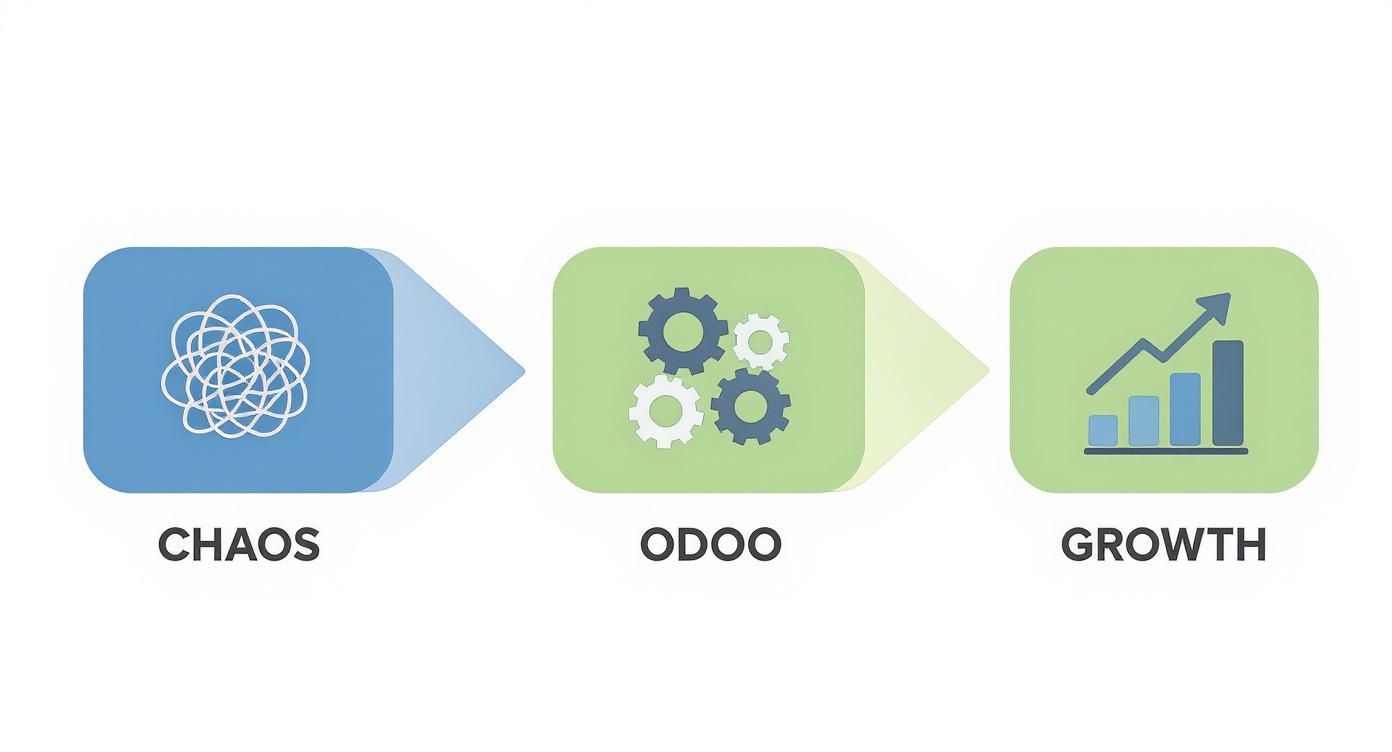
It really highlights how an ERP acts as the central organising force, untangling messy processes and turning them into a well-oiled engine for your business.
Remember, a successful implementation isn’t just about installing software; it’s a fundamental business transformation. Teaming up with an experienced firm for your Odoo implementation Sydney or Adelaide is the best way to navigate these phases smoothly and sidestep the common traps.
Phase 1: Discovery and Planning
Honestly, this is the most critical part of the whole project. Before anyone touches the software, you have to define what success actually looks like for your business. This means taking a good, hard look at your current workflows, pinpointing the real pain points, and setting clear, measurable goals.
Practical Case: An Adelaide-based distributor wanted to reduce picking and packing errors. During the planning phase, their implementation partner identified that the lack of real-time inventory visibility between their WooCommerce store and warehouse was the root cause. The entire project was then focused on this key objective: creating a single, accurate inventory count across all systems.
Phase 2: Configuration and Customisation
With a solid blueprint in hand, it’s time to start building. One of Odoo’s greatest strengths is its incredible flexibility. The first step is configuration, which involves setting up the standard modules, defining user roles, and establishing permissions that match your company’s structure.
But let’s face it, almost every business has unique processes that don’t fit neatly into an off-the-shelf box. This is where expert software development Sydney Adelaide really proves its worth. Customisation might involve building a specific reporting dashboard your finance team needs, creating a new workflow for quality control on the factory floor, or integrating with a local Aussie shipping carrier. This phase is all about making Odoo work for you, not the other way around.
Phase 3: Data Migration
All your historical data—customer details, sales records, product specs—is an incredibly valuable asset. The data migration phase is dedicated to carefully pulling this information from your old systems, cleaning it up, and loading it securely into Odoo.
A clean data migration is absolutely non-negotiable. Shifting messy, inaccurate data into your new ERP is like putting dirty fuel in a brand-new car engine—it’s guaranteed to cause problems from day one.
Phase 4: Team Training and Testing
An ERP system is only as powerful as the people using it. This phase is all about giving your team the skills and confidence they need to use Odoo effectively every single day. That means running comprehensive training sessions designed specifically for different roles, from the warehouse floor to the C-suite.
At the same time, the system goes through rigorous testing. Your team will run through real-world scenarios in a safe test environment to make sure everything works perfectly. Can you process an order from your Shopify implementation? Can you run an end-of-month financial report? Now is the time to find and squash any bugs before you go live.
Phase 5: Go-Live and Ongoing Support
Go-Live is the big moment—when you flick the switch and your new Odoo system becomes the heart of your operations. With all the planning and testing done right, this transition should be smooth. But the work doesn’t stop there. The first few weeks are crucial for answering user questions and smoothing out any unexpected bumps in the road.
Your Odoo implementation Adelaide or Sydney partner provides that vital post-launch support to help your team adapt quickly and ensure the system starts delivering value immediately. This ongoing partnership is key to helping you continue to refine and expand the system as your business grows.
Ready to turn your operational goals into a manageable, strategic project? Contact Wistec today to discuss your implementation plan with our experts.
Moulding Odoo to Your Business DNA
Let’s be honest, no off-the-shelf software is ever a perfect match for how your business actually runs. Every company has its own secret sauce—those unique processes and workflows that give you an edge. This is where an ERP system like Odoo really comes into its own. It’s less like a rigid software package and more like a high-performance toolkit, ready to be shaped to your exact specifications.
The whole point is to make Odoo work the way you do, not force your team into a clunky, one-size-fits-all system. Whether you need a few clever configurations or full-scale custom software development in Adelaide, the platform is designed to adapt and grow right alongside you. You’ll never be stuck in a box that doesn’t fit.
Your First Big Decision: Community vs. Enterprise
The journey to a custom-fit Odoo starts with a fundamental choice between its two main flavours. This decision really sets the stage for how you’ll build out your system.
Think of Odoo Community as the powerful, open-source engine. It’s completely free to use and packed with all the core functions you need to run a business. This makes it a fantastic starting point, especially for businesses that have in-house development talent or a clear idea of the customisations they want to build.
On the other hand, Odoo Enterprise is the premium, all-inclusive version. It takes everything in Community and adds a suite of advanced modules, unlimited functional support from Odoo itself, and hassle-free version upgrades. If your business needs sophisticated tools for accounting, manufacturing, or sales straight out of the box, Enterprise is often the quickest path to getting there.
To make it clearer, here’s how they stack up against each other:
Choosing Your Odoo Edition: Community vs. Enterprise
| Aspect | Odoo Community | Odoo Enterprise |
|---|---|---|
| Cost | Free to download and use (licensing is $0) | Paid subscription based on users and apps. |
| Core Features | Includes all the essentials: CRM, Sales, Invoicing, Website, eCommerce, and more. | All Community features plus advanced modules for Accounting, Manufacturing, Field Service, etc. |
| Support | Community forums and third-party partners. | Unlimited functional support directly from Odoo, plus access to a dedicated partner network. |
| Upgrades | Manual process, often requiring a development partner. | Seamless, fully supported upgrades to new versions are included. |
| Hosting | Self-hosted on your own servers or with a third-party provider. | Can be self-hosted or hosted on Odoo.sh, Odoo’s official cloud platform. |
| Ideal For | Start-ups, SMEs with development resources, or businesses with very specific needs. | Growing businesses, complex operations, and companies that want an all-in-one, supported solution. |
Ultimately, there’s no single “best” choice—it all comes down to your budget, your technical resources, and your long-term business goals.
The Odoo App Store: A World of Ready-Made Solutions
What would your smartphone be without its app store? Pretty limited, right? The Odoo App Store plays the exact same role for your ERP, offering a massive library of thousands of add-ons that can extend what your system can do.
Need to connect with a specific Australian payment gateway? Looking for a way to manage a complex subscription model? Chances are, someone in the community has already built an app for it. This incredible ecosystem means you can often add highly specialised features to your ERP system Odoo boosting efficiency without ever needing to write a single line of code.
How It Works in the Real World: Customising for Aussie Businesses
Let’s move from theory to practice. Here’s how real Australian businesses have tailored Odoo to solve their unique challenges.
- Practical Case (Custom Rental Module): A Sydney equipment hire company was struggling with a standard sales module. They worked with a local team on custom software development in Sydney to build a dedicated rental management app inside Odoo. It now handles their rental contracts, tracks equipment availability, schedules maintenance, and automates billing—all from one central hub.
- Practical Case (Integrating with Local Logistics): An e-commerce business using a Shopify implementation was stuck using a local shipping carrier that didn’t have a pre-built Odoo connection. A developer built a custom integration that now pulls live shipping rates into the checkout, automatically prints labels, and pushes tracking info back to the customer. Simple, seamless, and solved.
- Practical Case (Connecting WooCommerce and In-Store Repairs): A retailer using WooCommerce for online sales also offered in-store product repairs. They customised Odoo to create a unified workflow that tracks repair jobs, manages the inventory of spare parts, and links the repair costs directly to the customer’s account, giving them a complete picture of every interaction, online or off.
These stories show that Odoo isn’t just a piece of software; it’s a flexible framework you can build on.
Odoo’s open-source DNA is a natural fit for the Australian market. We’ve seen a huge spike in Odoo adoption across the Asia-Pacific region since 2020, driven by a growing demand for adaptable ERPs. Many Aussie SMEs start with the cost-effective Community edition and use local developers to customise it. As they scale, it’s common to see them migrate to the Enterprise version to access its more advanced features and professional support. You can dive deeper into Odoo’s global user trends on Spreadthoughts.com.
Ready to build a system that finally works the way your business does? Contact Wistec today to explore how a customised Odoo ERP can be built around your precise operational needs.
How to Know When Your Business Is Ready for Odoo
So, when is the right time to make the leap to an ERP system like Odoo? The truth is, the warning signs usually show up long before your systems completely fall apart. It starts as a low-level, constant friction in your daily operations.
Think about it. Are your teams stuck entering the same customer details into three different spreadsheets? Is getting a clear, up-to-the-minute picture of your inventory across your warehouse, your Shopify site, and your WooCommerce store a complete nightmare? These aren’t just small annoyances; they’re big red flags that your current setup is holding you back.
When simple questions like, “What’s our actual profit margin on this product line?” take days of manual data wrangling to answer, you know you’ve hit a wall. You’re probably spending more time just trying to keep your disconnected systems talking to each other than you are focusing on what really matters: your customers and your growth.
From Expense to Strategic Investment
It’s completely normal to feel a bit hesitant about the cost. But looking at an Odoo implementation as just another expense is missing the bigger picture. This is a foundational investment in the future of your business.
Remember the examples we talked about? The Sydney manufacturer who slashed lead times by a massive 30%, or the Adelaide retailer who finally found a way to scale without chaos. These results aren’t just about being a little more efficient; they create real, tangible competitive advantages.
You’re not just buying a piece of software. You’re building the operational backbone that will support your company for years to come. And you don’t have to go it alone. Expert partners, from those specialising in software development Sydney Adelaide to dedicated Odoo consultants, are there to map out the entire journey. With a solid plan, it’s a carefully managed project, not a blind leap of faith.
Stop pouring time and money into manual workarounds and broken processes. The era of digital sticky tape is over.
Ready to build a scalable, efficient foundation for your business? Schedule a consultation with a Wistec Odoo implementation Sydney expert today and see what’s really possible.
Got Questions About Odoo? We’ve Got Answers
Stepping into a new ERP system is a big move, and it’s natural to have a lot of questions buzzing around. We hear them all the time. To help clear things up, here are some straight-talking answers to the most common queries we get about Odoo.
How Long Does an Odoo Implementation Actually Take?
This is the classic “how long is a piece of string?” question. The real answer depends entirely on how complex your business is.
If you’re a smaller operation needing just the core modules like Sales and Inventory, you could be up and running in as little as 2-4 months. It’s a relatively straightforward process to get the essentials locked in.
But for a larger, more established business, it’s a different ball game. We’re talking custom-built modules, migrating years of data, and linking everything up with your existing systems, like a Shopify or WooCommerce store. In that case, you’re realistically looking at a 6-12 month project. The key is to partner with an experienced team for your Odoo implementation Sydney or Adelaide who can give you a clear, no-nonsense timeline from the start.
Is Odoo a Good Fit for My Industry?
Chances are, yes. The beauty of Odoo is its chameleon-like ability to adapt. Whether you’re in manufacturing, retail, professional services, or running a booming eCommerce store, its modular design means it can be shaped to fit your world, not the other way around.
The real magic of the erp system Odoo boosting efficiency is that it’s not a one-size-fits-all solution. It’s a foundation you build on. With thousands of community apps and the scope for custom software development Sydney Adelaide, it can be moulded to handle anything from intricate manufacturing processes to the complex inventory demands of a multi-channel retailer.
What’s the Real Difference: Odoo Community vs. Enterprise?
Let’s break it down simply.
-
Odoo Community is the free, open-source engine. It’s incredibly powerful and gives you all the core tools to run a business. This is a great option if you have a solid technical team in-house who can handle the setup and customisation.
-
Odoo Enterprise is the premium, fully-supported version. You get everything in Community, plus a suite of advanced modules (like the full Australian accounting suite and the brilliant Odoo Studio customisation tool), unlimited functional support directly from Odoo, and hassle-free upgrades. For most businesses looking to scale without the technical headache, Enterprise is the clear choice.
Will Odoo Play Nicely with My Other Software?
Absolutely. In fact, getting everything to talk to each other is one of its superpowers. The erp system Odoo boosting efficiency is built with a robust API and comes with a stack of ready-made connectors for the big players—think major payment gateways, Australian shipping carriers, and eCommerce giants.
And for any specialised or unique software you rely on? That’s where a good software development partner comes in. They can build custom integrations to ensure Odoo acts as the central hub for your entire operation, pulling everything together seamlessly.
Ready to see how a purpose-built ERP system can bring your operations together and fuel real growth? Wistec delivers practical, solution-driven technology built for Australian businesses. Contact us today for a personalised consultation and discover a solution built for your success.