

When you start looking up the meaning of an ERP system, it’s easy to drown in a sea of technical jargon. Let's cut through the noise.
At its core, an ERP system is the central nervous system of your business. It’s the digital backbone that connects every department, from sales and finance to the warehouse floor, into a single, intelligent platform. It gets rid of the guesswork by creating one version of the truth for your entire company.
What an ERP System Really Means for Your Business
Picture your business without an ERP. The sales team is working from one set of numbers in their CRM. Your accounts department is buried in completely different accounting software. Over in the warehouse, they're tracking inventory with spreadsheets that are probably already out of date.
Each department is stuck in its own silo. This isn't just inefficient; it's a recipe for miscommunication, frustrating delays, and expensive mistakes.
An Enterprise Resource Planning (ERP) system knocks down those walls. It pulls all your essential business functions—finance, HR, supply chain, manufacturing, sales—into a single, shared database. This means when a salesperson in Sydney locks in an order, the inventory is instantly updated for the warehouse team in Adelaide, and the financial transaction is recorded at the exact same moment.
An ERP transforms organisational chaos into crystal-clear clarity. It’s not just another piece of software; it's a business strategy that ensures everyone, from the warehouse floor to the executive suite, is making decisions based on the same complete, real-time information.
This concept of "ERP" can mean different things to different people in your organisation. What a CFO values is quite different from what a warehouse manager needs to get their job done.
Here’s a quick breakdown of how various roles see an ERP system:
ERP Meanings From Different Perspectives
| Business Role | What ERP Means to Them | Key Benefit |
|---|---|---|
| CEO / Managing Director | A complete, high-level view of the entire business's health and performance. | Strategic decision-making based on real-time, accurate data. |
| CFO / Finance Manager | A single, reliable source for all financial data—from invoicing to payroll and reporting. | Improved financial accuracy, faster closing periods, and better compliance. |
| Operations Manager | The central command for managing inventory, production schedules, and supply chain logistics. | Streamlined workflows, reduced operational costs, and better resource planning. |
| Sales Manager | A direct line of sight into inventory levels, customer history, and order fulfilment status. | Faster quote-to-cash cycles and a more informed sales process. |
| Warehouse Team Lead | Real-time inventory tracking, from receiving goods to picking, packing, and shipping. | Fewer stockouts, increased order accuracy, and more efficient warehouse management. |
Ultimately, while the day-to-day benefits vary, everyone gains from working with a unified, reliable source of information.
From Disconnected Data to Unified Strategy
This unified approach isn't just about convenience—it's a powerful engine for growth.
Here in Australia, the shift toward integrated systems is undeniable. The local ERP software market was valued at USD 930.18 million in 2024 and is projected to hit USD 1,190.52 million by 2030. This shows that businesses are increasingly seeing ERP not as an optional extra, but as a strategic necessity.
Tying everything together lets you:
- Gain total visibility: Get a genuine 360-degree view of your entire operation, from start to finish.
- Boost efficiency: Automate those mind-numbing repetitive tasks and smooth out workflows between teams.
- Make smarter decisions: Stop guessing and start using accurate, up-to-the-minute data for forecasting and strategic planning.
Whether you're looking at an Odoo implementation or connecting e-commerce platforms like Shopify and WooCommerce, the goal is always the same: create a single source of truth that aligns your entire organisation.
If you're a smaller operation wondering where to start, you might find our guide on ERP systems for small businesses particularly useful.
Exploring the Core Components of an ERP System
So, what really makes an ERP system tick? The magic is in its modules—the specialised, interconnected building blocks that manage different parts of your business. The best analogy is a smartphone; you install different apps (modules) depending on what you need to do. The crucial difference is that all these "apps" are designed to talk to each other, sharing data so everyone is working from the same playbook.
This concept map shows how core business functions like finance and sales radiate from a central ERP, creating a single, connected brain for your operations.

What this visual really drives home is that finance, sales, and HR aren't isolated departments anymore. They become integral parts of one unified system. This integration is where an ERP's true power lies, turning scattered data points into genuine business intelligence.
Key Modules and Their Practical Applications
While versatile platforms like Odoo offer dozens of specialised modules, most Australian businesses start with a core set. Let’s break down what these essential components actually do.
Finance and Accounting: This is the absolute heart of any ERP. It’s non-negotiable. This module automates invoicing, manages who you owe and who owes you, handles payroll, and generates the financial reports you rely on. It becomes the single source of truth for your company's financial health.
Customer Relationship Management (CRM): Your CRM module is your customer command centre. It organises every bit of customer data, tracks interactions, manages your sales pipeline, and fuels your marketing campaigns. It gives you a complete, living history of every relationship.
Inventory Management: If you sell physical products, this is a game-changer. It provides real-time tracking of stock levels, whether you have one warehouse or ten. It monitors every movement, manages SKUs, and helps you dodge the costly pains of stockouts or overstocking.
Supply Chain Management (SCM): This module gives you a bird's-eye view of your product's entire journey, from sourcing raw materials to final delivery. It helps you optimise procurement, manage supplier relationships, and keep your logistics running like a well-oiled machine.
When an ERP system is properly integrated, a single customer action triggers a seamless chain reaction. A sale logged in the CRM automatically updates stock in the inventory module, the finance module generates an invoice, and the SCM module is alerted if raw materials need reordering—all without a single person lifting a finger.
Practical Cases: How These Modules Create Real-World Value
The real value isn't just in the modules themselves, but in how they work together. Here are a couple of common practical cases we see with Australian businesses.
Practical Case 1: A Shopify Retailer in Sydney
A growing Sydney fashion brand using Shopify was constantly overselling its most popular items during flash sales. It was a nightmare for their customer service team and damaging their reputation. By implementing an ERP with tightly integrated Inventory and CRM modules, they now have a single, live view of stock. When an online order comes through, the inventory is instantly reserved, making it impossible for someone else to buy an out-of-stock product. This kind of seamless fix, often guided by an expert Odoo partner in Sydney, protects their brand and keeps customers happy.
Practical Case 2: A Manufacturer in Adelaide
An Adelaide manufacturing firm kept hitting production delays because they were ordering raw materials too late. Their new ERP’s Supply Chain Management (SCM) module now analyses production schedules and current stock levels to automatically trigger purchase orders. This ensures materials arrive exactly when needed, slashing storage costs and completely eliminating that frustrating production downtime. This is where custom software development in Adelaide turns an ERP from a simple database into a proactive business tool.
Whether you're running a WooCommerce store or a complex factory, the right mix of ERP modules creates a powerful, unified engine to drive your growth.
Ready to explore which ERP components could make the biggest difference for your business? Contact our team today for a free consultation to discuss a solution designed for your specific needs.
Choosing Your Platform: On-Premise vs Cloud ERP
One of the first big decisions you’ll make is where your ERP system will actually ‘live’. This choice between on-premise and the cloud goes far beyond just technology; it fundamentally shapes the cost, accessibility, and day-to-day management of your entire system. It’s less about servers and more about your business strategy—how much control do you need versus how much convenience do you want?
A simple way to look at it is like housing.
An On-Premise ERP is like building your own custom house from the ground up. You have complete control over every detail—the design, the security systems, the landscaping. But with that control comes full responsibility. You’re the one fixing the plumbing when it breaks (server updates) and handling all the upkeep (data backups).
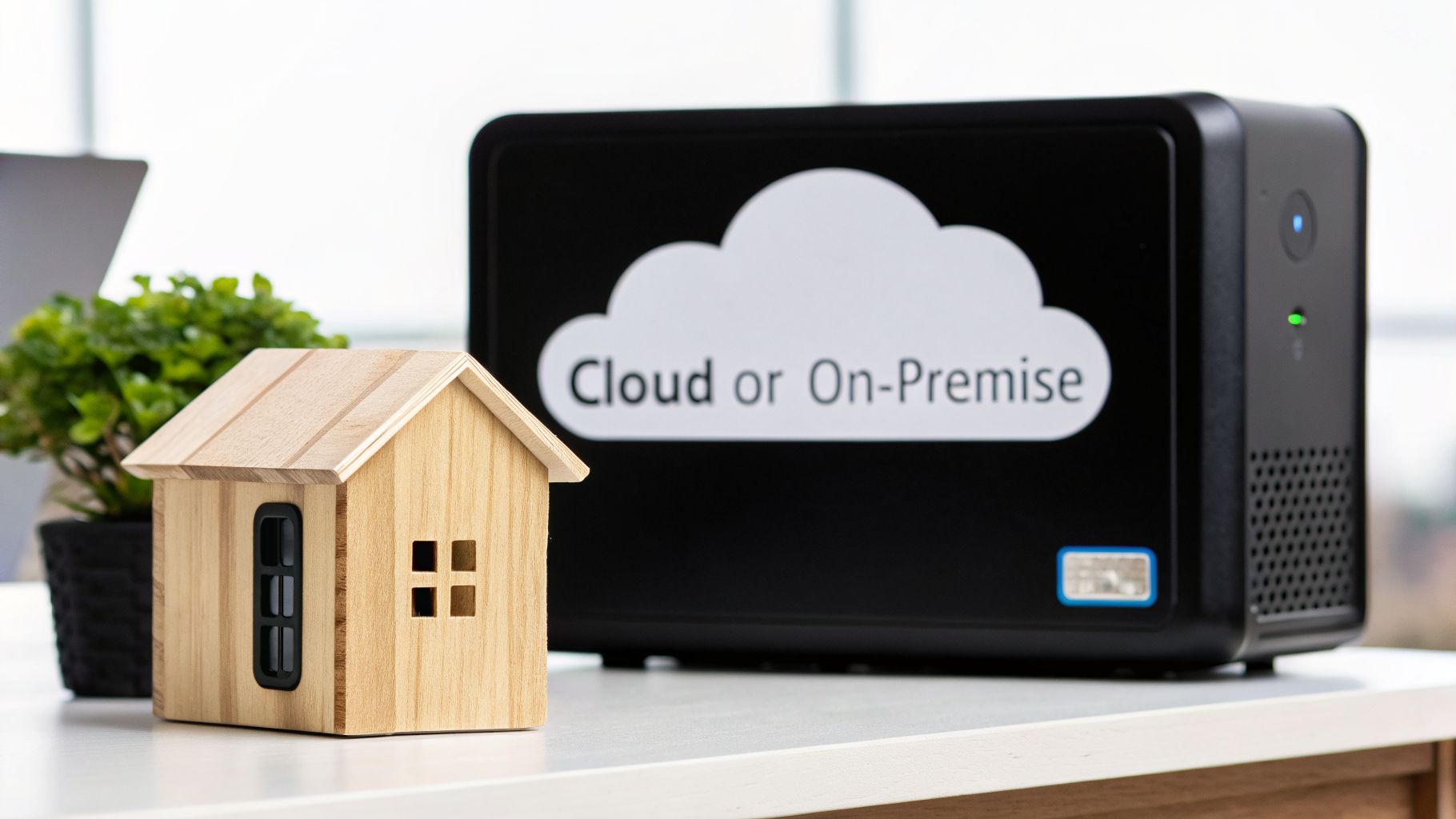
On the flip side, a Cloud ERP (often called SaaS or Software-as-a-Service) is like moving into a high-end, fully-serviced apartment. The building management (your ERP vendor) takes care of all the maintenance, security, and infrastructure. You just pay your monthly fee and get on with business, knowing everything behind the scenes is handled for you.
Why Most Businesses Are Moving to the Cloud
For the vast majority of Australian businesses, the debate is largely settled. The cloud has won. Cloud-based ERPs have become the standard, and for good reason. By 2026, it's expected that cloud-first solutions will completely dominate the Australian market as older, clunky on-premise systems are finally retired.
In fact, forecasts predict that 90% of organisations will be using some form of hybrid cloud setup by 2027. This tells us the move to the cloud is no longer a question of 'if', but 'when'.
This massive shift is happening for a few compelling reasons:
- Lower Upfront Costs: You get to skip the huge initial outlay for servers, hardware, and expensive software licences.
- Effortless Scalability: Need to add more users during a busy season or scale back? It's as simple as adjusting your subscription.
- Automatic Updates: The vendor handles all the tedious software updates and security patches, so you’re always on the latest, most secure version.
The Third Way: The Power of Open-Source
But there’s another option on the table, and it’s a powerful one: Open-Source ERP. Think of this as buying a high-quality, architect-designed kit home. You get a solid foundation and a brilliant set of blueprints, but you have total freedom to move walls, add extensions, and finish the interior exactly how you want it.
An open-source platform like Odoo offers the best of both worlds. You get the deep control traditionally associated with on-premise systems, but with the flexibility and modern architecture of a cloud solution. Crucially, you avoid being locked into a single vendor's roadmap.
This is where having the right implementation partner makes all the difference. If your business relies on a heavily customised Shopify integration or needs unique WooCommerce workflows, a specialist Odoo partner in Sydney can handle the software development needed to build a system that fits your operations like a glove, not the other way around.
As you weigh your options, comparing Cloud Vs On Premise is a vital first step. For a much deeper look into how these models work in practice, check out our guide on the benefits of moving your ERP to the cloud.
Ready to figure out which platform is the perfect foundation for your business? Contact Wistec for a no-obligation consultation today.
What Does an ERP Actually Do for Australian Businesses?
It’s one thing to talk about the theory behind an ERP, but the real magic happens when you see it solve actual, everyday business problems. An ERP isn't just a fancy database; it’s the central nervous system of an operation, turning chaos into clarity.
Let's look at a few practical cases of how Australian businesses are putting ERP systems to work to fix major operational headaches and get a serious return on their investment.
Slashing Waste for an Adelaide Manufacturer
Picture an engineering firm in Adelaide wrestling with constant production delays and mountains of wasted materials. They were juggling a messy collection of spreadsheets, meaning production schedules were built on guesswork and old data. This led to ordering too much stock and having expensive machinery sitting idle.
This is a classic case of data being trapped in silos. The fix? A focused Odoo implementation that zeroed in on their manufacturing and inventory modules. By linking sales forecasts directly to production planning and materials purchasing, they created a single, reliable source of truth for the entire company.
The results were felt almost instantly:
- They cut material waste by 18% in the first six months simply by ordering exactly what they needed for confirmed jobs.
- Their on-time delivery rate shot up to 97% because scheduling conflicts vanished and raw materials were always on hand.
- They unlocked thousands in cash flow that had been frozen in excess, unsold inventory.
This is where having expert software development in Adelaide makes all the difference. An off-the-shelf ERP wouldn't have cut it. They needed a system moulded to their specific processes, which is exactly what a skilled Odoo partner in Adelaide delivers.
Taming Inventory for a Multi-Location Retailer
Now, think about a popular Aussie retailer with stores scattered across the country and a buzzing WooCommerce website. Their biggest problem was that their online and in-store inventory systems were complete strangers. A customer could buy something online, only to get an apologetic phone call an hour later because the item had just been sold in-store. It was a recipe for frustration.
By plugging all their sales channels into a single ERP, they finally got a unified, real-time view of every single item, no matter where it was.
An integrated ERP system means the online store, the Sydney flagship, and the Adelaide boutique are all drawing from the same live inventory pool. It transforms a disjointed operation into a seamless, omnichannel retail machine.
This deep WooCommerce integration meant that as soon as an item sold online, the stock levels updated everywhere else—instantly. This stopped overselling in its tracks, boosted customer happiness, and gave management the accurate, up-to-the-minute sales data they needed to make smarter business decisions.
Freeing Up a Sydney Professional Services Firm
Over in Sydney, a successful consulting firm was drowning in paperwork. Their project managers were burning hours every week manually tracking billable time, cobbling together invoices, and chasing down payments. All this admin was stealing precious time that should have been spent on clients.
They teamed up with an expert Odoo partner in Sydney to roll out a system built around project management and accounting. The new ERP automated everything from time tracking and invoicing to payment reminders. The change was huge. It freed the team to focus on growing the business, not chasing paper trails, proving that an ERP can completely redefine what your team can achieve.
These stories show that an ERP system's true power isn’t in its features, but in its application. It’s all about solving tangible problems and creating real, measurable value. The impact varies by industry, but the core benefit—creating a single source of truth—remains the same.
ERP Impact Across Different Sectors
| Industry Sector | Common Challenge | How an ERP System Solves It |
|---|---|---|
| Manufacturing | Inefficient production scheduling, excess inventory, and supply chain bottlenecks. | Integrates production planning with real-time inventory and sales data to optimise workflows and minimise waste. |
| Retail & eCommerce | Disconnected online and in-store inventory, leading to overselling and poor customer experiences. | Unifies all sales channels into a single system for a live, accurate view of stock across the entire business. |
| Professional Services | Manual time tracking, complex project billing, and inefficient resource allocation. | Automates timesheets, invoicing, and project management, providing clear visibility into project profitability. |
| Wholesale & Distribution | Complex order management, inaccurate stock counts, and inefficient warehouse logistics. | Streamlines order processing, automates warehouse management, and optimises shipping for faster fulfilment. |
| Construction | Juggling multiple project timelines, managing subcontractor costs, and tracking equipment. | Centralises project management, financials, and resource planning for better budget control and on-time delivery. |
As you can see, no matter the industry, the fundamental challenge is often the same: disconnected information causing inefficiency and costing money. A well-implemented ERP breaks down those barriers and gets everyone working from the same playbook.
Ready to see how an ERP can solve your biggest operational challenges? Contact us for a no-obligation consultation and let's explore a solution designed for your Australian business.
The Future Is Now: AI in Modern ERP Systems
Modern ERP systems have moved far beyond being simple digital filing cabinets. They're becoming proactive, intelligent advisors for your business, and the catalyst for this evolution is Artificial Intelligence (AI). Think of it as the difference between using a basic calculator for sums and having a powerful data science platform that offers genuine, forward-looking strategic advice.
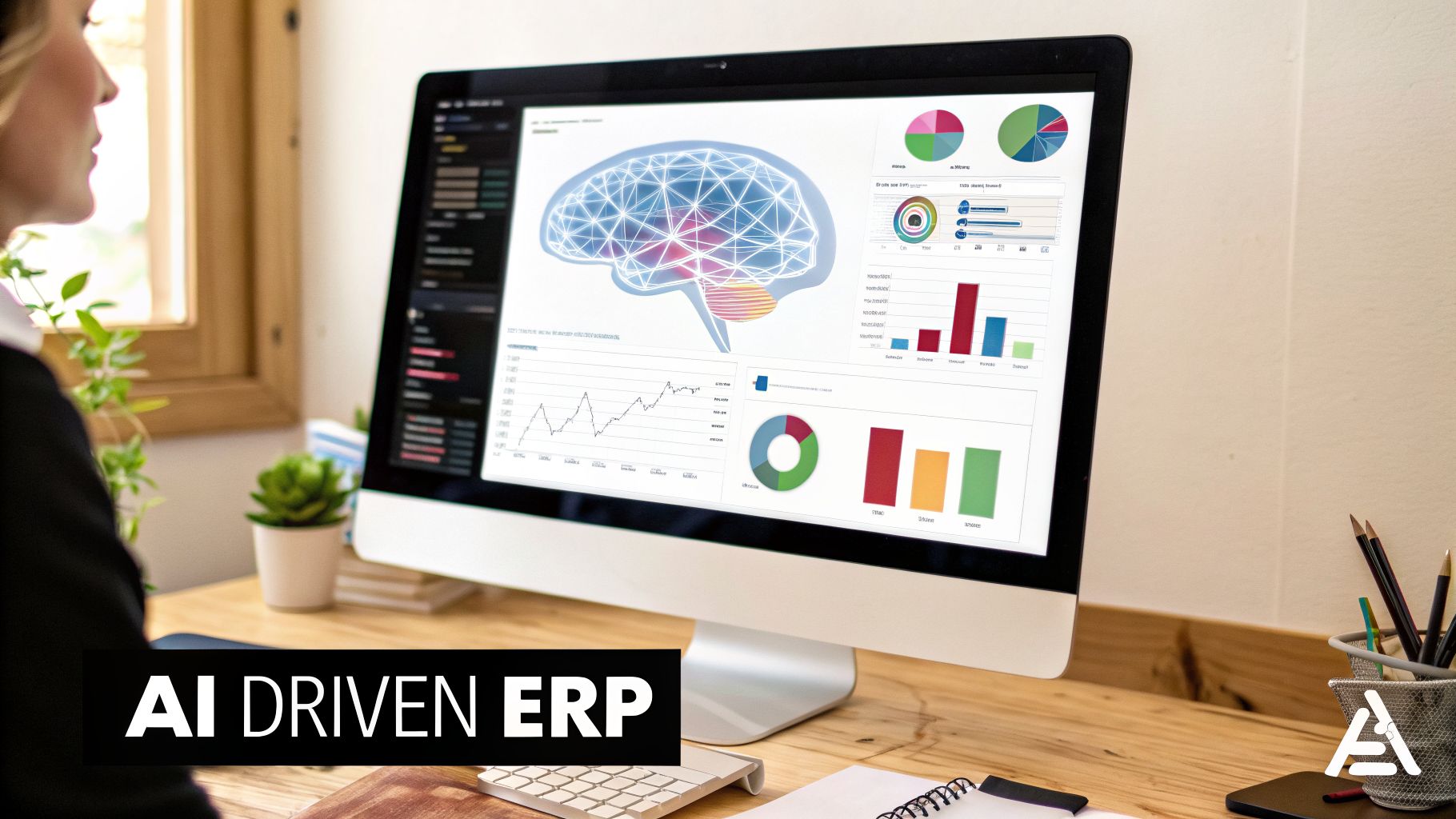
Traditionally, the ERP system meanings were all about centralising data and reporting on what had already happened. AI flips that script. It injects a layer of intelligence into the core system, allowing it to predict what's coming next and even automate complex decisions. This is where the real competitive edge is found today.
From Reactive Reporting to Predictive Power
Instead of just telling you what you sold last quarter, an AI-powered ERP can forecast future demand with surprising accuracy. It doesn't just look at your past sales; it crunches that data alongside market trends, seasonal shifts, and even external factors like public holidays to paint a clear picture of what's on the horizon.
This predictive capability has a ripple effect across the entire business:
- Smarter Inventory: AI anticipates which products are about to fly off the shelves, ensuring you stock up on the right items at the right time. This is a massive advantage for businesses running on platforms like Shopify or WooCommerce.
- Optimised Supply Chains: Intelligent algorithms can analyse shipping routes, carrier performance, and potential disruptions in real-time, automatically rerouting shipments to dodge delays and cut costs.
- Automated Finance: AI can take over tedious but critical tasks like invoice matching, expense approvals, and flagging potential fraud, freeing up your finance team for more strategic work while reducing human error.
AI fundamentally changes the purpose of an ERP from a system of record to a system of intelligence. It helps you answer not just "What happened?" but "What will happen next, and what should we do about it?"
AI Adoption in Australian Business
This isn't just some far-off theory; it's happening right now, right here in Australia. Small and mid-sized businesses are making a major shift towards AI-powered systems. In fact, research from the National AI Centre shows that 40% of Australian SMEs are already actively implementing AI.
Retail businesses are leading the charge at 70% adoption, and startups are even outpacing the big players, with a staggering 81% already using AI tools. You can read more about these findings on how Australian businesses are embracing AI.
As artificial intelligence becomes more integrated into business software, it's helpful to see how it's applied in different tools. For instance, a detailed Atera review shows how AI features are built into an all-in-one platform for IT professionals. For businesses in Sydney and Adelaide looking to harness this power, partnering with an expert Odoo partner with deep software development experience is the key to unlocking these game-changing capabilities.
Ready to see how AI can redefine your business operations? Contact Wistec for a no-obligation consultation to explore an intelligent ERP solution.
Begin Your ERP Journey with an Expert Partner
Getting your head around the different ERP system meanings is a great start, but it's the implementation that makes or breaks the project. Bringing a new ERP system into your business isn't just a technical rollout; it’s a major strategic move. It's a journey with distinct phases, where each step builds on the last to deliver a genuine return on your investment. This requires careful planning, real-world expertise, and a partner who truly gets what makes your business tick.
A well-run ERP project follows a clear, logical path, from the initial conversations right through to the day your team goes live.
The Path to a Successful Implementation
Discovery and Planning: This is ground zero. We sit down with you to figure out exactly what you want to achieve. We dig into your current workflows, pinpoint the bottlenecks and frustrations, and define what success actually looks like for you.
Software Development and Customisation: Let’s be honest, an off-the-shelf system rarely fits a business perfectly. Our expertise in software development in Sydney and Adelaide means we can mould platforms like Odoo to your specific operational needs, making the technology work for your processes, not the other way around.
Data Migration: Moving years of business data into a new system is a delicate operation. We handle this with extreme care to ensure every piece of information is accurate and ready to go, giving you a rock-solid foundation from day one.
Training and Go-Live: A new system is only as good as the people using it. We focus heavily on training to make sure your team feels confident and empowered. The goal is for everyone to hit the ground running and get the most out of the system from the moment you flick the switch.
An ERP implementation isn't about installing software. It's about transforming your business. That's why you need a partner who can manage the tech, guide your people through the change, and deliver a solution that’s genuinely built for growth.
Choosing the right partner is arguably the most critical decision you'll make. As a leading Odoo partner in Sydney and Adelaide, we specialise in guiding Australian businesses through every stage of this process. We also have a knack for building seamless integrations with vital e-commerce platforms like Shopify and WooCommerce, ensuring your entire operation works as one cohesive machine.
For a deeper look into what's involved, check out our detailed guide on what to expect during an ERP system implementation.
Don't let the thought of a complex project stop you from achieving the efficiency you need. Contact us today for a no-obligation consultation and let's talk about how the right ERP can become your most powerful asset for growth.
Your ERP Questions, Answered
Let's tackle some of the most common questions we hear from Australian business owners. These are the practical, real-world concerns that come up when you start thinking seriously about an ERP.
How Long Does an ERP Implementation Take?
This is usually the first question on everyone's mind, and the honest answer is: it really depends on what you need.
For a smaller business adopting a straightforward, mostly out-of-the-box system, you could be live in just a few months. But for a larger, more complex project that involves custom software development in Sydney or Adelaide, or deep integrations with platforms like Shopify or WooCommerce, the timeline naturally extends. These projects often take somewhere between six to twelve months.
The most important factor isn't the clock, but the clarity of the plan. A great implementation partner will give you a detailed roadmap so you know exactly what to expect.
Is an ERP System Only for Large Companies?
Not anymore. That’s a persistent myth that just isn't true today.
Modern, flexible platforms like Odoo have completely changed the game, making powerful ERP tools both accessible and affordable for businesses of every size. The real purpose of an ERP is to drive efficiency. In fact, small and mid-sized businesses often feel the biggest, most immediate benefits because they're finally leaving behind the chaos of spreadsheets and disconnected manual tasks.
What is the Biggest Challenge in an ERP Project?
You might think the biggest headaches are technical, but the reality is that the human element is almost always the toughest part. The technology can be perfect, but its success hinges on getting your team to embrace new ways of working.
This is exactly why partnering with an experienced Odoo partner in Sydney or Adelaide is so crucial. A good partner doesn't just manage the software; they manage the change. They focus heavily on user training, clear communication, and ongoing support to ensure your Odoo implementation delivers genuine value right from the start.
Ready to transform your operations with a system built for your business? Wistec delivers expert ERP solutions tailored for Australian companies. Contact us today for a no-obligation consultation to discover how we can help you grow.