

If you’re constantly jumping between disconnected spreadsheets, manually punching in sales data for the third time, and can’t seem to get a straight answer on your stock levels, you’re in good company. An ERP system for small businesses isn’t just a fancy acronym; it’s the next logical step for any ambitious company ready to scale efficiently, make smarter decisions, and gain a serious competitive edge.
Is Your Small Business Outgrowing Spreadsheets?
Picture a bustling local cafe. When it first opened, the owner managed everything with a simple notebook for orders, another for tracking coffee beans, and a basic spreadsheet for payroll. It worked perfectly when there were only a handful of customers and a small team.
But as the cafe’s reputation grew, the cracks started to show. The order book had no idea what the inventory book was doing, leading to surprise stockouts of the most popular syrups. The owner was pulling late nights, trying to manually reconcile daily sales with the payroll spreadsheet – a soul-destroying task riddled with potential for costly mistakes. This chaotic, disconnected approach is a classic sign of a business outgrowing its manual systems.
The Hidden Costs of Old Processes
These old-school methods come with significant hidden costs that go way beyond simple frustration. Think about the wasted hours spent on double data entry, the missed sales from inaccurate stock levels, and the poor decisions made with outdated information. All of these slowly chip away at your bottom line. Every separate system is another potential point of failure.
This exact struggle is why the Australian market for ERP software is booming. Valued at around AUD 930 million recently, it’s expected to climb to about AUD 1.17 billion by 2030. This growth is driven by small and medium-sized businesses, who realise they need better tools to keep up. You can get a deeper dive into these ERP trends from recent industry analysis.
Your Business’s Central Nervous System
An ERP system is so much more than just another piece of software. It acts as the central nervous system for your entire operation. It weaves every department—from sales and inventory to finance and customer service—into a single, cohesive platform.
Think of it like the human brain coordinating every function in the body. An ERP coordinates every business process, ensuring all parts work together in perfect harmony. Information flows instantly from one area to another, breaking down data silos and giving you a complete, real-time picture of your business’s health.
For ambitious Australian businesses, this level of integration is the secret to unlocking real growth. Instead of trying to patch together failing systems, you’re building a solid foundation to scale. This is especially vital for businesses looking at an Odoo implementation in Sydney or custom software development in Adelaide, where a strong core system is non-negotiable. It’s what makes everything from a seamless Shopify implementation to an efficient WooCommerce backend possible.
Ready to stop wrestling with spreadsheets and start building a more efficient, scalable business? Contact our team today for a no-obligation chat to see how we can help.
What an ERP System Actually Does for You
Ever feel like you’re running your business with a dozen different apps and spreadsheets that refuse to talk to each other? It’s a common frustration. Now, think about your smartphone for a second. It’s not just a phone, is it? It’s your calendar, camera, map, and contact book all rolled into one seamless device.
An ERP system for small businesses works in the same way. It takes all the separate, moving parts of your company—sales, finance, inventory, customer details—and connects them into a single, intelligent hub. This creates what we call a ‘single source of truth’, where everyone, from the sales floor to the warehouse, is working from the same real-time information.
This infographic paints a clear picture of the journey many businesses take, moving from tangled spreadsheets to a smart, unified system.
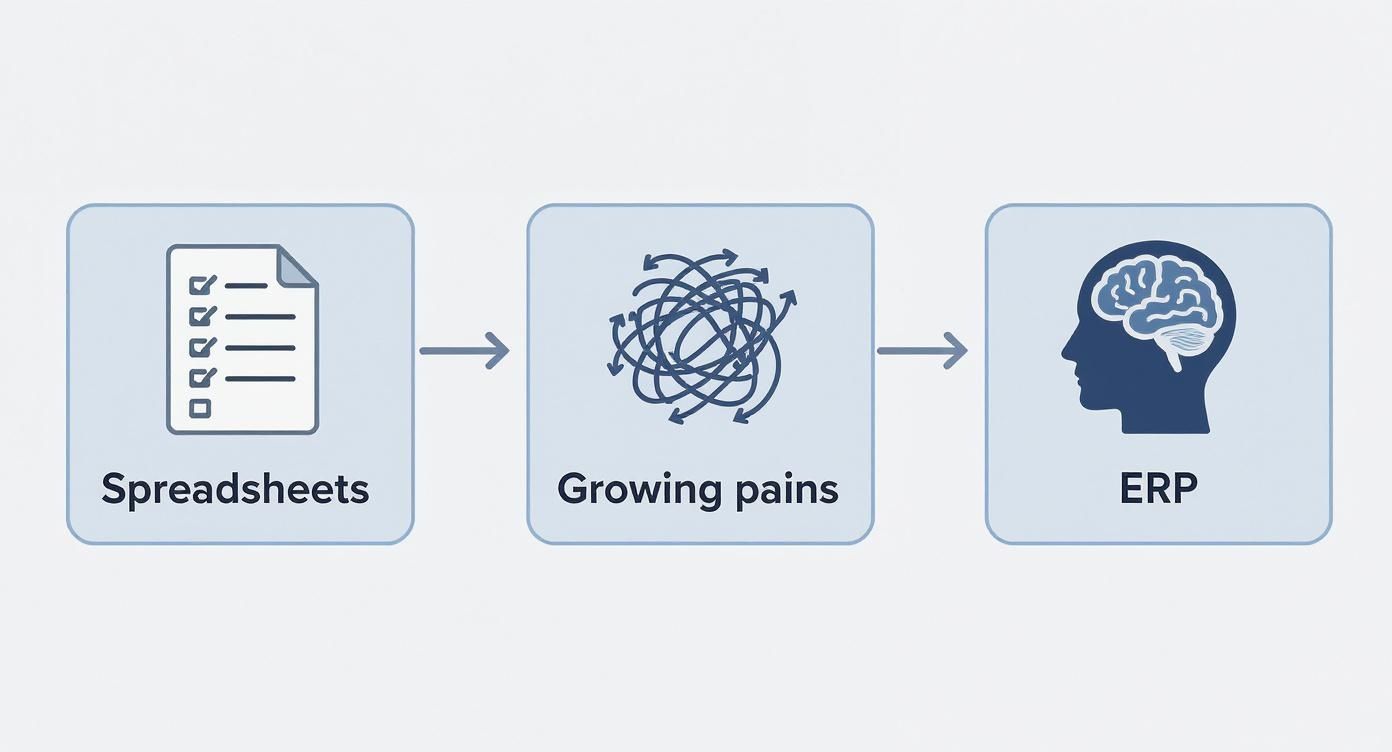
As you can see, businesses often start with manual tools, hit a wall as they grow, and then bring in an ERP to act as the central brain of the entire operation.
Breaking Down the Data Silos
Without an ERP, your business is probably running in ‘data silos’. Your sales team has its own data in its CRM. Your warehouse crew has its own stock levels in a spreadsheet. Your bookkeeper has completely separate figures in their accounting software. None of them is automatically in sync.
This disconnect is where so many costly mistakes are born. A practical case? A salesperson in Sydney sees an item is available and promises it to a major client. But the spreadsheet was last updated yesterday, and the warehouse team just sold the last one. Now you have an unhappy client and a headache you didn’t need.
An ERP smashes down those walls. When a sale is made, the system instantly updates inventory, flags the warehouse to ship the order, and records the transaction for your finance team. It’s all automatic, which dramatically cuts down the risk of human error.
To truly grasp the difference, let’s compare the old way with the new.
Manual Processes vs Integrated ERP System
| Business Function | Manual Method (Using Spreadsheets & Separate Apps) | Integrated ERP Method |
|---|---|---|
| Order Processing | A salesperson emails the order to the warehouse. Someone manually enters it into a shipping log and a separate accounting file. | A sales order automatically updates inventory, creates a shipping task, and generates an invoice in one click. |
| Inventory Management | Staff conduct manual stocktakes and update a spreadsheet. The sales team has to call or check the sheet for availability. | Stock levels adjust in real-time with every sale and purchase. Automated alerts are sent when stock is low. |
| Financial Reporting | The bookkeeper spends days at the end of the month pulling data from bank statements, sales logs, and expense reports. | Financial reports (P&L, balance sheet) are available instantly, with live data from across the business. |
| Customer Service | A support agent has to check multiple systems (CRM, order history, billing) to get a full picture of a customer’s issue. | The agent sees the customer’s complete history—orders, payments, and communications—on a single screen. |
The contrast is stark. One path is riddled with manual work, delays, and potential for errors, while the other is automated, instant, and accurate.
Gaining a Clear View of Your Entire Operation
Perhaps the biggest win with an ERP is the crystal-clear visibility you get across your entire business. You stop guessing and start making decisions based on solid, up-to-the-minute data.
An ERP is like having a live dashboard for your whole company. You can see cash flow, check production status, and monitor sales performance in real-time, all from one place.
This kind of insight is pure gold. You can spot a popular product trend early, fix a bottleneck in your warehouse before it causes major delays, and jump on opportunities your competitors haven’t even seen yet. For a growing business, this isn’t just a nice-to-have; it’s vital for staying ahead.
This is especially critical for businesses planning an Odoo implementation in Sydney or custom software development in Adelaide, where having a solid operational foundation is everything. Whether you’re running a Shopify implementation or a WooCommerce store, a good ERP ensures your online storefront is perfectly synced with everything happening behind the scenes.
Ready to see how a single system can give you total clarity and control? Speak with one of our ERP specialists today to explore a solution that fits your specific needs.
Essential ERP Features for Australian Businesses
Choosing an ERP system can feel like you’re lost in a jungle of tech-speak and never-ending feature lists. It’s overwhelming. But here’s the thing: not all systems are built the same, and picking one without the right core components is like buying a car without an engine. It looks the part, but it won’t get you anywhere.
Let’s cut through the noise and get straight to the non-negotiable features your Australian business needs to actually grow.
Think of these features as the pillars of a solid ERP. They’re what hold everything up, giving you the foundation for smooth operations and smart, data-backed decisions.
Financial Management: The Bedrock of Your Business
First things first, your ERP has to be a master of your finances. This is about so much more than just basic bookkeeping. A top-tier financial module will automate your invoicing, keep a real-time eye on expenses, manage who owes you and who you owe, and make tax time far less painful.
Imagine closing the books at the end of the month in just a few hours, not days. That’s the goal. With a solid financial core, you get an instant, accurate snapshot of your cash flow and profitability, so you can stop guessing and start making decisions with confidence.
Inventory and Supply Chain Management
If you sell physical products, this module is your command centre. It gives you a live, bird’s-eye view of your stock levels across every single location. This alone helps you dodge the costly mistake of selling an item you don’t have or running out of something critical right when you need it most.
A good system will even automate purchase orders when stock gets low and track your products all the way from the supplier to your warehouse, and finally, into your customer’s hands. That kind of control is gold for cutting down on storage costs and keeping your customers happy.
Customer Relationship Management (CRM)
When your CRM is baked right into your ERP, it completely changes the game. Instead of customer information being stuck in a separate spreadsheet or app, it’s connected to everything else. Your sales team can see a customer’s entire order history, check for outstanding invoices, and review past support chats—all from one screen.
A great ERP with an integrated CRM gives your team superpowers. They can have more informed conversations, solve problems faster, and identify upsell opportunities because they have the full customer story right at their fingertips.
This all-in-one approach is a huge reason why cloud-based ERPs have taken off in Australia, especially for businesses with remote teams. Interestingly, while research shows that accounting is the most critical feature for 89% of users, it’s followed closely by inventory management (67%) and CRM (33%). This really highlights the need for a well-rounded system. You can read more about Australian ERP implementation trends on havi.com.au.
E-commerce Integration: The Digital Storefront Link
In this day and age, a seamless e-commerce connection isn’t just a nice-to-have; it’s essential. This feature hooks your online shop directly into your core business operations. So, whether you’re running a Shopify implementation or using WooCommerce, a good ERP turns your website into a true extension of your warehouse and accounts department.
Let’s look at a practical case. A boutique clothing store in Sydney uses an Odoo ERP integrated with their Shopify site. When a customer buys a dress online, the system instantly kicks into gear:
- The inventory count for that dress is automatically updated.
- A notification pings the warehouse team to pick, pack, and ship the order.
- The sale is recorded in the financial module, no questions asked.
- The customer’s profile is updated in the CRM with their latest purchase.
This slick automation gets rid of tedious manual data entry, stops you from overselling, and gives your customers a smooth, professional experience. It’s the kind of operational efficiency that builds real loyalty and fuels growth.
For businesses ready to scale, finding the right partner is key. Whether you need an Odoo implementation in Sydney to pull all your operations together or custom software development in Adelaide to solve a unique problem, getting these essential features in place is the perfect first step.
Ready to give your business the tools it truly needs to thrive? Contact Wistec today for a free consultation to discuss a solution built around your needs.
Choosing the Right ERP Implementation Partner
Choosing an ERP system for your small business is a major decision; however, the software itself is only part of the equation. Without proper implementation, even the most advanced system can quickly become an expensive paperweight. This is precisely where your implementation partner steps in—they are the experts who transform a simple piece of software into a fully integrated and efficient part of your business.
Furthermore, in many cases, selecting the right partner matters even more than choosing the software itself. A great partner carefully analyses your unique processes, customises the system to match your needs, and ensures a seamless transition from start to finish. Conversely, the wrong partner merely installs default settings and moves on, leaving you with a complex tool that your team struggles to understand and use effectively.
Why Local Expertise Matters
When it comes to business technology, a local touch truly matters. After all, a partner who understands the Australian market also understands the local compliance requirements, tax regulations, and supply chain challenges that businesses face every day. This knowledge isn’t just helpful—it’s essential for long-term success.
For instance, a partner offering Odoo implementation in Sydney brings firsthand experience with the logistics and warehousing needs of a major port city. Likewise, a software development team in Adelaide truly understands the distinct demands of South Australia’s booming manufacturing and agricultural sectors. Consequently, they can offer practical, relevant, and timely guidance that offshore providers simply cannot match.
Your Vetting Checklist: What to Ask Potential Partners
Before you sign on the dotted line, you need to ask the tough questions. A good partner will welcome scrutiny and provide clear, confident answers. Use this checklist during your first few chats to sort the real experts from the rest.
- Can you show me local case studies? Ask for examples of Australian small businesses they’ve worked with, ideally in your industry. A proven track record is the best crystal ball you’ll get.
- What’s your experience with e-commerce? If you sell online, this is non-negotiable. Ask them about their direct experience with Shopify implementation or connecting WooCommerce stores. How have they solved tricky problems like real-time inventory syncing?
- What does your training process look like? A successful launch completely depends on your team actually knowing how to use the new system. Do they offer hands-on, customised training, or will they just hand you a thick user manual and walk away?
- How do you handle ongoing support? What happens after you go live? Get clear on their support model, how quickly they respond, and what it costs. You need a partner who’s in it for the long haul, not just the initial setup fee.
Your implementation partner should be invested in your long-term growth, not just a one-time sale. Their goal should be to empower your business with a tool that scales and evolves right alongside you.
Of course, the platform you choose is also a big piece of the puzzle. While you’ll hear big names like Microsoft Dynamics 365 and Oracle NetSuite thrown around, the real story for Aussie businesses is customisation. Data shows that less than 3% use a standard, out-of-the-box ERP. A massive chunk—between 33% and 48%—needs moderate to heavy customisation to fit their unique operations. This just goes to show how critical your implementation partner’s skills really are. You can dig into more Australian ERP market customisation trends on Statista.com.
Finding the right team to guide your ERP journey is the single most important investment you’ll make in this entire process. Take your time, do your homework, and choose a partner who truly understands your vision.
Ready to find a partner who gets the Australian business landscape? Contact Wistec today to discuss how our local experts can deliver a solution that drives real results for your business.
Real-World ERP Success Stories
Their stories prove that the right technology, implemented with the right partner, isn’t just another business expense. It’s a direct investment in a smarter, clearer, and more successful future.
From Shopify Chaos to Streamlined Success
The Challenge: A fast-growing Sydney e-commerce brand quickly outpaced its systems. Although products sold rapidly online, operations fell into disarray. The team juggled inventory, sales orders, and customer data across separate spreadsheets, which caused stockouts, overselling, and frustrating shipping delays.
The Solution: To regain control, the owner partnered with a local expert for an Odoo implementation in Sydney. Together, they built a seamless link between Shopify and warehouse operations. The team configured Odoo to instantly sync every new order, streamline workflows, cut manual tasks, and restore smooth, efficient operations.
The Results: The change was immediate and profound.
- Real-Time Inventory Sync: As soon as an item is sold on Shopify, the stock level is instantly updated in Odoo. This eliminated the risk of selling products they didn’t have.
- Automated Fulfilment: The warehouse team started receiving automated pick-and-pack lists, complete with shipping labels, directly from the system. No more manual order entry.
- Drastic Error Reduction: Those costly manual data entry mistakes became a thing of the past. In fact, the company reported a massive 70% reduction in shipping errors within the first three months alone.
This Sydney brand didn’t just buy new software; they completely overhauled their workflow, allowing them to scale their sales without scaling their stress.
Unlocking Profitability for an Adelaide Manufacturer
The Challenge: A small, family-owned manufacturing business in Adelaide mastered its craft but struggled with endless paperwork. Every job used physical job sheets, staff recorded materials by hand, and financial data went into an outdated accounting system weeks later. Consequently, the owner couldn’t track profitability in real time and often discovered issues too late to act.
The Solution: To fix this, the company chose a tailored approach instead of an off-the-shelf system. They partnered with a local custom software development firm in Adelaide to build a lightweight ERP solution from the ground up. The new system now connects directly to their production equipment, automatically capturing real-time data on machine hours and material use—removing guesswork, improving accuracy, and empowering smarter decisions.
By connecting their machinery directly to their accounting module, the manufacturer gained crystal-clear, real-time profitability insights for the first time. They could finally see exactly which jobs were making money and which were costing them.
The Results: This targeted solution delivered game-changing clarity.
- Accurate Job Costing: The owner could now see the true cost of every single product—including labour, materials, and machine time—as it was being made.
- Data-Driven Quoting: With accurate cost data on hand, they could create far more competitive and profitable quotes, knowing their pricing was spot on.
- Improved Efficiency: By pinpointing their most profitable products and processes, they rejigged their production schedule to focus on higher-margin work.
Ready to Take the Next Step?
By now, you’ve likely realised that an ERP system for small businesses isn’t an exclusive tool for large corporations. It’s a powerful, accessible solution for any ambitious Australian company ready to scale and grow. Ultimately, it’s about gaining clear insights, improving efficiency, and building a strong foundation for long-term success.
Transitioning from scattered spreadsheets to a unified system is one of the smartest moves you can make for your business’s future. So, where should you begin? Start by identifying what’s holding you back right now. Are you losing valuable hours to manual data entry? Do inventory errors lead to stockouts or excess products that tie up cash flow? Once you pinpoint your biggest pain points, you’re ready to find the right solution.
Your First Practical Steps
- For the E-commerce Retailer: Your Shopify implementation or WooCommerce store is booming, but it feels completely disconnected from your warehouse. This is causing shipping delays and inventory nightmares. A quick chat can map out exactly how to link them together properly.
- For the Growing Manufacturer: You’re still tracking jobs on paper, which makes it impossible to see if you’re actually making a profit on each run. A discussion around custom software development in Adelaide could show you how to plug your workshop floor directly into your financial data.
- For the Expanding Service Business: Juggling projects, clients, and invoices across three different platforms is slowing your whole team down. An expert Odoo implementation in Sydney could bring everything you do under one roof, managed from a single dashboard.
A genuine technology partner won’t just try to sell you a software license. They’ll sit down with you, help you pinpoint the real operational challenges you’re facing, and design a solution that solves those specific problems. That’s how you get a clear return on your investment.
Book Your Free Consultation Today and take that decisive next step toward building a smarter, more efficient, and more profitable business.
Got Questions? We’ve Got Answers
This is the big question, isn’t it? The cost of an ERP can vary greatly depending on the number of users, the tools required, and the level of customisation needed. For small businesses, cloud-based systems have changed the game by replacing large upfront costs with affordable monthly subscriptions.
Instead of viewing it as a cost, consider it an investment. A well-implemented ERP doesn’t just spend money—it saves and earns it by reducing costly errors, eliminating repetitive data entry, and providing clear insights that drive smarter, more profitable decisions.
How Long Does an ERP Implementation Take?
A successful implementation isn’t a race to the finish line. It’s about carefully building a powerful foundation that will support your business for years to come, making sure your team feels confident every step of the way.
Is My Business Too Small for an ERP?
Modern ERPs like Odoo are designed to grow with you. You can start with just the basics and a couple of users, then easily add more power as you expand. This makes them a fantastic fit for ambitious small businesses, whether you’re looking to get a handle on your Shopify implementation or connect your WooCommerce store. If manual work is holding you back, you’re not too small—you’re the perfect size.
Ready to get answers tailored to your specific business needs? The team at Wistec is here to help you navigate your options and find the perfect solution.