

Juggling disconnected spreadsheets, siloed sales data, and manual inventory counts? You’re not alone, but you’re falling behind. In today’s competitive landscape, Australian businesses need a centralised nervous system to manage every facet of their operations-from finance and HR to inventory and customer relations. An Enterprise Resource Planning (ERP) system provides this single source of truth, automating workflows, providing real-time insights, and unlocking scalable growth. But with so many options, how do you choose the right one for your specific industry needs?
This guide breaks down seven practical ERP system example solutions, showcasing how different platforms can transform specific industries. We move beyond generic feature lists to provide a strategic analysis of each platform, including screenshots, industry-specific workflows, and the measurable benefits you can expect. We will explore how platforms like Odoo, NetSuite, and Microsoft Dynamics 365 are implemented in real-world scenarios across retail, manufacturing, logistics, and professional services.
To truly achieve a single source of truth and a unified business, it’s essential to deeply understand the principles of system integration. Our analysis will show you how to connect disparate tools, whether it’s for a Shopify implementation or a complex manufacturing setup, creating a seamless operational flow. For businesses in Sydney or Adelaide, finding the right partner for Odoo implementation Sydney Adelaide or custom software development Sydney Adelaide is critical. This listicle is your roadmap to identifying the ideal ERP and the strategic approach needed for a successful rollout that delivers a genuine return on investment. Let’s find the platform that will future-proof your organisation.
1. Wistec
When searching for a premier ERP system example that demonstrates flexibility, deep customisation, and a business-first approach, Wistec stands out as a compelling choice for Australian businesses. As an official Odoo Licensed Partner, Wistec moves beyond generic, off-the-shelf solutions. Instead, it provides a full-service software development partnership, specialising in tailoring the powerful, open-source Odoo framework to meet the precise operational needs of diverse industries, from retail and manufacturing to healthcare and professional services.
Wistec’s core philosophy is “Solution Through Technology”, positioning itself as an integration-first provider. This means their expertise isn’t just in implementing an ERP, but in creating a unified digital ecosystem where every component of your business, sales, inventory, CRM, accounting, and HR, communicates seamlessly. They combine practical business insight with deep technical expertise in Python-based development to deliver solutions that are not only technologically robust but also strategically aligned with your commercial goals.
Why Wistec Excels: A Strategic Breakdown
What truly sets Wistec apart is its risk-reducing, client-centric delivery model. The firm’s developers work in tandem with accountants and business analysts, ensuring every customisation is scoped to solve a specific problem, such as reducing administrative overheads or boosting team productivity. This collaborative process translates complex technical requirements into clear, jargon-free business outcomes.
Strategic Insight: By leading with business analysis rather than pure technology, Wistec ensures the final ERP solution directly targets key performance indicators (KPIs) like cost reduction and efficiency gains. This approach maximises return on investment and minimises the risk of a misaligned implementation.
This is backed by an unparalleled guarantee structure: a 100% money-back promise and a free one-year warranty that includes fixing any code issues at no extra cost. This demonstrates profound confidence in their delivery quality and provides exceptional peace of mind for clients investing in a new system.
Core Capabilities and Use Cases
Wistec’s service offering is comprehensive, making them a one-stop technology partner.
- Custom Odoo ERP Implementation: As Odoo implementation specialists in Sydney and Adelaide, they leverage the platform’s open-source nature to build scalable systems without vendor lock-in. This includes powerful API integrations to connect with existing software.
- Web & eCommerce Development: They build high-performance, SEO-optimised websites using Shopify, WooCommerce, or entirely custom platforms, fully integrated with the ERP for real-time inventory and sales data.
- Mobile App Development: They create native iOS/Android or hybrid apps designed to enhance customer engagement or streamline internal operations.
- Bespoke Software & AI Solutions: For unique challenges that standard software cannot solve, Wistec develops custom applications and AI tools tailored to specific business needs.
Practical Application & Actionable Takeaways
Practical Case: A mid-sized manufacturing company in Adelaide struggles with disconnected systems. They use one software for inventory, another for accounting, and manual spreadsheets for production planning. This leads to stockouts, delayed invoicing, and poor visibility into job profitability.
Wistec’s Solution:
- Process Re-engineering: Wistec’s business analysts first map out existing workflows to identify bottlenecks.
- Unified Odoo Implementation: They implement a customised Odoo ERP, integrating the Manufacturing, Inventory, Sales, and Accounting modules. This is a classic Odoo implementation Sydney Adelaide project.
- Customisation: A custom module is developed to automate production scheduling based on sales orders and material availability, a clear example of targeted software development Sydney Adelaide.
- Integration: The ERP is integrated with their existing eCommerce platform (e.g., Shopify implementation or WooCommerce) to sync orders and stock levels automatically.
The result is a single source of truth, reduced manual data entry, and real-time insights that empower better decision-making. Ready to explore a tailored solution? Contact Wistec today.
| Feature | Strength & Advantage |
|---|---|
| Official Odoo Partner | Guarantees certified expertise, access to the latest updates, and adherence to best practices. |
| Risk-Free Guarantees | The 100% money-back and 1-year warranty policies remove financial risk from the implementation process. |
| Full-Service Integration | Capabilities extend beyond ERP to web, mobile, and AI, enabling a truly unified technology stack from one provider. |
| Business-Led Approach | Focuses on solving business problems and achieving measurable ROI, not just deploying software. |
Pricing & Access
Wistec does not publish fixed pricing. Each project is scoped and quoted individually to reflect the unique requirements of the business. This bespoke approach ensures clients only pay for what they need. To get started, you can request an instant price estimate or book a free consultation directly through their website.
For businesses in Australia seeking a highly capable, low-risk technology partner to deliver a customised ERP system, Wistec is an exemplary choice.
Website: https://www.wistec.com.au
2. Odoo
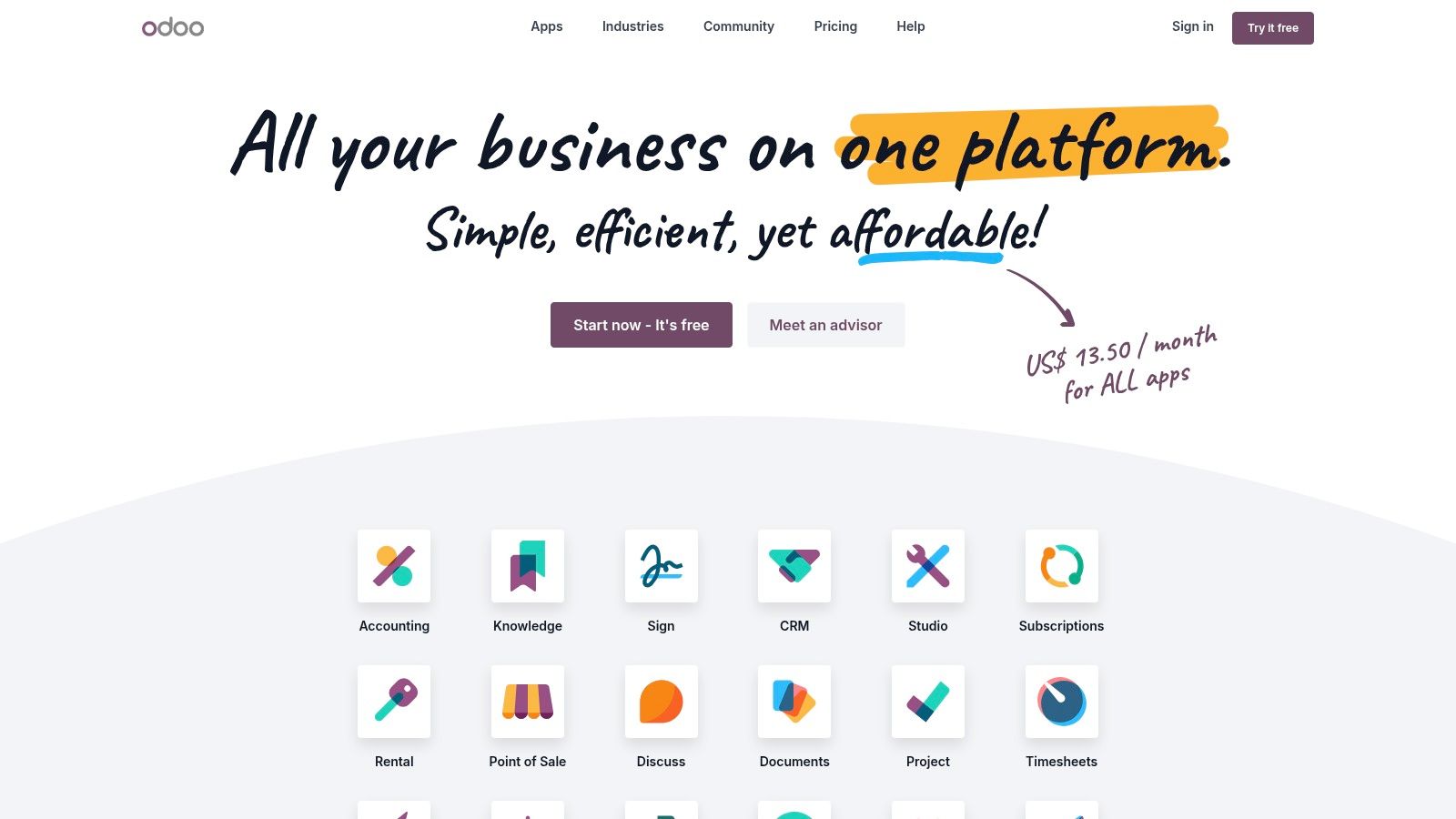
Odoo has carved out a unique space in the ERP landscape by offering a comprehensive, all-in-one suite of business applications that is both powerful and remarkably accessible. Unlike traditional ERP systems that often demand significant upfront investment and lengthy implementation cycles, Odoo’s modular, open-source approach allows businesses to start small and scale intelligently. This makes it an exceptional erp system example for small and medium-sized enterprises (SMEs) across Australia, from a growing Shopify store to a specialised manufacturing firm.
The platform’s key differentiator is its app-based structure. You can begin with a single application, like CRM or Accounting, for a low monthly cost (or even free with the “One App Free” plan) and add more modules as your business needs evolve. This “pay-for-what-you-need” model democratises access to enterprise-level technology, allowing businesses to build a custom ERP solution piece by piece, ensuring they only invest in the functionality that drives immediate value.
Strategic Analysis: The Modular Advantage
Odoo’s core strength lies in its integrated, yet modular, design. A retail business can combine the eCommerce, Inventory, Sales, and Point of Sale (POS) apps to create a seamless omnichannel experience. Customer data from an online WooCommerce sale instantly updates inventory levels, triggers accounting entries, and flows into the CRM for future marketing efforts without any manual intervention. This unified data model eliminates the silos that plague businesses using disparate software for different functions.
For a services firm, the combination of Project, Timesheets, Sales, and Accounting apps provides a complete project lifecycle management tool. From quoting a job in the Sales app to tracking billable hours and invoicing the client, the entire workflow is managed within a single, interconnected system.
Actionable Takeaways & Practical Cases
- Practical Case: A Sydney-based eCommerce business using Shopify struggled to sync inventory between their online store and a small physical pop-up shop. By adopting Odoo’s Inventory and POS apps, they achieved real-time stock synchronisation, preventing overselling online and stockouts in-store. This simple Odoo implementation Sydney Adelaide project saved them countless hours of manual reconciliation.
- Leverage the Ecosystem: While Odoo is user-friendly, complex projects benefit from expert guidance. Engaging a local partner for Odoo implementation Sydney Adelaide can accelerate your return on investment and ensure the system is tailored to your specific workflows.
- Integrate Your Sales Channels: Odoo excels at unifying sales data. A successful Shopify implementation or WooCommerce integration can centralise your inventory and order management, providing a single source of truth for your entire operation.
Odoo’s transparent pricing and free trial options make it incredibly easy to evaluate. For Australian businesses looking for a flexible and scalable ERP solution, Odoo presents a compelling and modern alternative to traditional, monolithic systems. Start your Odoo journey today by exploring their apps.
Website: https://www.odoo.com
3. Microsoft Dynamics 365 Business Central
Microsoft Dynamics 365 Business Central represents a powerful, all-in-one business management solution engineered for small and medium-sized businesses looking to connect their operations within a single, unified platform. As a leading erp system example, it leverages the familiarity and power of the Microsoft ecosystem to streamline finance, sales, service, and operations. For Australian businesses already invested in tools like Office 365 and Teams, Business Central offers a uniquely integrated experience, turning everyday applications into robust ERP interfaces.
The platform’s core appeal lies in its deep integration and comprehensive feature set, available directly through the cloud. It moves beyond basic accounting software by providing sophisticated capabilities in supply chain management, project management, and even manufacturing and service management in its Premium tier. This scalability allows a growing distribution company or a specialised service firm to manage their entire business lifecycle, from quoting to cash collection, all within the trusted Microsoft cloud environment.
Strategic Analysis: The Ecosystem Advantage
Business Central’s primary strength is its native integration with the broader Microsoft stack. An accountant can analyse financial data from Business Central directly within Excel, a sales representative can generate a quote from within Outlook, and project teams can collaborate on ERP data surfaced within Microsoft Teams. This seamless connectivity drastically reduces context-switching and boosts productivity by keeping users in the applications they use every day. The integration with Power BI provides best-in-class business intelligence, transforming raw operational data into actionable, visual dashboards.
For a wholesale distributor, this means the Inventory, Purchasing, and Sales modules work in concert with Power BI for demand forecasting and Outlook for customer communication. A professional services firm can combine the Projects, Resources, and Finance modules to manage project profitability from end to end, with all reporting and collaboration happening within their existing Microsoft 365 subscription. This unified data flow is a significant competitive advantage.
Actionable Takeaways & Practical Cases
- Practical Case: A law firm in Adelaide used the Projects module to track billable hours and case expenses. By integrating it with Outlook, they could generate and send invoices directly from their email client, reducing administrative time by 20% and improving cash flow through faster billing cycles.
- Partner for Specialised Needs: While Business Central is powerful, complex implementations, particularly those involving advanced manufacturing or integration with bespoke systems like Shopify or WooCommerce, often require specialised expertise. Engaging a local Microsoft partner for your software development Sydney Adelaide can ensure the system is perfectly configured for your industry’s unique demands.
- Leverage Power BI for Insight: Don’t just use the core ERP functions. Connect Business Central to Power BI from day one to create dashboards for key metrics like cash flow, sales performance, and project profitability. This provides the executive team with real-time visibility into business health.
With clear Australian pricing and a 30-day free trial, Microsoft Dynamics 365 Business Central is an accessible yet incredibly powerful ERP for businesses aiming to grow and optimise their operations on a familiar, world-class technology platform. Request a free trial to see it in action.
Website: https://www.microsoft.com/en-au/dynamics-365/products/business-central
4. Oracle NetSuite
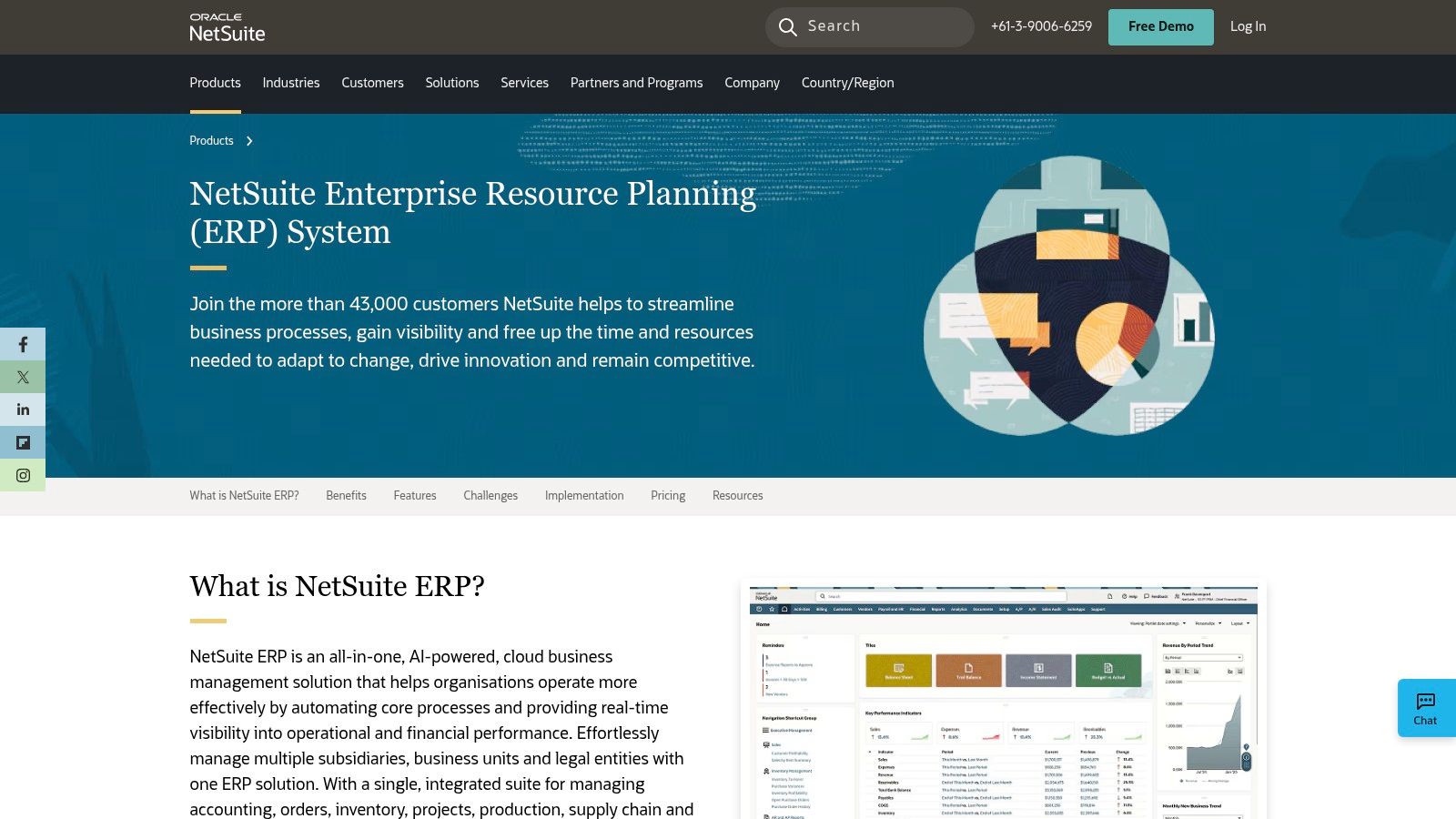
Oracle NetSuite stands as a pioneering force in cloud-based ERP, offering a unified and highly scalable platform designed for growth. As the first true cloud ERP, it provides a comprehensive suite that manages everything from advanced financials and inventory to global business operations. This makes it a leading erp system example for ambitious small to mid-market Australian businesses aiming to streamline complex processes, particularly those with multi-entity structures or plans for international expansion.
Unlike modular systems where functionality is added piece by piece, NetSuite is built as an integrated whole. It’s designed to be the single source of truth for an entire organisation from day one, providing real-time visibility across all departments. This comprehensive approach is ideal for businesses that have outgrown their entry-level accounting software and require a robust, all-in-one solution to manage their next phase of growth without the hassle of integrating disparate systems.
Strategic Analysis: The Unified Commerce Engine
NetSuite’s core advantage is its unified data model, particularly for multi-subsidiary and multi-currency operations. Its OneWorld module allows a parent company in Australia to consolidate financials, reporting, and compliance for subsidiaries in different countries, all in real-time. This is a game-changer for businesses scaling internationally, eliminating the need for complex manual consolidation in spreadsheets.
For an e-commerce brand operating across multiple channels, NetSuite centralises Order Management, Inventory, and CRM. An order from a Shopify store, a physical retail location, and a B2B portal all flow into the same system, providing a 360-degree view of the customer and accurate, real-time stock levels across every warehouse and storefront. This prevents overselling and enables sophisticated fulfilment strategies like ship-from-store.
Actionable Takeaways & Practical Cases
- Practical Case: An Australian apparel brand expanded into the New Zealand and UK markets. Using NetSuite OneWorld, they were able to manage inventory, sales, and financials for all three countries in their respective currencies from a single dashboard. This saved their finance team weeks of manual consolidation work each quarter.
- Engage Certified Partners: A successful NetSuite rollout hinges on expert implementation. The platform is powerful but complex. Partnering with a certified Australian firm for software development Sydney Adelaide or another major city ensures the system is configured to industry best practices and your unique business processes.
- Leverage Pre-built Integrations: Before commissioning custom development, explore NetSuite’s SuiteApp ecosystem. There are thousands of pre-built applications and connectors for platforms like WooCommerce, major banks, and logistics providers, which can significantly reduce implementation time and cost.
While pricing is quote-based and represents a more significant investment than entry-level systems, NetSuite offers unparalleled scalability and a unified view of business operations, making it a powerful engine for sustained growth. Schedule a product tour to learn more.
Website: https://www.netsuite.com.au/portal/au/products/erp.shtml
5. SAP Business One
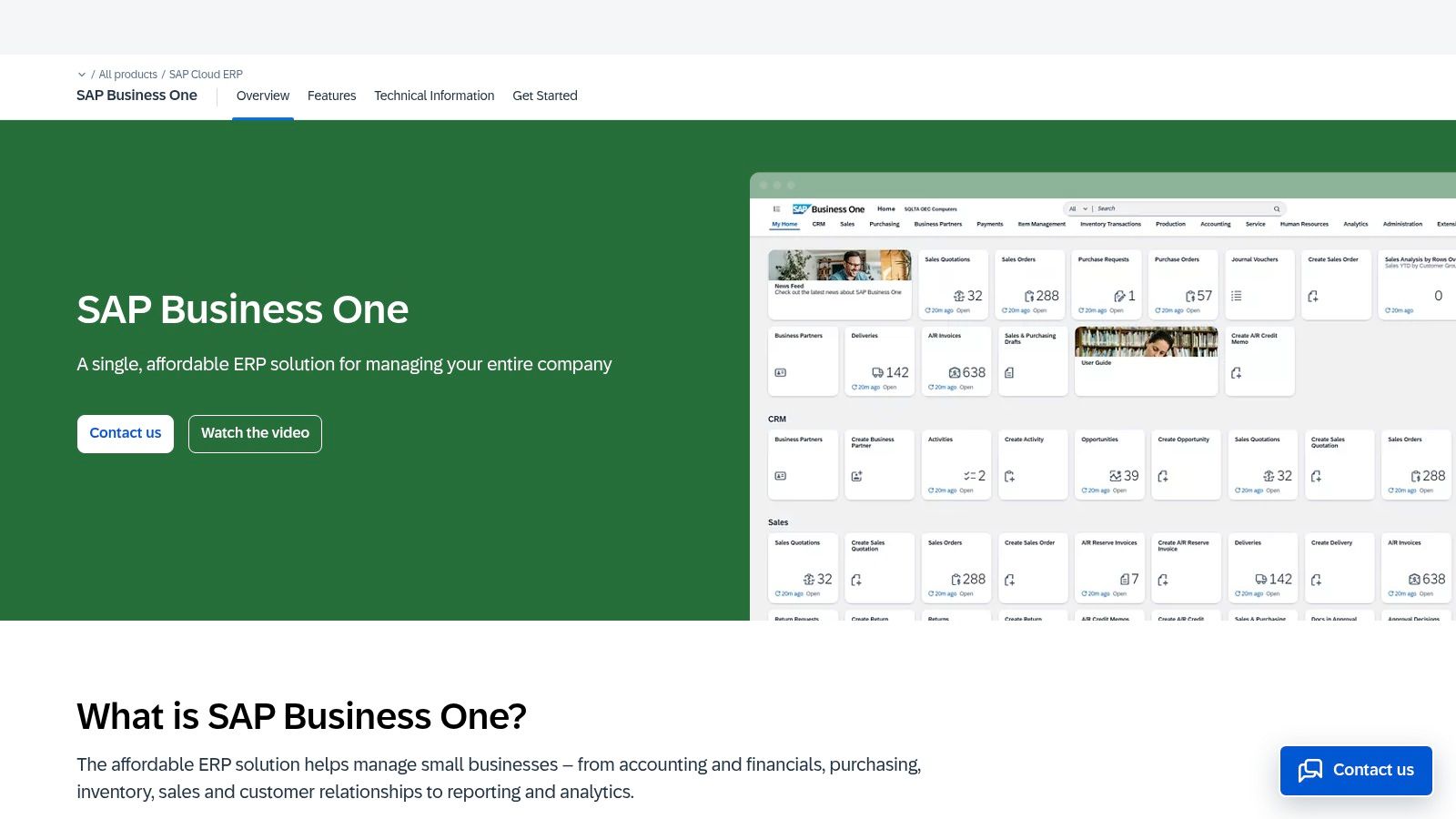
SAP Business One stands as a powerful and trusted erp system example designed specifically for small to midsize businesses that have outgrown their basic accounting software. Backed by the global reputation of SAP, this platform offers a comprehensive, end-to-end solution that integrates every core business function, from finance and sales to inventory and production. For Australian businesses aiming for structured growth and operational control, SAP Business One provides an enterprise-grade foundation delivered through a network of local partners.
Unlike modular, app-based systems, SAP Business One is conceived as a single, unified application that provides a complete view of your business from day one. This integrated approach ensures real-time data visibility across all departments, empowering decision-makers with accurate insights. Whether deployed on-premise or in the cloud, it offers the robustness and scalability needed to manage increasing complexity, making it ideal for established SMEs in manufacturing, distribution, and retail.
Strategic Analysis: The Power of Integration
The core advantage of SAP Business One is its tightly integrated architecture. A wholesale distribution company can manage its entire process chain, from Purchasing and Inventory to Sales and Financials, within one system. When a sales order is created, the system automatically checks stock levels, updates available-to-promise quantities, and initiates procurement or production workflows if needed. This real-time data flow prevents stockouts, optimises cash flow, and provides a clear picture of profitability on every transaction.
For a light manufacturing firm, the Production/MRP module is a game-changer. It allows for the management of bills of materials (BOMs), production orders, and material requirements planning based on sales forecasts and existing orders. This level of control, typically found in much larger ERP systems, enables smaller manufacturers to improve efficiency, reduce waste, and scale their operations effectively without the data silos of disconnected spreadsheets and software.
Actionable Takeaways & Practical Cases
- Practical Case: A food and beverage distributor in Victoria used SAP Business One to manage complex batch and expiry date tracking. This ensured compliance with food safety regulations and dramatically reduced spoilage by providing clear visibility on which stock needed to be moved first, saving them over $50,00 to $100,000 annually.
- Partner for Success: SAP Business One is implemented through a partner network. Choosing the right local partner is critical. Look for a partner in Sydney or Adelaide with proven experience in your industry to ensure the system is configured to match your specific business processes and compliance needs.
- Plan Your Data Migration: Migrating from multiple systems into a single ERP requires careful planning. Work with your implementation partner to clean and map your data from existing software, such as QuickBooks or Xero, to ensure a smooth transition and maintain data integrity from the outset.
While pricing is only available through partners, the long-term value of a unified, scalable system makes SAP Business One a formidable choice for Australian SMEs poised for significant growth. Find a local partner to begin your journey.
Website: https://www.sap.com/products/erp/business-one.html
6. Epicor (Kinetic and industry ERPs)
Epicor stands as a heavyweight erp system example specifically engineered for the “make, move, sell” industries. Unlike generalist ERPs that require extensive customisation, Epicor provides deeply specialised, cloud-based solutions like Kinetic for discrete manufacturing and Prophet 21 for distribution. This industry-first approach delivers powerful, out-of-the-box functionality that addresses the complex operational realities of Australian manufacturers, wholesalers, and logistics providers.
For these businesses, Epicor is not just a tool but a strategic asset. The platform is designed to manage the entire product lifecycle with precision, from raw material procurement and production scheduling to inventory management and final delivery. This focus on core industrial processes means less time spent on custom development and more time focused on optimising operations, improving efficiency, and driving growth in competitive markets.
Strategic Analysis: The Industry-Specific Advantage
Epicor’s core strength is its profound understanding of manufacturing and distribution workflows. For a discrete manufacturer, the Kinetic ERP provides granular control over the shop floor. It integrates Material Requirements Planning (MRP), Advanced Planning and Scheduling (APS), and even Manufacturing Execution Systems (MES) to create a single, cohesive operational view. This allows a business to track job costing in real-time, manage complex bills of materials, and optimise machine utilisation with data-driven insights.
For a wholesale distributor, Prophet 21 offers a different but equally specialised toolset focused on supply chain excellence. It excels at demand forecasting, warehouse management, and multi-channel order processing. Imagine an Australian distributor managing imports; Prophet 21 can handle everything from supplier management and landed cost calculations to optimised picking, packing, and shipping, ensuring profitability on every order.
Actionable Takeaways & Practical Cases
- Practical Case: A custom machinery manufacturer in Western Sydney implemented Epicor Kinetic to gain real-time visibility into job costing. They discovered certain projects were consistently running over budget due to unforeseen labour costs. By adjusting their quoting process based on this data, they improved overall project profitability by 15% within the first year.
- Leverage Local Expertise: Epicor’s partner-led model means implementation is handled by specialists. Engaging with a local partner who understands the nuances of Australian industrial standards and supply chains is crucial. This is similar to needing expert software development Sydney Adelaide for a custom project; the right partner ensures success.
- Focus on Integration Points: While Epicor is comprehensive, consider its integration capabilities for areas like eCommerce. If you sell direct-to-consumer via a Shopify or WooCommerce store, a robust connection is vital for maintaining a single source of truth across your entire operation.
Epicor’s pricing is not publicly available and requires engagement with their sales team or a local partner. This tailored approach ensures the solution, and its cost, are precisely matched to your business needs, making it a powerful choice for industrial-focused enterprises. Request a personalised demo now.
Website: https://www.epicor.com/en-au/
7. Pronto Software (Pronto Xi)
Pronto Software delivers a powerful, Australian-developed ERP solution, Pronto Xi, that stands out for its deep functional breadth and strong local focus. Unlike many global ERP giants, Pronto Xi is designed with the intricacies of Australian business operations, compliance, and market dynamics at its core. This makes it a formidable erp system example for established mid-market to large enterprises in sectors like manufacturing, distribution, and asset-heavy industries that require robust, locally supported technology with guaranteed data residency.
The platform’s major differentiator is its tight integration with IBM’s advanced analytics platform, Cognos. This isn’t just a reporting add-on; it’s a core component that embeds sophisticated business intelligence, forecasting, and data visualisation directly into the ERP workflows. This combination provides businesses with a single, unified system for both transactional processing and strategic decision-making, eliminating the common disconnect between operations and analytics.
Strategic Analysis: The Local Powerhouse Advantage
Pronto Xi’s strength is its all-inclusive, locally-optimised architecture. A complex Australian manufacturing firm can leverage modules for Manufacturing, Inventory, Supply Chain Management, and Financials that are already tailored for local regulations and business practices. The system can manage everything from raw material procurement and shop floor control to quality assurance and payroll, all while ensuring compliance with Australian standards. The embedded IBM Cognos analytics then allows for predictive forecasting of demand and optimisation of production schedules based on real-time data.
For a large-scale distribution or retail business, the combination of Distribution, Warehouse Management (WMS), Sales, and a customer portal provides an end-to-end operational backbone. Inventory is tracked from supplier to warehouse to customer, with analytics providing insights into stock turns, profitability by product line, and regional sales trends. This deep integration reduces the need for multiple third-party tools and complex custom integrations.
Actionable Takeaways & Practical Cases
- Practical Case: A national mining services company with operations in remote areas used Pronto Xi’s Asset & Facility Management module to track maintenance schedules for heavy equipment. The embedded analytics helped them shift from reactive repairs to predictive maintenance, reducing equipment downtime by over 30% and saving millions in lost productivity and repair costs.
- Prioritise Local Compliance and Support: If your business operates heavily within Australia and deals with complex awards or industry regulations, Pronto Xi’s local expertise is a significant advantage. The procurement process requires vendor engagement for a tailored proposal, so be prepared with a clear list of your operational requirements.
- Plan for a Structured Implementation: Pronto Xi is a comprehensive system. While it offers immense power, it is not a “plug-and-play” solution. A complex project might benefit from parallel software development Sydney Adelaide to handle integrations with legacy or specialised third-party systems.
While Pronto Xi’s pricing is not public, its value lies in its comprehensive nature and dedicated Australian support. For organisations seeking a robust, analytics-driven ERP that understands the local landscape, it is a leading contender. Contact Pronto to discuss your business needs.
Website: https://www.pronto.net
Top 7 ERP Systems Comparison
| Solution | Implementation Complexity 🔄 | Resource Requirements ⚡ | Expected Outcomes 📊 | Ideal Use Cases 💡 | Key Advantages ⭐ |
|---|---|---|---|---|---|
| Wistec | Moderate–High; customised Odoo projects with business-process rework | Partner team: developers, business analysts, accountants; project-based quotes | Integrated ERP + web/mobile; measurable admin cost reduction and productivity gains | Retail/eCommerce, manufacturing, logistics, hospitality, healthcare, professional services | Deep Odoo customisation, 100% money-back + 1yr free warranty; integration-first |
| Odoo | Low–Medium; start with one app, complex when heavily customised | Self-serve trial or partner support; cloud/on‑prem options; low entry cost | Scalable ERP foundation; fast trial and adoption | SMBs wanting modular, low-cost ERP pilots and gradual scaling | Large app ecosystem, transparent pricing, quick trials |
| Microsoft Dynamics 365 Business Central | Medium; standard setup straightforward, advanced scenarios need partners | Microsoft expertise, possible partner support; clear AU pricing and trial | Strong reporting and native Office 365 integrations | Organisations already on Microsoft 365 needing tight integration | Native Office/Power BI integration, clear pricing and partner network |
| Oracle NetSuite | Medium–High; multi-entity and advanced modules increase complexity | Partner-led implementations; quote-based pricing; skilled consultants | Robust multi-subsidiary financials and end-to-end cloud ERP | Growing SMBs/midsize firms with multi-entity or global needs | Mature cloud platform, OneWorld consolidation, industry editions |
| SAP Business One | Medium; partner-delivered with regional localization needs | SAP partner, DB/backend skills (HANA/SQL); partner procurement | Proven SMB ERP with global reach and reporting | SMBs seeking SAP ecosystem, multi-country support | SAP-backed ecosystem, flexible deployment and partner network |
| Epicor (Kinetic, Prophet 21) | Medium; industry-focused reduces customisation but requires scoping | Industry consultants and partners; demos before quoting | Strong manufacturing/distribution and shop-floor capabilities | Manufacturing and distribution firms needing vertical features | Purpose-built industry solutions with robust supply-chain features |
| Pronto Software (Pronto Xi) | Medium; modular but vendor-led evaluation and scoping | Local Australian support, IBM Cognos analytics expertise; partner engagement | Comprehensive ERP with integrated analytics and local compliance | Australian organisations needing data residency and analytics | Australian localisation, deep analytics (Cognos) and broad functional footprint |
From Example to Execution: Your Next Steps to a Unified Business
We’ve journeyed through a diverse landscape of ERP system example applications, from the intricacies of manufacturing floors in Sydney to the fast-paced world of multi-channel retail powered by Shopify and WooCommerce. Across every industry-specific scenario, a powerful, unifying theme has emerged: strategic integration is no longer a luxury, but the fundamental engine of modern business growth. The examples of Oracle NetSuite, SAP Business One, and Microsoft Dynamics 365 all demonstrate how a central nervous system can transform disconnected processes into a synchronised, efficient, and intelligent operation.
The core lesson from each erp system example is that success isn’t about simply acquiring software. It’s about meticulously aligning technology with your unique operational DNA. A hospitality provider’s needs for booking and guest management are vastly different from a healthcare clinic’s requirements for patient records and billing compliance. The true power lies in customisation and choosing a platform, like Odoo, that offers the flexibility to adapt and scale with your specific ambitions.
Key Takeaways for Your ERP Journey
As you move from consideration to action, keep these critical insights at the forefront of your strategy. These are the patterns we observed across every successful implementation, from large-scale Epicor deployments to localised Pronto Xi solutions in the AU market.
- Silos are Profit Killers: The most significant, measurable benefit seen in every example was the elimination of data silos. When your inventory, sales, finance, and CRM data don’t communicate, you create costly inefficiencies, miss opportunities, and damage the customer experience.
- Workflow Automation is Your Competitive Edge: The difference between a struggling business and a thriving one often comes down to automated workflows. A system that automatically updates stock levels across your eCommerce and physical stores after a sale, or triggers a purchase order when materials are low, frees up your team for high-value strategic work.
- Data-Driven Decisions are Non-Negotiable: Gut feelings have their place, but sustainable growth is built on a foundation of accurate, real-time data. An integrated ERP provides a single source of truth, giving you the clarity to forecast demand, manage cash flow, and optimise your supply chain with confidence.
Your Actionable Path Forward
Contemplating an ERP can feel overwhelming, but breaking it down into manageable steps makes the process achievable. The goal is to choose a partner and a platform that will become a long-term asset for your business.
- Document Your Pain Points: Before you even look at a demo, map out your current processes. Where are the bottlenecks? What tasks consume the most manual effort? Which departments are constantly misaligned? This document becomes your blueprint for a solution.
- Prioritise Your “Must-Have” Modules: Based on your pain points, define your core needs. A professional services firm might prioritise Project Management and Timesheeting, while a logistics company in Adelaide will focus on Inventory, Warehouse Management (WMS), and Fleet modules.
- Seek Local Expertise: A successful implementation depends on a partner who understands the local business landscape. Look for specialists in Odoo implementation Sydney Adelaide who have a proven track record within your industry and can provide ongoing support. A partner offering comprehensive software development Sydney Adelaide can ensure the solution is perfectly tailored.
- Plan for Change Management: The biggest hurdle in any ERP project is often human, not technical. Involve your team early, communicate the benefits clearly, and invest in proper training. Your system is only as good as the people who use it.
Ultimately, the powerful ERP system examples we’ve analysed are not just stories of software; they are stories of transformation. They represent a strategic decision to build a resilient, scalable, and intelligent foundation for the future. Don’t let operational friction dictate your company’s potential. It’s time to choose a path of unification and purposeful growth.
Ready to see how a tailored ERP can transform your Australian business? As specialists in custom Odoo implementation and integration for platforms like Shopify and WooCommerce, Wistec provides the local expertise needed to turn these examples into your reality. Contact Wistec today to discuss your unique challenges and build your unified business foundation.