

Let’s be honest, are you drowning in spreadsheets? Are you juggling a dozen different apps that don’t talk to each other, spending more time putting out fires than actually planning for growth? The right ERP software for small business can pull you out of that operational chaos and put you firmly in strategic control, bringing your entire business under one smart, unified system. This isn’t just a big-ticket item for corporations anymore; it’s the essential next step for ambitious small businesses in Australia that are serious about scaling up. Ready to see how? Contact our team for a no-obligation consultation today.
Why Your Business Is Ready For An ERP System

Trying to run a growing business without a central system is a bit like conducting an orchestra where every musician is playing from different sheet music. Your sales team has one version of the customer data, the warehouse has another for inventory, and finance is looking at reports from last week. The result? Confusion, wasted effort, and opportunities slipping through your fingers.
An Enterprise Resource Planning (ERP) system is your conductor. It makes sure every part of your business is playing in perfect harmony by bringing all your core processes—from accounting and stock control to sales and customer service—onto a single, unified platform. This is a fundamental shift that takes you from constantly reacting to problems to proactively planning your next move with solid data.
From Disconnected Apps to Unified Control
So many small businesses start out with a patchwork of tools. You might have one for accounting, another for tracking stock, and a handful of spreadsheets desperately trying to hold it all together. This might work for a little while, but it quickly becomes a major roadblock to growth. You lose countless hours manually copying data between systems, which inevitably leads to costly mistakes and a very fuzzy picture of your business’s true health.
Practical Case: Consider a small retail business in Adelaide using separate platforms. An order comes in via their WooCommerce site. An employee must manually check and update the inventory spreadsheet. Then, they key the sale into the accounting software and copy the customer’s details into a separate marketing list. It’s slow, prone to errors, and completely unsustainable as sales volume increases.
An integrated ERP automates that entire process. An order placed online instantly updates inventory levels in real-time, generates an invoice in the finance module, and adds the customer to your CRM—all without a single manual keystroke.
The Strategic Advantage for Australian Businesses
For Australian businesses, having this kind of operational control is a massive competitive advantage. It provides a solid foundation for smart scaling, whether you need an Odoo implementation in Sydney to manage a complex supply chain or expert software development in Adelaide to tailor the system to your unique needs.
Modern ERPs are also designed to connect with the tools you already rely on. They can offer seamless Shopify implementation or integrate perfectly with WooCommerce, creating a single source of truth that links your e-commerce storefront with your back-office operations. It’s all about empowering your team to make faster, better decisions.
If you’re ready to ditch the spreadsheet juggling act and start building a more efficient, scalable business, it’s time to see what an ERP can really do. Contact us for a personalised consultation, and let’s bring everything together.
So, What Does an ERP System Actually Do for You?

Let’s cut through the jargon. At its heart, ERP software for a small business is like the central nervous system of your entire company. It gets every part of your operation—sales, inventory, finance, customer service—talking to each other seamlessly.
Think about it: your customer data, stock levels, and financial reports all living in one place, speaking the same language. That’s the magic of an ERP. It finally puts an end to the soul-crushing grind of manual data entry and cross-referencing information between five different spreadsheets.
This “single source of truth” is more than just convenient; it’s the bedrock for a stronger, more efficient business. It’s what prepares you for real growth, whether you’re running a storefront in Sydney or a warehouse in Adelaide.
Eliminate Costly Errors and Boost Efficiency
Relying on manual data entry is like walking a tightrope without a net. A single typo can snowball into an incorrect order, a stockout that costs you a customer, or a financial report that sends you down the wrong path. An ERP system automates these jobs, slashing the risk of human error.
When an order comes in, the system instantly updates inventory, pings the warehouse, and logs the transaction in your accounting records. No double-handling. This frees up your team from mind-numbing, repetitive tasks so they can focus on work that actually moves the needle.
This is exactly why Australian small and medium-sized enterprises (SMEs) are turning to ERPs. The market is tipped to hit a massive AUD 10.37 billion by 2034 because business owners realise that centralising their data gives them a massive edge. You can find out more about this shift and its impact on the Australian ERP market.
A business without an ERP is like a kitchen with multiple chefs who don’t speak to each other. The result is chaos. An ERP is the head chef, making sure every station works in concert to deliver a perfect final product.
Gain Real-Time Visibility Into Your Business
How healthy is your business right now? Not last week, but this very second. Without an ERP, finding the answer means scrambling to pull together reports from different systems—a process that’s slow and often riddled with inaccuracies.
With a unified ERP, you get a live dashboard of your entire operation. You can see your cash flow, check inventory levels across multiple locations, track sales performance, and monitor production schedules, all in real-time.
This kind of insight is a genuine game-changer. It means you can spot trends as they emerge, catch problems before they blow up, and make sharp, data-backed decisions on the fly. You stop guessing and start knowing.
Practical Case: A Sydney Retailer’s Turnaround
Take a growing e-commerce business in Sydney that was drowning in complexity. They were using separate systems for their Shopify implementation and their warehouse, which led to constant stockouts and frustrated customers. It was a mess.
Then, they brought in a professional Odoo implementation in Sydney, and everything clicked into place.
- Unified Inventory: Online sales instantly updated their warehouse stock, which stopped them from selling products they didn’t actually have.
- Automated Fulfilment: Orders flowed straight from Shopify to the warehouse module, slashing picking and packing times by a huge 30%.
- Clear Financials: All sales and purchasing data are fed directly into the accounting module, giving them a crystal-clear, real-time view of their profitability.
This single change solved their biggest operational headaches and put them on the fast track to scalable growth.
This is the real-world power of a well-integrated ERP. It tears down the walls between different parts of your business. Whether you need expert software development in Sydney to build custom features or a team in Adelaide to connect your WooCommerce store, the goal is always the same: to create a single, powerful engine to drive your business forward.
Ready to see how a unified system can transform your operations? Contact us today for a personalised consultation, and let’s build your foundation for growth.
Finding The Right Features For Your Business
Choosing an ERP system isn’t about ticking off the most features on a list; it’s about getting the right ones for your business. Not all ERPs are built the same, and the modules that will make or break your success hinge entirely on how you operate. Think of it like building a custom toolkit for a specific job, rather than buying a generic set from the hardware store.
The real goal is to find ERP software for a small business that solves your biggest headaches today, while also giving you a clear runway for growth tomorrow. Let’s dig into the essential modules every growing business should have on its radar.
The Core Engine: Financial Management
At the very heart of any good ERP lies its financial management module. This is your command centre, the single place you can go to truly understand your profitability, cash flow, and overall business health. It’s designed to replace that messy web of spreadsheets and clunky accounting software with one, real-time source of truth.
A solid financial module puts tedious but critical tasks on autopilot—things like invoicing, paying suppliers, and reconciling bank statements. This doesn’t just save you a mountain of time; it dramatically cuts down on the risk of human error, the kind of small mistakes that can throw your entire financial picture out of whack. For businesses operating across Australia, it makes consistent financial reporting and compliance a whole lot simpler, giving you a crystal-clear view no matter where you are.
Practical Case: A Sydney-Based Manufacturer
Picture a small manufacturing company in Sydney. Their biggest operational nightmare is job costing. Without a single, connected system, they’re just guessing. They struggle to accurately track the labour, materials, and overhead for each production run, which makes it nearly impossible to know which of their products are actually making them money.
This is where an ERP with strong manufacturing and finance modules changes the game. Suddenly, they have complete clarity.
- Real-Time Cost Tracking: As materials are pulled from the storeroom and hours are logged on the shop floor, the costs are automatically tied to that specific job in the system. No more manual data entry.
- Accurate Profitability Analysis: They can now see the precise profit margin on every single order as it’s completed, not just a vague guess at the end of the month.
- Smarter Quoting: With all that historical cost data right there, they can build new quotes for customers that are both competitive and profitable.
This is exactly where a partnership for an Odoo implementation in Sydney can be a game-changer, tailoring the system to capture the precise data that matters most to a local manufacturer.
Essential ERP Modules For Growing Businesses
To make sense of it all, it helps to see how specific modules solve the real-world problems you’re likely facing every day. The right combination can feel like unlocking a new level for your business.
| Module | What It Solves | Key Benefit for Your Business |
|---|---|---|
| Financial Management | Disjointed spreadsheets, manual invoicing, and slow financial reporting. | A single source of truth for your cash flow, profitability, and overall financial health. |
| Inventory Management | Overstocking, stockouts, and not knowing what you have on hand. | Optimises stock levels to free up cash and prevent lost sales. |
| Manufacturing/MRP | Inefficient production scheduling and inaccurate job costing. | Streamlines production from raw materials to finished goods for better profitability. |
| CRM | Siloed customer data leads to poor service and missed sales opportunities. | Provides a 360-degree customer view to improve relationships and boost sales. |
| E-commerce Integration | Manually updating inventory levels between your website and your warehouse. | Automatically syncs online sales with your stock, preventing overselling. |
Choosing the right modules from the start sets the foundation for a system that doesn’t just support your business but actively helps it grow.
Inventory and E-commerce Integration
If you sell physical products, you know that managing stock is a constant juggling act. Hold too much inventory, and you’re tying up precious cash. Hold too little, and you’re facing stockouts and losing frustrated customers. An inventory management module, especially one that talks directly to your sales channels, gives you the visibility and control to finally hit that sweet spot.
Modern ERPs can connect seamlessly with major e-commerce platforms. This means when a customer buys something on your website, your inventory levels are updated everywhere—instantly.
This kind of connectivity is non-negotiable for today’s retailers. A customer buying from your Shopify store should trigger the exact same inventory update as a wholesale order entered by your sales team. This ensures you never sell a product you don’t actually have.
This is precisely why a flawless Shopify implementation or WooCommerce integration is such a high priority for product-based businesses. It directly connects the customer-facing side of your business to your back-end operations. For companies with teams in different states, expert software development in Sydney or Adelaide can ensure these vital connections are built to be robust and reliable.
The Power of an Integrated CRM
Finally, let’s talk about customers. A Customer Relationship Management (CRM) module that’s actually part of your ERP gives your sales and service teams superpowers. Instead of working from isolated contact lists and separate notes, they get a complete, 360-degree view of every single customer interaction.
From one screen, they can see a customer’s entire order history, check on the status of their payments, and view any past service requests. This allows them to provide faster, more personal service and spot opportunities to help customers more effectively. When your sales, finance, and operations data all live in the same place, your whole team is empowered to build genuinely stronger customer relationships.
Ready to build a toolkit that solves your specific business challenges? Contact our team for a no-obligation chat to explore which ERP features will drive the most value for your business.
Choosing Between Cloud And On-Premise ERP
One of the first big decisions you’ll face when looking at ERP software for a small business is where it will actually live. This isn’t just a technical detail; choosing between a cloud or on-premise system has a massive impact on your budget, your IT headaches, and your ability to adapt and grow. It’s a foundational choice that dictates how you’ll manage your company’s most important information.
Think of it like this: an on-premise ERP is like buying a house. You pay a huge sum upfront for the property (the software licences) and the land it sits on (your servers). Once you’re in, you’re on the hook for all the upkeep, security, and any future renovations.
A cloud ERP, on the other hand, is like leasing a modern, fully serviced office. Your initial outlay is far lower, the landlord (the provider) handles all the maintenance and security, and your team can work from anywhere with an internet connection.
The Clear Advantage of The Cloud for Small Businesses
For almost every growing business, the agility and cost-effectiveness of a cloud-based ERP make it a no-brainer. The subscription model swaps a huge capital investment for a predictable operational expense, which is much kinder to your cash flow. You simply don’t need an in-house IT wizard to manage servers, patch security holes, or run updates—it’s all part of the service.
This frees you up to focus on what you do best: running your business. Imagine a business owner in Sydney using a cloud ERP like Odoo to check real-time stock levels in their Adelaide warehouse and approve a purchase order, all from their laptop while on the road. That kind of control and flexibility just isn’t realistic with an on-premise system.
Cloud-based systems give you enterprise-level power without the enterprise-level price tag or complexity. You get access to the latest technology and security, automatically, letting you compete with much larger players in your industry.
The infographic below shows how your primary business focus helps determine which ERP modules you should prioritise from the get-go.
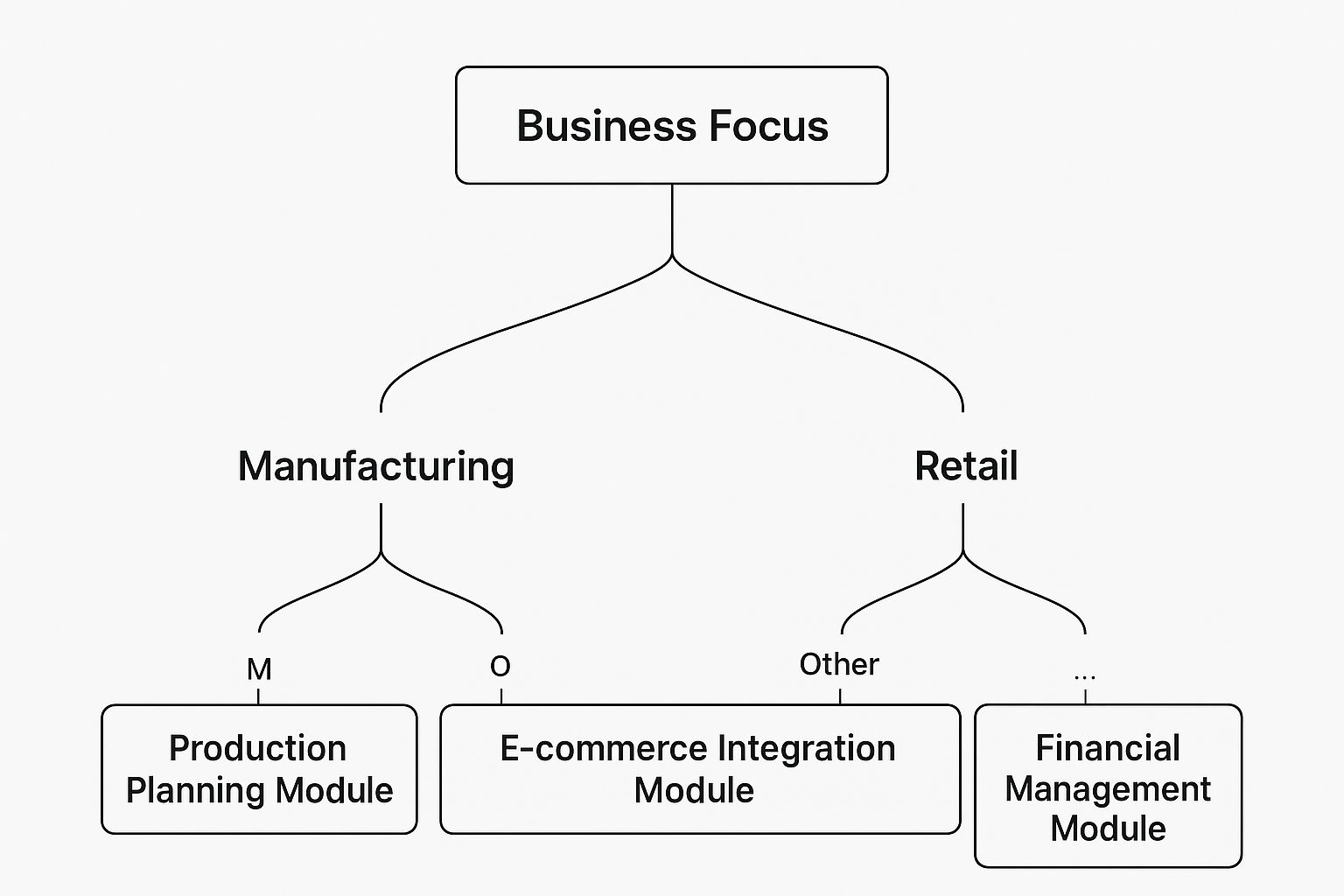
This decision path makes it clear that whether you go with cloud or on-premise, the system’s core modules must match your daily operations to really deliver results.
On-Premise Solutions: A Niche Choice
So, is there ever a good reason to choose an on-premise ERP anymore? In some very specific cases, yes. A business in a heavily regulated field with strict data sovereignty rules, or one operating in a remote area with spotty internet, might find an on-premise setup is its only option.
But these situations are the exception, not the rule. The trade-offs are huge: you’re stuck with the version you buy, upgrades are complex and costly projects, and you have to keep buying more physical hardware to scale up. For a dynamic small business, that kind of rigidity can quickly put the brakes on growth.
Cloud-based ERP systems have become the standard for Australian small businesses, and for good reason. Locally, cloud ERP adoption has been growing by more than 20% annually. It’s now common for businesses with just 10-20 employees to implement cloud solutions to become more agile and cut their IT overheads. With pricing often starting around AUD 100 to 150 per user per month, these powerful tools are well within reach. You can learn more by checking out these Australian small business ERP trends.
Practical Cases in Action
Let’s bring this to life with a couple of practical cases:
- A Retailer with a WooCommerce Store: A cloud ERP is the perfect match here. They need flawless WooCommerce integration to keep orders and inventory synced in real-time. The ability to automatically scale server power during peak shopping times like Christmas is a massive advantage they’d never get from a fixed on-premise server. A professional Shopify implementation team can ensure this connection is robust from day one.
- A Custom Manufacturer in Adelaide: They might think they need an on-premise system for data security. The truth is, modern cloud ERPs offer security protocols that are often far more robust than what a small business could manage itself. With expert software development in Adelaide, they can customise a cloud solution like Odoo to perfectly fit their unique production workflows while still enjoying the benefits of remote access and lower costs.
For any modern, growth-minded business, the flexibility, scalability, and cost-efficiency of the cloud are simply too good to ignore.
Are you ready to explore how a cloud-based ERP can provide the foundation for your business’s growth? Contact us today for a personalised consultation to see how an Odoo implementation in Sydney or a custom solution can work for you.
Your Blueprint For A Successful ERP Implementation

Picking the right ERP software for a small business is a great start, but it’s only half the battle. The real magic happens during implementation. An ERP is only as good as its rollout, and getting it right can be the difference between unlocking immediate efficiency and being stuck with months of frustrating disruption.
Think of it like building a house. You wouldn’t just start laying bricks without a detailed blueprint, right? The same goes for an ERP. This plan breaks down what can feel like a huge technical project into a series of clear, manageable steps, so you can launch with confidence.
A great implementation isn’t about just flipping a switch. It’s a careful process of moving your operations, getting your team on board, and making sure the new system genuinely works for your business.
Step 1: Define Your Core Needs and Goals
Before you can even think about a solution, you need to know exactly what problems you’re trying to solve. What are the biggest pain points in your current workflow? Where are the bottlenecks that are really holding your business back?
Figuring this out is a team sport. You need to sit down with the key people from every department—from the warehouse floor to the sales desk—and actually map out how they get their work done. This discovery phase is absolutely critical; it shapes the entire project and ensures the system you build solves real-world problems.
A classic mistake is trying to make a shiny new ERP system copy an old, clunky process. The point isn’t to digitise your current chaos. It’s to seize the opportunity to build smarter, more efficient ways of working from the ground up.
Step 2: Find The Right Local Implementation Partner
It can be tempting to try and manage an ERP implementation yourself to cut costs, but this is almost always a false economy. A skilled implementation partner is your expert guide, navigating you around common pitfalls that can derail projects and blow your budget.
For Australian businesses, choosing a local partner is a massive advantage. They get the local market, the compliance rules, and the business culture. A partner offering software development in Adelaide or an expert in Odoo implementation in Sydney can provide the kind of hands-on, face-to-face support that a remote international firm just can’t.
Practical Case: A Retailer’s E-commerce Integration
Picture a retailer in Sydney who was scaling up their online store. They needed their new ERP to talk flawlessly with their website. By working with a partner who had deep experience in Shopify implementation, they made sure their inventory, orders, and customer data were perfectly synchronised from day one. That local, specialised knowledge was the key to a smooth launch.
Step 3: Plan Your Data Migration and Integrations
Moving your data from the old systems into the new ERP is one of the most delicate parts of the entire job. This is where the old saying “garbage in, garbage out” really rings true. Before you move a single customer record, you have to clean your data. That means getting rid of duplicates, fixing errors, and archiving anything that’s out of date.
Once your data is sparkling clean, the next focus is on the integrations. Your ERP has to connect with all the other tools your business depends on.
- E-commerce Platforms: For most, a rock-solid connection to WooCommerce or Shopify is a must-have.
- Payment Gateways: Ensure you get paid without a hitch by linking to your payment processor.
- Shipping Carriers: Automate your logistics by connecting directly to your shipping partners.
A local team with expertise in software development in Sydney can build custom integrations if an off-the-shelf one doesn’t exist, ensuring your entire tech ecosystem works together as one.
Step 4: Train Your Team for Enthusiastic Adoption
The most powerful ERP software for a small business is completely useless if your team doesn’t know how to use it—or even worse, refuses to. Getting your team to actually use and love the new system comes down to great training and clear communication.
Don’t wait until go-live day to spring it on them. Get your team involved early, show them exactly how the new system will make their jobs easier, and find a few “champions” in each department to help their colleagues along. The goal is to build genuine excitement, turning them from reluctant users into the new system’s biggest fans.
Done right, an ERP implementation turns a piece of software into the central engine that drives your business forward. With a solid plan and the right partner, you can make sure your investment pays off for years to come.
Ready to start your ERP journey with a trusted local expert? Contact us for a personalised consultation to discuss your unique business needs and map out your path to success.
Ready to Take the Next Step and Unify Your Business?
You’ve seen how a modern ERP can pull all the scattered pieces of a small business together and get them working as one. Those endless hours of manual data entry and the frustrating communication gaps between departments? They aren’t just small annoyances; they’re genuine roadblocks holding your business back. It’s time to stop just surviving and start properly thriving.
Think about the real friction points in your day-to-day work. Where are the bottlenecks? Where do things fall through the cracks? Now, imagine them simply gone. Picture having one central hub where your sales data, inventory levels, and financial reports all talk to each other effortlessly. This isn’t some far-off fantasy—it’s what happens when a business decides to invest in its own foundation.
If you’re serious about building a more efficient, profitable, and scalable business, our team is here to help you make it a reality. It all starts with a simple conversation to understand exactly what you need.
Your Local ERP Partner
Choosing the right software is a huge decision, but it’s only half the battle. Just as important is choosing the right partner to guide you through the process. With hands-on expertise and local Australian support, we don’t just sell software; we make sure it works for you.
We specialise in:
- Expert Odoo implementation in Sydney and Adelaide.
- Custom software development in Sydney and Adelaide for those unique challenges that no off-the-shelf product can solve.
- Seamless Shopify implementation to get your e-commerce and back-office operations in sync.
- Reliable integration with WooCommerce to unify all your online sales channels.
We’re the local partner you need to make your transition to an ERP a genuine success. Contact us today for a personalised consultation, and let’s map out the best path forward for your business.
Your ERP Questions Answered
Stepping into the world of ERP software can feel a bit daunting, but it doesn’t need to be. Let’s cut through the noise and get straight to the answers you’re looking for as a small business owner.
How Much Does ERP Software Cost For A Small Business In Australia?
You’re likely looking at a starting figure of around AUD $100 to $250 per user, per month for a modern, cloud-based ERP. But that’s only part of the story. The real investment often lies in the implementation – the critical work of setting it all up, moving your data across, and training your team.
My advice? Always ask for a quote that clearly breaks down the software licence fees from the one-time implementation costs. This transparency is key to understanding the full picture of what it’ll take to get you up and running smoothly.
How Long Does An ERP Implementation Take?
For a small business, a typical project will take somewhere between 3 and 9 months. The final timeline really hinges on a few things: how complex your day-to-day operations are, the volume of historical data you need to bring over, and how much tailoring the system needs to fit your specific workflow.
Two things will keep your project on schedule and on budget more than anything else: a rock-solid project plan from the get-go and an experienced local partner who knows what they’re doing.
Can An ERP Integrate With My Shopify Or WooCommerce Store?
Yes, absolutely. This isn’t just a ‘nice to have’; it’s a fundamental feature of any modern ERP worth its salt. Systems like Odoo are built to connect seamlessly with leading e-commerce platforms, accounting tools, and all the other software that keep your business running.
Think of it this way: the integration creates a single source of truth for your orders, inventory, and customer information. It kills manual data entry, which in turn prevents those frustrating stock errors and keeps your customers happy. A professional Shopify implementation makes sure this connection is bulletproof.
When Is The Right Time For My Business To Get An ERP?
You’ll know it’s time when you start feeling the growing pains. Are your staff bogged down in manual, repetitive tasks? Do you have different numbers in different spreadsheets? Is getting a clear, real-time snapshot of your business’s health nearly impossible? Those are your signs.
These aren’t just little headaches; they are genuine roadblocks holding your business back. If these problems sound familiar, it’s the perfect moment to start looking at how an ERP can build a stable platform for your future growth. Whether you need an Odoo implementation in Sydney or custom software development in Adelaide to sync up with WooCommerce, the goal is to put these operational nightmares to bed for good.
Ready to bring all your operations under one roof and see what your business is truly capable of? The team at Wistec delivers practical, solution-focused technology to fuel your growth. We specialise in building ERP solutions that get real results.