

Picture this: your factory floor is humming along, but the whole operation is held together by a tangled web of spreadsheets and standalone software. Production schedules are in one place, inventory is tracked somewhere else entirely, and the accounting team has its own separate system. This chaos isn’t just frustrating; it’s a silent profit killer.
This digital disconnect is where costly errors, frustrating production delays, and massive missed opportunities are born. The answer isn’t another spreadsheet. It’s a proper ERP software for manufacturing industries, which acts as a single, central nervous system for your entire operation.
Why Manufacturing Still Runs on Disconnected Systems
For too many Australian manufacturers, this patchwork of isolated processes is just the way things have always been done. The production manager is a wizard with a complex Excel file, while the warehouse crew updates stock levels in a program that doesn’t talk to anything else. This creates information silos—little islands of data that are completely cut off from the rest of the business.
This lack of a single source of truth is a huge drag on efficiency. When a new sales order comes in, does someone have to physically check stock or call three different people to confirm material availability? That’s a manual scavenger hunt. Forecasting becomes pure guesswork, and figuring out the true cost of a production run is next to impossible. Each department is flying blind, unable to see how their decisions ripple through the entire company.
The Real Cost of Data Silos
The fallout from these disconnected systems is real, and it hits your bottom line hard. Without everyone working from the same real-time information, problems don’t just happen—they snowball.
- Production Bottlenecks: A critical shortage of raw materials goes unnoticed until the assembly line grinds to a sudden, expensive halt.
- Inventory Errors: You’re either tying up cash in overstocked items that gather dust or you’re dealing with stockouts that lead to delayed orders and angry customers.
- Reduced Profitability: Inaccurate job costing can mean you’re unknowingly losing money on your best-selling products.
- Compliance Risks: Traceability becomes a nightmare. Trying to track a batch during a quality audit or a product recall is a painful, manual process.
It’s been shown that data synchronisation errors between separate systems can cost businesses up to 25% of their revenue. That’s a massive hit caused by operational friction and poor decision-making.
A genuinely unified platform eliminates these challenges. Practical Case: A furniture manufacturer in Western Sydney was struggling with this exact issue. By implementing a unified system, they connected their online store directly to their production floor. Now, a sale on their website automatically triggers a work order and allocates materials, cutting manual entry and errors entirely. A well-executed Odoo implementation in Sydney can bring your entire workflow—from the initial quote to the final shipment—into one cohesive system. This isn’t just about the factory floor, either. A manufacturer with an online store can benefit from a seamless Shopify implementation or WooCommerce integration, linking web sales directly to production queues and inventory levels. This creates a powerful digital backbone for the business, connecting the front office to the shop floor and providing the clarity needed to compete.
Ready to ditch the spreadsheets for a powerful, unified system? Our expert software development team in Sydney and Adelaide can design a solution that fits your unique manufacturing needs. Contact Wistec today for a free consultation.
How a Manufacturing ERP Becomes Your Digital Factory
Let’s get one thing straight: a manufacturing ERP isn’t just another piece of software you install. It’s better to think of it as a digital twin of your entire factory floor. Every department, every process, every single moving part is mirrored in one central system, where an action in one area instantly ripples through and informs all the others.
This is what turns a chaotic, disconnected workflow into a finely tuned operational machine.
An ERP makes this possible by creating a single source of truth for your business. Instead of critical information being locked away in separate spreadsheets, outdated programs, or someone’s head, it flows freely between every part of your operation. This interconnectedness is the real secret sauce behind an intelligent, responsive manufacturing business.
The infographic below paints a familiar picture for many manufacturers—a jumble of disconnected systems where inventory, accounting, and operational data are all stuck in their own silos.
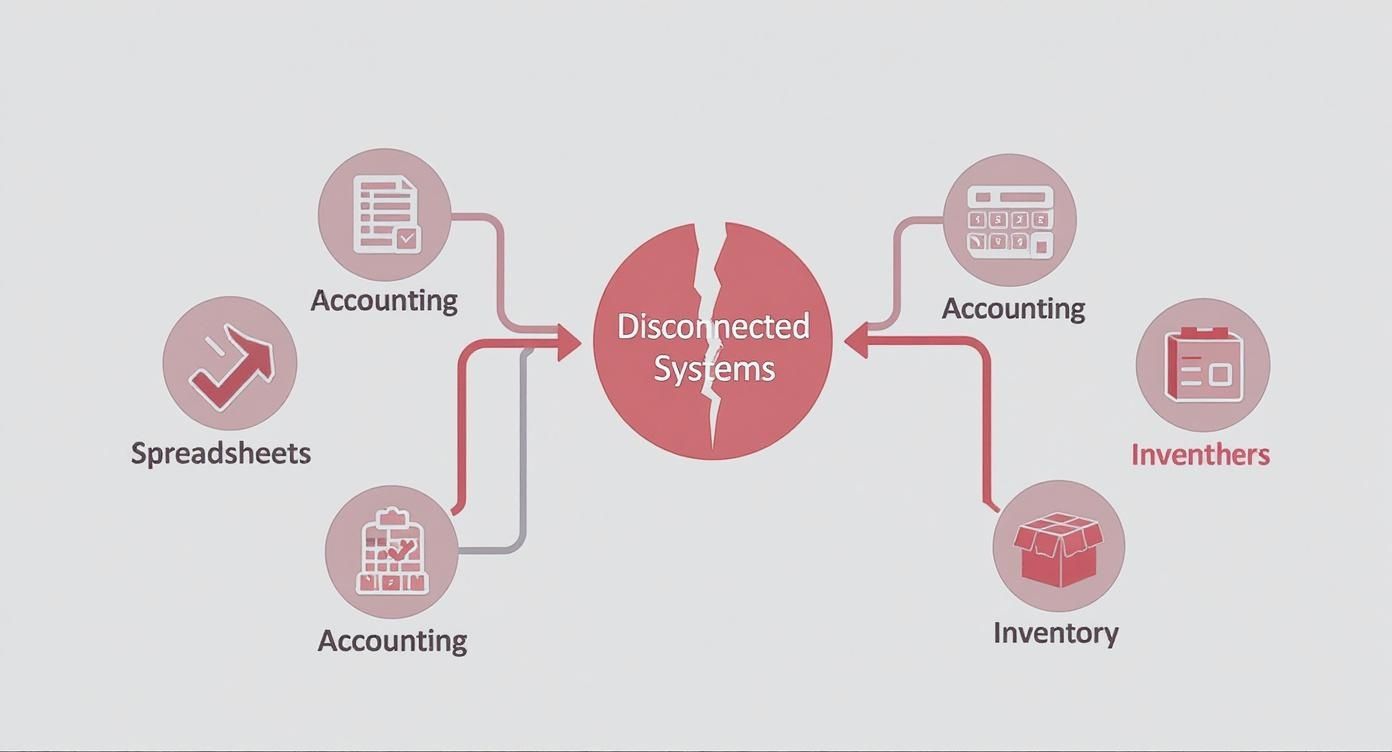
This kind of fragmentation creates massive operational blind spots, making it almost impossible to get a clear, real-time view of what’s actually happening. A good ERP breaks down these walls, finally connecting all the pieces of the puzzle.
To get a feel for how this works in practice, let’s look at the core modules that bring it all together. The table below gives a quick snapshot of the essential components every Australian manufacturer should look for.
Core ERP Modules for Australian Manufacturers
| ERP Module | Core Function | Key Benefit for Manufacturers |
|---|---|---|
| Bill of Materials (BOM) | Defines the “recipe” for each product, listing all parts and materials. | Guarantees product consistency and accurate job costing. |
| Production Planning | Schedules and coordinates all manufacturing jobs based on demand and capacity. | Maximises machine uptime and prevents production bottlenecks. |
| Inventory Control | Tracks all raw materials, work-in-progress, and finished goods in real-time. | Prevents costly overstocking and frustrating, order-delaying stockouts. |
| Supply Chain Management | Manages supplier relationships, procurement, and logistics from end to end. | Improves purchasing efficiency and builds a more resilient supply chain. |
These modules aren’t just separate tools; they work together to create a seamless flow of information that drives the entire business forward.
The Master Recipe: Bill of Materials
At the very heart of any manufacturing ERP is the Bill of Materials (BOM). Think of it as the master recipe for your product. It’s an exact, hierarchical list detailing every raw material, sub-assembly, part, and the quantity needed to produce one single finished unit.
Without a precise BOM, you’re flying blind. You might order too much of one component and not nearly enough of another, grinding production to a halt and tying up cash. A well-managed BOM inside an ERP system ensures consistency, pinpoint accuracy in costing, and smart, efficient purchasing. It’s the foundational document that tells you what to buy, what to build, and exactly how much it will all cost.
Orchestrating the Factory Floor: Production Planning
If the BOM is the recipe, the Production Planning module is the head chef orchestrating the entire kitchen. This is where the magic happens. It takes sales forecasts, current orders, and inventory levels to build a master production schedule.
It answers the big questions:
- What do we need to make?
- How many do we need?
- And when do we need to make it by?
This module acts like an air traffic controller for your production lines, making sure jobs are scheduled smartly to maximise machine uptime and get the most out of your team. It stops bottlenecks before they start by aligning material availability with your actual production capacity, turning reactive firefighting into proactive management. This is a core benefit we see time and again with a professional Odoo implementation in Sydney—planning becomes driven by data, not guesswork.
An effective ERP provides the framework to manage not just what’s happening now, but what needs to happen next. It connects customer demand directly to the shop floor, creating a seamless flow from order to fulfilment.
Gaining Control of Your Assets: Inventory and Supply Chain
Finally, the Inventory Control and Supply Chain Management modules make sure you have the right materials, in the right place, at the right time. The inventory module gives you real-time visibility into stock levels, tracking everything from raw materials and work-in-progress (WIP) to finished goods across all your locations. It stops both costly overstocking and the frustrating stockouts that delay customer orders.
The Supply Chain Management (SCM) piece extends this visibility outwards to your suppliers and inwards to your customers. It manages procurement, keeps tabs on supplier performance, and optimises logistics. This integration is absolutely vital for modern manufacturers, especially those selling online through a Shopify implementation or WooCommerce, as it directly links e-commerce sales to your purchasing and production schedules.
A powerful ERP weaves these functions together seamlessly. Practical Case: When a sales order comes in from a connected online store, the system instantly checks finished goods inventory. If stock is low, it consults the BOM and inventory data to automatically generate purchase orders for raw materials and create a work order for the production floor. This automated, intelligent workflow is what makes an ERP the true digital backbone of a modern factory.
Is your factory ready for a digital transformation? Our software development team in Sydney and Adelaide specialises in creating unified systems that connect every aspect of your operation. Get in touch with Wistec to start building your digital factory today.
How to Choose the Right ERP for Your Manufacturing Business
Choosing an ERP system isn’t like buying any other piece of software. It’s a massive decision that will become the backbone of your entire manufacturing operation for years to come. Think of it less as a purchase and more as a foundational business partnership. This guide will walk you through the big choices you need to make, from cloud vs. on-premise to figuring out the real cost, so you can find the perfect fit for your business.
The first major fork in the road is deciding where your ERP will live: in the cloud or on your own servers. An on-premise system means you buy the software licences outright and run everything on your own hardware. This gives you total control, but it also means you’re on the hook for all the maintenance, security, and expensive upgrades.
Cloud ERPs, on the other hand, are hosted by the vendor. You access them over the internet for a subscription fee. This model slashes the upfront cost and hands the headache of server management, backups, and security over to the provider.
The Cloud Takeover in Australian Manufacturing
The shift to the cloud isn’t just a fleeting trend—it’s a fundamental change in how businesses operate. We’ve seen a massive swing towards cloud-based ERP systems among Australian small and medium-sized manufacturers in recent years, with adoption rates jumping by over 20% annually. It used to be that only the big players could afford the huge upfront investment and lengthy rollout of an ERP. Not anymore. Modern cloud systems let companies with as few as 10 employees get up and running with a powerful, scalable solution quickly and affordably. If you’re interested, you can explore more data on this market shift to see why the cloud is winning.
This has completely levelled the playing field. Smaller manufacturers can now access the same sophisticated tools that were once the exclusive domain of multinational corporations. It means you can scale your system up or down as the market changes, paying only for what you actually use.
Next, you need to think about the software’s design. The old way was the monolithic, all-in-one system. You got a massive suite of features, whether you needed them or not, which often resulted in a clunky, bloated system full of functions you never touched.
The modern alternative is a modular platform. Think of it like building with LEGOs—you start with a solid foundation and add specific blocks (modules) like inventory, production, or accounting as your business requires them.
This approach gives you incredible flexibility, and it’s a key reason platforms like Odoo are becoming so popular with Australian manufacturers. You can start with the absolute essentials and add new capabilities as you grow, ensuring the system evolves with your business. This is the advantage we build into every Odoo implementation in Sydney or Adelaide.
Don’t Get Blindsided: Understanding the Total Cost of Ownership
One of the biggest mistakes I see businesses make is getting fixated on the initial licence or subscription fee. The true price of an erp software for manufacturing industries is its Total Cost of Ownership (TCO). This includes every single direct and indirect cost over the system’s entire life.
Here are the so-called “hidden” costs you absolutely must budget for:
- Implementation and Customisation: This is often the biggest ticket item. It’s the work required to configure the system to match your unique workflows, which needs expert software development in Sydney or Adelaide to get right.
- Data Migration: Pulling years of data from old spreadsheets or legacy software into a new ERP is a complex, painstaking process. Don’t underestimate it.
- Training and Change Management: Your team needs to learn the new system inside and out. Skimping on training is one of the top reasons ERP projects fail.
- Ongoing Support and Maintenance: This covers vendor support plans, software updates, and potential hardware upgrades if you go the on-premise route.
- Third-Party Integrations: Need your ERP to talk to your e-commerce store? Connecting it to other crucial systems, like a Shopify implementation or a WooCommerce site, often requires specialised development.
Navigating Australia’s unique market and compliance rules requires local know-how. Partnering with an Australian-based team ensures your ERP is not only technically sound but also configured for local business conditions and regulations.
Ready to explore an ERP solution without the nasty surprises? Our experts can help you map out the true TCO and build a system that delivers genuine value from day one. Contact Wistec for a transparent consultation today.
Real-World ERP Success Stories from Australian Factories
It’s one thing to talk about features and theories, but the real proof is always in the pudding. The true test of any ERP software for manufacturing industries is the tangible, measurable impact it has on the factory floor. The best way to grasp its value is to see how other Australian businesses have solved their biggest operational headaches with a unified system.
Let’s look at a few anonymised success stories that show these systems in action.
These examples go beyond abstract benefits and get right down to real-world results, from slashing waste to breaking into new markets. They prove that a well-implemented ERP isn’t a cost centre; it’s a powerful engine for growth and efficiency.
Case Study One: Slashing Lead Times in Metal Fabrication
An Adelaide-based metal fabrication company was being buried under long lead times and spiralling material costs. Their entire operation was a chaotic mix of disconnected spreadsheets and manual job tracking. Urgent orders were constantly falling through the cracks, they couldn’t quote jobs accurately, and profits were being eaten away by excessive scrap.
The solution was a strategic Odoo implementation in Adelaide, zeroing in on production planning and inventory control. By linking their sales orders directly to the shop floor schedule and material requirements, they finally gained complete visibility.
The results were remarkable:
- Lead Times Reduced: They cut their average order-to-delivery time by an incredible 30%, delighting customers and boosting their overall capacity.
- Material Waste Slashed: Real-time inventory tracking and precise Bill of Materials (BOM) management led to a 15% reduction in material waste.
- Improved Quoting Accuracy: With solid data on labour and material costs, their quotes became far more competitive and, more importantly, profitable.
This case highlights a core truth: visibility is control. When you can see every moving part of your operation in real-time, you can make smarter, faster decisions that directly impact the bottom line.
Case Study Two: Ensuring Compliance for a Sydney Food Producer
For a growing food and beverage producer in Sydney, compliance was everything. Their old, paper-based system for tracking batches was slow, riddled with errors, and simply couldn’t scale to meet the tough traceability requirements of major retailers. Every audit was a fire drill, and their inability to guarantee end-to-end traceability was a massive roadblock to expansion.
They needed a system that could provide rock-solid, batch-level tracking from the moment raw ingredients arrived to the final product shipment. After engaging a local software development team in Sydney, they implemented an ERP with robust quality control and traceability modules built-in.
This new system changed the game for them, allowing them to:
- Achieve Effortless Compliance: They could now pull a full traceability report for any batch in minutes, satisfying even the most demanding auditors.
- Expand Market Reach: With certified compliance, they successfully landed contracts with two major national supermarket chains that were previously out of reach.
- Boost Consumer Confidence: The ability to guarantee product safety and quality became a key selling point, strengthening their brand’s reputation in the market.
Case Study Three: Connecting the Factory Floor to the Online Storefront
For manufacturers who also sell direct-to-consumer, integrating e-commerce can be a genuine game-changer. Take a local Australian furniture maker who was running a successful online store but struggling to connect web sales to their production schedule. Online orders had to be manually re-entered into their production system, a recipe for delays and inventory sync errors.
By integrating their ERP with their e-commerce platforms through a professional Shopify implementation and WooCommerce connection, they created a seamless flow of information. Now, when a customer places an order online, it automatically generates a work order on the factory floor and reserves the necessary materials from inventory. Simple as that.
This direct link proved the tangible ROI of a truly unified system. It wiped out manual data entry and ensured the entire business—from the customer’s click to the final delivery—operated as one cohesive unit.
These stories show that the right ERP, implemented by experts who understand the local landscape, can solve real-world manufacturing challenges. Are you ready to write your own success story?
Take the first step towards transforming your operations. Contact Wistec for a no-obligation consultation and discover how a tailored ERP can drive real results for your business.
Getting Your ERP Implementation Right and Dodging the Pitfalls
Rolling out a new ERP system is a massive undertaking for any manufacturing business. Let’s be clear: this isn’t just about installing some new software. It’s a complete overhaul of how your business runs, and you need a solid game plan to pull it off. A successful launch is a carefully planned mission, not a hopeful leap in the dark, designed to modernise your operations and find efficiencies you never knew you had.
The whole journey is broken down into critical stages that demand careful management. From the headache of migrating decades of data to making sure every single user is properly trained, every step has a huge impact on the final result. Many manufacturers I’ve worked with find a phased rollout—introducing the system module by module—is the smartest way to go. It minimises the chaos and gives your teams a chance to actually adapt.
And getting this right has never been more important. The Australian market for ERP software is booming, valued at around AUD 930.2 million in 2024 and tipped to reach AUD 1.17 billion by 2030. While everyone’s keen to digitalise, the biggest roadblock is still the same old story: trying to get shiny new systems to talk to the old ones. You can discover more insights on this growing market.
Sidestepping Common Disasters
Unfortunately, ERP projects have a bit of a reputation for blowing the budget or just not delivering on their promises. The funny thing is, the problem is rarely the software itself. It almost always comes down to a handful of predictable—and completely avoidable—mistakes.
Spotting these risks early is the best way to steer clear of them.
- Poor Project Management: If there’s no clear leadership, no defined milestones, and a timeline that’s more fantasy than reality, the whole thing will drift off course fast.
- Lack of Executive Buy-In: When the bosses aren’t visibly backing the project, it tells everyone else it’s not a priority. That’s a surefire way to get resistance from the team.
- Underestimating Change Management: The biggest hurdle is almost always the people. If you don’t prepare your team for new ways of working, you’re setting yourself up for poor adoption and a failed project.
An ERP project’s success is determined less by the technology and more by the people and processes around it. A great plan executed by an engaged team will always outperform brilliant software implemented in a chaotic environment.
Your Insurance Policy for Success
So, how do you actually navigate these challenges? The single most effective thing you can do is bring in an experienced implementation partner who truly gets the ins and outs of manufacturing. Think of them as your guide, helping you set clear goals, keep the project scope in check, and lead your team through the entire transition. This is especially true when you start talking about customisations and integrations.
Practical Case: A medical device manufacturer in Adelaide needed their new ERP to integrate with highly specialised, compliant machinery. A generic rollout would have failed. By using a local software development Adelaide team, they were able to build a custom API that allowed the new ERP to communicate flawlessly with their legacy equipment, ensuring a smooth transition without compromising on compliance. A skilled software development team in Sydney can similarly ensure your ERP communicates perfectly with your other essential systems, like a custom-built machine or a Shopify implementation.
At the end of the day, a successful rollout of an erp software for manufacturing industries comes down to expertise. Whether you’re looking at an Odoo implementation in Sydney or a completely custom software development project in Adelaide, the right partner brings the technical skills and project discipline you need to deliver on time, on budget, and actually transform your business. They’re your best insurance policy against the common disasters that derail these critical projects.
Are you ready to plan an ERP implementation that delivers real results without the common headaches? Contact Wistec today to build a strategic roadmap for your business.
The Future of Manufacturing Is Smart and Connected
The ERP systems of today are laying the groundwork for the ‘smart factories’ of tomorrow. We’ve moved past using ERP software for manufacturing industries just to look back at what’s already happened. The real power now lies in predicting what’s coming next. Modern ERPs are no longer just digital filing cabinets; they’re becoming intelligent, proactive partners that spark genuine innovation.
Think about it this way: instead of an ERP simply telling you a machine has broken down, what if it could see the failure coming? By integrating Artificial Intelligence (AI) and data from Internet of Things (IoT) sensors, the system can anticipate equipment failure before it ever happens. It can then automatically schedule maintenance, preventing a costly production shutdown. This is where manufacturing is heading—a smart, interconnected ecosystem running on live data.
This evolution is opening up huge opportunities for Australian manufacturers. In fact, the local enterprise resource planning market is projected to grow at a compound annual growth rate of 15.20% between 2025 and 2034, potentially reaching a value of AUD 10.37 billion. This isn’t just a number; it’s a clear signal that businesses are hungry for more automation and real-time control over their operations. You can read the full research about this market growth for a deeper dive.
Building a Future-Ready Operation
This isn’t some far-off sci-fi concept. The future is being built right now on modern ERP platforms. Here’s a glimpse of how these technologies are making factories smarter:
- Predictive Analytics: Machine learning algorithms sift through years of production data to forecast future demand with incredible accuracy. This helps you fine-tune inventory and avoid the dual headaches of stockouts and overstocking.
- IoT Integration: Sensors placed on your factory floor stream live data straight into the ERP. This gives you a minute-by-minute snapshot of every machine’s health, output, and overall performance.
- Automated Supply Chains: An intelligent ERP can look beyond your four walls. It can track external factors like shipping delays or severe weather and automatically adjust production schedules or reroute material orders to keep things running smoothly.
An ERP is no longer just a system of record; it’s a strategic investment in your company’s future agility and resilience. It provides the digital backbone required to compete in a world where speed and intelligence are paramount.
The path to a smart factory starts with a solid foundation. Whether that means a new Odoo implementation in Sydney, a bespoke software development project in Adelaide, or linking your factory floor to a Shopify implementation or WooCommerce storefront, the end goal is always the same: to create a single, intelligent source of truth for your entire business.
Don’t just get ready for the future—start building it. Our team of experts is here to help you map out a clear strategy for your digital journey.
Ready to build a smarter, more connected manufacturing business? Book a free, no-obligation consultation with a Wistec expert today and let’s explore your future.
Got Questions? We’ve Got Answers
Stepping into the world of manufacturing ERPs can feel a bit overwhelming, and it’s natural to have questions. You’re not just buying software; you’re investing in the future of your operations. Let’s tackle some of the most common queries we hear from Australian manufacturers just like you.
What’s the Real Cost of a Manufacturing ERP?
There’s no one-size-fits-all price tag. The cost really boils down to your specific needs, how many people will be using the system, and how much customisation you require. For a small Aussie manufacturer, a cloud-based system like Odoo can get started from just a few thousand dollars for the initial setup and licensing.
The beauty of a tailored Odoo implementation in Sydney or Adelaide is that you only pay for what you actually need. You’re not stuck with a bloated system full of features you’ll never touch, making it a smart, cost-effective choice.
How Long Does It Take to Get an ERP Up and Running?
Every business is different, but a good rule of thumb for a small to medium-sized manufacturer is anywhere from three to nine months. That timeline covers the whole journey—from the initial discovery sessions and planning right through to migrating your data, training your team, and flicking the ‘on’ switch.
What affects that timeframe? Mostly, it’s the complexity of your current operations and how much data needs to be carefully moved from your old systems. Partnering with a dedicated team for software development in Sydney can make this process a whole lot smoother and faster.
Rushing an ERP rollout is a recipe for disaster. The most successful projects are planned meticulously and often rolled out in phases. This approach minimises disruption and gives your team the time they need to get comfortable, which is the key to making it stick.
Can a New ERP Talk to My Existing Tools?
You bet. Modern ERP systems are built to be the central nervous system of your business. They’re designed to connect seamlessly with the tools you already rely on, whether it’s your factory floor machinery (via IoT sensors), your accounting software, or your online store.
For instance, a smooth Shopify implementation or a WooCommerce integration can link your online sales directly to your production schedule and inventory. Practical case: a clothing manufacturer in Adelaide automated their entire process. When a customer clicks ‘buy’ on their WooCommerce site, the ERP confirms fabric stock, schedules the sewing job, and prints a shipping label, all without a single person needing to intervene. That’s the power of a fully connected system.
Why Bother with a Customisable ERP Like Odoo?
Think of it this way: generic, off-the-shelf software makes you bend your processes to fit its rigid box. A customisable ERP like Odoo does the complete opposite—it adapts to your unique way of doing things.
In manufacturing, where no two businesses are truly alike, that flexibility is everything. You can start with the essential modules like inventory and manufacturing, then add more specialised functions as your business grows. The system evolves with you, not against you.
Ready to stop guessing and start making data-driven decisions? The experts at Wistec are here to help you build and implement an ERP system that fuels real, measurable growth for your manufacturing business.