

Still wrestling with outdated spreadsheets and a tangled mess of disconnected software? Imagine a single, central hub for your entire business—finance, inventory, operations, you name it—accessible from anywhere, anytime. That’s the power of an ERP on cloud.
Think of it this way: instead of building your own office from the ground up, you’re renting a space in a state-of-the-art, fully serviced high-rise. It’s ready when you are, flexible enough to grow with you, and all the heavy lifting is handled for you.
Why Australian Businesses Are Moving to Cloud ERP
For many Aussie businesses, there comes a moment when the old ways just don’t work anymore. When your sales, inventory, and accounting systems don’t talk to each other, you end up with data silos, crippling inefficiencies, and decisions based on guesswork. This is the exact point where moving to an ERP on cloud stops being a simple tech upgrade and becomes a genuine business evolution.
The momentum behind this shift is impossible to ignore. The Australian Enterprise Resource Planning (ERP) software market has already ballooned to AUD 930 million. And it’s not slowing down, with forecasts pointing to continued growth fuelled by digitalisation and the critical need for unified solutions. You can explore more about this market growth to see just how big this trend is.
The Old Way: On-Premise Systems
Not long ago, the only option was an on-premise ERP. This involved buying hefty servers, navigating complex software installations, and keeping a dedicated IT team on standby just to keep the lights on. It was the equivalent of constructing your own office building—a massive upfront cost followed by endless bills for security, maintenance, and power.
This traditional model essentially chained your data and operations to a physical location. For a business with teams spread across Sydney and Adelaide, or a workforce that needs to be mobile, it was a recipe for bottlenecks and collaboration headaches.
The Modern Approach: ERP on Cloud
An ERP on cloud completely upends that old-fashioned model. Your provider handles all the infrastructure—the servers, the security, the updates—and you simply log in and access powerful, business-changing software through your web browser. This turns a daunting capital expenditure into a predictable, manageable operating cost.
Suddenly, your business becomes incredibly agile. Picture your sales rep finalising a deal on their tablet while on the road. Instantly, the warehouse team gets the picking order on their screen, and the finance department sees the transaction pop up in real-time. That seamless flow of information is what it takes to compete today.
A cloud ERP system acts as the central nervous system for your entire business. It ensures that every department—from sales and marketing to operations and finance—is working from a single, unified source of truth, eliminating errors and empowering strategic decisions.
Let’s make this real with a practical case. A fast-growing online store using a Shopify implementation or WooCommerce can plug its storefront directly into a cloud ERP. When an order comes through, the system can automatically adjust stock levels, send a notification to the shipping courier, and log the sale in the financial accounts—all without a single person lifting a finger. That kind of automation, achieved through expert software development in Sydney or Adelaide, is a total game-changer.
To give you a clearer picture, let’s break down the core differences.
On-Premise ERP vs ERP on Cloud: A Quick Comparison
This table offers a high-level look at how these two approaches stack up across the factors that matter most to your business.
| Aspect | On-Premise ERP | ERP on Cloud |
|---|---|---|
| Initial Cost | High capital expenditure (hardware, licenses, IT staff) | Low initial setup, subscription-based model (OpEx) |
| Deployment | Long and complex, requiring on-site installation | Fast and straightforward, accessed via the internet |
| Accessibility | Limited to the physical location of the servers | Accessible from anywhere with an internet connection |
| Maintenance | Managed internally by your IT team, costly and time-consuming | Handled entirely by the provider, including updates & security |
| Scalability | Difficult and expensive; requires purchasing new hardware | Easy and flexible; scale up or down as needed |
| Security | Responsibility falls entirely on your internal team | Managed by expert providers with robust security protocols |
As you can see, the cloud model is built for the flexibility and speed that modern businesses demand.
Ultimately, choosing an ERP on cloud is about setting your business up for the future. It gives you a scalable foundation to adapt, expand, and outmanoeuvre the competition. If your current systems are what’s holding you back, it’s time to seriously consider what the cloud can do for you.
Ready to see how a modern ERP can unify your operations? Our expert team specialises in Odoo implementation in Sydney and Adelaide, alongside custom software development. Contact us today for a personalised consultation and discover how we can help you grow.
What Are the Real-World Benefits of a Cloud ERP System?
Enough with the theory. Let’s talk about what actually happens when a business moves its core operations to a cloud ERP. The decision is almost always driven by tangible advantages that directly improve a company’s agility, day-to-day efficiency, and, of course, the bottom line.
These aren’t just small tweaks. They’re fundamental shifts that can give you a serious competitive edge by solving some of the most frustrating operational headaches out there. A good cloud ERP becomes the engine for real, sustainable growth.
This infographic breaks down some of the key benefits businesses see when they make the switch.
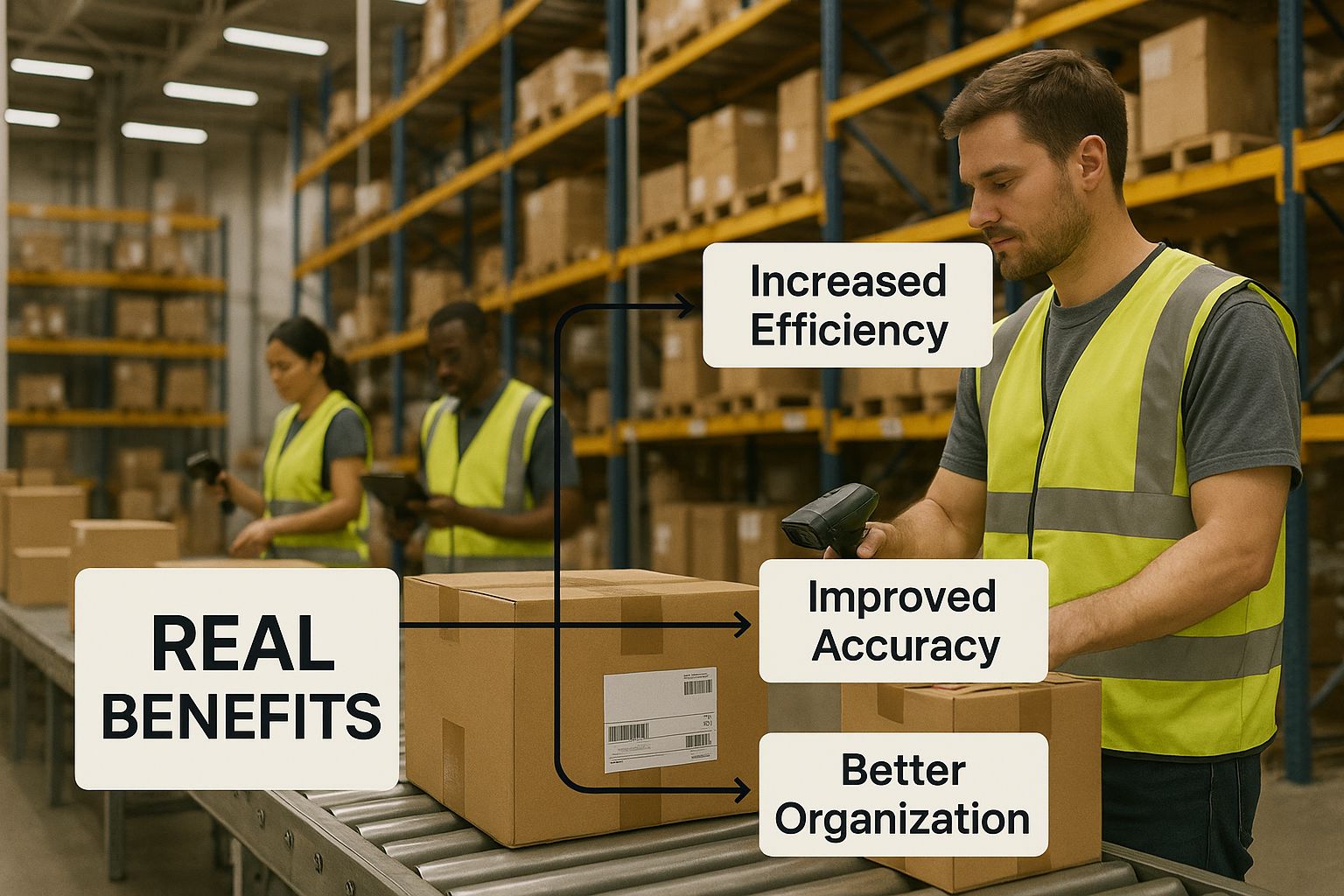
As you can see, a well-integrated cloud ERP sits right at the heart of a modern eCommerce warehouse, connecting people and processes so everything just works.
Achieve True Scalability on Demand
One of the most powerful features of a cloud ERP is the ability to scale your resources up or down almost instantly. With old-school on-premise systems, you had to guess your peak demand and buy expensive hardware to match. That meant paying for a ton of capacity you weren’t even using most of the year. Cloud ERP flips that entire model on its head.
Practical Case: Think about a growing eCommerce business with a Shopify implementation. During the Black Friday rush, order volume might jump by 1000% in a single day. An on-premise server would likely buckle under that pressure, leading to a crashed site, lost sales, and very unhappy customers. An ERP on cloud, on the other hand, just automatically allocates more power to handle the spike. When the sale is over, it scales back down. You only ever pay for what you actually use.
Slash Upfront Costs and Predict Your Spend
Moving to the cloud completely changes the financial game. Instead of a massive, upfront Capital Expenditure (CapEx) for hardware and licences, you shift to a predictable, manageable Operational Expenditure (OpEx). It’s a game-changer.
You pay a simple monthly or annual subscription fee, eliminating the huge financial barrier that once kept powerful enterprise-level software out of reach for smaller businesses. This financial predictability is a huge reason behind the rapid cloud ERP adoption we’re seeing in Australia. In fact, projections show the Australian ERP market could rocket from AUD 2.52 billion to AUD 10.37 billion in the next decade, with a compound annual growth rate of 15.2%. A lot of that growth is down to this flexible cost model. You can discover more insights about Australia’s ERP market growth.
Empower Your Teams with Anytime Access
Work doesn’t just happen at a desk anymore. A cloud ERP system frees your team from the office, giving them secure access to vital business data from any device, anywhere they have an internet connection.
This anytime, anywhere access is essential for Australian businesses with geographically dispersed teams. A sales manager in Sydney can approve an order on their tablet while the warehouse team in Adelaide instantly receives the notification to begin fulfilment.
This level of connectivity sparks real-time collaboration, speeds up decision-making, and just makes everyone more productive because they’re all working from the same, up-to-the-minute information.
Eliminate the Burden of Maintenance
With a traditional ERP, your IT team is stuck doing all the grunt work: server maintenance, security patches, software updates, backups. It’s a constant drain on their time and energy—resources that could be spent on projects that actually move the business forward.
When you use an ERP on the cloud, the provider handles all of that for you. Updates and new features are rolled out automatically in the background. Your system is always secure and running the latest version, without your team lifting a finger or experiencing any downtime. This frees up your people to focus on what they do best: growing the business.
Ensure Business Continuity and Recovery
What would happen if your office had a fire, a flood, or even just a major power outage? If your server is on-site, that could mean catastrophic data loss and days—or even weeks—of downtime. It’s a terrifying thought.
Cloud ERP providers have robust, built-in disaster recovery and business continuity plans. Your data is automatically backed up and copied across multiple secure data centres. If one location ever goes down, the system instantly fails over to another, meaning your business can keep running with little to no interruption. It’s a level of security and resilience that very few companies could afford to build for themselves.
Ready to unlock these benefits for your business? Our team provides expert Odoo implementation Sydney and Adelaide businesses trust. Get in touch with us today for a no-obligation chat about your needs.
Choosing the Right Cloud Deployment Model

So, you’ve decided to move your ERP on cloud. That’s a fantastic first step. The next, and arguably more critical, question is how. The world of cloud computing isn’t a one-size-fits-all solution; it offers different deployment models, each with its own level of control, flexibility, and responsibility.
Getting this choice right is crucial. It’s about aligning your technology with your actual business goals, your budget, and where you see your company heading in the long run.
To make sense of these technical options, let’s talk about something we all understand: pizza. This simple analogy cuts through the jargon and makes it crystal clear what you’ll be managing versus what your cloud provider handles for you.
SaaS (Software-as-a-Service): The Delivered Pizza
SaaS is hands-down the most popular model for an ERP on cloud, and for good reason. Think of it as ordering a pizza delivered straight to your door. The pizza parlour (your provider) does everything—they source the ingredients, fire up the oven, bake it to perfection, and bring it to you. You just open the box and enjoy.
In the ERP world, this means the vendor manages the entire stack: the servers, the software, all the updates, and the security. You simply access a powerful, ready-to-go application through your web browser on a subscription basis. It’s the fastest, most straightforward way to get up and running, making it perfect for businesses that want to focus on what they do best, not on becoming IT experts.
Practical Case: Imagine a growing online retailer using a Shopify implementation. They’re struggling to connect their sales, inventory, and finance data. A SaaS-based Odoo implementation in Sydney is a perfect fit. They can subscribe, plug in their store, and have a fully functional ERP running in weeks—without ever having to buy a single server.
PaaS (Platform-as-a-Service): The Take-and-Bake Kit
Next up is PaaS. This is like grabbing a take-and-bake pizza kit from the supermarket. The provider gives you the foundation—the dough, sauce, and cheese (which in tech terms is the platform, operating system, and development tools). It’s up to you to add your favourite toppings and bake it in your own oven.
This model gives you a lot more control without the headache of managing the underlying hardware. You can build, test, and run your own custom applications on the provider’s platform. PaaS is a fantastic middle-ground for businesses with in-house software development Sydney teams who need to create unique applications that integrate with their ERP.
IaaS (Infrastructure-as-a-Service): The Raw Ingredients
At the most fundamental level, we have IaaS. This is like going to the store and buying all the raw ingredients—flour, yeast, tomatoes, and cheese—to make a pizza from scratch. You have complete creative control over the final product, but you’re also responsible for every single step of the process.
With IaaS, you’re essentially renting the basic building blocks of computing: servers, storage, and networking. From there, you install the operating system, manage all the software, and handle every configuration. It offers maximum control and flexibility, but it demands serious technical expertise. This is typically the domain of large enterprises with complex needs and dedicated IT departments.
The Hybrid Cloud: The Best of Both Worlds
For many Australian businesses, the best solution isn’t just one or the other. A hybrid cloud approach lets you mix and match, combining your own private cloud or on-premise servers with public cloud services. This way, you can keep highly sensitive data or legacy systems securely on-site while using a flexible public cloud for scalable applications like your ERP on cloud.
This balanced strategy is particularly useful for organisations in Adelaide and across Australia that need to comply with specific data sovereignty laws or integrate with specialised on-premise machinery. It truly gives you the security and control of a private setup alongside the cost-efficiency and agility of the public cloud.
Choosing the right deployment model is a foundational decision in your cloud journey. By understanding these options, you can confidently select the path that not only supports your business today but also sets you up for future growth.
Unsure which model is right for you? Our experts can help you navigate these choices. We specialise in Odoo implementation, custom software development in Adelaide, and integrating platforms like WooCommerce. Contact us for a personalised consultation to build the perfect technology foundation for your business.
How Australian Companies are Winning with Cloud ERP
Theory and tech specs are one thing, but nothing tells the real story like seeing a cloud ERP in action. The true measure of any business system is the impact it has on the ground—solving those persistent problems, finding new efficiencies, and fuelling real growth. These stories are playing out right now in warehouses, factories, and offices all across Australia.
From manufacturers in Adelaide to retailers in Sydney, businesses are using cloud ERP to completely redefine what’s possible. They aren’t just updating a piece of software; they are fundamentally rewiring how they operate to be faster, more accurate, and far more agile. These anonymised practical cases show you exactly what that looks like.
Practical Case: Unifying a Disconnected Supply Chain in Adelaide
A mid-sized manufacturing firm in Adelaide was struggling with a crisis of visibility. Their operations were a patchwork of disconnected systems—one for inventory, another for production schedules, and a maze of spreadsheets for financial tracking. This setup was a recipe for constant data entry errors and made getting a clear, real-time picture of their supply chain almost impossible.
Their biggest headache was forecasting. Without a unified view, they were constantly over-ordering raw materials while simultaneously running out of critical components. This led to costly production delays and, even worse, frustrated clients.
The Solution: The company brought in a comprehensive Odoo implementation in Adelaide. This cloud-based ERP pulled every part of their operation—from procurement and inventory to manufacturing and accounting—onto a single, unified platform.
The results were immediate and profound. With real-time inventory tracking, they cut their carrying costs by 18% in the first year alone. More importantly, their production planners could finally see the entire supply chain from one dashboard. This meant they could make proactive decisions that boosted their on-time delivery rates by over 25%. The cloud ERP became the backbone of their business.
Practical Case: Real-Time Inventory Control for a Multi-State Retailer
Picture a popular retail chain with major stores in Sydney and Melbourne, plus a booming online shop. Their biggest problem? Inventory management. Stock levels were managed locally at each store, and the online inventory was in its own separate silo. A customer might see an item online that was supposedly out of stock, while that very same product was sitting on a shelf in the Sydney store.
This disconnect was costing them. It led directly to missed sales and a clunky, frustrating experience for customers. To compete, they knew they needed a single source of truth for their entire inventory, accessible everywhere, all the time.
They went with a cloud ERP system integrated directly with their point-of-sale (POS) and WooCommerce platforms. This gave them a live, unified view of every single item, whether it was in the warehouse, on a store shelf, or in a customer’s online cart. The change was remarkable. “Click and collect” suddenly became reliable, and staff could instantly check stock in other stores to save a sale on the spot.
Practical Case: Automating the Backend for a Scaling Shopify Store
A Sydney-based eCommerce brand, built on a Shopify implementation, was growing like wildfire. While fantastic for the bottom line, their backend processes were starting to crack under the pressure. Every single online order required manual work: an employee had to key the sale into their accounting software, manually update an inventory spreadsheet, and then generate a shipping label.
This wasn’t just inefficient; it was becoming a serious bottleneck holding them back. The team was so bogged down in admin they had no time left to focus on marketing or developing new products.
By connecting their Shopify store to a cloud ERP, they automated the entire order-to-fulfilment process.
- When a customer places an order, the sale is automatically logged in the ERP’s financial module.
- Inventory levels are instantly updated across all systems.
- A picklist is automatically sent to the warehouse team’s mobile devices.
- Shipping labels are generated with a single click.
This automation clawed back an estimated 20 hours of manual work every week. It allowed the team to stop doing tedious data entry and start focusing on strategic initiatives to grow the business. It’s a perfect example of how expert software development in Sydney can build seamless, automated workflows that make a real difference.
These Australian success stories all point to the same conclusion: a cloud ERP is so much more than just software. It’s a powerful engine for operational excellence.
Ready to write your own success story? Our team specialises in creating customised solutions, from the Odoo implementation Sydney and Adelaide-based businesses rely on to complex Shopify and WooCommerce integrations. Contact us today for a personalised consultation and let’s explore how we can transform your operations.
Overcoming Common ERP Concerns: Security and Cost
Right, let’s talk about the two biggest hurdles that come up whenever a business thinks about moving its ERP to the cloud: Is our data really safe? And what’s this actually going to cost us when all is said and done?
These aren’t just minor questions; they’re deal-breakers. You’re talking about your company’s most sensitive information and completely rethinking how you budget for technology. It’s only natural to need some solid, reassuring answers.
Is the Cloud Secure Enough for My Business?
Let’s get straight to the security question. The idea of your data living on some server you can’t see or touch can feel a bit unnerving at first. But here’s the thing: that perception often doesn’t line up with reality.
Top-tier cloud providers have invested fortunes in security—we’re talking teams of world-class cybersecurity experts and layers upon layers of protection. Think advanced encryption, constant 24/7 threat monitoring, and regular audits by independent third parties. It’s a level of security that, frankly, most individual businesses could never afford to build themselves.
And Australian businesses are voting with their feet. National stats show that over 90% of organisations here already use the cloud in some way. What’s more, about 54% are planning to move their core systems, like ERPs, into public cloud environments. That’s a huge vote of confidence, especially given Australia’s tough data privacy laws. You can dig into these cloud adoption statistics to see the trend for yourself.
It’s a Partnership: The Shared Responsibility Model
A key idea to grasp here is the shared responsibility model. The best way to think about it is like renting a space in a high-security vault. The company that owns the vault is responsible for the building itself—the thick walls, the complex locks, the cameras, and the guards. But you, and only you, are responsible for who has the key to your personal safe deposit box inside.
It works the same way with cloud ERP. The provider secures the global infrastructure (the “vault”), while your team manages who gets in the door—things like access controls, user permissions, and your own data policies (the “keys”). It’s a partnership that creates an incredibly robust defence for your system.
Unpacking the True Cost: Total Cost of Ownership
Now, for the money question. A cloud ERP gets rid of that giant, upfront bill for servers and hardware, which is a huge plus. But to really compare apples with apples, you need to look at the Total Cost of Ownership (TCO). This gives you the full, long-term picture of every single cost involved.
With an on-premise system, the initial purchase is just the beginning. It’s often followed by a long trail of hidden and ongoing expenses. A cloud ERP, on the other hand, flips the script. It shifts your spending from a lumpy, unpredictable capital expense (CapEx) to a smooth, predictable operational expense (OpEx). That makes budgeting a whole lot easier.
To show you exactly what I mean, let’s break down the TCO for both models.
Total Cost of Ownership Breakdown On-Premise vs Cloud ERP
The table below really highlights the financial differences, showing where the true value of a cloud model lies by comparing all the cost components side-by-side.
| Cost Component | On-Premise ERP (Primarily Capital Expenditure) | ERP on Cloud (Primarily Operational Expenditure) |
|---|---|---|
| Initial Setup | High costs for servers, hardware, and software licences. | Minimal setup fees, primarily for configuration. |
| IT Staffing | Requires a dedicated, in-house IT team for management. | Drastically reduced need for internal IT maintenance staff. |
| Maintenance | Ongoing costs for hardware repairs, replacements, and facility needs. | All infrastructure maintenance is included in the subscription fee. |
| Upgrades | Significant expenses for new software versions and hardware. | Automatic updates and new features are included at no extra cost. |
| Security | You bear the full cost of firewalls, monitoring, and compliance. | Enterprise-grade security is built-in and managed by the provider. |
When you lay it all out like that, the financial argument becomes crystal clear. A cloud ERP delivers far better value over time by wiping a whole lot of hidden and unpredictable expenses off the books.
Feeling more confident about the security and cost side of things? Our team is here to help you get the clarity you need. We offer expert guidance and services, including Odoo implementation in Sydney and Adelaide, custom software development, and seamless integrations with platforms like Shopify and WooCommerce. Get in touch today for a personalised consultation and let’s build a secure, cost-effective technology foundation for your business.
Ready to Start Your Cloud ERP Journey? Here’s How.
So, you’ve seen what a cloud ERP can do, you understand the models, and you’ve heard the success stories. It’s tempting to jump straight in, but a successful launch is all about laying the right groundwork. This isn’t just a tech upgrade; it’s a fundamental shift in how your business operates, setting you up for future growth.
Think of it less like flipping a switch and more like building a foundation. Get the first few steps right, and you’ll avoid the common headaches and start seeing a real return on your investment from day one.
Step 1: Pinpoint Your “Why”
Before you even think about software vendors, you need to look inward. What are the specific, nagging problems you’re trying to solve? Simply aiming for a “new system” is too vague. You need clear, measurable goals that will act as your north star throughout the entire project.
Practical Case: Imagine an eCommerce business struggling to keep up with orders from their Shopify store. A powerful goal wouldn’t be “get a better system.” It would be “cut our order processing time by 30% and completely eliminate stockouts.” A target that specific gives the project a clear purpose and makes it easy to measure success down the track.
A rock-solid set of goals is your project’s compass. It ensures every decision, from feature selection to process changes, is directly linked to a real business outcome. This keeps your team focused and stops the project from spiralling out of control.
Step 2: Find the Right Partner, Not Just a Vendor
This might be the most important decision you make. The right implementation partner does so much more than just install software; they’re your strategic guide. They should bring years of industry-specific experience to the table, helping you navigate the tricky parts and mould the system to fit your business like a glove.
Look for a team that has a proven track record and understands your local market. For instance, a firm that specialises in Odoo implementation in Sydney and Adelaide will get the unique challenges and opportunities Australian businesses face. Their expertise in software development across Sydney and Adelaide is also crucial, especially when you need to connect your ERP to other essential tools, like a WooCommerce website or custom-built applications.
Your Next Step Towards a Smarter Business
Starting your cloud ERP journey is a massive leap forward in building a more connected, efficient, and scalable company. When you match the right system with the right team, you don’t just improve operations – you unlock entirely new ways to grow.
Ready to see how a powerful cloud ERP could transform your business? Our experts are here to help guide you through every stage. We specialise in Odoo implementation, custom software development, and creating seamless integrations that just work.
Contact us today for a personalised consultation and let’s start building your roadmap to success.
Got Questions About Cloud ERP? We’ve Got Answers.
Thinking about moving your business operations to a cloud ERP is a big step, and it’s natural to have a few questions. Let’s break down some of the most common queries we hear from business owners just like you, so you can make your next move with confidence.
How Long Does a Cloud ERP Implementation Take?
This is the million-dollar question, and the honest answer is: it depends. For a small or medium-sized business getting a straightforward Odoo implementation in Sydney, you’re likely looking at a timeframe of 3 to 6 months.
But if you’re a larger organisation in Adelaide with a lot of custom features to build or years of complex data to move across, the project could easily stretch to 9 or even 12+ months. A good partner won’t just give you a timeline; they’ll build a realistic roadmap and actively manage the project to keep everything on track for a smooth changeover.
Is My Business Data Truly Secure in the Cloud?
Absolutely, and in many cases, it’s even more secure than keeping it on your own server. Top-tier cloud ERP providers invest heavily in multi-layered security. We’re talking about advanced encryption, round-the-clock monitoring, and regular security audits from independent experts. Frankly, it’s a level of protection most individual businesses can’t afford to build themselves.
In Australia, providers also have to comply with our strict data sovereignty and privacy laws. Think of it as a partnership: the ERP provider secures the core infrastructure, and you manage who on your team gets access. Together, you create an incredibly secure home for your business data.
Can a Cloud ERP Connect to Our Other Software?
Yes, and this is where a cloud ERP really shines. Modern systems are built from the ground up to talk to other software through APIs (Application Programming Interfaces). This allows your ERP to become the central nervous system of your entire operation.
A skilled software development Sydney team can connect all the crucial tools you rely on. Here are a few practical cases of how this works:
- eCommerce Integration: Imagine your inventory, customer details, and sales orders syncing automatically between your ERP and your Shopify implementation or WooCommerce site. No more manual updates.
- CRM Connection: Your sales team and your operations team finally work from the same playbook because customer information flows seamlessly from your CRM into the ERP.
- Financial Software Links: Stop wasting time with manual data entry. You can automate the flow of financial information straight into your accounting software, which cuts down on human error.
By connecting everything, you create one source of truth that helps you run a much smarter, more efficient business.
Ready to get clear, personalised answers for your business? The team at Wistec specialises in creating practical technology solutions that drive real results. Whether you need an affordable Odoo implementation, a high-converting website, or custom software development, we are your trusted Australian-based partner.
Start your journey with a personalised consultation from Wistec today.