

So, you’ve heard the term ERP, but what does it actually stand for? The textbook definition is Enterprise Resource Planning. But that doesn’t really tell you much, does it?
Let’s put it in simpler terms.
What Does ERP Actually Mean for Your Business?
Forget the acronym for a moment. Think of an ERP system as the central nervous system for your entire company. It’s the digital backbone that connects every single department—from finance and sales to the warehouse floor—into one intelligent, cohesive unit.
The days of wrestling with mismatched spreadsheets and chasing information across different departments are over. An ERP gets everyone on the same page.
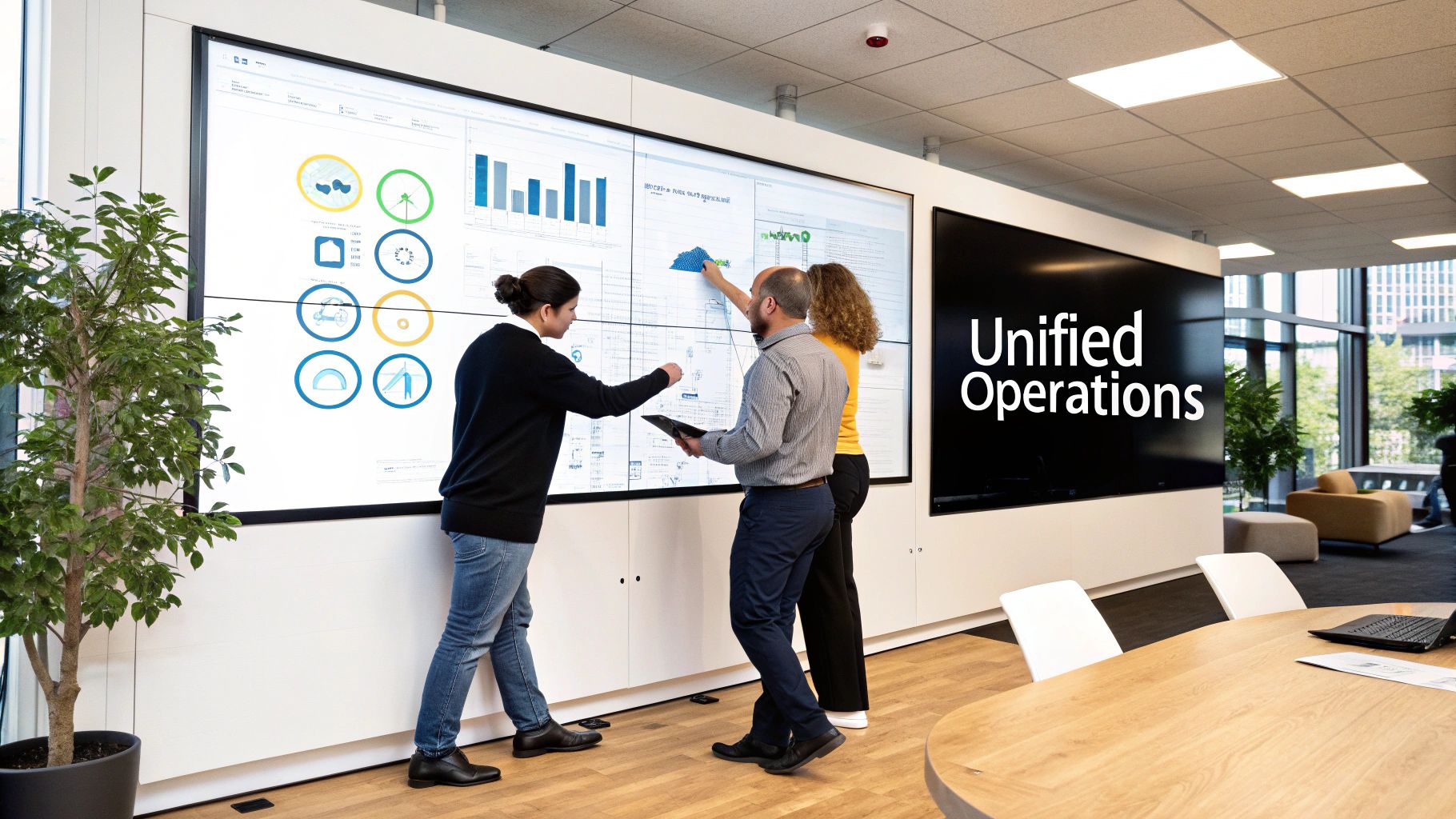
The real goal here is to create a single source of truth. When your finance team, your sales reps, and your inventory managers are all looking at the same real-time data, you can finally make smart, confident decisions based on what’s happening right now.
Unifying Disconnected Operations
One of the biggest headaches for growing businesses is the “silo effect.” This is where each department operates in its own little world. The warehouse has no idea what sales are coming in, and the sales team promises a product that is just out of stock. Sound familiar?
An ERP system smashes down those walls.
For example, if you run a retail business with a Shopify implementation or a WooCommerce store, an ERP can connect everything. An online sale automatically updates your inventory levels, triggers a notification to the warehouse, and logs the transaction in your accounting books—all without anyone lifting a finger.
This isn’t just a hypothetical benefit; businesses across Australia are proving its worth. It’s predicted that by 2025, ERP adoption among Australian businesses will hit 70%. They’re seeing real results, like 20-30% reductions in administrative time and 10-20% savings on inventory costs. You can explore more about how local businesses are leveraging ERP for significant ROI.
Practical Cases and Customisation
Ultimately, the real meaning of an ERP is found in how it solves your specific problems. For a manufacturer, it’s all about fine-tuning production schedules. For a professional services firm, it’s about nailing project billing and managing consultant time effectively.
An effective ERP implementation isn’t just about software; it’s about re-engineering your processes for maximum efficiency. It turns data into actionable intelligence, giving you a powerful competitive edge.
This is why a one-size-fits-all approach rarely works. Platforms like Odoo are brilliant because they can be moulded to fit your exact needs. A specialised Odoo partner in Sydney or Adelaide can build a solution that plugs directly into your unique workflow, integrating with tools you already use or creating new functions from scratch.
The right software development in Sydney or Adelaide ensures the system works for you—not the other way around.
Ready to see what a unified system could mean for your business? Contact us today for a consultation on a custom Odoo implementation and transform your operations.
The Core Components of a Modern ERP System
Thinking of an ERP as one giant piece of software misses the point. The real magic is in its individual parts, or what we call modules. A modern ERP is more like a set of specialised, high-performance tools that all talk to each other perfectly. Each module tackles a specific part of your business, and when they work together, they create one seriously powerful, unified system.
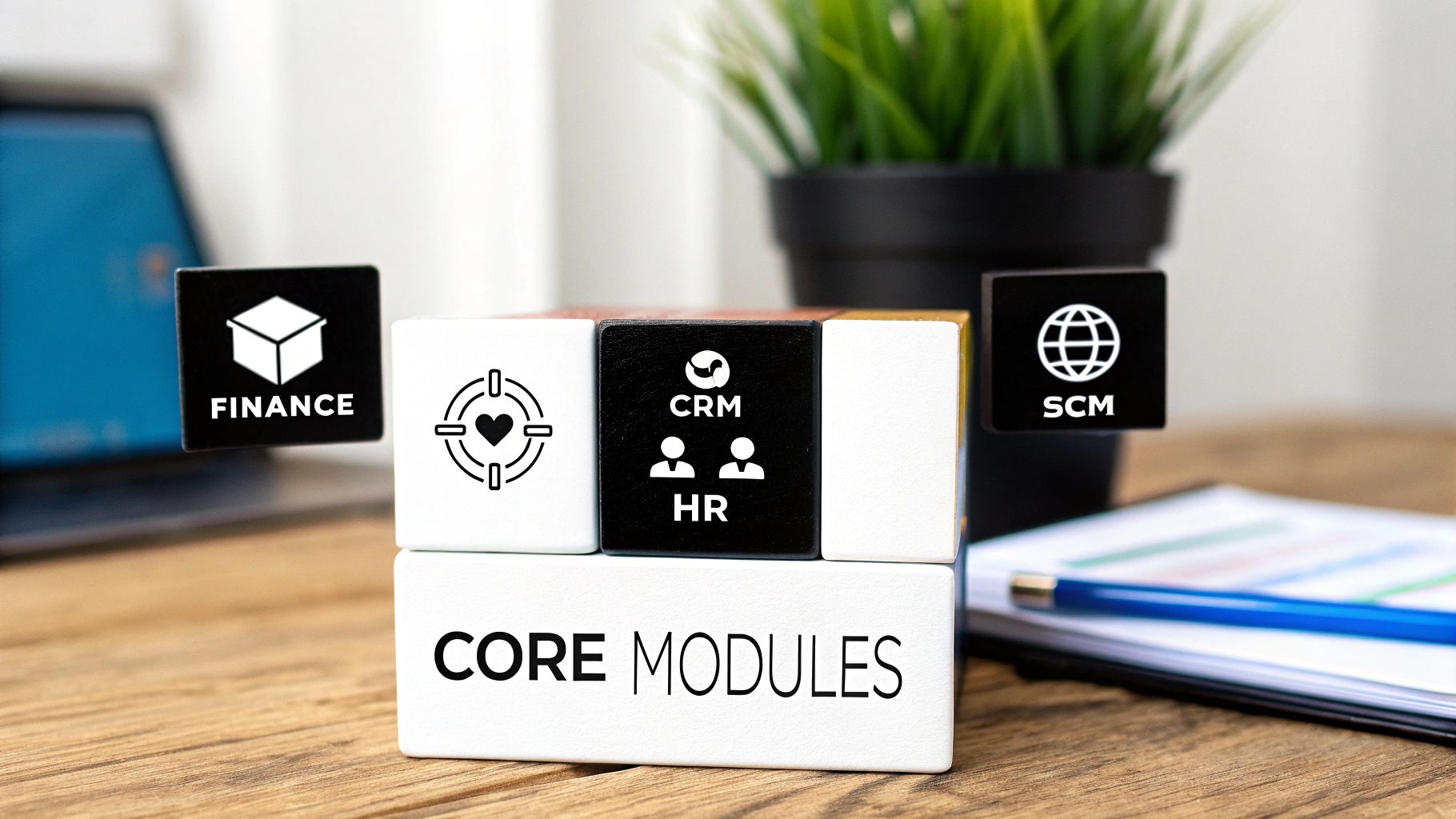
This modular design, which is central to systems like Odoo, is fantastic because it lets you start with just the tools you need right now and add more as your business grows. It’s a flexible approach that’s clearly catching on. Just look at the numbers: the Australian ERP software market hit a $930 million valuation in 2024 and is expected to climb to $1.17 billion by 2030. That kind of growth tells you that businesses are really starting to value integrated technology.
Now, let’s break down what these modules actually do.
The Essential Building Blocks
While every business has its quirks, most modern ERPs are built around a few non-negotiable core modules. Think of these as the foundation for your entire operation, making sure every crucial process is connected, and you can see what’s happening everywhere, all at once.
To give you a clearer picture, here’s a quick breakdown of the most common modules and what they bring to the table.
Core ERP Modules and Their Business Functions
| ERP Module | Primary Function | Ideal For (Business Type) |
|---|---|---|
| Finance & Accounting | Manages all money-related activities—general ledger, accounts payable/receivable, financial reporting, and budgeting. It’s the system’s financial backbone. | Essentially, every business, from startups to large enterprises. |
| Customer Relationship Management (CRM) | Tracks and manages every customer interaction, from initial contact and sales pipelines to ongoing support and marketing campaigns. | Sales-driven organisations, service providers, and any business with a customer-facing role (e.g., eCommerce, retail). |
| Supply Chain Management (SCM) | Oversees the entire product journey: procurement of raw materials, inventory management, warehousing, and logistics, right through to final delivery. | Manufacturers, distributors, wholesalers, and retailers—anyone who moves physical products. |
| Human Resources (HR) | Handles all employee-related data and processes, including payroll, recruitment, onboarding, performance management, and time tracking. | Any company with employees, particularly those looking to scale their team and standardise HR processes. |
| Manufacturing/Production | Manages the end-to-end production process, from bills of materials (BOM) and work orders to quality control and shop floor scheduling. | Businesses that produce their own goods, from small workshops to large-scale industrial plants. |
These modules aren’t just standalone tools; their power comes from how they interact with one another to automate workflows and provide a single source of truth across your entire business.
The real “aha!” moment with an ERP is when you see the modules communicating. A sale logged in the CRM can instantly trigger an inventory update in the SCM and generate an invoice in the Finance module—all without a single person lifting a finger.
Connecting People and Processes
A great ERP doesn’t just connect data; it connects your people and processes too. Beyond the operational heavy-lifters, functions like Human Resources (HR) are brought into the same system, making sure your team is just as integrated as your financials.
This is especially critical for managing a complex supply chain. For a deeper dive into this, it’s worth reading up on unlocking supply chain automation to see how an ERP makes it possible.
When you bring it all together, this level of integration is make-or-break for platforms like WooCommerce or a custom Shopify implementation, where seamless coordination is everything. Getting the right mix of modules, put in place by an expert Odoo partner in Sydney or Adelaide, makes sure your technology is actually helping you grow, not holding you back.
Wondering which modules would be the best fit for your business? Our team specialises in software development in Sydney and Adelaide, and we help businesses like yours build the perfect system. Let’s have a chat about how a custom Odoo implementation can connect the dots in your operations.
How an ERP’s Meaning Changes from One Industry to the Next
An ERP system isn’t some off-the-shelf product you just plug in and run. Its real value, its true meaning, is shaped entirely by the problems it solves for a specific business. While the big idea of a single, unified system is always there, what an ERP actually does day-to-day can look completely different from one company to the next.
Think of it this way: the software itself isn’t where the magic happens. The magic is in how it’s moulded to fit the unique rhythm and demands of your operations. This is why we talk about different “ERP meanings”—it’s all about translating the broad concept of Enterprise Resource Planning into real, tangible results for your industry. A great ERP is like a chameleon, adapting its colours and functions to tackle the most urgent challenges a business is up against.
A Tale of Two Businesses
To really see this in action, let’s look at a couple of practical cases from different Australian businesses and what an ERP truly means to each of them.
Practical Case 1: The Manufacturing Firm
Picture a bustling manufacturing business in Adelaide. For them, an ERP is the very heartbeat of the factory floor. Its meaning is all about precision, efficiency, and squeezing every drop of value out of their resources.
- Production Planning: The ERP’s main job is to look at incoming sales orders, predict future demand, and build a rock-solid production schedule that keeps expensive machinery running and minimizes downtime.
- Inventory Control: It means knowing, down to the last bolt, exactly what raw materials are sitting on the shelves. More importantly, it automatically reorders supplies before a shortage can grind the entire production line to a halt.
- Quality Assurance: From the moment a component arrives to the final assembled product, the system is tracking everything, making sure quality checks are performed and logged at every single stage.
For this manufacturer, the ERP is the master coordinator, taking the potential chaos of the shop floor and turning it into a smooth, predictable, and profitable operation. A tailored Odoo implementation can handle everything from complex bill of materials (BOMs) to preventative maintenance schedules for their equipment.
Practical Case 2: The eCommerce Retailer
Now, let’s shift gears to a trendy online fashion brand in Sydney, powered by Shopify. For them, the meaning of an ERP revolves around one thing: the customer experience. It’s all about creating seamless, multi-channel sales.
An ERP for a retailer isn’t just a backend tool for managing stock; it’s the engine that delivers on the promises you make to every single customer, every single time.
Their day-to-day focus is completely different:
- Stock Synchronisation: The second a customer clicks “buy”, the ERP has to instantly update stock levels across their Shopify implementation, their pop-up store in the city, and any other marketplace they sell on, like WooCommerce. This is what prevents the nightmare of overselling a popular item.
- Order Fulfillment: It puts the entire pick, pack, and ship process on autopilot. The system sends order details straight to the right warehouse and spits out shipping labels, all to ensure delivery is fast and spot-on.
- Customer Data Hub: By bringing all customer information into one place, the ERP gives the marketing team a goldmine of data. They can easily see purchase histories to build targeted campaigns that boost loyalty and bring customers back.
For this online retailer, the ERP is the glue that holds their entire sales strategy together, guaranteeing a flawless customer journey from the first click all the way to the unboxing.
Your Partner in Customisation
These two examples barely scratch the surface, but they make one thing crystal clear: the meaning of an ERP is fluid. For a law firm, it might be about managing project timelines. For a food producer, it’s about tracking ingredients and batch numbers. The key is to find a system flexible enough—and a team skilled enough—to shape it to your world.
This is precisely why working with an expert in software development in Sydney or Adelaide is so vital. A top-tier Odoo partner in Sydney or Adelaide won’t just install a piece of software. They dive deep into your unique workflow and build a system that speaks your industry’s language.
Ready to discover what an ERP could mean for your business? Contact our team today, and let’s talk about building a solution that solves your specific challenges.
The Real-World Payoff: What an ERP Actually Does for Your Business
Forget the technical jargon for a moment. The true value of an ERP system lies in the powerful, bottom-line results it unlocks. Investing in the right system isn’t just about new software; it’s one of the smartest strategic moves you can make to set your business up for long-term growth. The effects spread through every department, turning messy, disconnected workflows into a genuine competitive edge.
The first thing most businesses notice is a massive jump in productivity. An ERP takes over the repetitive, soul-crushing manual tasks that eat up your team’s day. Imagine invoices that generate themselves, inventory levels that update instantly after a sale, and financial reports that are ready at the click of a button. This automation frees your people to focus on what really matters: strategy, innovation, and looking after your customers.
From Guesswork to Smarter Decisions
When all your data lives in one place and updates in real-time, you can finally stop running your business from outdated spreadsheets and pure gut feel. An ERP gives you a live, honest picture of your entire operation—from cash flow and stock levels to your sales pipeline. This kind of clarity means you can spot trends early, get ahead of problems, and jump on opportunities with genuine confidence.
The real magic of an ERP is its ability to turn messy data into clear, actionable intelligence. When every decision is backed by live facts, you build a much stronger, more agile business.
This unified view has a direct impact on customer happiness, too. When your sales team can see a customer’s complete story—every purchase, every support ticket, every conversation—they can deliver a far more personal and efficient service. For businesses running a Shopify implementation or WooCommerce store, this creates that seamless experience customers now expect, from the moment they click “buy” to the moment the package arrives.
The Cloud ERP Wave in Australia
A huge part of this shift is the move to cloud-based ERPs. Here in Australia, adoption is booming, with growth clearing 20% each year as companies ditch clunky, expensive on-premise servers. A recent survey revealed that over 72% of businesses named agility and easy data access as their top reasons for moving to the cloud. You can find more insights into the future of ERP solutions in Australia.
The cloud model just makes sense. It offers incredible flexibility, slashes upfront costs, and lets your team access crucial information from anywhere. A key advantage of having everything integrated is how it smooths out core business cycles. To see this in action, it’s worth understanding the nuts and bolts of the Order-to-Cash process.
Ultimately, a well-planned Odoo implementation, handled by an expert in software development in Sydney or Adelaide, cuts down operational costs, makes compliance simpler, and builds a rock-solid foundation for whatever comes next.
Ready to see these benefits in your own business? As your trusted Odoo partner in Sydney and Adelaide, Wistec can build a solution that delivers real, measurable results. Contact us for a consultation today!
Your Path to a Successful ERP Implementation
Knowing what an ERP is and what it can do is one thing. Actually making it work for your business? That’s a completely different ball game. A successful ERP implementation isn’t just about installing some new software; it’s a major business project that needs a rock-solid plan, clear goals, and a bit of expertise to pull it off. Getting it right from the start is the difference between unlocking a powerful new asset and creating an expensive, frustrating headache.
The real work begins long before you even think about the technology. It starts with an honest, hard look at how you operate right now. Where are the biggest bottlenecks holding you back? How much time is being wasted on manual data entry? Pinpointing the exact problems you need to solve will shape every single decision that follows, from picking the right platform to deciding which modules to roll out first.
Think of it this way: a well-implemented ERP creates a positive feedback loop that strengthens your entire operation.
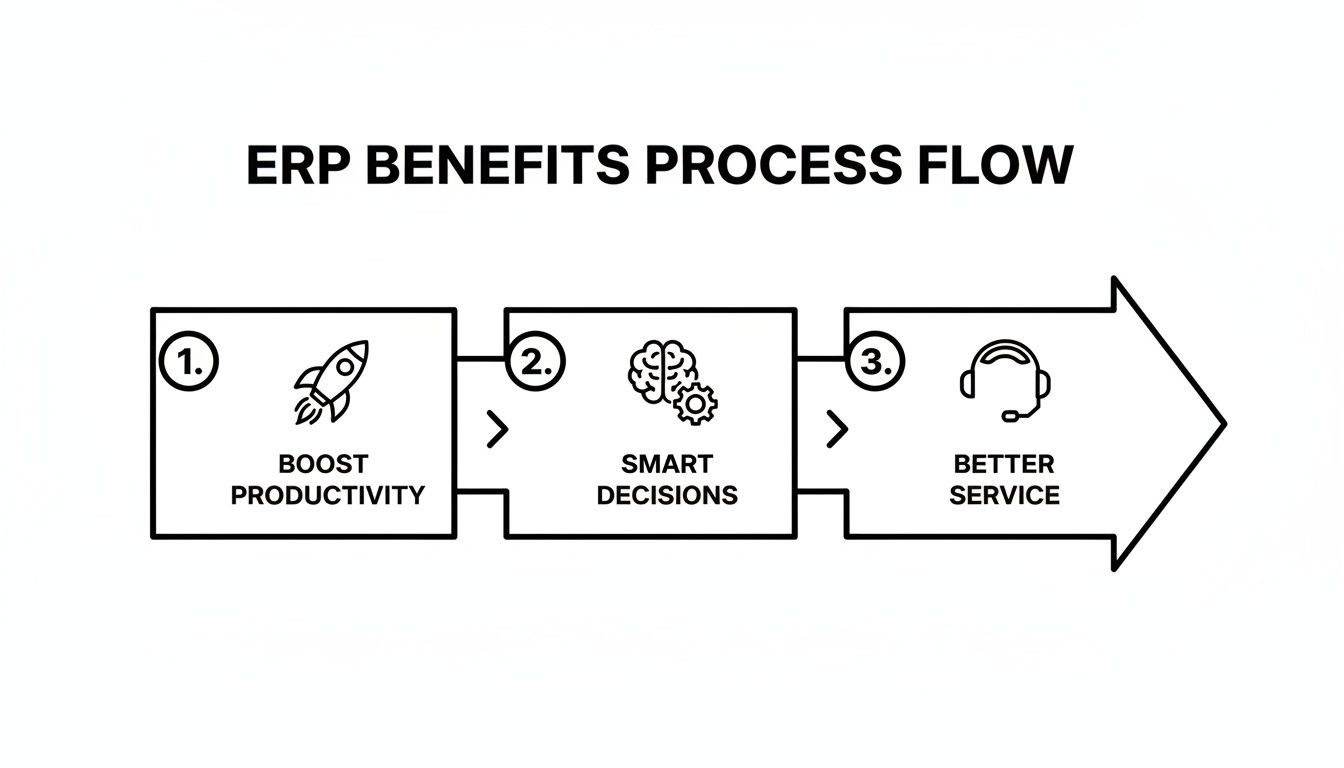
As this process shows, it all connects. The project boosts your team’s efficiency, which gives them the data they need to make smarter decisions, and that ultimately leads to a better experience for your customers.
Laying the Groundwork for Success
Before you jump into software demos, you need to map out your requirements and set a realistic budget. One of the most common traps is underestimating the total cost. It’s not just about the license fees; you have to account for implementation, customisation, training for your team, and ongoing support down the track.
Here are the critical first steps to get right:
- Define Your “Why”: Get specific. Document the pain points you expect the ERP to fix. Are you battling with inaccurate inventory levels for your WooCommerce store? Do you need a much better way to track projects and profitability for your service business?
- Assemble Your Team: You need a project champion. Designate a project lead and bring in key people from every department that will touch the new system. Their buy-in and feedback are essential if you want a solution that people will actually use.
- Prioritise Features: Make two lists: “must-haves” and “nice-to-haves.” This simple exercise is incredibly powerful for evaluating potential platforms like Odoo against your real-world needs, ensuring you don’t get sold on bells and whistles you’ll never use.
Choosing Your Platform and Partner
Once you have a crystal-clear picture of what you need, you can start looking at solutions. For many growing businesses, a flexible, modular platform like Odoo is a fantastic choice because it can be adapted to your unique workflow. But remember, the software is only half of the equation. Finding the right implementation partner is just as crucial.
A successful ERP project is a partnership. The right technology expert doesn’t just install software; they take the time to understand your business goals and configure the system to hit them, steering you clear of common pitfalls like messy data migration and poor user adoption.
This is precisely where an expert Odoo partner in Sydney or Adelaide proves their worth. A specialist in software development in Sydney or Adelaide won’t just handle the technical heavy lifting; they’ll manage the project, train your team, and make sure the transition is as smooth as possible. They’ve seen what works—and more importantly, what doesn’t—and can guide your project to a successful launch. Whether you have a complex manufacturing setup or need a streamlined Shopify implementation, their experience is the best insurance you can get for a positive ROI.
Don’t leave your success to chance. Contact Wistec today for a strategic consultation, and let’s build an ERP solution that genuinely drives your business forward.
Common ERP Questions, Answered
Thinking about an ERP system naturally brings up a lot of questions. We get it. To help clear things up, here are some straight answers to the queries we hear most often from businesses trying to figure out what ERP really means for them.
How Long Does an ERP Implementation Take?
There’s no single answer here, as the timeline really depends on your business’s complexity and how much tailoring you need. For a small or medium-sized business using a flexible system like Odoo, a standard setup can take anywhere from a few weeks to several months.
For bigger, more complicated projects, you might be looking at six months or longer. As your dedicated Odoo partner in Sydney and Adelaide, our strategy is to use a phased approach. We’ll get your most critical modules up and running first so you see value right away, then build out the rest over time. The key to staying on track is always a well-defined project scope.
Is ERP Software Only for Large Manufacturing Companies?
Not anymore. That’s a common myth leftover from the early days of ERP. While the technology did get its start in manufacturing, today’s platforms are built to support businesses of all shapes and sizes, across just about every industry you can think of.
We’ve built custom Odoo solutions for retailers needing a smooth Shopify implementation or WooCommerce connection, service firms that need to track project costs and profitability, and even hospitality businesses managing their bookings. The beauty of a modern, modular ERP is that you only pay for what you need, which makes it a smart investment for a growing business, not just a multinational giant.
“The idea that ERP is just for manufacturers is outdated. Today, a well-implemented ERP is the operational backbone for any business aiming to scale efficiently, from a local service provider to a global eCommerce brand.”
How Is an ERP Different from My Accounting Software?
Let’s use an analogy. Your accounting software is like a specialist—it’s brilliant at managing one critical part of your business: the money. An ERP system, on the other hand, is the general manager responsible for the entire operation.
It takes that same financial data and connects it directly to everything else—your inventory, sales pipeline (CRM), HR, and supply chain. This integration builds a single, real-time view of your whole business, which means no more double-handling data between separate programs.
That single source of truth is what lets you make smarter, more holistic decisions. If you feel like you’re constantly trying to piece together information from different systems to see the big picture, it’s probably time to talk to a software development Sydney and Adelaide expert about graduating from basic accounting software.
Ready to see what a modern ERP could truly mean for your business? At Wistec, we build practical technology solutions that deliver real-world results. As your expert Odoo partner, we can design and implement a system perfectly suited to your unique needs.