

That feeling of being swamped by spreadsheets and disconnected apps isn't just a growing pain—it's a clear signal that you've hit an operational ceiling. An Enterprise Resource Planning (ERP) system isn't just complex corporate jargon; think of it as a unified command centre, designed to bring order to the chaos and set your small business up for real, scalable growth.
What Is an ERP for a Small Business?
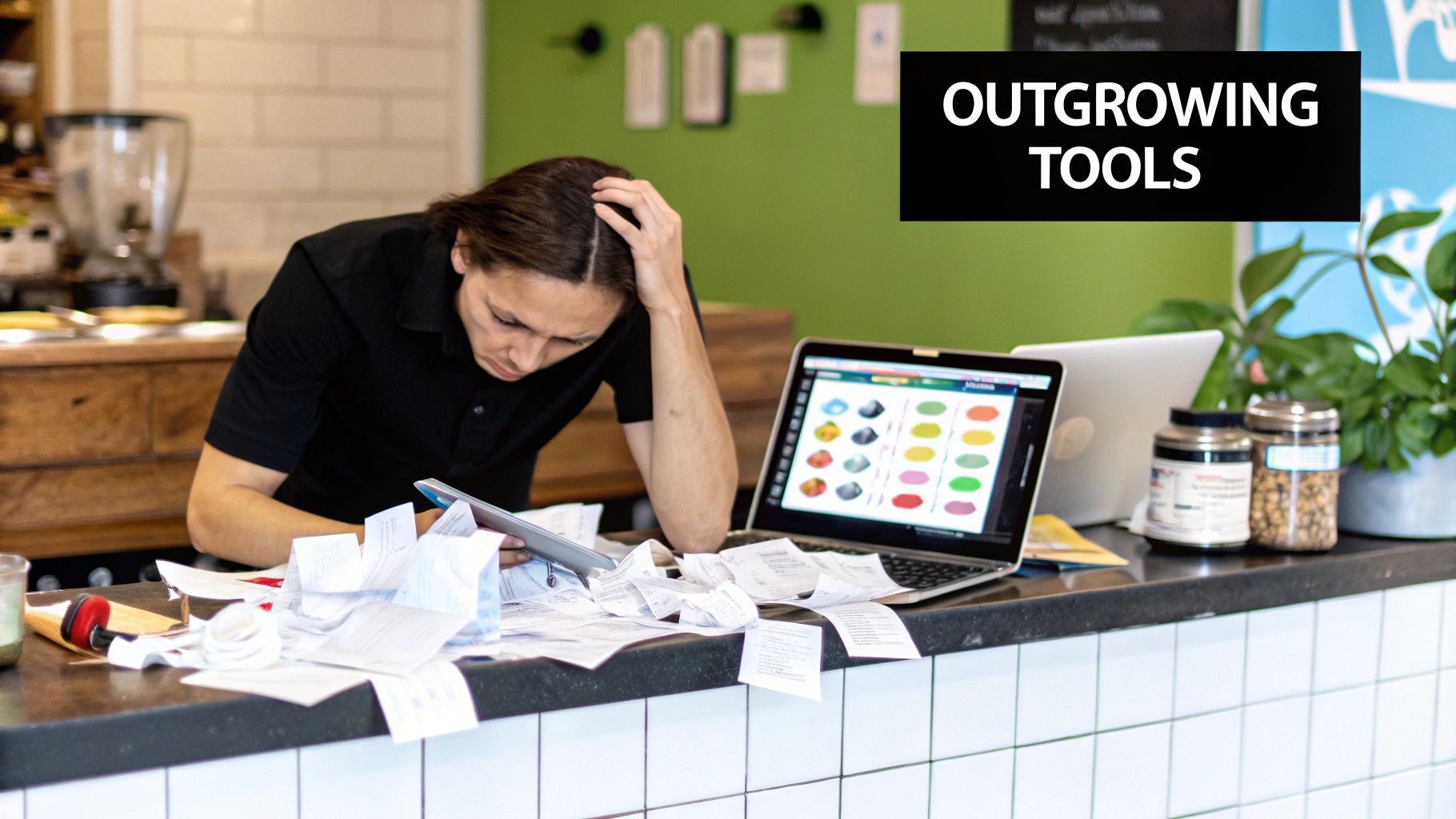
Imagine trying to run a bustling café. Your orders come through one app, your inventory is painstakingly tracked on a spreadsheet, and staff schedules are managed in a completely separate calendar. This kind of disjointed setup inevitably leads to confusion, frustrating delays, and costly mistakes.
An ERP system acts as that single screen that connects every moving part of your business. It gives you a clear, real-time view of your entire operation, from the front counter to the back office. For a small business, this means finally replacing all those fragmented tools with one cohesive platform where everything talks to each other.
An ERP brings all your critical business data into one place. This integration eliminates duplicate data entry, reduces human error, and gives you a reliable "single source of truth" for making smarter, faster decisions.
From Disconnected Apps to a Central Hub
So many small businesses get to a point where the simple software they started with begins working against them. You might be losing hours every week manually reconciling sales data from your WooCommerce store with your accounting software. Or maybe you're struggling to get an accurate stock count because your Shopify setup doesn't automatically update your warehouse records.
These aren't just minor annoyances; they're huge red flags telling you it’s time for a change.
If you're nodding along, you’re not alone. The shift towards integrated systems is gaining serious momentum among Australian SMEs. With the Australian ERP market projected to hit US$941.69 million in 2025 and around 40% of SMEs actively looking at new solutions, it’s obvious that getting operations right is a top priority. You can read more about the latest ERP adoption trends in Australia on wmsit.com.au.
A modern ERP is the next logical step in your business journey. It empowers you to manage everything—from accounting and inventory to customer relationships and sales—all from one place.
Signs Your Small Business Has Outgrown Spreadsheets
Wondering if you’ve hit that ceiling? This table breaks down common frustrations and shows exactly how an ERP provides the solution.
| Common Business Problem | How an ERP Solves It |
|---|---|
| Data is siloed in different apps and spreadsheets. | Creates a single, unified database for all information. |
| Inaccurate inventory counts lead to stockouts or overstocking. | Provides real-time, automated inventory tracking across all channels. |
| Manual data entry is time-consuming and prone to errors. | Automates workflows and eliminates the need for duplicate entries. |
| It's difficult to get a clear, big-picture view of business health. | Offers comprehensive dashboards and reporting for instant insights. |
| Customer information is scattered, leading to poor service. | Centralises customer data, history, and communications in one CRM module. |
| Financial reconciliation at the end of the month is a nightmare. | Integrates sales, purchasing, and expenses directly into your accounting. |
Seeing your own challenges in this list is a strong sign that the tools that got you here won't get you to the next level. An ERP is built to solve these problems from the ground up.
Ready to see how an ERP can unify your operations? Whether you need expert Odoo implementation in Sydney or custom software development in Adelaide, our team can design a solution that fits your unique business needs. Contact Wistec today for a free consultation and discover a smarter way to grow.
The Real-World Pay-Off of a Unified System
Let's move past the theory. The real magic of an ERP in a small business shows up in tangible, everyday results. The single biggest advantage? You finally get a 'single source of truth' for your entire operation. It's the end of confusion, where conflicting data lives in different spreadsheets, apps, and notebooks.
This unified view leads directly to better, faster decisions. No more gut-feel guesses or waiting days for someone to pull a report. With all your information in one place, you get instant clarity on what's working and what isn't, empowering you to act with confidence.
Unlock Powerful Efficiency Gains
Think of an ERP as your automation engine. It takes over the repetitive, soul-crushing tasks that eat up your time—generating invoices, processing sales orders, or updating inventory levels. By automating these workflows, you and your team are freed up to focus on growing the business, not getting bogged down in admin.
For Australian small businesses, a connected system delivers another crucial benefit: simplified compliance. Managing requirements for GST, Single Touch Payroll (STP), and Business Activity Statements (BAS) is so much easier when all your financial data is accurate and in one spot.
A well-implemented ERP doesn't just organise your data; it transforms your operational capacity, allowing you to handle more business without necessarily needing more staff.
The impact here is massive. For Australian SMEs, the top reported benefits are centralised data, better collaboration, and faster processing. It's no wonder the local ERP market is forecast to blow past US$1.1 billion within five years. This growth is being driven by a need for sharper compliance and real-time analytics. You can dig into more data with the Australian cloud ERP market forecast on kenresearch.com.
A Practical Case: Seamless Retail Management
Imagine a small retailer in Adelaide. They have a physical shopfront and a booming online store using both Shopify and WooCommerce. Before an ERP, managing stock was a constant headache. An item sold online wouldn't immediately register as "gone" in the store's system, leading to overselling, frustrated customers, and frantic phone calls to fix orders.
With an integrated ERP solution, that entire problem just vanishes.
- Real-Time Sync: When a product sells on their Shopify site, the ERP instantly updates the stock level everywhere—in the physical store's point-of-sale system and on their WooCommerce dashboard.
- Automated Reordering: The system can be set up to automatically trigger a purchase order when stock for a popular item dips below a certain level. No more manual stocktakes to figure this out.
- Unified Customer View: Every purchase a customer makes, whether in-store or online, is logged in one central profile. This is gold for providing better service and running targeted marketing campaigns.
This seamless integration doesn't just prevent costly mistakes; it massively improves the customer experience, turning one-time buyers into loyal fans. It’s a perfect illustration of how a unified system delivers tangible, real-world value.
Ready to gain this kind of control and efficiency? An expert Odoo implementation in Sydney or specialised software development in Adelaide can build the perfect unified system for your unique business needs. Get in touch with Wistec to book your discovery call.
Choosing Your ERP Solution and Partner
Picking the right ERP is easily one of the biggest technology decisions your small business will ever face. This isn't just about buying a piece of software; you're choosing the operational backbone for your company for years down the track. Getting it right starts with taking a good, hard look at how you actually work.
Before you even start looking at vendors, get a clear picture of your current workflows. Where are things really getting stuck? Are you constantly battling to reconcile inventory between your physical shop and your Shopify store? Is your team buried under a mountain of manual data entry just to get purchase orders out? Nailing down these specific pain points is the first step—it gives you a non-negotiable checklist of features you need.
Cloud vs On-Premise: The Clear Winner for SMEs
One of the first big decisions you'll come across is whether to go with an on-premise or a cloud-based system. An on-premise ERP means you buy the software licence outright and run it on your own servers. This route demands a hefty upfront investment in hardware, not to mention the IT staff needed to handle maintenance, security, and all the updates.
For almost every small and medium-sized business today, a cloud-based ERP is the smarter, more flexible option. These systems work on a subscription basis, which slashes your initial setup costs. Even better, they're designed to grow with you. You can start with just the essentials and easily add more users or features as your business expands, all without the headache of managing server space or IT infrastructure.
Finding the Right Fit and the Right Partner
Let's be clear: not all ERPs are the same. The best solution for your business will have features built specifically for your industry and will connect seamlessly with the tools you already use every day, like WooCommerce or other critical apps. But the software is only half the battle.
The success of an ERP implementation isn't just about the technology—it’s about the expertise and support of the partner you choose to guide you through the process. A great partner turns a complex project into a competitive advantage.
This is where having local expertise makes all the difference. When you choose a partner who really gets the Australian business environment, you’re signing up for proper hands-on support, training, and customisation. A team that specialises in Odoo implementation in Sydney, for instance, will know exactly how to configure the system to meet local compliance rules and common business practices.
Take a growing Adelaide-based retailer, for example. They needed an ERP to sync their warehouse operations with their e-commerce store. Instead of going with a generic overseas provider, they found a local firm with proven experience in software development in Adelaide. This partner didn't just set up the ERP; they built a custom integration to handle the retailer's specific shipping logic, guaranteeing a smooth and successful rollout.
The right partner doesn’t just sell you a licence and disappear. They get invested in your success. They’ll be there to help migrate your data, train your staff, and provide ongoing support to make sure you get a real return on your investment.
Ready to find the perfect ERP solution and an expert partner to bring it to life? Whether you need a sophisticated Shopify implementation or a full-scale ERP rollout, we have the expertise to help. Contact Wistec for a no-obligation consultation today.
Navigating Your ERP Implementation Journey
The thought of implementing a new ERP system can feel like you're about to climb a mountain. It’s a huge undertaking, but it’s not an uncontrollable avalanche. Think of it as a well-marked trail with distinct stages: planning, data migration, system setup, training your team, and finally, the go-live day.
Breaking it down this way turns a daunting project into a series of manageable steps.
While every business has its own unique way of doing things, a successful implementation always kicks off with a rock-solid plan. This is about more than just installing software. You're essentially transplanting your business's DNA—your data, your processes, and your people—into a new, more powerful home. To get that right, you need a clear roadmap, realistic timelines, and a committed team to see it through.
This visual flow really nails the essential early stages of choosing an ERP, from mapping your needs to finding the right partner.
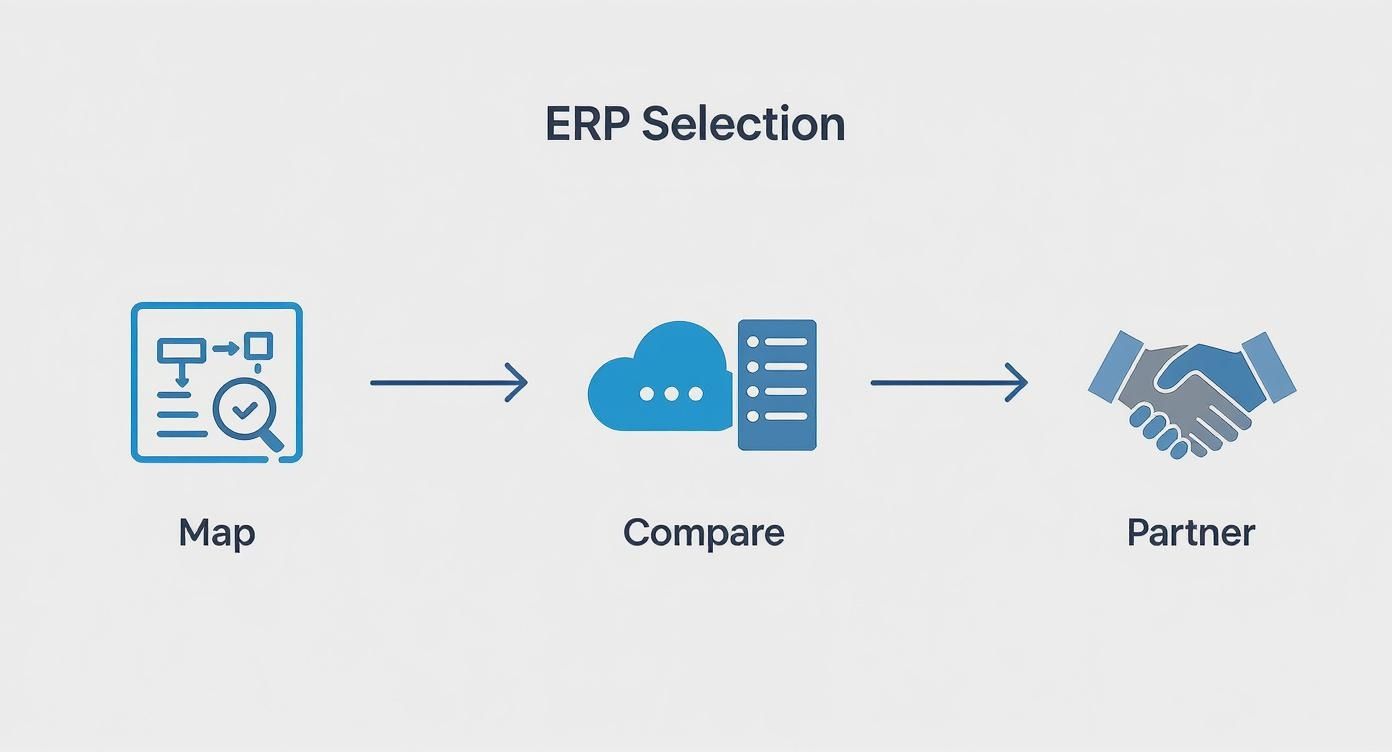
As you can see, a great outcome really depends on the thoughtful prep work you do before any of the technical stuff begins.
A Practical Case From Adelaide
Let's look at a real-world example. A small distributor in Adelaide was drowning in a sea of chaotic spreadsheets. Their inventory counts were always off, processing orders was painfully slow, and getting a clear financial picture felt like a guessing game. They decided to move to an Odoo ERP to bring everything together, but the journey wasn't without its bumps.
Their biggest hurdle? Cleaning up their data. Years of inconsistent entries meant their customer and product information was an absolute mess. Getting it ready to migrate was a painstaking process, but it was absolutely critical. Another challenge was getting the team on board. Some people were just comfortable with the old, clunky way of doing things and were nervous about the change.
"The turning point was when our implementation partner showed us exactly how the new system would make our daily tasks easier. Seeing the direct benefits—like automated invoicing—got everyone excited about the change."
Their local implementation partner was the hero of the story. They provided hands-on training and configured the Odoo system to fit their specific workflow, which even included a custom connection for their WooCommerce store. They helped navigate every obstacle, setting realistic timelines and making sure the project stayed on track.
This story shines a light on a crucial truth about bringing an erp in small business operations: the human element is just as important as the technology. Success truly hinges on clear communication, thorough training, and having great support.
To make sure you get a positive return on your investment, you need to partner with a team that has proven expertise. Whether you're after a specialist in Odoo implementation in Sydney or custom software development in Adelaide, the right guide makes all the difference.
Ready to start your implementation journey with an expert partner? Contact Wistec for a consultation and let's build your roadmap to success.
Common ERP Mistakes and How to Avoid Them
Getting into an ERP project is a massive step for any business. The payoff can be huge, but the path is often littered with predictable roadblocks. The funny thing is, most erp in small business projects don't fail because the software is bad. They stumble because of simple, avoidable mistakes in planning and people management. Knowing what these traps are ahead of time is your best defence.
The biggest mistake we see, time and time again, is a fuzzy project scope. Businesses get excited, jump into demos, and are wowed by flashy features without first sitting down and writing out exactly what they need the system to fix. You end up with software that does a million things you don't need, while completely missing a function that’s critical to your daily operations.
Another classic oversight is forgetting about the people. Your team has their own way of doing things. It might not be perfect, but it's what they know. If you try to force a new system on them without getting their input or giving them proper training, you’re basically asking for pushback and a tool that nobody uses.
Miscalculating the True Investment
It’s so easy to get fixated on the software subscription price and completely miss the bigger picture. The licence fee is just the ticket to the game. You've still got to account for implementation, moving all your old data across, training your staff, and any custom tweaks you'll need. For example, while you might see starting figures around $9,000 per user for a small business ERP, that number can climb depending on how complex your project really is.
This is especially true in the Australian market. Local IT spending is forecast to reach US$95.6 billion by 2025, with a huge chunk of that going towards tools just like ERPs. If you don't budget for the entire project from day one, you risk running out of steam—and cash—before you even get the system up and running. If you're curious about the local landscape, you can explore the latest market analysis on nextmsc.com.
An ERP rollout is not just a technology project; it's a business transformation project. Success hinges on treating it as a strategic investment in your people and processes, not just a software purchase.
Choosing the Wrong Partner or Going It Alone
This one is probably the most dangerous mistake of all: thinking you can figure out a complex implementation on your own. The software is just a set of tools. The real magic happens when it’s configured to fit your business like a glove, and that takes an expert. A good implementation partner is your best insurance policy against a costly failure.
Think about it in practical terms. We worked with a Sydney-based e-commerce brand that needed a new Shopify implementation to talk to their ERP. By bringing in a local expert in software development in Sydney, they sidestepped a world of integration headaches. The partner knew precisely how to get inventory and orders syncing instantly, saving the in-house team months of painful trial-and-error.
Similarly, an Adelaide manufacturer needed a very specific Odoo implementation in Adelaide to handle their unique production line and connect it to their WooCommerce store. Their partner’s industry experience was the difference between a smooth launch and a complete mess. Don't try to go it alone. The right partner will guide you past these common pitfalls and make sure your investment pays off handsomely.
Ready to implement an ERP the right way, with expert guidance? Contact Wistec for a no-obligation strategy session.
Your Top ERP Questions, Answered
Even once you see the potential, diving into the world of an ERP in small business can feel a bit daunting. It’s only natural to have a few practical questions. Let's tackle some of the most common ones we hear from business owners, giving you the straight answers you need to move forward.
How Much Does an ERP Cost for a Small Business in Australia?
There's no simple "off the shelf" price, because the cost really hinges on your business—how many people will use it, how complex your day-to-day operations are, and what custom features you might need. The good news is that modern cloud systems like Odoo have completely changed the game, offering affordable subscription models that remove the need for a massive upfront investment.
A straightforward setup might start in the low thousands. However, a more detailed project involving a lot of data migration and linking up other software will naturally cost more. The only way to get a firm number is to talk to a specialist partner—someone who lives and breathes Odoo implementation in Sydney or Adelaide. They can sit down with you, understand your needs, and give you a proper quote covering the software, setup, and ongoing support.
How Long Does ERP Implementation Take?
For a small business, you could be looking at anywhere from a few weeks to several months. What makes the difference? It really comes down to the complexity of your processes, the amount of historical data you need to bring over, and how many other platforms, like Shopify or WooCommerce, need to be connected.
A phased rollout is almost always the smartest play for small businesses. Get the core stuff sorted first—like accounting and inventory—to score some early wins. You can always add more functionality down the track. This approach makes the whole transition much smoother and less overwhelming for your team.
Working with an experienced team that provides software development in Sydney or Adelaide is key here. They'll help you build a realistic timeline and keep the project moving, making sure you go live without any frustrating delays.
Can an ERP Integrate with My Shopify or WooCommerce Store?
Yes, absolutely! In fact, this is one of the biggest wins of a modern ERP. Top-tier systems like Odoo come with ready-made connectors designed specifically for major eCommerce platforms, which makes linking them up surprisingly simple.
Once connected, your critical data starts flowing between the systems in real-time.
- Inventory levels stay perfectly in sync everywhere you sell.
- Sales orders from your website appear in your ERP automatically.
- Customer details are kept in one central, organised place.
- Shipping information is tracked from a single dashboard.
This completely gets rid of mind-numbing manual data entry, prevents you from accidentally overselling products, and gives you a single source of truth for your entire operation. An expert in Shopify implementation can make sure this digital handshake works perfectly from day one.
Is My Business Too Small for an ERP System?
It’s less about size and more about complexity. The right time for an ERP isn't about your headcount; it's about the headaches you're facing. If you feel like you're drowning in spreadsheets, constantly fighting inaccurate stock levels, or pulling your hair out trying to get a clear financial picture, then you're ready.
Modern cloud ERPs are designed to grow with you. You can start with just the essentials and bolt on new features as your business expands. The trick is to solve your operational bottlenecks before they start to put the brakes on your growth.
Ready to get clear, personalised answers to your ERP questions? The team at Wistec has the expertise to guide you. Whether you're considering an ERP for the first time or need to integrate your existing systems, we provide practical solutions that drive real results.