

Think of an Enterprise Resource Planning (ERP) system as the central nervous system for your company’s finances. When it comes to ERP in finance, it’s the one piece of technology that connects every department — from sales and inventory to HR and operations — into one unified financial hub. It’s a massive leap beyond juggling countless spreadsheets and tedious manual data entry.
Instead of fragmented data, you get one source of truth for every dollar earned, spent, and tracked. This gives you a live, accurate, and incredibly powerful view of your company’s financial health at any given moment.
How an ERP Completely Changes Your Financial Operations
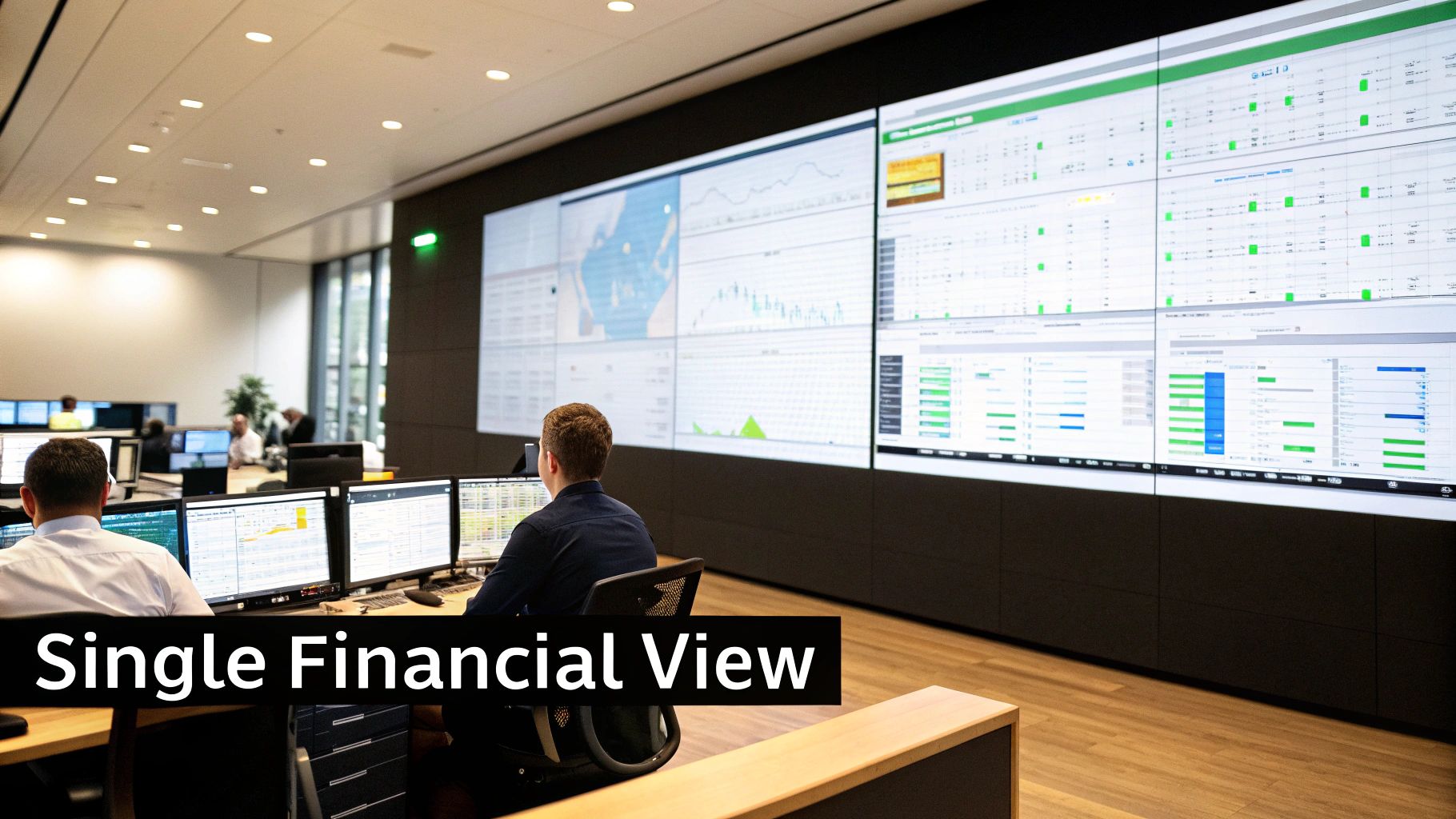
Picture your finance team as the command centre of your business. Without an ERP, they’re essentially flying blind, trying to navigate with outdated maps. They’re forced to piece together information from siloed reports, chasing down data from sales, inventory, and operations. It’s a recipe for delays, costly errors, and big strategic decisions based on little more than educated guesswork.
An ERP in finance flips that script entirely.
It creates a seamless, automatic flow of information. When your sales team closes a deal through your Shopify implementation or a new product is added via WooCommerce, the financial impact is instantly recorded in the general ledger. No waiting, no manual entry. This real-time data integration is the secret to turning your finance team from simple record-keepers into a true strategic powerhouse.
Before and After ERP: A Financial Operations Snapshot
This table shows just how stark the difference is between old-school, manual processes and the integrated, automated world an ERP system creates.
| Financial Task | Traditional Method (Without ERP) | Modern Method (With Finance ERP) |
|---|---|---|
| Financial Reporting | Manual data consolidation from multiple spreadsheets. Prone to errors and takes weeks. | Automated, real-time reports generated in minutes with a single click. |
| Invoice Processing | Manual entry, physical approvals, and slow payment cycles. High risk of human error. | Automated invoice capture, digital approval workflows, and faster payment processing. |
| Budgeting & Forecasting | Based on historical data from static spreadsheets. Inflexible and slow to update. | Dynamic, data-driven forecasting using live information from across the business. |
| Auditing | A painstaking process of gathering paper trails and reconciling disparate records. | Simplified audits with a clear, centralised, and unchangeable digital trail for every transaction. |
The takeaway is clear: an ERP doesn’t just make things faster; it makes them smarter, more accurate, and far more reliable.
The Power of a Single Source of Truth
At its heart, the biggest advantage of an ERP is creating a single, rock-solid source of financial data. It’s the end of conflicting spreadsheets and the soul-destroying task of manual reconciliation. Instead of your team spending weeks just closing the books, they can generate perfectly accurate reports in days, or sometimes even hours.
This unified view gives your leadership team the confidence to make sharp, strategic decisions. They can analyse profitability right down to the individual product line, manage cash flow with surgical precision, and forecast future performance based on what’s actually happening in the business right now.
An ERP system doesn’t just organise your data; it unlocks its strategic value. By connecting every part of the business, it provides the clarity needed to spot opportunities, manage risks, and drive real, sustainable growth.
Meeting Modern Business Demands
It’s no surprise that the demand for these systems is exploding. The Australian Enterprise Resource Planning (ERP) market, currently valued at around AUD 930 million, is projected to grow at a blistering CAGR of 15.2% from 2025 to 2034. This surge is expected to push the market to a massive AUD 10.37 billion, which speaks volumes about the critical need for financial automation. You can read more about the Australian ERP market’s growth.
Whether it’s through a flexible Odoo implementation Sydney Adelaide businesses rely on or custom software development Sydney Adelaide firms need, a modern ERP is no longer a luxury—it’s the essential framework for efficiency, accuracy, and strategic insight.
Ready to see what this could look like for your business? Contact Wistec today for a no-obligation consultation and discover how a tailored ERP solution can help you build for the future.
The Must-Have Modules for Financial Mastery
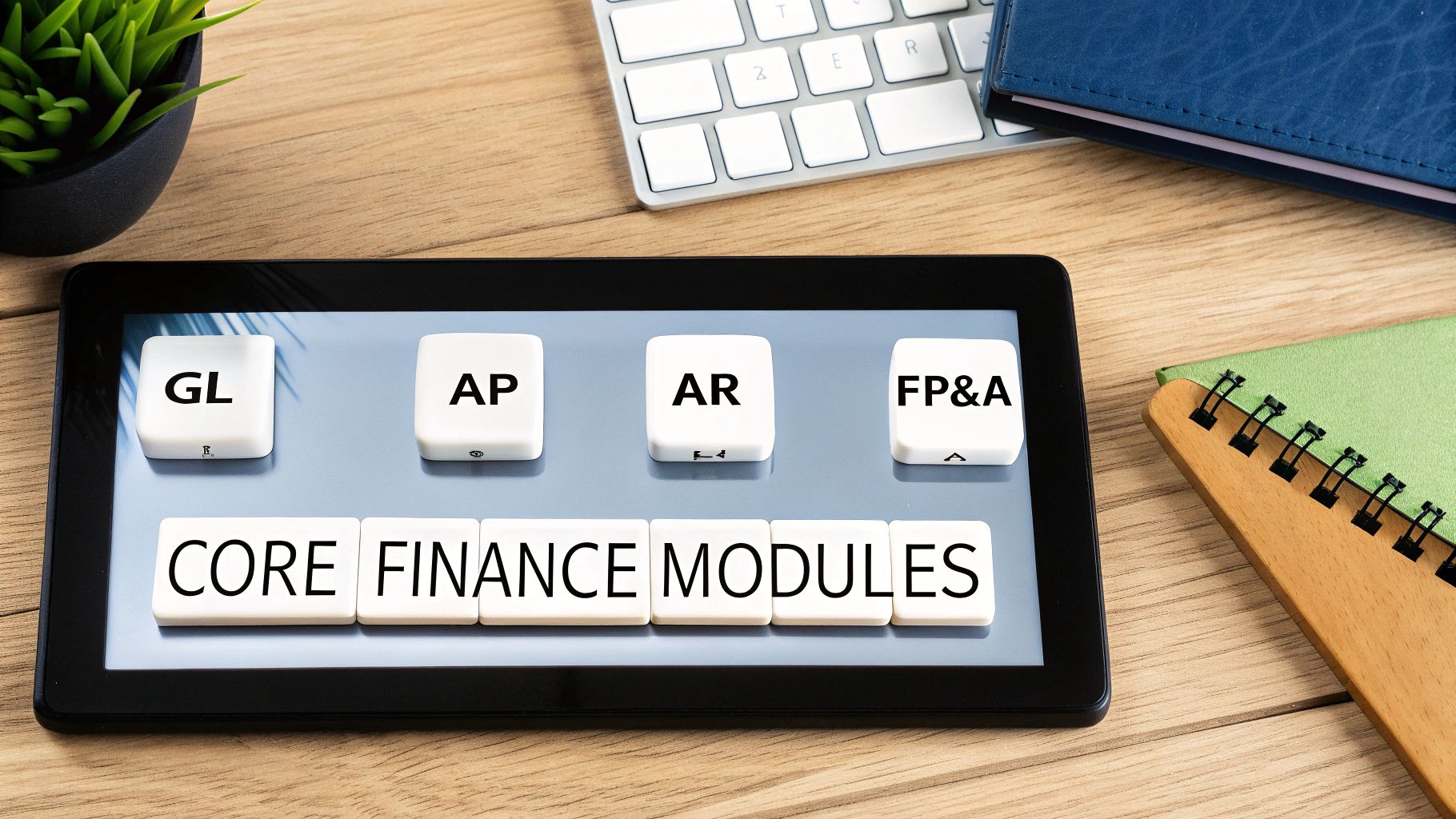
An ERP in finance isn’t some giant, one-size-fits-all program. It’s better to think of it as a specialist team of interconnected modules, each built to master a specific corner of your financial world. The real magic happens because every member of this team communicates flawlessly, ensuring nothing ever slips through the cracks.
At the heart of any good finance ERP are the foundational modules that handle the daily grind. For any business that’s serious about getting its finances right, these are the absolute non-negotiables.
- General Ledger (GL): This is the central nervous system of your entire financial operation. Every single transaction—from a major asset purchase down to a box of pens—gets recorded here. The result is a complete, accurate, and auditable financial record you can trust.
- Accounts Payable (AP): This is where you automate the tedious process of paying your bills. It takes care of managing supplier invoices, scheduling payments on time, and slashing the manual data entry that so often leads to costly mistakes and late fees.
- Accounts Receivable (AR): The other side of the coin, the AR module automates invoicing your customers and keeping track of who has paid. It gives you a crystal-clear view of outstanding revenue, making it far easier to manage cash flow and chase up overdue accounts.
These core modules create a rock-solid operational base, but true financial mastery is about looking forward, not just staring in the rearview mirror.
Strategic Modules for Future Growth
Beyond the day-to-day accounting, modern ERPs offer advanced modules that turn your historical data into a powerful tool for strategic foresight. These are the tools that allow your finance team to become true guides for the business, steering it towards long-term success.
The Financial Planning & Analysis (FP&A) module is the perfect example. It takes you past basic reporting and into the realm of dynamic budgeting, sophisticated forecasting, and powerful scenario modelling. You can finally ask those crucial “what if” questions—what’s the impact of a new product line? What if the market takes a downturn?—and get solid, data-backed answers in minutes, not weeks.
A well-implemented ERP transforms your finance function from a reactive cost centre into a proactive strategic partner. It provides the tools to not just report on what happened, but to accurately predict what will happen next.
Integrating Your Sales Channels
For any business selling online, this integration is absolutely vital. Whether you’re running a Shopify implementation or managing a huge WooCommerce store, every single sale needs to flow seamlessly into your financial records. A good ERP makes sure that sales figures, inventory levels, and customer details are automatically synced with your General Ledger.
This completely removes the painful manual work of reconciling sales reports with bank statements. For businesses considering an Odoo implementation Sydney Adelaide firms often recommend, this direct pipeline gives you a real-time, 360-degree view of your business performance.
This deep level of integration is essential if you want to scale your operations. When your sales and finance systems are speaking the same language, you get the clarity you need to make much smarter business decisions.
Ready to build a financial system that drives your business forward? Get in touch with Wistec’s experts to explore how custom software development Sydney Adelaide businesses trust can create a perfectly integrated solution for you.
What a Finance ERP Actually Does for Your Business
Think of a finance ERP as less of a software upgrade and more of a fundamental shift in how your business operates. It’s a strategic move that pays real, measurable dividends, and the first thing you’ll notice is the impact on your finance team’s day-to-day. All those repetitive, soul-crushing tasks that used to swallow up their week? Gone. Automated.
Suddenly, your sharpest financial minds aren’t buried in manual data entry, chasing down invoices, or wrestling with endless spreadsheets. They’re free to step back from the grunt work and focus on what they were hired to do: providing the strategic insights that steer the company in the right direction.
From Manual Grind to Strategic Guidance
One of the most powerful things a modern ERP does is create a single source of truth for your financial data. This sounds like a simple technical feature, but in reality, it completely changes the game for reporting accuracy and speed. When every bit of financial information lives in one unified system, the agonising, error-riddled process of closing the books each month gets dramatically faster.
We’re talking about reports that once took weeks to cobble together now being ready in days, sometimes even hours. And the best part? You can actually trust the numbers. This gives your leadership the confidence to make quick, well-informed decisions, backed by a live view of what’s happening across the entire business.
Nailing Compliance and Security
In Australia, staying on top of financial regulations isn’t optional. A properly set-up ERP is your best friend here. It locks in standardised workflows and creates an airtight audit trail for every single transaction, which makes demonstrating compliance or preparing for an audit incredibly straightforward.
A great ERP doesn’t just record your financial data; it builds financial controls directly into your day-to-day operations. Compliance stops being a frantic quarterly exercise and becomes a continuous, automated part of how you work. This doesn’t just cut down on risk—it builds a far more secure and transparent financial foundation.
This push towards smarter systems is happening everywhere. As Australian businesses invest in digital tools to get ahead, IT spending is expected to reach a massive USD 95.6 billion in 2025. A huge chunk of that is going directly into ERP adoption for critical finance functions like accounting, auditing, and compliance. You can see more details on Australian ERP market trends here.
At the end of the day, you get a more efficient, cost-effective, and secure operation that’s ready to grow without breaking. Whether you’re after the kind of flexible Odoo implementation Sydney Adelaide businesses are looking for, or need custom software development Sydney Adelaide experts can provide, the goal is the same. An ERP is the bedrock for turning your finance department into a powerhouse for growth.
Ready to see how an ERP could reshape your financial operations? Contact Wistec today for a no-obligation chat about your business goals.
Real-World Examples of ERP Success
The theory is great, but let’s be honest, the real power of an ERP in finance shows up when it solves the frustrating, day-to-day problems businesses actually face. So, let’s get practical and look at a couple of stories of how Australian businesses are getting ahead by implementing their ERP systems the right way. These aren’t just abstract concepts; they show a clear, undeniable return on investment.
Think about a fast-growing online retailer in Sydney. They were killing it on sales, but their biggest headache was the chasm between their booming Shopify implementation and their clunky old accounting software. Every single day was a manual slog of reconciling sales, triple-checking inventory levels, and just trying to figure out where their cash was.
Case Study: A Sydney Retailer’s eCommerce Integration
This retailer decided enough was enough and went with an Odoo implementation Sydney Adelaide businesses often lean on for its flexibility. The mission was straightforward but absolutely critical: build a seamless, two-way bridge between their Shopify store and their new financial core.
The moment it went live, the difference was like night and day.
- Live Financial Sync: Every sale, refund, and discount code used on Shopify instantly appeared, correctly coded, in the Odoo general ledger. No more manual entry.
- Perfect Inventory Alignment: When a product sold online, the inventory count updated everywhere, in real-time. This put a stop to overselling popular items and frustrating customers.
- Automated Reconciliation: The soul-crushing task of matching bank deposits to endless sales reports simply vanished. This move alone freed up the finance team for an estimated 15 hours every week.
Suddenly, they had one source of truth. This clarity allowed them to make smarter buying decisions, manage their cash flow with genuine confidence, and finally scale their operations without the back-office chaos.
An ERP doesn’t just manage your numbers; it connects your core business operations directly to your bottom line. For an online store, this means every click, sale, and return has an immediate and accurate financial footprint.
Case Study: An Adelaide Manufacturer’s Profitability Breakthrough
Now, let’s head over to Adelaide and look at a manufacturer facing a completely different, but equally frustrating, problem. They were crafting top-quality products but had a blind spot: they couldn’t nail down their exact cost of goods sold (COGS). With one system on the factory floor and another in the finance office, their profit calculations were little more than educated guesswork.
They brought in a team for custom software development Sydney Adelaide firms trust to build a specialised connection between their production machinery and their ERP. This wasn’t an off-the-shelf fix; it was a purpose-built solution designed to capture real-time data on material usage, machine runtime, and labour for every single job.
This live data feed completely changed their financial perspective. For the first time, they could see the precise cost of every single item coming off the line. This allowed them to see which products were genuine money-makers and which were actually dragging them down. Armed with this knowledge, they tweaked their pricing and fine-tuned their production runs, boosting their overall net profit by 12% in the first year alone.
From online retail to the factory floor, these examples make one thing crystal clear: a finance ERP isn’t just about being more efficient. It’s about gaining the razor-sharp clarity you need to make smarter, more profitable decisions.
Whether you’re running a WooCommerce store or juggling a complex supply chain, the right ERP can unlock value you never knew was there.
Are you ready to see what a tailored ERP could do for you? Contact Wistec for a no-obligation consultation, and let’s talk about the unique challenges in your business.
Your Roadmap to a Smooth ERP Implementation
Kicking off an ERP project feels like a massive undertaking, and in many ways, it is. However, the secret to turning a potentially chaotic process into a manageable one is a solid, practical plan. Ultimately, a successful rollout hinges on a step-by-step approach that sees you through from the initial sketches to a successful launch and beyond. In fact, this roadmap is what keeps your ERP in finance project on track, on time, and on budget.
Before anything else, the journey starts long before you look at any software. First, you need to clearly define what success actually looks like for your business. What are you trying to achieve? Are you aiming to slash your month-end close time? Do you need real-time visibility into your stock levels? Or perhaps it’s about making your Shopify implementation talk seamlessly to your accounting ledgers. Ultimately, these goals become the North Star for every single decision that follows.
After that, once your objectives are crystal clear, the next critical step is picking the right implementation partner. This is about so much more than just technical chops. You need a team that genuinely gets your industry and understands the unique challenges you face every day. Whether you need the kind of flexible Odoo implementation Sydney Adelaide businesses rely on, or require custom software development Sydney Adelaide experts can deliver, your partner choice is a make-or-break decision.
Navigating the Critical Phases
With the right partner on board, the project then moves into its core phases. Let’s be honest: data migration is often the trickiest part. It involves carefully moving years of historical financial data into the new system, and this step requires meticulous planning to ensure every piece of data is clean, accurate, and mapped correctly to its new home. Otherwise, you could be dealing with the fallout for months.
Once the data is sorted, comprehensive user training becomes completely non-negotiable. Your team needs to feel comfortable and confident with the new system from the moment it goes live. To make this happen, a phased deployment is usually the safest and most practical approach. By rolling out the ERP module by module or department by department, you minimise business disruption—far smarter than the high-risk “big bang” launch where everything changes overnight.
A successful ERP implementation is 20% technology and 80% people and process. Forgetting about change management and user training is the quickest way to see a technically perfect system fail.
Avoiding Common Project Pitfalls
Even the most carefully planned projects can hit roadblocks. Two of the most common tripwires are scope creep — where new features and requests keep getting tacked on — and poor change management. Therefore, it’s absolutely vital to lock in a clear project scope from the get-go and have a formal process for considering any changes.
Implementing a new ERP system successfully is truly a complex puzzle. Consequently, the key pieces below need to fit together perfectly. Getting these right from the start is the difference between a project that delivers real value and one that becomes a costly headache.
ERP Implementation Key Success Factors
| Success Factor | Why It’s Critical | Risk of Neglect |
|---|---|---|
| Executive Sponsorship | Strong leadership ensures the project gets the resources and priority it needs. It drives the vision from the top down. | Without it, the project can stall, lose funding, or face resistance from other departments. |
| Clear Project Scope | A well-defined scope prevents “scope creep” and keeps the project focused, on time, and within budget. | An undefined scope leads to endless additions, budget overruns, and missed deadlines. |
| Dedicated Project Team | A skilled, cross-functional team ensures all business areas are represented and their needs are met. | Key requirements are missed, leading to a system that doesn’t fit the business’s actual workflows. |
| Effective Change Management | People naturally resist change. A proper plan helps manage expectations, provides training, and secures user buy-in. | Low user adoption, active resistance, and a failure to realise the expected benefits of the new system. |
| Clean Data Migration | Your ERP is only as good as the data within it. Clean, accurate data is foundational for reliable reporting. | “Garbage in, garbage out.” Poor data quality leads to flawed insights and a lack of trust in the system. |
| Realistic Timeline & Budget | Setting achievable goals from the outset prevents team burnout and manages stakeholder expectations. | The project is set up for failure, causing frustration, rushed work, and compromised quality. |
Ultimately, a smooth implementation boils down to clear communication, strong project management, and a genuine understanding of your business needs. This structured approach is what prevents chaos and ensures your new ERP becomes a powerful asset, not a frustrating expense.
Ready to start your journey toward financial excellence with a system built for your needs, like a WooCommerce integration? Contact Wistec today for a no-obligation consultation, and let’s build your roadmap together.
The Future of Finance AI and Predictive ERP
The world of ERP in finance is taking a massive leap forward, moving beyond just automating tasks and into the much more exciting space of intelligent prediction. Moreover, the next evolution is all about Artificial Intelligence (AI) and machine learning, which are transforming ERP systems from a simple record-keeper into a strategic partner that can see what’s around the corner.
This isn’t some far-off concept; it’s already here. In fact, AI-driven ERPs are now handling incredibly complex financial processes with a level of accuracy that was once unimaginable. For example, picture AI agents that can spot potential fraud in real time by flagging suspicious transactions, or smart systems that match supplier invoices to purchase orders and receipts, all without a single person lifting a finger.
From Hindsight to Foresight
But the real game-changer is predictive analytics. In fact, when these tools are built directly into an ERP, they can sift through years of your historical data to forecast future cash flow, pinpoint emerging market trends, and even model the outcomes of different financial scenarios. As a result, your financial data isn’t just a rearview mirror showing you where you’ve been — it’s a crystal ball helping you navigate the road ahead.
Naturally, unlocking these powerful capabilities hinges on a solid implementation plan. To help with that, the following infographic outlines the typical stages of an ERP implementation roadmap, from setting clear goals to a successful launch.
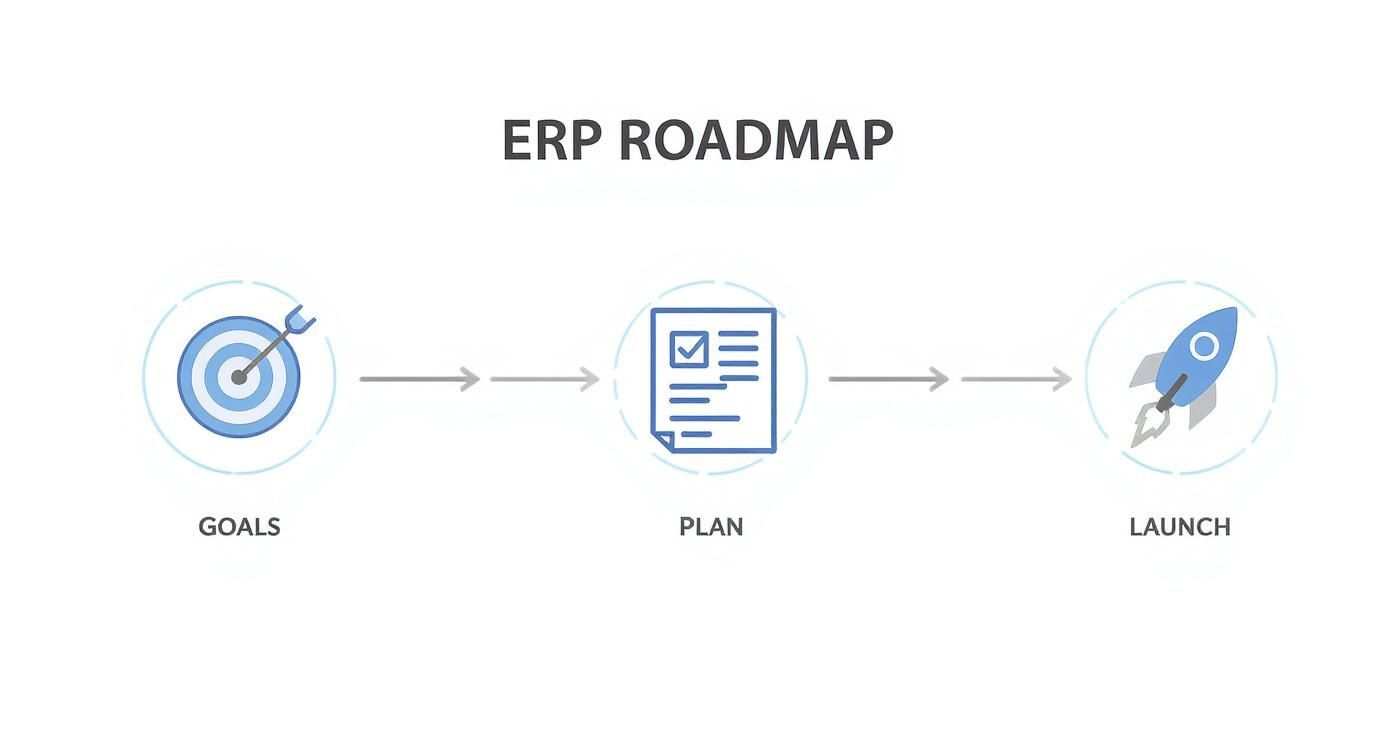
As you can see, a successful project is always built on a foundation of clear goals and careful planning, long before any technology gets switched on.
By embracing predictive AI, your finance team can finally shift from reacting to what’s already happened to proactively shaping what comes next. It’s about making financial management smarter, more agile, and ready for whatever the market throws at you.
Whether you’re considering an Odoo implementation Sydney Adelaide businesses favour for its flexibility, or the kind of custom software development Sydney Adelaide experts deliver for unique challenges, the future is intelligent. This proactive approach even extends to optimising a Shopify implementation or a complex WooCommerce store with AI-driven insights. It’s how modern businesses aren’t just surviving—they’re thriving.
Ready to build a more intelligent financial future for your business? Contact Wistec today for a no-obligation consultation and discover how our expertise can prepare you for what’s next.
Take Control of Your Financial Future
We’ve walked through how a modern ERP in finance can completely reshape a finance department, moving it from a reactive, number-crunching cost centre to a strategic powerhouse that drives real growth. Moreover, that level of efficiency, clarity, and deep insight isn’t just a ‘nice-to-have’ anymore; for any business with serious ambitions, it’s fundamental to staying competitive.
Let’s be honest, those outdated, cobbled-together systems are holding you back. Additionally, the daily grind of manual data entry and the blind spots created by disconnected information aren’t just minor headaches—they’re major roadblocks preventing you from scaling effectively. Clearly, it’s time to put a financial foundation in place that’s built for where you’re going, not where you’ve been.
Maybe you need a flexible Odoo implementation Sydney Adelaide businesses rely on, or perhaps you’re looking for custom software development Sydney Adelaide specialists to build something truly unique. Furthermore, you might even just want to finally get your Shopify implementation or WooCommerce store properly integrated with the rest of your operations.
Ultimately, whatever your specific need, the journey always starts with a conversation. Our team is here to help you map out a practical ERP solution that makes sense for your goals and your budget. So, it’s time to take that first step towards genuine financial control and operational excellence.
Ready to build a more resilient and profitable future for your business? Get in touch with Wistec today for a no-obligation chat to see how we can help. https://www.wistec.com.au