

A modern construction ERP is the master blueprint for your entire business. Think of it as the central nervous system connecting project management, finance, and what’s happening on-site into a single, cohesive whole. It’s about ditching that chaotic mix of spreadsheets and standalone apps for one source of truth, giving you a firm grip on costs, schedules, and ultimately, your profitability.
Why Disconnected Systems Are Demolishing Your Profits
The Australian construction industry is a tough game. We’re all dealing with razor-thin margins, ongoing labour shortages, and material costs that seem to change with the weather. But many businesses are unknowingly making it harder for themselves by juggling a patchwork of outdated systems. Spreadsheets for accounts, another program for scheduling, and stacks of paper invoices from subbies—it’s a tangled mess that makes it impossible to see the real financial health of any given project.
Trying to run a business this way is like building a high-rise without a master plan. The structural crew has one set of drawings, the electricians have another, and the plumbers are working off scribbled notes. Each team is in its own bubble, which only leads to clashes, expensive rework, and delays that blow budgets and timelines out of the water. Operating without a central, agreed-upon plan is a recipe for disaster.
The True Cost of Data Silos
When your information is scattered across different systems, you’re not just disorganised—you’re actively losing money. A site manager in Adelaide might sign off on a variation, but the finance team back in Sydney has no idea about the cost until a surprise invoice lands on their desk weeks later. This kind of disconnect causes real, tangible problems:
- Inaccurate Bidding: How can you price the next job accurately if you don’t have real-time cost data from the last one? Your bids become guesswork, and you run the risk of underquoting and wiping out your profit margin before you even break ground.
- Delayed Decision-Making: A small issue on-site that isn’t flagged with head office immediately can quickly snowball into a major, expensive crisis.
- Poor Resource Allocation: You could have a half-a-million-dollar excavator sitting idle on one site while another project is stalled, waiting for that exact piece of machinery.
An integrated system means everyone—from the project manager on the ground to the procurement officer in the office—is looking at the same live information. It puts an end to the blame game and builds a culture where everyone is accountable. To get a better grasp of how different systems can work together, you can learn more about what system integration is and why it’s so critical.
The Blueprint for Survival and Growth
A centralised Enterprise Resource Planning (ERP) platform is the master blueprint your business needs. It creates a single source of truth that ties every moving part of your operation together. This isn’t just a simple software update; it’s a fundamental change in how you manage projects, control your finances, and plan for growth. In today’s market, a well-implemented ERP like one built on Odoo isn’t a luxury—it’s essential for survival.
As a leading Odoo partner in Sydney and Adelaide, we’ve seen firsthand how a unified platform can completely change the game for construction businesses. When you integrate everything from the initial bid to the final invoice—and even connect to systems like Shopify or WooCommerce through a custom Shopify implementation—you get a level of visibility you’ve never had before. Our expert software development in Sydney and Adelaide is all about building tailored solutions that solve these exact problems.
Ready to plug the profit leaks and build your business on a stronger foundation? Contact our team for a free consultation today and find out how a custom Odoo implementation can deliver a serious return on your investment.
The Building Blocks of a Powerful Construction ERP
Think of a construction ERP less as a piece of software and more as the central nervous system for your entire operation. It’s the digital backbone that connects every moving part. Instead of getting bogged down in abstract features, let’s look at the essential modules that do the heavy lifting. Each one acts like a specialist on your team, working in perfect sync to turn potential chaos into controlled, profitable projects.
The picture below paints a familiar scene for many in the industry: scattered systems causing confusion and inefficiency. It also shows the solution.
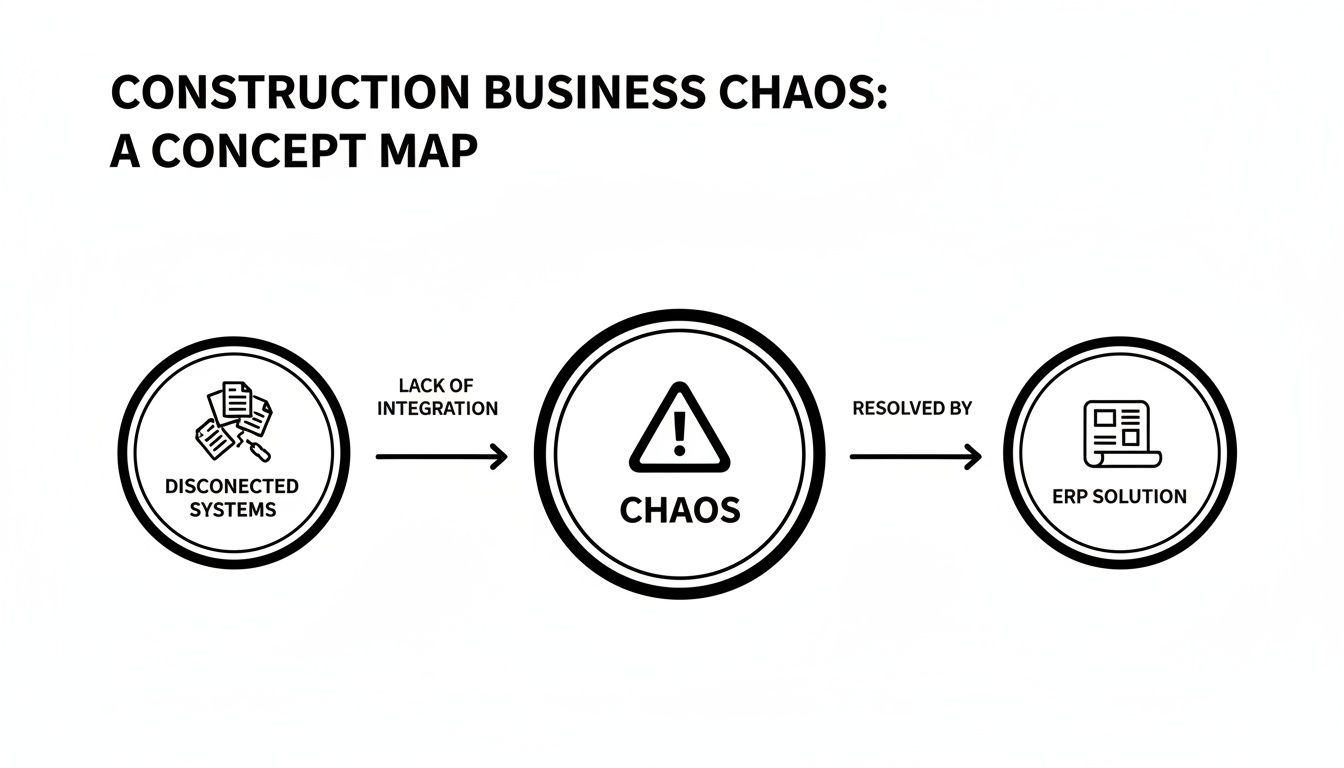
As you can see, disconnected systems are a blueprint for disaster. An integrated ERP is what brings order, clarity, and control back to your projects.
Project Costing and Accounting
This is your project’s live financial dashboard, and it’s non-negotiable. It meticulously tracks every dollar—from the initial estimate and material purchase orders right through to subcontractor invoices and the final progress claim. The real magic here is the real-time visibility it gives you into project costs, which is your best defence against budget blowouts.
Practical Case: A commercial builder in Adelaide used our Odoo implementation to link their on-site tablet app directly to their central accounting module. When a supervisor approved a $5,000 variation for extra plumbing work, the project cost was immediately updated in the ERP. The project manager received an instant alert that the plumbing budget was now at 95% capacity, allowing them to make proactive adjustments instead of discovering the overspend a month later.
Procurement and Inventory Management
This module is your digital quartermaster—an essential part of any ERP in the construction industry. It brings order to the entire process of ordering, receiving, and managing materials. More importantly, it ensures the right supplies arrive on-site precisely when they’re needed, eliminating the costly delays that come from stock shortages.
It also stops you from tying up precious capital in excess materials just sitting in a warehouse. By linking directly with supplier systems, it helps create a just-in-time supply chain that keeps your projects moving and your cash flow healthy.
Key ERP Modules for Construction Success
| ERP Module | Core Function | Problem Solved |
|---|---|---|
| Project Costing & Accounting | Tracks all job-related expenses against the budget in real time. | Prevents budget overruns and provides a clear view of project profitability. |
| Procurement & Inventory | Manages material orders, deliveries, and on-site stock levels. | Eliminates project delays from material shortages and reduces wasted capital. |
| Subcontractor Management | Centralises contracts, compliance documents, and payment schedules. | Simplifies subcontractor admin and reduces compliance risks. |
| Equipment Management | Monitors asset location, usage, maintenance, and allocation. | Maximises asset utilisation and prevents costly equipment downtime. |
These modules aren’t just standalone tools; their power comes from working together to give you a complete operational picture.
How The Core Modules Work Together
The true strength of an ERP is how these individual modules talk to each other. It’s a constant, seamless flow of information.
- Project Costing automatically pulls data from Procurement to track what you’ve spent on materials.
- Subcontractor Management sends approved invoices straight to the Accounting module for payment.
- Equipment Management assigns the cost of running a machine directly to a specific project code.
This seamless connection, often fine-tuned through expert software development in Sydney and Adelaide, completely gets rid of data silos. Suddenly, you have a complete, 360-degree view of every project. While platforms like Odoo provide a brilliant foundation, some businesses have unique workflows that need a more tailored fit. In those cases, looking into Custom Enterprise Software Development can be the next logical step to build a system that mirrors your processes perfectly.
Ultimately, a cohesive system delivered by a trusted Odoo partner in Sydney, Adelaide, helps you shift from guessing to knowing. You can finally make decisions based on accurate, up-to-the-minute information, securing your profitability and setting the stage for real growth. Speak with an expert today to see how these modules can solve your specific challenges.
How a Unified ERP Builds a Foundation for Growth
Deciding to bring in an ERP isn’t just a tech move; it’s a strategic decision that shapes the future of your construction business. The real magic of an ERP for the construction industry is how it weaves together every part of your operation, turning isolated bits of data into a powerful competitive edge that you can see on your profit and loss statement.
Think of it as the central nervous system for your company, especially in the demanding Australian market. Imagine one system connecting the project management apps your site teams use with the financial forecasting tools in the back office. This creates a single source of truth, getting rid of the guesswork and letting you make smarter, faster decisions based on what’s happening right now.
Moving from Putting Out Fires to Planning Ahead
Without a central system, construction companies often find themselves in a constant state of reaction, always dealing with problems caused by miscommunication or old data. A unified ERP completely changes that dynamic, helping you get ahead of challenges and spot opportunities before they pass you by.
You’ll see the biggest change in your bidding and forecasting. When you have accurate, historical data on labour, materials, and subcontractor costs right there, your bids become incredibly precise. You can price jobs with confidence, knowing you’re both competitive and profitable, protecting your margins right from the start.
An ERP takes your business from managing project-by-project chaos to building a predictable, scalable, and profitable future. It’s the difference between reacting to the market and leading it.
This isn’t just theory; the numbers back it up. Research on Australian construction firms shows a clear link between adopting an ERP and improving business performance. One study found that a massive 53% of companies reported high growth after implementing an ERP. Even more telling, 27% said the system was crucial to their survival through tough economic times. You can dig into the data behind these results by reading the full findings on construction ERP success.
Creating a Connected Business Ecosystem
A modern ERP does more than just handle your internal workflows; it plugs you into your entire business network. It becomes the central hub that can connect with all sorts of external platforms, creating a smooth flow of information that makes everything more efficient.
Here are a couple of real-world examples:
- Supplier Integration: A construction company in Sydney could connect its Odoo ERP with a supplier’s Shopify or WooCommerce online store. This setup, achieved via a professional Shopify implementation, could automatically trigger purchase orders when material stock hits a certain level, making sure supplies arrive just in time without anyone having to lift a finger.
- Subcontractor Portals: A firm in Adelaide could give its subcontractors a secure portal linked directly to the ERP. They could submit invoices, upload compliance documents, and check payment statuses themselves, which would slash the administrative workload for your team.
This kind of deep integration, often built through expert software development in Sydney and Adelaide, creates a strong ecosystem around your core business. Your ERP becomes more than just an internal tool—it becomes a strategic asset for building better relationships with clients and suppliers.
As a leading Odoo partner in Sydney and Adelaide, we specialise in creating these connected environments. A successful Odoo implementation is about much more than just software; it’s about architecting a system that supports every single one of your strategic goals. It’s the key to reducing risk, boosting profitability, and securing your company’s future in a tough industry.
Ready to stop chasing data and start driving growth? Speak with our ERP specialists today to design a system that will become your company’s most valuable asset.
Navigate the Labour Crisis with Smarter Resource Management
It’s no secret that Australia’s construction industry is staring down the barrel of a major skilled labour shortage. This isn’t some far-off problem; for many firms, it’s a daily battle that puts timelines and profits at risk. The answer isn’t just about finding more people—it’s about making your existing team more effective. An ERP in the construction industry is the key, acting as a force multiplier that helps you get more done with the skilled professionals you already have.
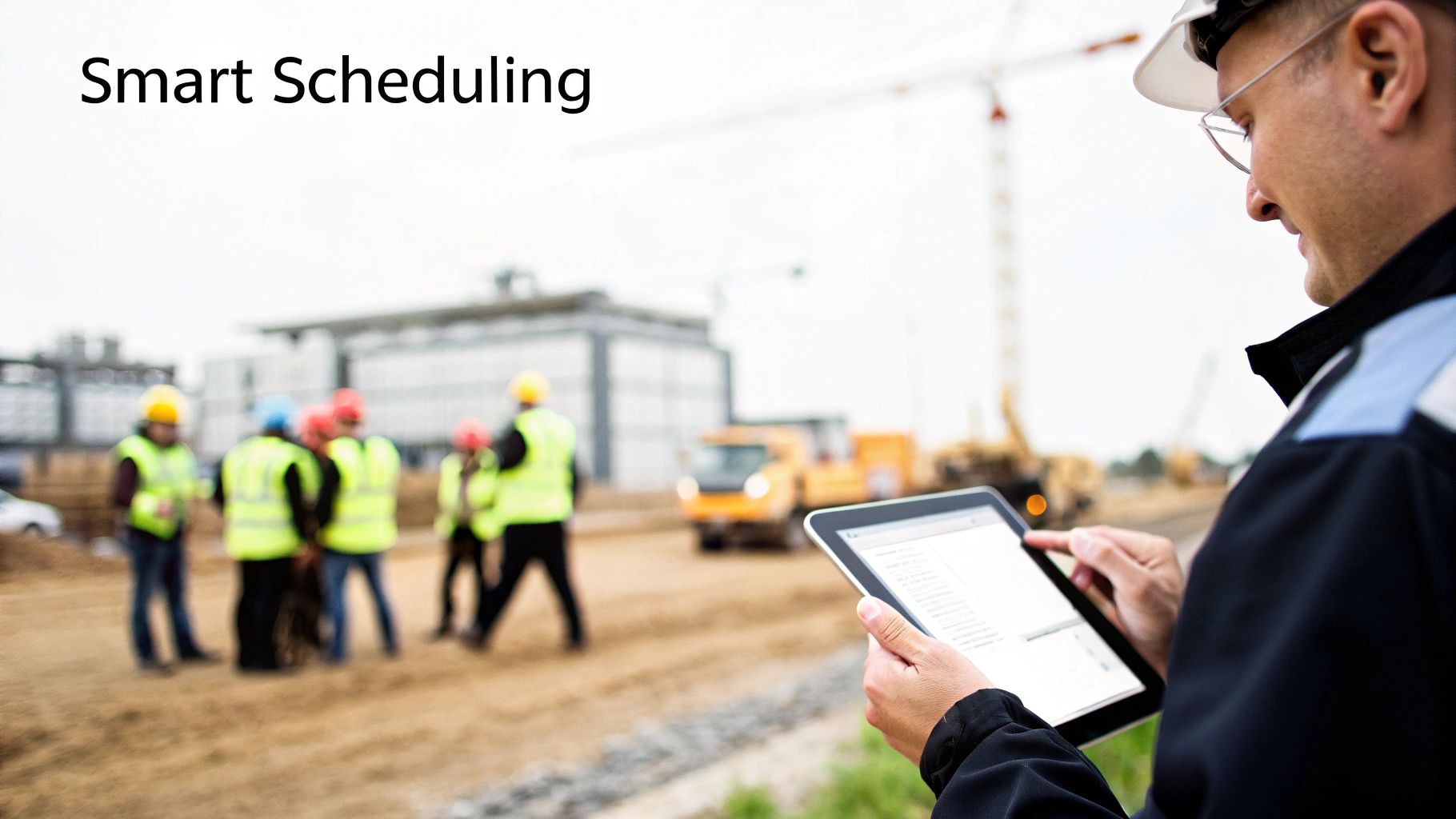
The secret sauce is automation. Just think about the sheer number of hours your project managers, site supervisors, and admin staff lose to repetitive, low-value tasks. Chasing compliance documents, manually running payroll, and reconciling purchase orders are all necessary evils that pull focus from what really matters—the actual build. An ERP takes over these workflows, freeing up your skilled people to do what they do best: manage projects, solve complex problems, and push the business forward.
Turning Chaos into Clockwork Precision
Beyond just automating the busywork, an ERP brings a whole new level of intelligence to managing your two most valuable assets: your people and your equipment. At the heart of this are advanced scheduling and resource management modules. They work to get the right people with the right skills and the right machinery to the right site, at exactly the right time.
Practical Case: A Sydney-based civil engineering firm used their ERP’s equipment management module to track their excavators via GPS. Before the ERP, they discovered one machine had been sitting unused at a completed site for three weeks, costing them thousands in lost rental opportunities. Now, the system automatically flags idle equipment and suggests re-deployment to active projects in the area, maximising asset utilisation and directly boosting their bottom line. This is a common outcome of a well-planned Odoo implementation.
An ERP transforms resource allocation from a frantic juggling act into a strategic, data-driven process. It’s about making sure every person and every machine is generating value, every single day.
The scale of this workforce challenge can’t be understated. Infrastructure Australia is forecasting a peak shortage of up to 300,000 workers by 2027, a crisis that will hit regional areas the hardest. When you combine this labour gap with productivity that has remained stubbornly flat, the pressure on construction firms is immense. An ERP is a direct response, integrating workflows to make the most of your limited labour pool and drive efficiency. You can explore the full market capacity report to see just how deep this challenge runs.
Fostering a Better Company Culture
This isn’t just about the bottom line; it’s about building a better, more organised place to work. When projects run smoothly, and your team isn’t constantly putting out fires, job satisfaction goes way up. A less chaotic workplace means less stress and frustration, which is crucial for holding onto the top talent you fought so hard to find. Adopting an ERP sends a clear signal to your team: we’re investing in tools to make your job easier and more rewarding.
As a leading Odoo partner in Sydney and Adelaide, this is exactly what we do. Our software development in Sydney, Adelaide, is all about creating intuitive platforms—whether it’s for a Shopify implementation or WooCommerce integration—that make your operations smarter. An Odoo implementation could be the critical solution your business needs to not just survive the labour crisis, but thrive in it.
Ready to get more from your team? Contact Wistec for a consultation and discover how smarter resource management can safeguard your projects and your profits.
Your Roadmap for a Seamless ERP Implementation
Let’s be honest, the idea of implementing a new Enterprise Resource Planning (ERP) system can feel a lot like taking on a massive construction project. It seems complex, daunting, and full of potential pitfalls. Business owners often worry about the disruption, the budget, and whether the team will even use the new software.
But it doesn’t have to be that way. With a clear plan and an experienced partner, the whole process can be managed smoothly, causing very little interruption to your day-to-day work. It’s not about flipping a switch and hoping for the best; it’s about a careful, step-by-step approach.
This journey is all about replacing uncertainty with a solid, structured plan that delivers real value from day one. A well-managed implementation is the foundation that will completely change how your business operates for the better.
A Practical Case Study in Action
Picture a mid-sized residential construction firm right here in Sydney. They were juggling multiple projects, but their profits were being eaten away by unexpected costs and scheduling blowouts. Their critical information was all over the place—job costing in spreadsheets, scheduling in a separate app, and piles of paper invoices from subbies. Without one central source of truth, project managers and the finance team were constantly out of sync.
As their chosen Odoo Partner in Sydney and Adelaide, we started by getting into the trenches with them. We mapped out every single workflow, from the first client quote right through to the final handover. This deep dive allowed us to pinpoint their biggest headaches and figure out which modules would give them the quickest wins. We kicked things off with project costing and subcontractor management. Our software development in Sydney and Adelaide then focused on building a system that actually worked the way they did.
A successful ERP implementation isn’t about forcing your business to fit the software. It’s about configuring the software to support and improve the way you already work, guided by a partner who understands your industry.
The Phased Implementation Journey
We take our clients through a clear, multi-stage process we’ve honed over countless projects in Sydney and Adelaide. It’s designed to minimise risk and make the transition as smooth as possible, which is absolutely central to a successful Odoo implementation.
- Discovery and Planning: First up, we get to know your business inside and out. We dig into your unique challenges, set clear project goals, and draw up a detailed blueprint for the entire implementation. This stage is all about getting on the same page and building a solid foundation.
- Customisation and Configuration: This is where we shape the Odoo platform to fit your specific workflows like a glove. It might mean customising reports, connecting to existing systems like Shopify or WooCommerce through a dedicated Shopify implementation, or building special features to handle your unique compliance needs.
- Data Migration and Testing: We carefully move your essential data—from supplier lists to active project details—into the new system. Then, we test everything relentlessly to make sure every module works perfectly, and all the data is spot-on before you go live.
- Team Training and Go-Live: Getting your team on board is everything. We provide practical, hands-on training for everyone, from site managers to the accounts team, so they feel confident from the get-go. We then manage the go-live, providing extra support during those crucial first few days.
- Ongoing Support and Optimisation: Our partnership doesn’t stop when the system is launched. We’re there for the long haul, providing continuous support and helping you tweak and improve the system as your business grows.
This structured approach turns a seemingly massive task into a series of clear, manageable steps. For a closer look at what this process involves, you can find more details in our complete ERP system implementation guide. By working with an expert team, you can confidently navigate the path to a fully integrated, high-performing business.
Ready to build your own success story? Book a no-obligation consultation with Wistec today, and let us show you how a seamless ERP implementation can become your company’s greatest asset.
Unify Your Technology to Maximise ROI
Are you juggling a handful of different software subscriptions that refuse to talk to each other? You’re not alone. Many construction firms find themselves in this exact spot, and it’s a silent killer of profitability. This jumble of separate apps for accounting, project management, and scheduling creates a messy, fragmented tech stack. It forces your team to waste precious hours on double-handling data, creates clunky workarounds, and leaves you guessing about the real-time health of your business. It’s time to stop patching holes and start building on a solid foundation.
Moving all your tools onto a single, unified ERP platform like Odoo is probably the single most powerful step you can take to boost your return on investment. Picture an ecosystem where every part of your operation is connected. Your team’s on-site mobile apps feed live data directly into the project costing module, which is seamlessly linked to your supplier’s WooCommerce portal for procurement. Suddenly, you have a single source of truth driving real, tangible business results.
The Hidden Costs of a Disconnected Tech Stack
The true cost of wrestling with multiple systems isn’t just about the monthly subscription fees—it’s the operational chaos it breeds. When your data is locked away in different silos, simple tasks become painful, and critical information inevitably gets lost in translation. This has a direct, and often costly, impact on your ability to deliver projects on time and on budget.
A recent report on digital adoption in Australia’s construction sector really hammered this point home. While firms are embracing more tech—using an average of 6.2 different technologies—the typical business is still grappling with 11 separate data environments. This fragmentation is a major driver of operational costs for a whopping 45% of businesses. The report found that by consolidating with an ERP in the construction industry, business leaders could reclaim an estimated 10.5 hours per week just by eliminating duplicate work. You can discover insights on digital adoption in construction from Deloitte to see the full picture.
From Consolidation to Competitive Advantage
Bringing your systems together in a unified ERP does more than just tidy up your digital toolkit; it gives you a serious competitive edge. When everything is integrated, you unlock a new level of efficiency and control that was impossible before.
- Slashed Operational Costs: Automating data entry and smoothing out workflows cuts down on administrative overhead, freeing up your team to focus on work that actually adds value.
- Sharper Project Delivery: With real-time data at your fingertips, you can make smarter decisions on the fly, keeping projects on track and protecting your margins.
- Stronger Safety and Compliance: A central system makes it far easier to track certifications, manage safety protocols, and reduce risk across all your sites.
Choosing the right technology partner is crucial. You don’t just need software; you need a solution that delivers a tangible return. A skilled Odoo partner in Sydney Adelaide doesn’t just complete an Odoo implementation—they build the technological backbone for your company’s future growth.
This is where expert software development in Sydney and Adelaide makes all the difference. A partner like Wistec knows how to connect the dots, ensuring every part of your business works in harmony. And to truly maximise your ROI, it pays to keep an eye on what’s next, like the Top 10 Construction Technology Trends that are reshaping the entire industry. A modern ERP gives you the perfect platform to adopt these innovations as they emerge.
By making the move to a single, powerful platform, you gain the visibility and control needed to compete and win. For those thinking about this strategic shift, understanding the benefits of cloud-based systems is a great next step. You can explore our guide on how a modern ERP on the cloud can provide the flexibility and security your business needs.
Ready to stop paying for disconnected software and start investing in real ROI? Contact Wistec today for a no-obligation chat about how a unified ERP can become your greatest competitive advantage.
Your Top Questions About Construction ERP, Answered
Leaping to a new ERP system is a big step, so it’s completely normal to have a few questions. We get it. Here are some honest answers to the most common concerns we hear from construction leaders weighing their options.
Is an ERP System Actually Affordable for My Business?
Yes, it absolutely can be. Forget the old-school, monolithic systems that cost a fortune and lock you in for years. Modern platforms like Odoo have changed the game completely. They’re built in a modular way, which means you start with—and only pay for—the tools you genuinely need today.
Practical Case: A small Adelaide-based subcontractor with 15 employees started with only Odoo’s Project and Accounting modules. This kept their initial investment low while solving their biggest pain point: tracking job profitability. A year later, as they grew, they added the Inventory and Purchase modules. This phased approach made the Odoo implementation manageable and cost-effective.
Will Implementing This Thing Disrupt Our Current Projects?
This is a huge concern for every construction business we work with, and for good reason—downtime is not an option. Our approach to software development in Sydney and Adelaide is designed from the ground up to cause minimal disruption. We don’t believe in a “big bang” switch-over.
Instead, we roll out the system in carefully planned stages, tackling your biggest pain points first to give you immediate wins. While we handle all the technical heavy lifting, like development and data migration in the background, your team keeps building. The goal is a smooth transition, not a chaotic interruption.
How Hard Is It for My Team to Learn a New System?
Any new tool is only as good as the people using it, so making the software easy to learn is a massive priority. Odoo is well-regarded for its clean and intuitive design—if your team can use a modern website, they can use Odoo. But we know great software isn’t enough.
A new system is only as good as the team using it. That’s why we focus on empowerment through practical, role-specific training that builds confidence from day one.
Our partnership with you goes well beyond just setting up the software. We provide hands-on training that’s built around the real-world tasks your team performs every day, whether they’re in project management, accounts, or on-site. This even covers connecting with other tools you might use, like Shopify or WooCommerce. As your expert Odoo partner in Sydney and Adelaide, we stick around to provide ongoing support, ensuring your team doesn’t just use the system, but actually relies on it to make their jobs easier.
Ready to build a construction business that’s more efficient, profitable, and ready for whatever comes next? The team at Wistec has the on-the-ground experience to guide you through every step. We deliver practical solutions that get real results.
Contact us today for a no-obligation consultation to discuss your custom ERP solution.