

For any manufacturing business, an Enterprise Resource Planning (ERP) system is less of a software and more of a central nervous system. It connects every part of your operation, from the raw materials hitting the receiving dock to the final product shipping out the door. Think of it as the single source of truth that replaces that chaotic patchwork of spreadsheets, aging software, and paper trails.
This integration isn't just about convenience; it’s about making smarter, faster decisions in a market that doesn't wait around.
Why Smart Factories Run on Modern ERP Systems
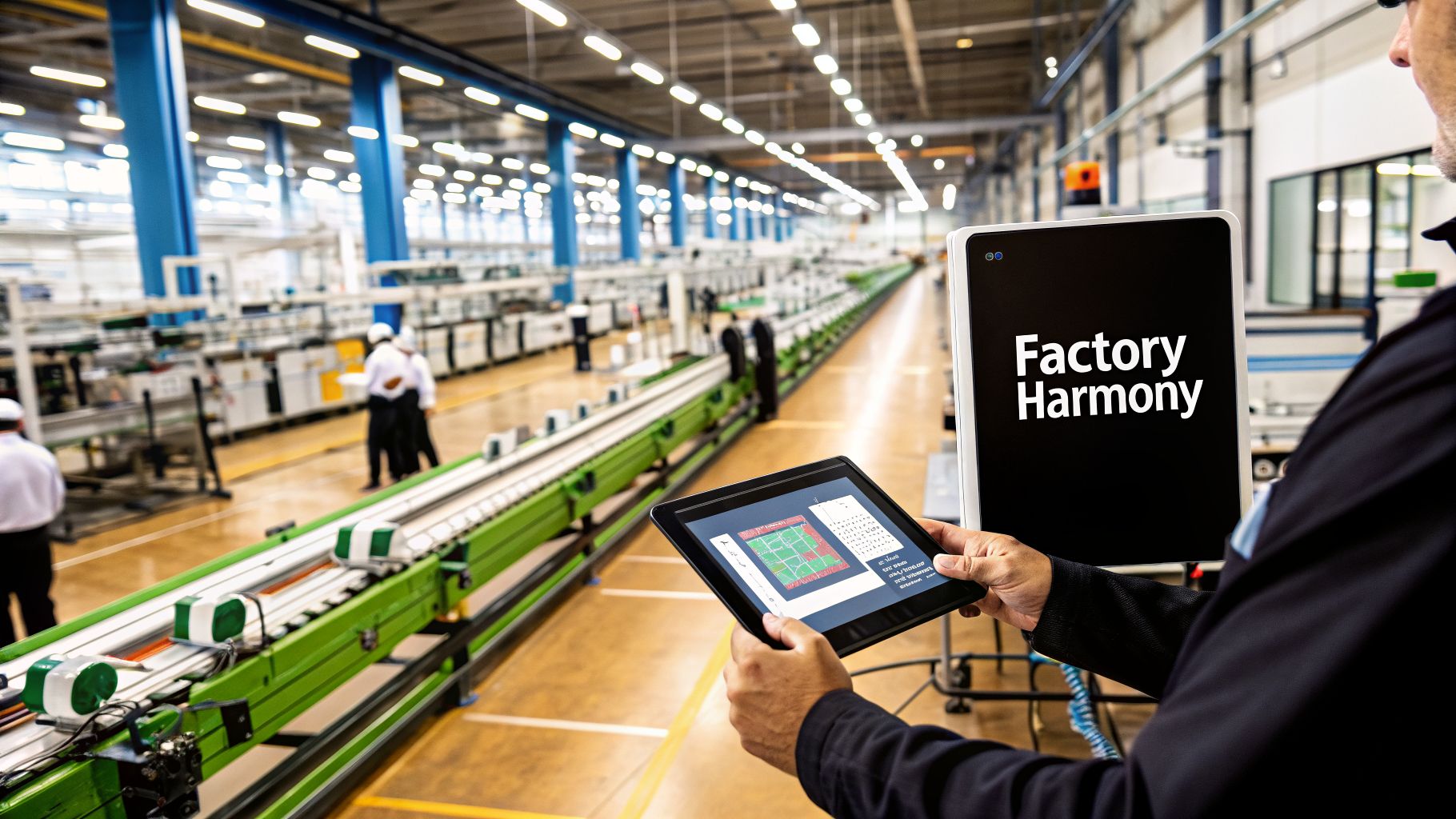
Picture your factory floor as a high-performance orchestra. The supply chain, production line, quality control, and finance teams are all brilliant musicians. But without a conductor, they're just playing their own tune, creating noise instead of music. A modern ERP is that conductor. It ensures every single department works in perfect harmony, reading from the same sheet of music.
This unified approach finally puts an end to the constant fire-fighting that comes from disconnected systems. Say goodbye to tedious manual data entry, surprise stock-outs, and unexpected production delays. Instead, you get a crystal-clear, real-time view of your entire operation, allowing you to spot bottlenecks before they become disasters, slash waste, and seriously boost productivity.
The Shift to Integrated Operations
Moving to a central system isn't just a trend—it's a fundamental change in how the most successful manufacturers get things done. It’s the essential backbone for implementing advanced Industry 4.0 principles and is what separates a reactive workshop from a proactive, data-driven smart factory.
The numbers back this up. The Australia ERP Software Market was valued at USD 930.18 million and is expected to climb to USD 1,190.52 million by 2030. Businesses making the switch are seeing incredible results, like achieving up to 23% reductions in inventory levels simply by improving their demand forecasting and resource planning. You can discover more insights about this growing market on Next MSC.
A purpose-built manufacturing ERP provides the visibility and control needed to compete effectively. It turns raw data into actionable intelligence, empowering you to optimise processes, reduce operational costs, and scale your business with confidence.
A Practical Case for Change
Let’s look at a real-world scenario. Imagine a metal fabrication business in Adelaide struggling with job costing. They use one system for quotes, a collection of spreadsheets to track material usage on the floor, and yet another program for invoicing. This disjointed mess leads to them constantly under-bidding on jobs, which eats away at their profit margins.
By implementing an ERP for the manufacturing industry, they bring everything under one roof. Suddenly, quotes are generated using live material costs. The shop floor automatically tracks labour and machine time against the job. Invoices are created the moment the job is marked complete. The result? Pinpoint-accurate costing, predictable profits, and a smooth workflow from quote to cash. This is a common success story we see with a well-executed Odoo implementation.
Ready to bring that kind of control to your factory? A skilled Odoo partner in Sydney or Adelaide can walk you through the entire journey, from initial software development in Sydney and Adelaide to seamless integration with your other essential platforms like your Shopify implementation or WooCommerce store.
Let's discuss how an Odoo implementation can bring harmony to your factory. Contact us today for a personalised consultation.
The Engine Room: Key Modules That Run Your Production Line
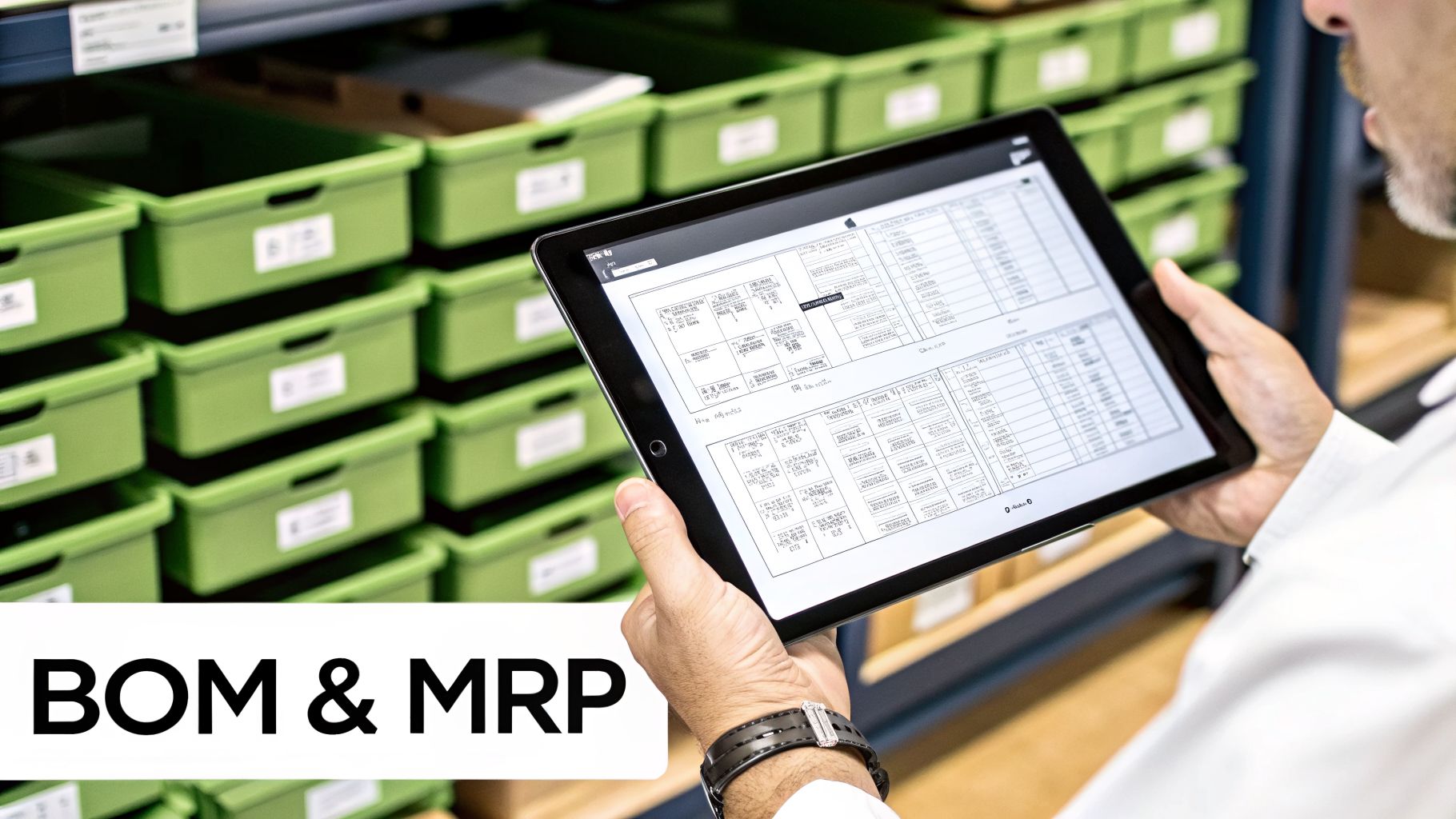
A proper ERP for manufacturing isn’t one giant, clunky program. It’s far smarter than that. Think of it as a suite of specialised tools, each designed to perfect one part of your production process. When these tools work in harmony, they turn your factory into a finely tuned, highly profitable machine.
Let’s pull back the curtain and look at the essential modules that make it all happen.
The absolute foundation of any manufacturing ERP is the Bill of Materials (BOM). This isn't just a list; it's the master recipe for your product. It details every nut, bolt, sub-assembly, and gram of raw material needed to create a single finished item.
Get the BOM wrong, and everything that follows—from purchasing to costing—will be inaccurate. It’s the single source of truth that the entire system relies on.
Material Requirements Planning: The Brains of the Operation
So, you have the recipe (the BOM). Now you need to figure out exactly what ingredients to buy and when to get them. That’s the job of Material Requirements Planning (MRP). This module is the strategic core of your supply chain.
It looks at your sales orders and production schedule, cross-references them with the BOM, and checks what you already have in stock. From there, it calculates precisely what you need to order and when, often generating purchase orders automatically. This simple process kills two of the biggest profit drains in manufacturing: production delays caused by missing parts and cash being tied up in a warehouse full of excess stock.
Practical Case: A custom furniture maker in Adelaide, for example, used their Odoo implementation to harness MRP. The system now automatically orders specific timber veneers and hardware the second a new cabinet order is confirmed. This single change cut their stock holding costs by over 30% and virtually eliminated delays while waiting for materials.
Shop Floor Control and Production Scheduling: Your Eyes and Ears
If MRP handles the what, then Shop Floor Control (SFC) and Production Scheduling handle the how and when. The scheduling module is your master coordinator, creating a detailed timetable that assigns jobs to specific machines, work centres, and people. It’s all about optimising the flow to get more done with less downtime.
The SFC module acts as your real-time command centre on the factory floor. It gives you an immediate, live view of:
- Job Progress: Know instantly which orders are running on time, which are finished, and which are falling behind.
- Machine Status: Track uptime, downtime, and performance to catch maintenance issues before they become critical failures.
- Labour Tracking: Capture the exact time your team spends on each task, giving you pinpoint accuracy for job costing.
This is where all that data comes together, allowing managers to spot a bottleneck and reallocate resources long before it threatens a delivery deadline. Of course, managing all this information effectively relies on having a solid system in place, often supported by a specialised document management system software for manufacturers.
Inventory and Quality Management: Protecting Your Assets and Reputation
Great Inventory Management goes way beyond a simple stocktake. A dedicated ERP module gives you a complete, 360-degree picture of everything you hold—raw materials, work-in-progress (WIP), and finished goods, even across multiple warehouses. If you want to dive deeper, we cover this in our guide to the best inventory management software.
By using tools like barcode scanning and real-time data feeds, an ERP’s inventory module can achieve over 99% stock accuracy. This makes your planning reliable and puts an end to those frantic, last-minute emergency orders.
Finally, the Quality Management (QM) module is your guardian of standards. It lets you build quality checks directly into your production workflow, from inspecting incoming raw materials to final product testing. If a bad batch of materials arrives, the system can flag and quarantine it immediately, ensuring it never makes it onto the production line to cause costly defects later.
These modules aren't just features; they're the pillars of a modern, competitive manufacturing business. When they're integrated seamlessly, they transform a series of disconnected tasks into a smooth, data-driven operation that gives you the control you need to scale.
Measuring the Real-World Impact of Your ERP
Putting an ERP system into your manufacturing business isn't just about getting new software. It's about getting real, measurable results that you can see on the balance sheet. Forget vague promises of 'efficiency'—we need to talk about the Key Performance Indicators (KPIs) that directly affect your profitability and give you an edge over the competition. These are the numbers that prove your investment was worth it.
A properly set-up ERP gives you the data to stop guessing and start making smart, informed decisions. By tracking the right metrics, you can see exactly where things are improving, where bottlenecks are still causing headaches, and how a small tweak on the shop floor ripples through to your bottom line. This is what data-driven manufacturing truly looks like.
The push for this kind of clarity is happening right now across Australia. A recent survey found a staggering 72% of Australian CFOs are planning to increase their ERP spend to sharpen their digital strategies and decision-making. On top of that, 85% of CFOs see their ERP as essential for handling local compliance like GST and payroll. You can discover more about how Australian businesses are planning their ERP strategies right here.
Tracking Overall Equipment Effectiveness
One of the most powerful metrics your ERP will unlock is Overall Equipment Effectiveness (OEE). Think of OEE as the gold standard for measuring how productive you really are. It’s not just about one thing; it multiplies three crucial factors to give you the complete picture:
- Availability: How much of the planned production time is your equipment actually running?
- Performance: How close are you running to the machine's top theoretical speed?
- Quality: Of all the parts you made, how many were good enough to sell?
A perfect OEE score of 100% means you’re making only good parts, as fast as possible, with zero downtime. Of course, perfection is a fantasy, but tracking your OEE gives you an honest, unflinching look at your operational health. We saw this with a food manufacturer in Sydney who used their Odoo implementation to discover one of their packaging lines was running at just 62% OEE, mostly due to lots of small, frequent stops. By digging into the data and fixing the root cause, they boosted OEE to 78% in three months, adding thousands of dollars to their daily output without buying a single new machine.
Optimising Cash Flow with Inventory Metrics
Cash flow is the lifeblood of any manufacturer, and nothing drains it faster than letting excess inventory pile up on your shelves. Your ERP is the key to monitoring your Inventory Turnover Rate—a KPI that shows how many times you sell and replace your entire stock over a specific period.
A high turnover rate is a brilliant sign. It means sales are strong and you’re not tying up precious capital in stock that’s just gathering dust.
Before their ERP, an Adelaide-based components supplier was stuck with a low turnover rate. They were constantly over-ordering just to be safe, which tied up a huge amount of cash. After getting an Odoo partner in Adelaide to overhaul their system, they finally had real-time visibility into sales trends and supplier lead times. This gave them the confidence to switch to a just-in-time inventory model, which increased their turnover rate by 40% and freed up a massive chunk of working capital.
Enhancing Customer Satisfaction Through Fulfilment
In today's market, customers expect speed and reliability. The Order Fulfilment Cycle Time measures the entire journey from the moment a customer clicks 'buy' to the moment the package arrives on their doorstep. A long cycle time is a red flag, pointing to problems in your order processing, production scheduling, or shipping department.
An ERP system smashes the walls between these departments. When an order comes in—whether it's from a B2B portal or an integrated e-commerce site like Shopify or WooCommerce—the ERP instantly checks inventory, schedules a production run if needed, and pings the warehouse. This kind of seamless automation dramatically cuts down the cycle time, improves your on-time delivery stats, and ultimately, builds the kind of customer loyalty that keeps people coming back.
Ready to see these kinds of results in your business? Our expertise in software development in Sydney and Adelaide ensures your ERP doesn't just work, but drives the outcomes that actually matter. Contact us to start measuring the true impact of your operations.
Your Practical ERP Implementation Roadmap
Rolling out a new ERP for the manufacturing industry can feel like a massive undertaking. It’s easy to get overwhelmed. But the secret isn’t in one giant leap; it's in breaking the journey down into a series of clear, manageable steps. A successful implementation is never about just flipping a switch—it's a carefully planned project that weaves the right technology directly into the fabric of your business goals.
We've found that a proven, phased approach is the best way to get it done. It turns a daunting challenge into an achievable plan, ensuring a smooth transition with the least possible disruption to your daily operations. Each stage builds on the last, gathering momentum and delivering real value along the way.
The whole point is to create a positive domino effect. Better productivity on the floor leads to healthier cash flow, which ultimately results in happier customers.
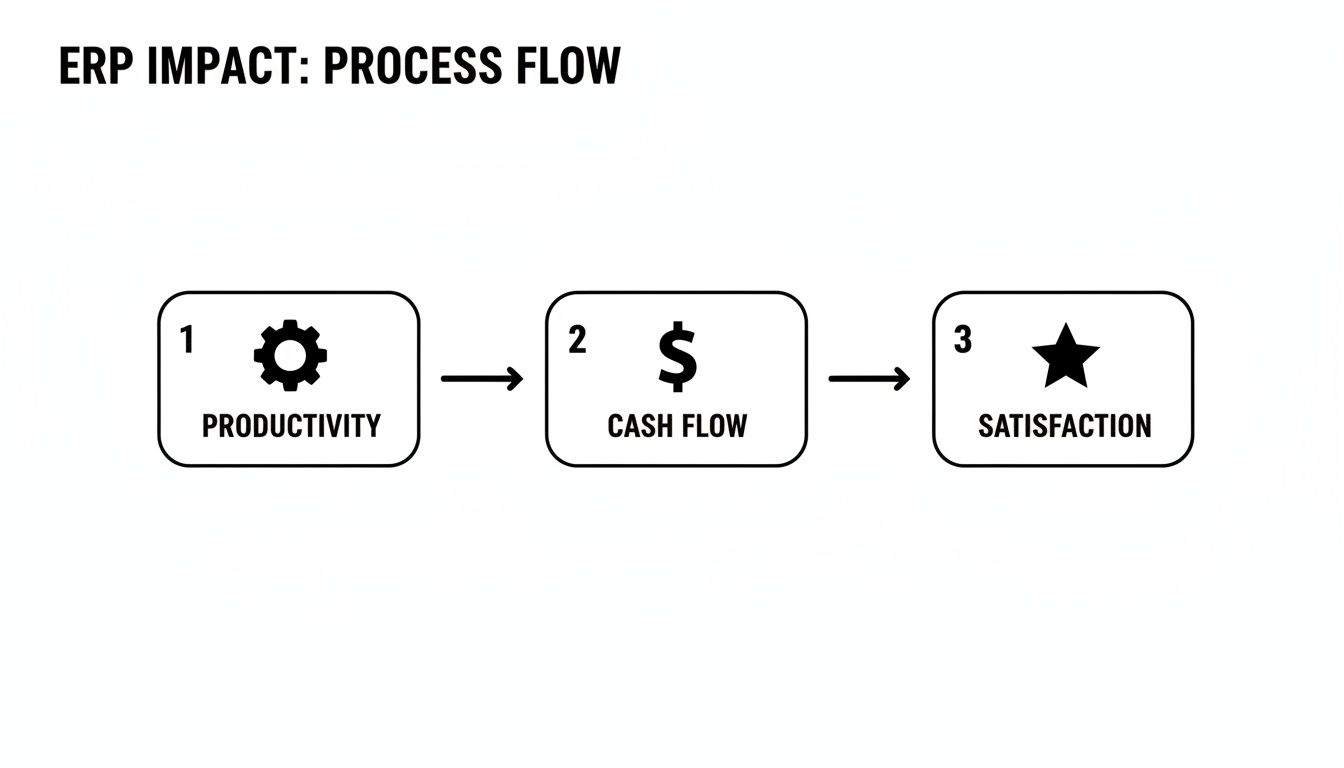
This isn’t just a theory. Operational gains create a chain reaction that ripples through the entire business, all the way to the person buying your product.
Phase 1: Discovery and Planning
Honestly, this is the most important part of the entire project. Before we even think about software, we need to get our hands dirty and understand your business from the inside out. We'll dive deep into your current processes, pinpoint the real pain points, and define exactly what a "win" looks like for you.
It's all about asking the tough questions. Where are your biggest bottlenecks right now? What information do you wish you had at your fingertips to make better decisions? Where do you see the business in five years? This groundwork ensures the system we build solves your actual problems, not just the ones a software brochure talks about.
Phase 2: Design and Configuration
With a rock-solid plan in hand, we can start designing the solution. This is where your chosen Odoo partner in Sydney or Adelaide gets to work, shaping the system to fit your unique workflows. Forget one-size-fits-all. This is about tailoring the ERP so it feels like it was built just for you.
We’ll configure the core modules—Manufacturing, Inventory, Quality Control—to mirror the processes we mapped out in phase one. This means setting up user roles, permissions, and the initial system parameters. The goal is a system that feels natural to your team from the moment they log in. Drawing on our software development in Sydney and Adelaide experience, we’ll also map out any integrations you need, like connecting your ERP to Shopify or WooCommerce for a seamless link between production and sales.
Phase 3: Data Migration and Testing
An ERP is useless without good data. This phase is all about carefully moving your critical business information—customer lists, supplier details, bills of materials—from the old systems into the new one. It demands meticulous attention to detail to clean, format, and transfer everything accurately. Get this wrong, and you're in for a world of pain after launch.
At the same time, we start testing. And we mean really testing. We run conference room pilots (CRPs), where your key people put the system through its paces using real-world scenarios. This is where we kick the tyres and make sure everything works exactly as it should. It’s the perfect time to find and fix any glitches before they can affect your live operations. If you're curious about the nitty-gritty, you can learn more about our ERP system implementation methodology.
Practical Case: An Adelaide Manufacturer’s Turnaround
We worked with an Adelaide-based manufacturer of custom metal parts who was drowning in spreadsheets. Scheduling was a manual nightmare, leading to conflicting jobs and constantly missed deadlines. Their inventory was all over the place—they’d run out of critical materials while other parts gathered dust for months.Our Odoo implementation followed this exact roadmap. In the design phase, we set up the MRP and Shop Floor Control modules to automate their entire production flow. During testing, their team ran dozens of actual job orders through the new system, which not only built their confidence but also helped us iron out a few small configuration wrinkles.
The result? After going live, they had real-time stock accuracy for the first time ever. The new scheduling system slashed their average lead times by a massive 20%, letting them take on more work and keep their customers happy.
Phase 4: Training and Go-Live
Once the system is fully tested and loaded with your data, the focus turns to your people. Great training is absolutely essential for getting everyone on board and making sure you see a return on your investment. We provide role-based training, so everyone from the machine operator to the CFO knows exactly how to use the parts of the system that matter to their job.
'Go-Live' is the big day—the carefully planned switch from your old ways to the new ERP. We can do this over a weekend or in stages to keep business disruption to an absolute minimum. With a good partner guiding you, it’s a smooth, well-managed event, not a chaotic scramble.
Phase 5: Support and Optimisation
The journey isn't over when the system is switched on. The final phase is all about ongoing support. We’ll be there to answer questions and sort out any issues as your team gets comfortable. More importantly, we'll work with you to keep optimising the ERP, refining workflows or adding new features as your business grows and changes.
This long-term partnership ensures your ERP evolves with you, delivering value for years to come. In fact, this focus on continuous improvement is a key reason Australian SMEs with modern ERPs are seeing profit boosts of up to 45%. These systems solve deep-rooted manufacturing headaches like fragmented data and tricky compliance.
Ready to build your own roadmap to manufacturing excellence? Contact our team today for a no-obligation consultation.
Choosing the Right ERP and Implementation Partner
Picking a new ERP for the manufacturing industry is one of the biggest calls you'll make for your business. The success of this major investment hinges on two things in equal measure: the software itself and, critically, the partner you choose to bring it to life. Get either one wrong, and even the most powerful system will fall flat.
Think of it this way: the software is the engine, but the implementation partner is the expert mechanic and engineer who installs it, tunes it to your specific needs, and makes sure it runs perfectly. The engine itself needs to be robust and built for the rigours of manufacturing, but the real difference between a chaotic rollout and a project that adds genuine value is the team guiding you.
What to Look for in an ERP Solution
Before you even think about partners, you need to be crystal clear on what the software must do. Not all ERPs are created equal, especially when you get into the nitty-gritty of a production environment. Your evaluation should be a practical, hands-on exercise, not just ticking boxes on a feature list.
Here are the absolute non-negotiables:
- Made for Manufacturing: Does it have strong, native modules for Bill of Materials (BOM), Material Requirements Planning (MRP), and Shop Floor Control? A generic, one-size-fits-all ERP will almost always cause headaches down the line.
- Ready to Grow: The system you choose today has to support where you want to be tomorrow. A solution that feels perfect now could become a frustrating bottleneck in three years if it can't handle more users, complex products, or a higher volume of transactions.
- Plays Well with Others: Your ERP can't operate in a silo. It needs to connect seamlessly with other vital systems. For manufacturers selling direct-to-consumer, for instance, a clean Shopify implementation or WooCommerce integration is essential to link the factory floor directly to the customer's shopping cart.
Why Your Implementation Partner is Your Most Important Choice
You can buy the best software on the market, but without an expert team to install, configure, and support it, you’ve just bought a very expensive and complicated problem. A great implementation partner is your guide, your technical expert, and your long-term support crew, all rolled into one. They bring more than just IT skills to the table; they bring deep industry knowledge.
An experienced Odoo partner in Sydney or Adelaide, for example, understands the real-world challenges Australian manufacturers face every day. They know the difference between discrete and process manufacturing and can speak your language. This expertise is what ensures the system isn't just installed, but meticulously shaped to your unique operational DNA. You can explore what top-tier Odoo implementers offer to see just how different this approach is.
Your partner’s job is to challenge your assumptions, find better ways to work, and ensure the ERP becomes a strategic asset, not just an operational cost. They transform a software project into a genuine business improvement project.
The difference between going it alone with an off-the-shelf product and working with a dedicated partner is night and day. This table breaks it down clearly.
Off-the-Shelf vs Partner-Led ERP Implementation
| Factor | Off-the-Shelf ERP | Customised Partner Implementation (e.g., Wistec Odoo) |
|---|---|---|
| Configuration | You are left to figure out complex manufacturing workflows on your own, often with minimal, generic support. | Experts who live and breathe manufacturing configure the system for your specific processes, ensuring it works exactly as you need it to. |
| Data Migration | A high-risk, often manual process. One mistake here can corrupt your data and cripple the system from day one. | A fully managed process that includes data cleansing and validation to guarantee a clean, accurate start. |
| Training & Support | You get generic online tutorials and a ticket system. Good luck getting someone on the phone who understands your setup. | Your team gets hands-on, role-based training. You have dedicated, local support from people who know your system inside-out. |
| Customisation | Extremely limited or impossible. You’re forced to change your business processes to fit the software’s rigid structure. | Backed by full software development in Sydney and Adelaide, the system is adapted to fit your unique business needs and competitive advantages. |
Ultimately, choosing the right partner for your Odoo implementation isn't just a good idea—it's the single best way to de-risk your investment and ensure you get the maximum return from it.
Ready to find a partner who understands your manufacturing business? Let's talk about how our expert team in Sydney and Adelaide can guide your ERP project to success.
Ready to Take the First Step?
You've just walked through the blueprint for modernising your factory floor. If there's one thing to take away, it's this: a manufacturing ERP isn't just another piece of software. It’s the central nervous system of a competitive, resilient manufacturing operation. Think of it as the key to finally getting that bird's-eye view you need to be efficient and grow without the constant chaos.
But knowing what to do is one thing. Actually doing it is where the real change happens.
Let's Talk About Your Factory
The path forward starts with a simple, honest conversation. The next logical step is to book a chat with our team—no strings attached. We can dive into what's really holding you back. Maybe it's wrestling with complex bills of materials, trying to make your Shopify implementation talk to your production line, or connecting WooCommerce to an inventory system that seems to have a mind of its own.
Taking action is what separates the businesses that just get by from the ones that truly lead their market. An ERP built for manufacturing doesn't just tidy up your data; it gives you the operational clarity to out-think and outperform the competition.
Real-World Problems, Practical Solutions
We've been down this road with countless Australian manufacturers. Just recently, we worked with a specialised components maker who was constantly fighting stockouts and pushing back delivery dates because their systems were a tangled mess. We rolled out a targeted Odoo implementation that automated their inventory and production scheduling. Suddenly, they had the control and insight they needed to scale up properly.
This is what we do. As a leading Odoo partner in Sydney and Adelaide, we bring more than just ERP knowledge to the table. Our deep roots in software development in Sydney and Adelaide mean we build systems that are perfectly moulded to your specific business goals. We don’t just install software; we build the engine that will power your growth for years to come.
Ready to build a smarter, more profitable manufacturing business? Let's map out your strategy together.
Schedule your free consultation with our manufacturing ERP specialists today and build the future of your business.
Frequently Asked Questions
You've got questions, and that's a good thing. Making a big decision like implementing an ERP means getting all the details straight. Here are some of the most common questions we hear from manufacturers just like you.
How Long Does a Typical ERP Implementation Take?
This is the big one, isn't it? For a small to medium-sized manufacturer, a typical Odoo implementation project usually lands somewhere between 3 to 9 months.
The final timeline really hinges on a few things: how many people will be using the system, the level of customisation you need, and how much data needs to be brought over from your old setup. We often recommend a phased rollout—getting core modules like inventory and production live first—to start delivering value much sooner.
Is Odoo a Good Fit for Small Manufacturers?
Absolutely. In fact, Odoo's modular approach makes it a fantastic ERP for the manufacturing industry, especially for smaller, growing businesses. You can kick things off with just the essentials—say, Manufacturing, Inventory, and Sales—and then bolt on other functions like Quality or Maintenance as your operations scale up.
This ‘pay-for-what-you-need’ model gives you all the power without the hefty price tag of larger, more rigid systems.
A key strength of Odoo is its scalability. It grows with you, so you're not paying for complex features you won't use for years. This makes it a smart, future-proof investment for ambitious manufacturers.
Can an ERP Connect to My E-commerce Store?
Yes, and this is non-negotiable for most modern manufacturers. As your Odoo partner in Sydney and Adelaide, a huge part of what we do is creating a seamless, two-way street between your ERP and your online store.
We take care of the technical heavy lifting for your Shopify implementation or WooCommerce integration, making sure sales orders, stock levels, and customer details sync up in real-time. Our background in software development in Sydney and Adelaide means you get a rock-solid connection that kills manual data entry and stops those frustrating stockouts before they happen.
Ready to build a manufacturing operation that’s more connected, efficient, and ready for growth? At Wistec, we build technology solutions that are driven by your unique business needs. Let's have a chat about how the right ERP can give you the control and clarity you need to scale confidently.
Contact us today to schedule your no-obligation consultation!