

Finding yourself over budget and behind schedule again? Chances are, the real problem is the tangle of disconnected spreadsheets, siloed accounting software, and paper timesheets you're wrestling with every day. It’s a costly reality for so many in the Australian construction industry, where fragmented data is a direct line to lost profits and frustrating project delays.
Why Disconnected Systems Are Holding Your Projects Hostage
Think about it like this: you wouldn't try to build a high-rise with multiple, conflicting sets of blueprints. Imagine the foundation team working from one version, the electricians from another, and the plumbers from a third. The result is predictable chaos—rework, missed deadlines, and an unhappy client. This is exactly what’s happening inside your business when you run on disconnected systems.
Each piece of software, from accounting to project management, holds a different piece of the puzzle. Without a central hub to bring it all together, you never see the full picture. Your project managers can't get a handle on real-time costs, your finance team struggles to match invoices to project progress, and critical decisions get made with outdated, incomplete information.
The True Cost of Data Chaos
This lack of a single source of truth isn't just an annoyance; it’s a massive financial drain. Poor data management has been a huge burden on the Australian construction industry, reflecting global trends where the problem cost the sector an eye-watering $1.85 trillion back in 2020 alone. For local firms, this translates to billions in lost productivity, all because of siloed systems.
This operational friction shows up in a few key ways:
- Budget Overruns: When cost tracking is messy and delayed, you don't realise you're overspending until it's far too late to fix it.
- Delayed Timelines: Poor communication between the office and the job site inevitably leads to mistakes that require time-consuming fixes.
- Reduced Profitability: Every single hour spent on manual data entry or correcting errors is an hour not spent on work that actually makes you money.
The Integrated Solution
The answer is an integrated ERP for construction industry solution. It acts as the central nervous system for your entire operation, connecting every department and function to provide one unified, real-time view of your projects. To get a better sense of how these systems pull everything together to control costs, it's worth reading a detailed overview like A Homebuilder's Guide to Construction Enterprise Resource Planning.
This is where an expert Odoo partner in Sydney and Adelaide makes all the difference. At Wistec, we specialise in custom Odoo implementation and software development in Sydney and Adelaide, designed to turn operational chaos into organised success. While we also handle Shopify implementation and WooCommerce projects, our passion is creating a single, powerful system for your business.
Ready to connect your operations and finally take back control of your projects? Contact Wistec today for a free consultation and let's explore how a unified ERP can help you build a more profitable future.
The Blueprint for a Modern Construction ERP
So, what exactly makes a construction ERP tick? Forget thinking of it as just another piece of software. It’s better to see it as your project’s central nervous system, where every module is a key player on your team, all communicating in real time. It's a single, unified platform built to bring order to the controlled chaos that is a construction project.
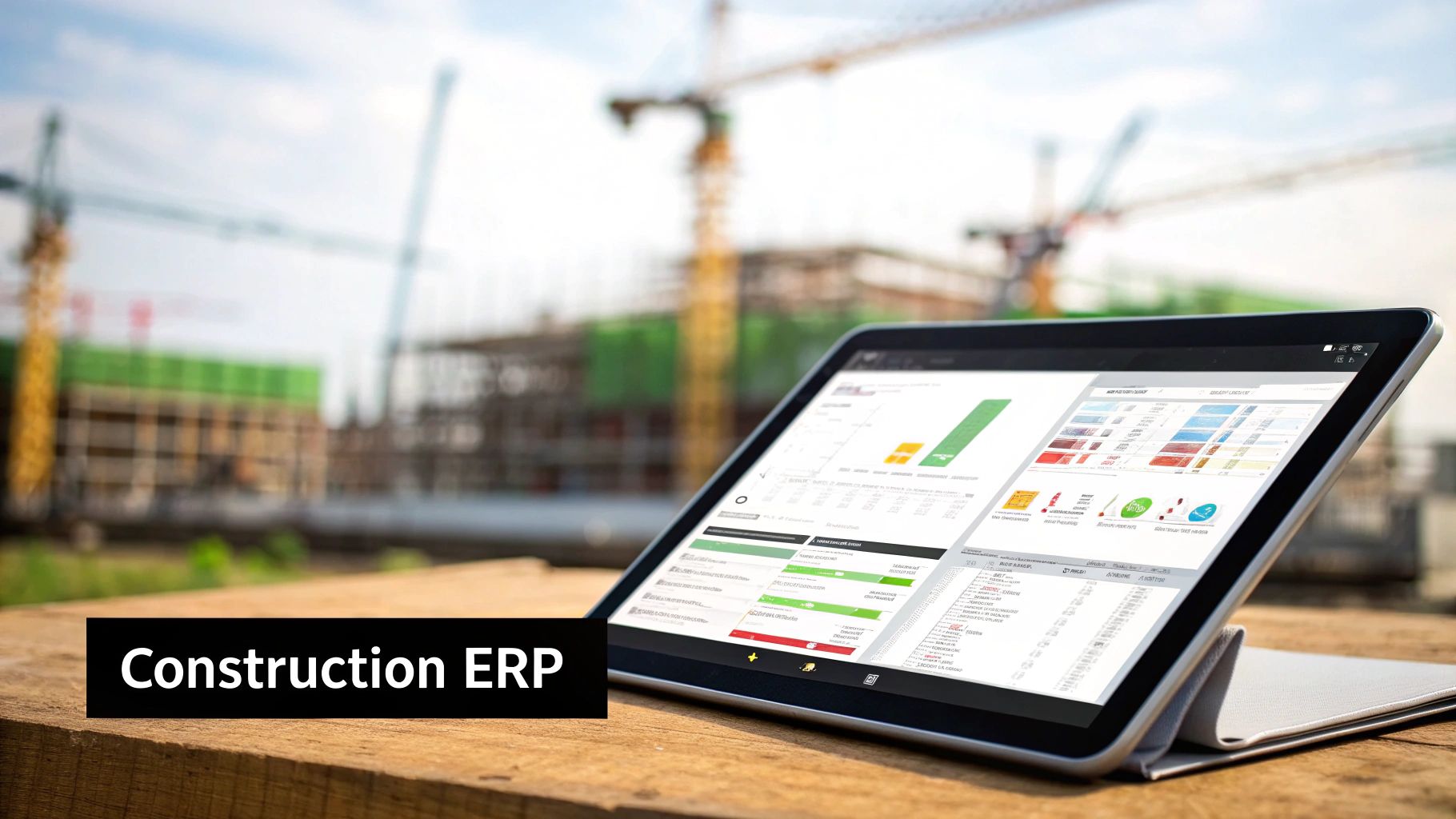
At its heart, the system is made up of core components, or modules, that are designed to work together seamlessly. Each one is built to solve a specific challenge you face on the job site and in the back office, turning isolated data points and disconnected tasks into a smooth, efficient operation.
Let's break down the essential players on the team.
H3: Project Management: The Digital Site Foreman
Think of the Project Management module as your digital site foreman. It’s the conductor of the orchestra, keeping timelines tight, allocating the right resources, and making sure every single task—from pouring the foundation to the final handover—is tracked and completed on schedule. This gives you a crystal-clear, live view of project progress, flagging potential delays long before they become expensive problems.
Practical Case: An Adelaide-based commercial builder used their Project Management module to connect site supervisors' daily log apps directly to the main project timeline. When a concrete pour was delayed by weather, the system automatically pushed back dependent tasks like framing and notified the relevant subcontractors, preventing a costly scheduling pile-up.
H3: Financial Management: The Project Treasurer
Next up is the Financial Management module, which essentially acts as your project’s dedicated treasurer. This is where your cost control lives, giving you an immediate and accurate picture of every dollar spent and earned. It ties job costing, payroll, invoicing, and accounts payable into one seamless financial workflow.
Imagine knowing your exact profit margin on a project at any given moment, not just weeks after it’s wrapped up. This module makes that a reality by linking labour hours and material costs directly to specific project activities. It also simplifies the headache-inducing parts of the job, like subcontractor payments, and helps ensure you’re always compliant with Australian labour laws and tax obligations. A key goal of any modern ERP is to automate business processes, and this is where it delivers serious financial value.
H3: Procurement and Inventory: The Supply Chain Guardians
Nothing grinds a project to a halt faster than running out of a critical material. The Procurement and Inventory module is your supply chain guardian, stepping in to prevent those shortages before they can even happen. It handles everything from automating purchase orders and tracking material deliveries to managing stock levels in the warehouse or on-site.
By connecting procurement directly with your project timelines, the system ensures materials are ordered and delivered precisely when they're needed—not too early, and definitely not too late. This cuts down on waste, puts a stop to expensive rush orders, and keeps your crews on the tools.
H3: Asset Management: The Equipment Expert
Your heavy equipment and tools are some of the most valuable assets you own. The Asset Management module is the expert in charge of keeping them running smoothly and efficiently. It tracks maintenance schedules, monitors usage hours, and manages the location of every single piece of machinery in your fleet.
A well-maintained fleet is a profitable fleet. Proactive maintenance slashes the risk of unexpected breakdowns, which are a notorious source of project delays and budget blowouts. This module turns asset management from a reactive headache into a smart, proactive strategy.
This part of the system is all about maximising the return on your equipment investment by ensuring high uptime and smart allocation across different job sites. It makes sure the right machine is in the right place at the right time, ready to work.
H3: Key ERP Modules and Their Impact on Construction
To put it all together, this table shows how each core module directly contributes to a more successful project outcome.
| ERP Module | Core Function | Primary Benefit |
|---|---|---|
| Project Management | Schedules tasks, allocates resources, tracks progress, manages RFIs and change orders. | Improves on-time delivery, reduces delays, and enhances communication between site and office. |
| Financial Management | Manages job costing, payroll, invoicing, budgeting, and financial reporting. | Provides real-time profit visibility, tightens cost control, and ensures financial compliance. |
| Procurement & Inventory | Automates purchasing, tracks material orders, and manages stock levels. | Prevents material shortages, reduces waste, and optimises just-in-time delivery. |
| Asset Management | Schedules maintenance, tracks equipment location and usage, and manages fleet health. | Minimises downtime, reduces repair costs, and maximises equipment return on investment. |
These core modules are the foundation of a system designed to drive both efficiency and profitability on every project you undertake. At Wistec, as an Odoo Partner in Sydney and Adelaide, we specialise in Odoo implementation and custom software development to build out these blueprints using powerful, flexible platforms like Odoo. For a deeper look at how it works, you can explore the https://wistec.com.au/odoo-erp/.
Let's Talk Brass Tacks: How an ERP Actually Makes You Money
Okay, let's cut through the jargon and talk about what really matters: your bottom line. An ERP system isn't just another line item on your software budget; it's a direct investment in making your construction business more profitable. When you get it right, the features on the screen translate into real dollars in your bank account.
The first and most obvious win? You get your team's time back. Just think about the hours your project managers, estimators, and office staff burn every single week manually punching in numbers, chasing down invoices, or trying to make five different spreadsheets talk to each other. A good ERP with automated workflows can genuinely slash that admin time by up to 50%.
That means your PMs are out on site, solving real problems and keeping the job on track, not chained to a desk doing paperwork. You're shifting their focus from low-value admin to high-value work that actually protects your margins.
Moving from Damage Control to Profit Control
We’ve all been there—the slow, painful creep of a budget blowout. It’s one of the biggest financial killers in this industry. An ERP gives you the live, real-time visibility you need to get ahead of it. Every single cost, whether it’s a box of screws or a major subcontractor claim, is tracked against the budget as it happens.
This isn't about looking at a report at the end of the month and finding out you're in the red. It's about seeing a small leak the moment it starts, so you can patch it before it becomes a flood.
Here’s where you’ll see the money flow back into the business:
- Slash Material Waste: With dead-accurate inventory tracking, you order precisely what you need, right when you need it. This puts a stop to expensive over-ordering, cuts down on the chances of theft from the site, and minimises materials getting damaged or going off.
- Speed Up Your Cash Flow: Automated invoicing and payment reminders get your claims out the door faster and track who owes you what. Getting paid on time is absolutely critical for keeping the cash flowing to cover wages and suppliers without having to rely on expensive credit.
- Build Rock-Solid Client Trust: Imagine being able to give your clients and investors crystal-clear, accurate progress reports at the drop of a hat. That level of transparency builds immense confidence, which is gold when it comes to winning repeat business and securing your next big project.
The Proof is in the Numbers
This isn't just theory; the impact is well and truly proven. Australia's ERP software market is already huge, valued at USD 930.18 million in 2024 and it's only getting bigger. More importantly, within our own industry, a massive 62% of construction companies that implement an ERP report tangible cost savings. Why? Because automation kills off double-handling and helps them use their resources far more efficiently.
In fact, it’s not uncommon for businesses to see returns on their ERP investment hit between 150-300%. That’s how a technology spend becomes a serious value-generator. If you're interested in the broader trend, you can read the full report about the Australian ERP market.
At the end of the day, this is more than just software—it's a foundational tool for modern construction management. A properly implemented ERP pays for itself not just in the costs you save, but in building a stronger, more efficient, and ultimately more profitable company.
This is exactly the kind of concrete ROI an expert Odoo partner in Sydney and Adelaide like Wistec helps you achieve. While our software development in Sydney and Adelaide covers everything from Shopify implementation to WooCommerce, our focus with an Odoo implementation for a construction business is always the same: turning your operational data into your most powerful financial asset.
Ready to see how an ERP can transform your bottom line? Contact Wistec for a personalised consultation and let's build your ROI roadmap together.
Weaving AI and Automation into Your Workflow
The next big leap in construction management is already here, and it's built on intelligence. Bringing Artificial Intelligence (AI) and automation into your ERP isn't just a sci-fi concept; it's a very real strategy for building a serious competitive advantage. Think of it as giving your projects a crystal ball—the power to see problems before they actually happen.
This is the magic of AI-driven predictive analytics. By digging through mountains of historical project data—everything from past timelines and subcontractor performance to material costs and even weather patterns—the system can forecast potential delays and budget blowouts with unnerving accuracy. You stop reacting to problems and start preventing them from ever taking root.
Shifting from Reactive to Predictive Project Management
A smart ERP for the construction industry doesn't just collect data; it uses AI to actively sniff out risks that are simply impossible for a human to spot. For example, it might flag that a specific combination of a certain subcontractor, a particular project type, and the winter season has historically led to a 15% schedule slippage.
That's the kind of heads-up that lets you make smarter decisions, faster. You can get ahead of resource scheduling by predicting crew availability or even automate safety compliance on-site using image recognition to check that everyone is wearing the right PPE. It’s about turning your own company’s hard-won experience into your sharpest tool for planning the future. You can find out more about using AI to improve productivity in your business.
Connecting the Site to the System in Real Time
Modern ERPs are also evolving into the central nervous system for all your other site tech. Your system can link up seamlessly with the mobile apps your crew uses in the field or even pull in data from drone flyovers. This creates a constant stream of real-time information, giving you an unmatched view of progress and feeding live site conditions straight back into your project management and financial dashboards.
By 2026, the integration of AI into construction ERP systems is set to revolutionise project delivery across Australia. These predictive tools are crucial for forecasting timelines and labour needs, which is especially vital given the sector's ongoing labour shortages. By monitoring thousands of data points, advanced platforms can proactively flag risks related to budgets, safety, and even weather disruptions. Discover more insights about the future of AI in construction ERP on in4velocity.com.
This level of connectivity gets your business ready for what's next. You’re no longer just managing projects; you're intelligently steering them with foresight backed by hard data. At Wistec, we're more than just an Odoo partner in Sydney and Adelaide—we're a forward-thinking software development team. We have deep expertise in Odoo implementation, Shopify implementation, and WooCommerce, and we know how to build the intelligent, automated systems your business needs to win.
Are you ready to equip your business for the future of construction? Contact Wistec to discuss how we can integrate AI and automation into your workflow.
Your Odoo Implementation Roadmap
Getting a construction ERP up and running isn't like flicking a switch. It's a journey, and a well-planned one at that. If you get it wrong, you’re looking at costly disruptions and a system that never quite delivers. That's why working with an expert is so crucial—they provide a clear roadmap that breaks a massive project down into manageable, strategic steps.
The idea is to build a system around your business, not force your business to fit the software. It's a team effort from day one, designed to create a powerful tool that your people will actually want to use.
The Odoo implementation process typically follows a three-stage flow, making sure everything is handled correctly from the initial idea right through to launch.
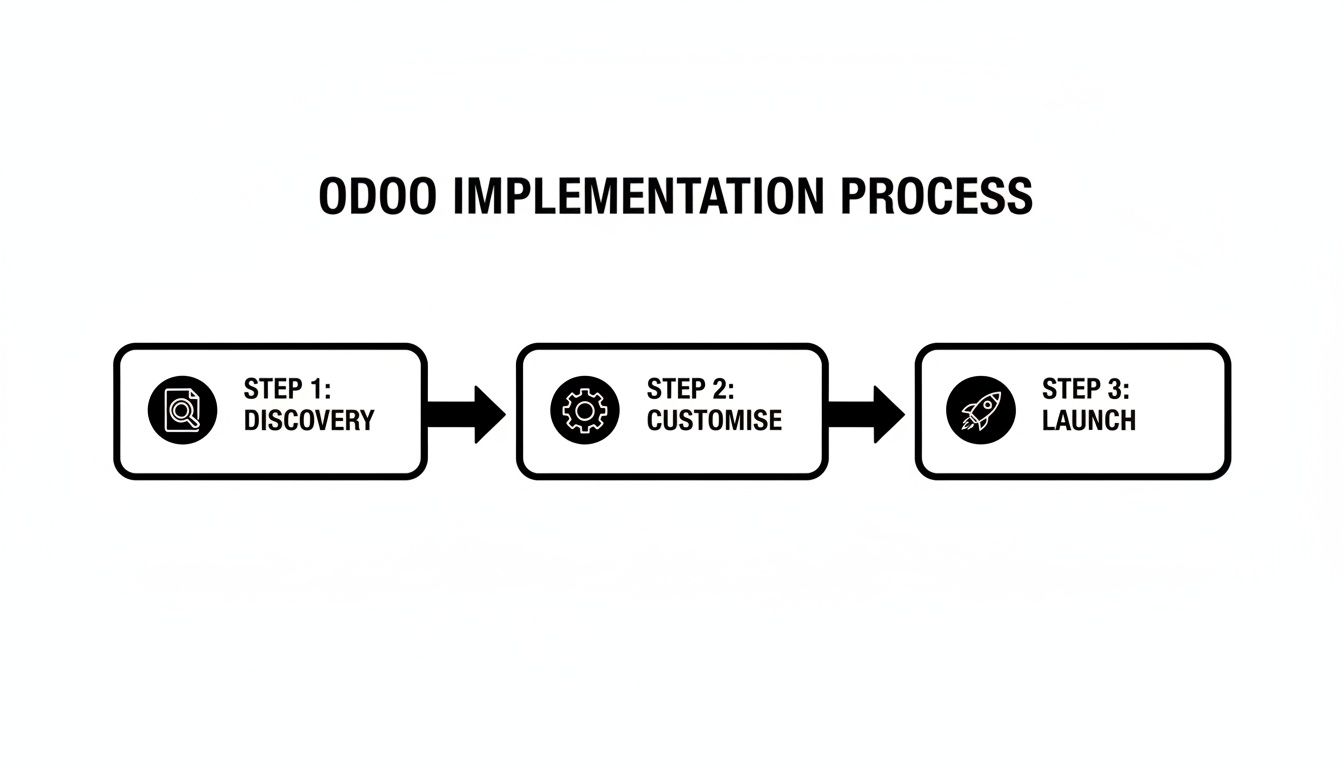
As you can see, a successful launch depends entirely on a solid foundation of discovery and careful customisation.
Phase 1: The Discovery and Planning Foundation
Honestly, this is the most important part of the entire project. Before anyone writes a single line of code, a skilled Odoo partner in Sydney and Adelaide needs to get their hands dirty and learn how your business really works. We're talking about a deep dive into your operations.
The goal is to understand everything from how you bid on jobs to the way you handle subcontractor payments. We map out your workflows, pinpoint the exact sources of frustration, and clarify what you want to achieve. This isn't just about software; it's about making your business run better.
Phase 2: Customisation and Data Migration
Once we have that solid blueprint, the real building begins. Odoo is an incredibly flexible platform, and this is where we shape it to fit your business like a glove. This could mean creating custom job costing reports, setting up automated approval workflows, or connecting it to other essential tools you already rely on.
At the same time, we get started on data migration. This is where so many projects stumble. Pulling clean, accurate data from old spreadsheets and siloed software into your new ERP is absolutely essential for a smooth start. A careful, meticulous approach here avoids the classic "garbage in, garbage out" trap that can cripple a system from day one.
A common pitfall is underestimating how tricky data migration can be. An experienced partner makes sure your historical project data, client lists, and financial records are moved across correctly, giving you a reliable foundation from the moment you go live.
This is where your software development Sydney and Adelaide partner really proves their worth, turning a standard platform into your company’s unique central hub. Whether it's an Odoo implementation, a Shopify implementation, or a WooCommerce project, this tailored approach is what makes all the difference.
Phase 3: Go-Live and Ongoing Support
"Go-Live" day is the exciting finish line for all the planning and hard work. But the job isn't done. The best partners provide thorough training to make sure your entire team feels confident with the new system right from the start. This is the key to getting everyone on board and maximising your return on investment.
After the launch, reliable support is just as important. Your business will grow and change, and your ERP will need to keep up. Having a local partner you can call on for support, troubleshooting, and future upgrades ensures your investment keeps paying off for years to come. For more on this, check out our guide on what to look for in expert Odoo implementers.
A successful ERP project is a genuine partnership, from start to finish. Are you ready to build a smarter, more connected construction business? Contact Wistec today for a consultation and let's map out your success together.
A Sydney Builder's Success Story
It’s one thing to talk theory, but it’s another to see how this all works in the real world. Let’s look at a mid-sized Sydney builder who was dealing with all the usual headaches. Their business was a mess of disconnected spreadsheets, late invoices creating drama with their subbies, and absolutely no real-time view of where project costs were actually sitting. Figuring out their profit margin on a job was pure guesswork until weeks after it was wrapped up.
They knew they couldn't grow the business on such a dodgy foundation. The constant admin was drowning their project managers in paperwork, keeping them in the office instead of out on site where they needed to be. That was the tipping point. They decided to find an Odoo partner in Sydney who actually got the construction industry.
The Wistec Solution
After they brought us on board, the first thing we did was a proper deep dive into how they really worked. Our software development Sydney team didn’t just install some off-the-shelf software; we mapped out a custom Odoo implementation that targeted their biggest pain points. A key focus was automating payments to their subcontractors and tying the procurement module directly into their on-site material needs.
What did this mean in practice? Purchase orders were now linked straight to project budgets. Material deliveries were tracked from the supplier right to the site gate. We configured the financial module to automatically process subcontractor invoices once work milestones were ticked off, which put an end to the frustrating payment delays and arguments.
The results were solid and you could measure them.
Within the first year, the company cut its administrative overhead by a massive 20% and saw project completion times improve by 15%. This wasn't just about being a bit more efficient; it was about building a stronger, more profitable business.
This Sydney builder’s journey is a perfect example of how the right ERP for the construction industry is more than just software—it’s a tool for growth. They went from constantly putting out fires to proactively managing their entire operation with clarity and confidence.
Checklist Before You Choose Your ERP Partner
Choosing the right partner is just as critical as choosing the right software. A good partner understands your industry's quirks and knows how to get the most out of the system. For any Aussie construction business looking at a new ERP, here’s a practical checklist to help you vet potential partners like us.
| Evaluation Criteria | Key Questions to Ask | Why It Matters |
|---|---|---|
| Industry Experience | Can you show us case studies from other construction companies you've worked with in Australia? | Construction has unique needs (e.g., progress claims, retentions). You need a partner who speaks your language, not a generic IT firm. |
| Technical Expertise | Who is on your development team? Are they in-house or outsourced? What are their qualifications with Odoo? | In-house expertise means better communication, accountability, and a deeper understanding of the platform's capabilities for customisation. |
| Implementation Process | What does your discovery and implementation roadmap look like? How do you handle data migration from our old systems? | A clear, structured process minimises disruption. A vague plan is a major red flag for budget blowouts and delays. |
| Post-Launch Support | What kind of ongoing support, training, and maintenance packages do you offer after we go live? | The job isn't done at launch. You need a reliable partner for bug fixes, user training, and future system enhancements. |
| Local Presence | Are your consultants and support staff based in Australia? Can we meet them face-to-face? | Having a local team in Sydney or Adelaide means they understand the local business environment and are in your time zone when you need help. |
This isn’t just about ticking boxes; it's about finding a team you can trust to become a genuine extension of your own.
Ready to write your own success story? Contact Wistec for a no-obligation chat today. Let our experts in Sydney and Adelaide show you what a properly configured Odoo solution can really do for your construction business.
Your Top ERP Questions, Answered
Deciding to bring an ERP into your construction business is a big move, and it's smart to have questions. You're talking about a significant investment in how you operate, so you need to be sure. Let's tackle some of the most common questions we hear from construction owners just like you.
How Long Will an ERP Implementation Actually Take?
This is usually the first thing people ask, and the honest-to-goodness answer is: it varies. The timeline for an Odoo implementation is tied directly to how complex your business is and how many modules you need to get up and running. For a typical mid-sized Aussie construction firm, you're usually looking at a timeframe of three to nine months.
What really shapes that timeline is the discovery phase at the start. A good Odoo partner in Sydney or Adelaide won't just jump in; they'll spend real time upfront digging into your specific workflows. This detailed planning is what allows them to map out a clear project plan with realistic deadlines, so there are no nasty surprises waiting for you down the track.
Is This Really Affordable for a Smaller Construction Business?
Yes, absolutely. The old myth that ERPs are just for the big end of town is well and truly busted. Modern, cloud-based systems like Odoo have a modular design, and that’s a massive advantage for smaller and growing businesses.
What does that mean for you? It means you don't have to buy a huge, one-size-fits-all system on day one. You can start with the absolute essentials—say, project management and financials—and then simply add more capabilities as your company grows. This makes it a much smarter, more affordable way to operate, avoiding the massive upfront costs that came with older, clunky systems.
The real power of a modular ERP is that it lets you invest strategically. You pay for what you need today, knowing you have a clear path to expand the system's power as your business and its needs evolve.
Will My Team Actually Use It?
This is the make-or-break question. A powerful system is completely useless if your team finds it too confusing and avoids it. Thankfully, the days of clunky, hard-to-learn software are largely behind us. Modern ERPs are built with clean, intuitive interfaces that people can pick up much more quickly.
Beyond the software itself, a good implementation partner knows that training isn't just a tick-a-box exercise. They’ll deliver hands-on training tailored to the different roles in your company. Your project managers, accounts team, and site supervisors will all get shown how to use the system for their specific daily tasks. This approach makes for a much smoother transition and helps everyone see the benefits for themselves, fast.
This focus on people is central to quality software development in Sydney and Adelaide. Whether we’re handling a Shopify implementation or a WooCommerce project, that core principle of designing for the user never changes.
Ready to get straight answers to your own questions? The team at Wistec is here to cut through the noise. As a leading Odoo partner, we can walk you through the whole process and build a solution that’s right for your business.