

Ever felt like you’re trying to run your business with one hand tied behind your back? For example, you have one system for your finances, another for sales, and your inventory is tracked on a spreadsheet that’s probably out of date by the time you open it. As a result, it becomes organised chaos, and it’s holding your business back.
This is where an Enterprise Resource Planning (ERP) system comes in. Essentially, think of it as the central hub for your entire operation. Instead of juggling a dozen different tools that don’t talk to each other, an ERP brings everything together—from accounting and HR to your supply chain and customer relationships—into one cohesive platform.
As a result, it creates a single source of truth. More importantly, it gives you a clear, real-time picture of what’s happening across your business, allowing you to make smarter and faster decisions.
From Silos to Synergy: What ERP Delivers
When different parts of your business can’t communicate, you get bottlenecks, costly mistakes, and missed opportunities. An ERP breaks down these walls, creating a seamless flow of information that turns isolated functions into a powerful, unified machine.
Here’s a breakdown of that transformation:
| Core Business Function | The Problem Without ERP | The Solution With ERP |
|---|---|---|
| Finance & Accounting | Manual data entry, delayed financial reports, and a foggy view of cash flow. | Automated invoicing, real-time financial dashboards, and accurate forecasting. |
| Sales & CRM | Disconnected customer data, inefficient lead tracking, and missed sales opportunities. | A complete 360-degree view of every customer, streamlined sales pipelines, and better service. |
| Inventory Management | Stockouts or overstocking, manual stocktakes, and inaccurate order fulfilment. | Live inventory tracking, automated reordering, and optimised warehouse operations. |
| Human Resources | Clunky payroll processes, tedious leave management, and disconnected employee records. | Integrated payroll, self-service employee portals, and simplified compliance. |
| Project Management | Poor resource allocation, budget overruns, and missed deadlines. | Centralised project tracking, automated time-sheeting, and real-time budget monitoring. |
Ultimately, an ERP isn’t just about organising data; it’s about using that organised data to make smarter, faster decisions that directly impact your bottom line.
A Market on the Verge of Explosive Growth
The push for enterprise resource planning in Australia isn’t just a trend; it’s a fundamental shift in how businesses operate. The numbers paint a clear picture. Valued at USD 1405.2 million in 2024, the Australian ERP market is on a steep upward trajectory.

Projections show it soaring to USD 7568.9 million by 2035, driven by a massive compound annual growth rate of 16.54%. For a deeper dive, you can explore the full market projections to see just how significant this movement is.
So, what’s fuelling this incredible growth? It comes down to a few core needs that Aussie businesses can no longer afford to ignore:
- The Need for Real-Time Data: Gut-feel decisions are a thing of the past. Success now depends on having live dashboards and analytics at your fingertips.
- Operational Efficiency: Why have your best people bogged down in repetitive admin? ERPs automate the grunt work, freeing up your team to focus on innovation and growth.
- Scalability for the Future: A modern cloud ERP grows with you. Whether you’re adding new product lines, expanding interstate, or launching online, the system scales to meet your needs.
Real-World Wins for Australian Businesses
The theory sounds great, but what does this look like in practice?
To begin with, consider a practical case. A Melbourne-based e-commerce store with a popular Shopify site was struggling during a major sale. They oversold a popular item because their inventory system didn’t update in time. As a result, customers placed orders for products that were no longer in stock. However, after an Odoo implementation, their Shopify store was tied directly to their ERP system. Now, sales, inventory, and customer data sync instantly, ensuring stockouts and customer disappointment are no longer an issue.
Similarly, think of a manufacturing firm in Perth. By using an ERP, they can track every screw and every minute of labour from the moment an order is placed to the final delivery. Consequently, this level of visibility gives them precise control over costs and timelines. In turn, it helps sharpen their competitive edge in a highly competitive market.
We see this transformation frequently with professional services firms. Many of them struggle with manual timesheets and complex project billing. By implementing an ERP like Odoo, they can automate time tracking, link billable hours directly to client projects, and generate accurate invoices with just a click. As a result, their billing process becomes faster, more accurate, and far easier to manage, which ultimately improves cash flow and overall profitability.
However, technology alone is not the complete solution. This is where the right expertise makes all the difference. A specialist Odoo partner in Sydney or a team experienced in software development in Adelaide will not simply sell you software. Instead, they will analyse your specific operational challenges. For instance, they may integrate your ERP with an existing WooCommerce store or design a customised workflow that fits your unique processes.
Ultimately, the first step is recognising that disconnected systems are the anchor holding your business back. Once you address this challenge, you can begin building a more efficient, connected, and scalable operation. The question now is simple: are you ready to cut the rope and unify your business systems?
How ERP Drives Profitability in Your Industry
An effective enterprise resource planning Australia system isn’t some generic, off-the-shelf software. Think of it more like a precision tool, specifically engineered to solve your industry’s most expensive headaches. Its true power shines when it’s configured to fix the exact operational pains holding your business back, turning those frustrating bottlenecks into genuine profit centres.
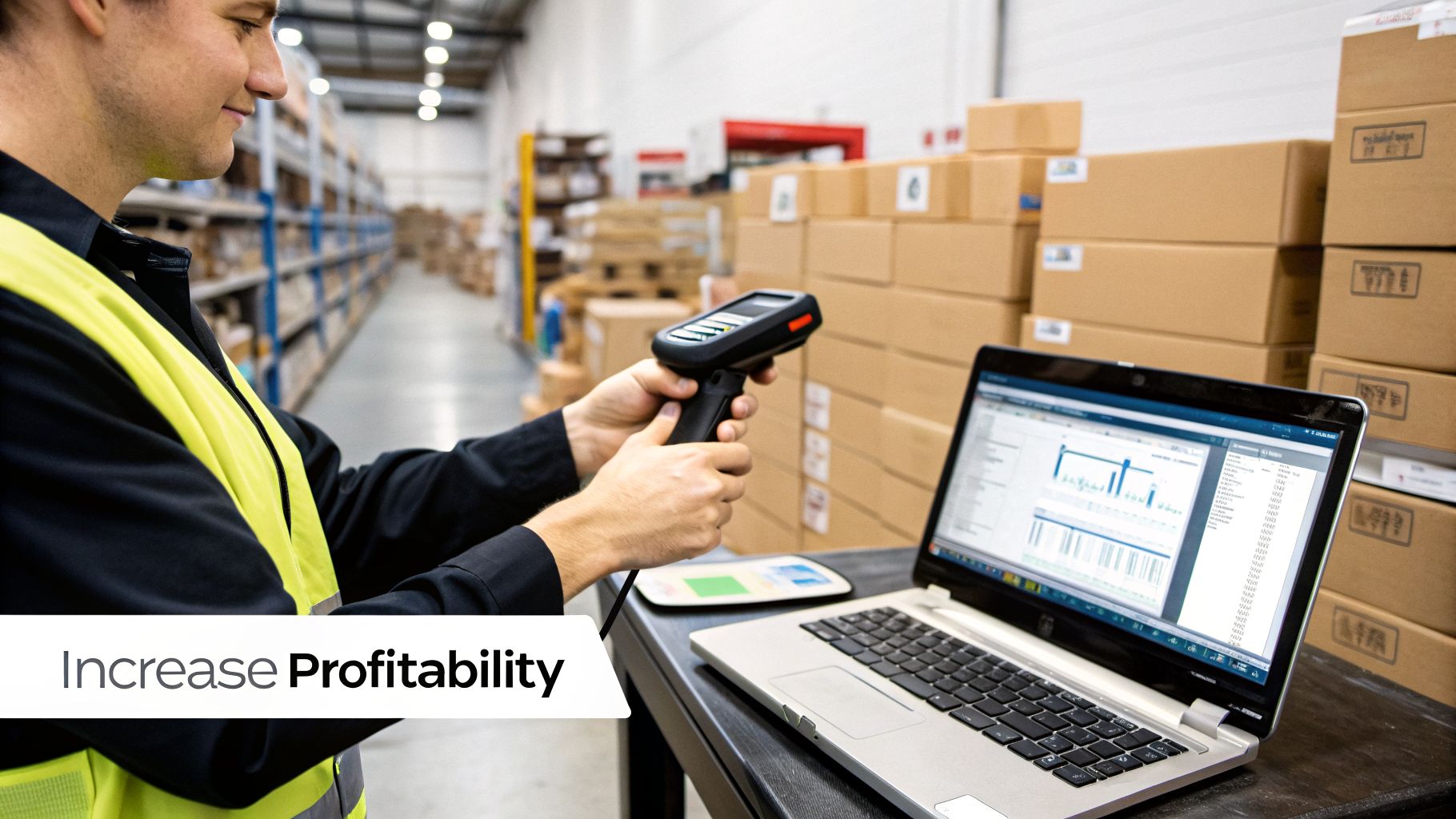
Theory is one thing, but results are what really count. Let’s get out of the clouds and look at the real-world, money-making applications of a well-implemented ERP across key Australian industries.
Retail and E-commerce Automation
Practical Case: For Australian retailers, particularly those on platforms like Shopify or WooCommerce, the biggest nightmare is often inventory management. Trying to manually sync stock across a website, physical store, and marketplaces is a recipe for disaster. It leads to overselling during a big sale, which means unhappy customers and an administrative mess to clean up.
This is where a targeted ERP completely changes the game. A proper Shopify implementation tied to an Odoo implementation automates inventory syncing in real time. When a product sells online or in-store, the stock count updates everywhere—instantly. This simple change eliminates overselling, cuts down on mind-numbing data entry, and gives you a crystal-clear picture of what’s actually selling.
Manufacturing and Supply Chain Control
The Australian manufacturing sector is in a constant squeeze between complex supply chains and razor-thin margins. Without one source of truth, you’re left wrestling with disconnected spreadsheets to track raw materials, juggle production schedules, and keep costs in check. It’s an uphill battle.
An ERP gives manufacturers a command-and-control view of the entire production line. From forecasting what you’ll need and ordering materials to scheduling machine time and tracking finished goods, every single step becomes visible and optimised. This level of control is how you minimise waste, boost efficiency, and hit your delivery deadlines, every time.
If you’re looking for that competitive edge, we dive much deeper into this topic in our guide on enterprise resource planning for the manufacturing industry. This is also where specialised software development in Sydney, Adelaide can be a game-changer, tailoring the system to fit your unique workflows like a glove.
Logistics and Warehouse Optimisation
In logistics, speed and accuracy are everything. An ERP functions as the central nervous system for your warehouse and distribution network. It gives you real-time shipment tracking, works out the most efficient picking and packing routes, and even automates freight calculations.
- Improved Order Accuracy: With scanners and automated workflows, the system ensures the right products go into every box, dramatically cutting down on costly shipping errors and returns.
- Smarter Space Utilisation: The ERP helps you understand exactly how stock moves, allowing you to organise your warehouse for maximum efficiency and faster order turnarounds.
- Real-Time Visibility: You and your customers get to see where a shipment is from the moment it leaves your warehouse to the second it arrives. That transparency builds trust and improves the entire customer experience.
Professional Services and Project Management
For service-based businesses—such as consultants, law firms, and creative agencies—profitability depends heavily on accurately tracking billable hours and managing project resources. However, relying on manual timesheets and a patchwork of different project management tools often leads to lost revenue, billing errors, and blown project budgets.
To illustrate this, consider a practical case. An Adelaide-based engineering firm was struggling to manage multiple complex projects while also tracking consultant time across different systems. As a result, project visibility was limited, and invoicing was often delayed or inaccurate. After implementing Odoo, they finally had a single system where staff could log hours directly against specific projects and tasks.
The impact was immediate. Project managers could suddenly monitor budget usage in real time, allowing them to make faster and more informed decisions. At the same time, invoicing became automated and far more accurate, significantly reducing administrative work. Moreover, the firm was able to identify which services generated the highest profitability.
Ultimately, this is a clear example of how an Odoo partner in Sydney or Adelaide can tailor a system to address real business challenges. Instead of dealing with scattered and confusing data, businesses gain clear, actionable insights that support smarter planning and stronger financial performance.
Whether you’re selling online with WooCommerce, fabricating goods, or managing complex client work, the right ERP provides the backbone you need to grow your business profitably. Book a free consultation with our Australian ERP experts today to discuss your specific industry needs.
Mastering Australian Compliance with Your ERP
Running a business in Australia means dealing with a mountain of regulations. Getting tax, payroll, or reporting wrong isn’t just a headache; it can lead to some seriously hefty fines from the ATO. This is where a modern enterprise resource planning Australia system stops being a ‘nice-to-have’ and becomes your most powerful tool for staying on the right side of the law.

Imagine trying to keep your books compliant without one. It’s like trying to navigate peak-hour Sydney traffic blindfolded. A well-tuned ERP, on the other hand, is your GPS. It automates the rules, flags potential issues before they become problems, and gets your reports ready for you, so you can actually focus on growth, not paperwork.
Getting GST and BAS Reporting Right, Every Time
For any Aussie business, dealing with Goods and Services Tax (GST) is a non-negotiable part of running operations. However, trying to manually calculate GST on every sale and purchase, track all your credits, and then consolidate everything for your Business Activity Statement (BAS) can quickly become overwhelming. As a result, it often leads to mistakes, unnecessary stress, and wasted weekends spent reconciling numbers.
This is where an ERP system changes the game.
Because all your financial data sits within one unified platform, the system automatically applies the correct GST treatment to transactions as they occur. In other words, sales, purchases, and tax calculations are processed consistently and accurately in real time. Consequently, when it’s time to lodge your BAS, the system can generate the necessary report in just a few clicks, using up-to-date financial data.
Instead of juggling multiple spreadsheets or manually double-checking figures, businesses can rely on a streamlined process. Ultimately, this means no more guesswork—just clean, organised, and ATO-ready figures that make compliance far easier to manage.
Taming the Beast of Australian Payroll and Super
Let’s be honest: Australian payroll is notoriously complex. Between Fair Work, modern awards, and ever-changing ATO rules, it’s incredibly easy to get wrong. This is precisely why a modern ERP with a built-in payroll module isn’t just a feature; it’s a necessity.
A properly configured ERP handles the heavy lifting for you:
- Single Touch Payroll (STP) Phase 2: It reports your payroll data directly to the ATO every time you pay your staff, making sure you’re fully compliant with the latest digital reporting standards. No more manual file uploads.
- Superannuation Contributions: The system accurately calculates and tracks super guarantee payments for every eligible employee, helping you avoid the steep penalties that come with late or incorrect payments.
- Award Interpretation: If your team works under different awards, an ERP can be set up to automatically calculate the correct pay rates, allowances, and overtime. This massively reduces the risk of underpayment claims and keeps you compliant with Fair Work.
A critical mistake we see businesses make is assuming any off-the-shelf ERP can handle Australian payroll. Localisation is everything. A generic system just won’t cut it; it needs to be built specifically for our local laws and regulations.
This is where having local experts in your corner makes all the difference. Partnering with a specialist Odoo Partner in Sydney or a team that provides expert software development in Sydney, Adelaide ensures your system is perfectly aligned with Aussie rules from day one. They don’t just click ‘install’—they build a compliance backbone for your entire operation.
Practical Case: A national retailer was drowning in payroll complexity. With stores across multiple states, their staff fell under a maze of different retail awards. After a custom Odoo implementation, we centralised their entire payroll. The new system automatically applied the right pay conditions based on each employee’s award, role, and location, virtually eliminating errors and ensuring they were Fair Work compliant. It also seamlessly connected their Shopify implementation and WooCommerce sales channels, giving them a single source of truth for all financial data.
An ERP is far more than just an efficiency tool; it’s your first and best line of defence in a complicated regulatory world. Ready to make your business audit-proof? Book a free consultation with our Australian ERP experts today to discuss how we can secure your compliance.
Choosing Your ERP: Cloud Versus On-Premise
One of the first big forks in the road on your ERP journey is deciding where your system will actually live. You’ve got two main choices: hosting it yourself on-premise, or running it in the cloud.
Think of it this way: an on-premise system is like buying a freestanding house. You own it outright, you have total control, and you can renovate it to your heart’s content. But you’re also on the hook for everything—the massive upfront cost, the ongoing maintenance, the security, and all the repairs. In ERP terms, this means buying expensive servers, software licences, and hiring a dedicated IT team just to keep the lights on.
The cloud, on the other hand, is like leasing a premium apartment in a brand-new building. You pay a predictable subscription fee, and the provider takes care of all the infrastructure, security, maintenance, and upgrades. It’s no surprise this model has become the go-to for Australian businesses.
Why the Cloud Is Winning in Australia
The shift to cloud ERP isn’t just a passing trend; it’s a fundamental change in how businesses operate. The numbers don’t lie. The market for cloud-based and SaaS ERP solutions in Australia is tipped to hit AUD 2.90 billion in 2025. From there, it’s projected to explode, reaching AUD 11.94 billion by 2035. You can see the full market projections here to grasp the sheer scale of this movement.
This isn’t just about following the crowd. Businesses in dynamic hubs across New South Wales, Victoria, and Queensland are seeing real, tangible benefits. On average, they save 20-30% on their total cost of ownership simply by avoiding the huge capital spend on servers and the staff to manage them.
Here’s why the cloud is simply the smarter choice for most Australian businesses:
- Lower Total Cost of Ownership (TCO): You swap a massive upfront investment for a predictable monthly or annual fee. This covers everything from the hardware and software to ongoing support.
- Effortless Scalability: As your business grows, your ERP grows with you. Need to add more staff, open a new warehouse, or handle a massive spike in online orders? You can scale up your plan with a few clicks, not a trip to the server store.
- Automatic Security and Updates: Your provider handles all the security patches and system updates in the background. This means you’re always running the latest, most secure version of the software without lifting a finger.
- Work from Anywhere: This is non-negotiable in today’s world. With a cloud ERP, your team can securely access the system from anywhere with an internet connection—be it the office, a client site, or a home office.
What This Looks Like in the Real World
Practical Case: Imagine you run an e-commerce store on a platform like Shopify. A cloud-based ERP like Odoo can plug directly into your store, keeping your inventory, orders, and financials perfectly synchronised in real-time. You never have to lose sleep worrying if your server will crash during a Black Friday sale. You can explore some of these setups in our guide to cloud-based ERP solutions.
We see this all the time with our clients. A growing business using WooCommerce can integrate a cloud-based Odoo system and suddenly their sales, stock levels, and accounting are all speaking the same language. This frees them up to focus on what they do best—marketing and serving customers—instead of playing IT support in a back room.
This is where having a specialist on your side really pays off. A local Odoo partner in Sydney or Adelaide won’t just set up your cloud ERP; they can provide custom software development in Sydney or Adelaide to make sure it integrates flawlessly with every other tool you rely on.
For the vast majority of Australian businesses, a cloud ERP is the most affordable, flexible, and future-proof way to grow.
Ready to see how a cloud ERP could reshape your operations? Contact Wistec today for a free, no-obligation consultation, and let’s map out your path forward.
Finding the Right ERP Implementation Partner
A powerful ERP system is like a high-performance engine. It has incredible potential, but it’s completely useless without a skilled mechanic to install it, fine-tune it, and make sure it runs perfectly for your specific needs. Honestly, the single most critical decision you’ll make on your enterprise resource planning Australia journey isn’t about the software you choose, but who you choose to implement it.
A true partner does so much more than just install a program. They become an extension of your own team, a strategic guide who gets to know your business inside and out. Their job is to translate your big-picture goals into clean, automated workflows that actually make life easier. They’re the ones steering the ship, from the initial discovery sessions all the way through to post-launch support, making sure the system solves your real-world problems and delivers a genuine return.
The Key Phases of a Successful ERP Project
A structured, well-managed implementation is the difference between a smooth transition and a chaotic, budget-blowing nightmare. Any partner worth their salt will walk you through a series of distinct project phases, each with its own clear goals. This keeps everyone on the same page and the entire project on track.
You can generally expect the process to look something like this:
- Discovery and Planning: Your partner will take a deep dive into your current processes, pinpointing frustrations and mapping out what your ideal future looks like. This is where the blueprint for the entire project gets drawn up.
- Design and Configuration: Using the blueprint from the discovery phase, the partner starts designing your ERP solution. This involves setting up the standard modules and planning out any custom work needed to fit your unique way of operating.
- Data Migration: This is one of the most delicate stages. A good partner will guide you through cleaning, formatting, and transferring your critical business data—from customer lists to inventory records—from the old systems into the new ERP.
- Training and Testing: Before the big switch, your team gets hands-on training to feel confident with the new system. At the same time, rigorous testing is done to squash any bugs and iron out any kinks in the process.
- Go-Live and Support: This is launch day. Your partner should be right there with you, providing intensive “hypercare” support to troubleshoot any immediate issues and ensure a seamless changeover. They’ll also offer ongoing support to help you get the absolute most out of your investment for years to come.
Once you’ve settled on your deployment model, the very next step is to find the right team to bring it all to life. This flowchart helps simplify that initial decision point before you even begin talking to potential partners.
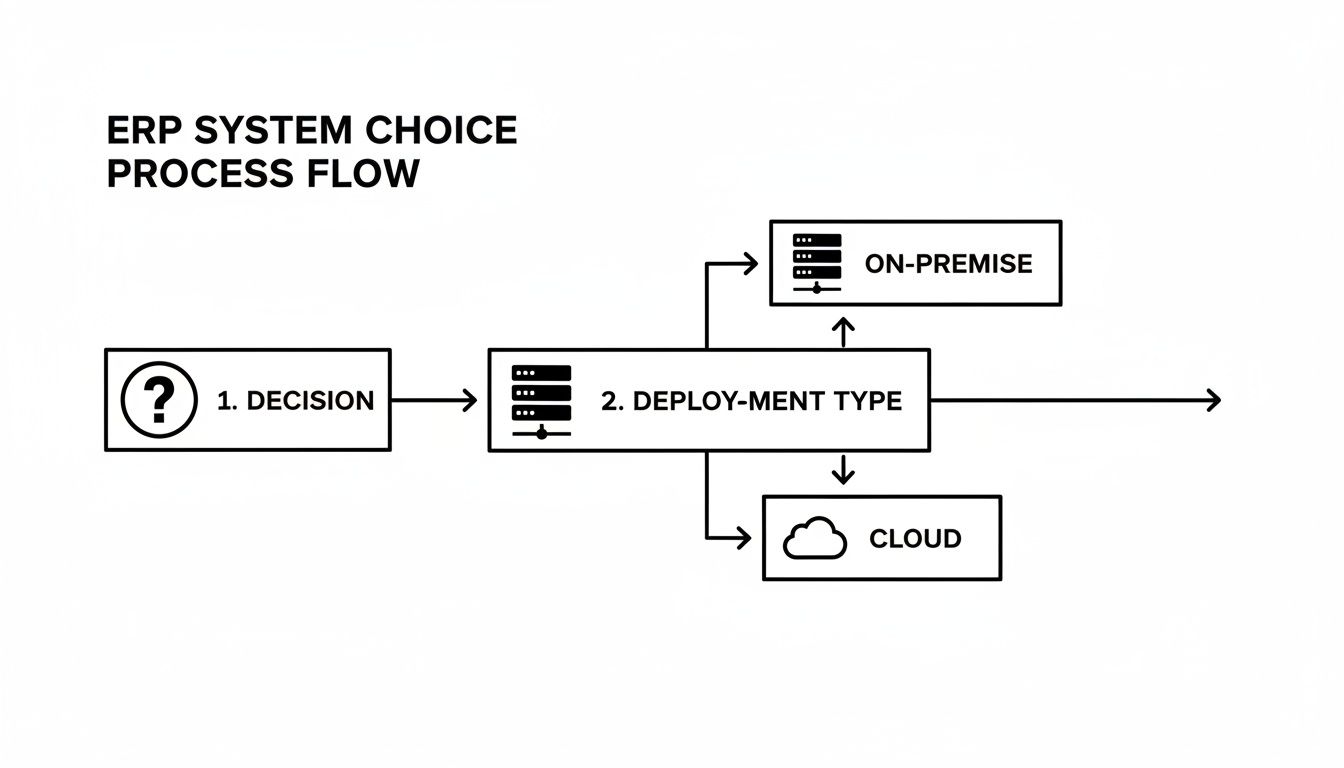
As you can see, the choice between on-premise and cloud is a fundamental one that will heavily influence which partners are the right fit for your business.
Checklist for Vetting Your ERP Implementation Partner
Finding the right partner means asking the right questions. Remember, you’re not just hiring another supplier; you’re choosing a long-term strategic ally for a mission-critical part of your business. Use this checklist to dig deeper than the sales pitch and find a team that truly gets what you need.
A great partner will have solid, experience-backed answers to these questions.
Checklist for Vetting Your ERP Implementation Partner
| Evaluation Criteria | Key Questions to Ask Your Potential Partner | Why This Is Critical for Success |
|---|---|---|
| Local Industry Experience | Can you show me case studies or examples of your work with Australian businesses in my industry (e.g., retail, manufacturing)? | An experienced partner already knows the unique operational challenges, compliance hurdles, and market pressures of your sector in Australia. |
| Technical Integration Skills | How do you handle custom software development in Sydney Adelaide for integrating with platforms like Shopify or WooCommerce? | Your ERP has to communicate seamlessly with your other essential tools. Proven, hands-on integration skill is absolutely non-negotiable. |
| Platform-Specific Expertise | Are you an official Odoo Partner in Sydney Adelaide? What level of certification do your consultants hold? | Official partnership and certifications are clear proof of deep expertise, a direct line to the software vendor, and a commitment to quality. |
| Project Management Approach | What's your project management methodology? How will you keep us in the loop on progress, timelines, and budget? | A clear, transparent process is your best defence against scope creep, budget overruns, and nasty surprises. It keeps the project on track. |
| Post-Launch Support | What do your support and training packages look like after we go live? If we run into trouble, who do we call? | A successful launch is just the beginning. You need a partner who is invested in your long-term success and is there to help you grow. |
A partner’s answer to the integration question is often the most telling. Vague responses are a major red flag. A great partner will want to know exactly which platforms you use—whether it’s a Shopify implementation or a bespoke internal tool—and will immediately start talking about APIs, data flows, and potential workflows.
Choosing your implementation partner will shape your business for years to come, so take your time and do your homework. You’ll want to find a team that shows a genuine passion for seeing you succeed. For more insight, you can learn about what to expect from top Odoo implementers in our detailed overview.
Ready to Unify Your Business? Here’s Your First Step.
If you’re still wrestling with disconnected spreadsheets and clunky, manual processes, you know things have to change. In the Australian market, cobbling together different systems isn’t just inefficient anymore—it’s actively holding you back. You’ve seen what a proper enterprise resource planning system in Australia can do, from cleaning up operations to locking down compliance. Now it’s time to make it happen.
Just picture it: six months from now, your inventory is perfectly synchronised, your financial reports generate themselves, and you finally have one clear, honest view of your entire business. That isn’t some far-off goal. It’s a very real possibility, and it all starts with a simple conversation.
Practical Steps Toward a Connected Future
Making the switch to a single, unified system is more about strategy than software. A big piece of that puzzle involves navigating the common data integration challenges that trip so many businesses up. This is exactly where a good partner proves their worth, helping you pull all your scattered information into one logical, cohesive home.
But what does that look like on the ground?
- Practical Case for a retailer using Shopify: An order comes through your Shopify implementation and instantly updates your stock levels, your books, and your warehouse team. No one has to lift a finger because your Odoo implementation handled it all.
- Practical Case for a manufacturer in Adelaide: You can see material costs, production schedules, and labour hours in real-time. You know, right now, whether a job is profitable or not, thanks to specialised software development in Adelaide that customises your ERP.
These aren’t just bullet points on a feature list. They represent real, tangible improvements that hand you back your time and give you genuine control over your business.
From Big Idea to Business Reality with a Local Partner
Pulling this off requires real expertise. A local Odoo Partner in Sydney or Adelaide brings an understanding of the Australian market that you just can’t get from an overseas provider. They offer more than a standard Odoo implementation; they deliver custom software development in Sydney and Adelaide that connects everything that matters to you, whether it’s WooCommerce or a highly specialised tool unique to your industry.
The best ERP projects don’t start with a sales pitch about software. They start with a frank conversation about your business’s biggest headaches. The whole point is to build a system that serves you, not the other way around. That focus is what unlocks a genuine, measurable return on your investment.
The journey to a smarter, more connected business can begin today. We invite you to book a no-obligation chat with our team of experts. Let’s talk about the specific challenges you’re facing and start mapping out your path to a truly unified and more profitable future.
Book Your Free ERP Consultation with Wistec Today
Your Top ERP Questions, Answered
Thinking about an enterprise resource planning system in Australia? You’re not alone. It’s a big step, and naturally, you’ve got questions. Let’s tackle some of the most common ones we hear from business owners just like you.
How Long Will This Actually Take to Implement?
The honest answer is: it depends. A straightforward Odoo implementation for a smaller business with fairly standard processes can be up and running in 3-6 months.
However, if your business is larger or has more moving parts—think complex data migration or custom software development in Sydney, Adelaide—you’re likely looking at a timeline of 9-12 months, sometimes longer. The biggest factors are always the size of your business, the complexity of your day-to-day operations, and how much customisation you need.
What’s the Real Cost of an ERP in Australia?
This is the big one, isn’t it? For a small or medium-sized business adopting a flexible cloud ERP like Odoo, you can expect an initial implementation project to fall somewhere between $20,000 and $70,000. Monthly per-user subscription fees follow this.
For larger enterprises needing deep customisation, especially when integrating with systems like a major Shopify implementation or WooCommerce store, the investment can easily push past $100,000. When you’re budgeting, make sure you account for everything: licensing, the implementation itself, team training, and ongoing support from your Odoo partner in Sydney, Adelaide.
While exploring your options, you’ll undoubtedly come across major players in the market. For example, if you’re curious about one of the most well-known systems, this guide on What Is Microsoft Dynamics 365 Explained offers a great overview.
Can an ERP Actually Talk to My Other Software?
Yes, and it absolutely should! A modern ERP isn’t just another piece of software; it’s designed to be the central nervous system of your entire business. Getting it to connect with the tools you rely on every day is a critical part of the process.
Practical Case: A good implementation partner will ensure your ERP integrates seamlessly with e-commerce platforms like Shopify or WooCommerce, your CRM, and other essential apps. An Odoo Partner in Sydney can, for instance, use custom software development in Sydney Adelaide to build a perfect API link between your Odoo ERP and your Shopify store, creating a single source of truth, eliminating tedious manual data entry, and breaking down the information silos holding your business back.
Ready to unify your operations and unlock real growth? Wistec delivers solution-driven technology built specifically for Australian businesses. From custom Odoo ERP implementation to high-converting websites, we build practical solutions that get results.
Book a free, no-obligation consultation with our Australian experts today!