

So, what exactly is e-commerce website development? At its core, it’s the craft of building a digital storefront to sell your products and services online. But it goes so much deeper than just a pretty design.
We’re talking about constructing a robust, secure, and intuitive platform that handles the entire customer journey—from browsing your catalogue and adding items to the cart, right through to seamless payments and shipping. A well-built e-commerce site is your hardest-working salesperson, operating 24/7 to bring in revenue.
Why E-commerce Is Your Ultimate Growth Engine
Shifting to online retail isn’t just a trend anymore; it’s the new standard for doing business. A powerful e-commerce website is more than a digital brochure—it’s the most effective engine you have for growth and scale.
Think of it this way: you can have a local shop with set business hours, or you can have a global flagship store that never, ever closes. That’s the difference e-commerce makes.

A strategic online presence shatters geographical barriers. A retailer in Adelaide can sell effortlessly to customers in Sydney, Perth, or even London. A manufacturer based in Sydney can tap into a national market without the crippling overheads of physical expansion.
Unlock Data and Build Real Relationships
Unlike a traditional brick-and-mortar store, an e-commerce platform is an absolute goldmine of customer data. Every single click, search, and purchase gives you incredible insight into what your customers actually want.
This lets you:
- Personalise their shopping experience: You can recommend products based on what they’ve looked at before, making their time on your site far more engaging.
- Sharpen your marketing: Figure out what actually drives a sale and aim your campaigns with laser precision, boosting your return on investment.
- Build genuine customer loyalty: Use that data to create reward programs and targeted emails that make your customers feel genuinely seen and valued.
This data-driven approach is no longer a ‘nice-to-have’; it’s fundamental to modern business. It helps you not just to sell, but to learn, adapt, and build real, lasting connections with your audience.
The Massive Australian Market Opportunity
The numbers don’t lie. In 2025, Australia’s e-commerce market rocketed to a staggering AUD 33.83 billion, proving just how vital online shopping has become down under.
With internet penetration sitting at nearly 95%, this market is only going to get bigger. Forecasts predict it will explode to AUD 56.70 billion by 2035. For retail stores, manufacturing firms, and logistics companies, this means professional e-commerce development isn’t a luxury—it’s the ticket to capturing that growth. You can dive into the full report on Australia’s e-commerce market trends for more details.
A well-built e-commerce platform transforms your business from a local player into a global contender. It’s not just about selling online; it’s about creating a scalable, intelligent system that fuels sustainable growth and operational efficiency.
For any business looking to grab a piece of this pie, choosing the right platform and the right partner is absolutely crucial. Whether it’s a fast-to-market Shopify site for a new brand, a flexible WooCommerce store for a content-rich business, or a powerful Odoo implementation to fuse your sales front with your back-end operations, the right tech stack paves the way for success.
As a leading firm in software development in Sydney and Adelaide, and a trusted Odoo partner, we specialise in building these exact kinds of growth engines.
Ready to build an e-commerce platform that doesn’t just sell, but scales with your ambition? Contact Wistec today for a personalised consultation.
Choosing Your E-commerce Platform Foundation
Picking the right platform is easily the most critical decision you’ll make when building your e-commerce website. This isn’t just a technical choice; it’s the very foundation of your online business. It dictates your store’s flexibility, how easily you can scale, and what your day-to-day management will look like. Think of it as choosing the chassis for a car—it determines everything else you can build on top.
There are a few fantastic options out there, but each one is built for a different kind of business. Let’s break down the main contenders to figure out which path is right for your brand, whether you’re a boutique in Adelaide or a national distributor based in Sydney.
Shopify for Speed and Simplicity
Shopify is the undisputed champion for businesses that need to get up and running fast. It’s a fully hosted, all-in-one solution, which is just a fancy way of saying they handle all the tricky technical stuff—like security, hosting, and software updates—so you can focus on what you do best: selling your products.
This makes it a perfect match for direct-to-consumer brands and startups. Practical case: a local Adelaide fashion boutique wanted to take their designs Australia-wide. A Shopify implementation let them launch a gorgeous, secure, and mobile-ready store in a matter of weeks, not months. The backend is so intuitive that they can manage products and orders themselves without needing a developer on speed dial.
Of course, that simplicity comes with a few trade-offs. While the Shopify App Store is massive, you are ultimately playing in their sandbox. For businesses with really complex or unique requirements, this can feel a bit restrictive. We’ve actually put together a guide on how to work around these issues, which you can read here: Overcoming Common Shopify Limitations.
WooCommerce for Flexibility and Content Integration
If your business is already built on WordPress, then WooCommerce is a no-brainer. It’s an open-source plugin that transforms the world’s most popular content management system into a powerful, fully-featured online store. The keyword here is customisation. If you can dream it up, chances are you can build it with WooCommerce.
This platform shines for businesses where content and commerce are two sides of the same coin. Practical case: a wellness brand that relies heavily on its blog, in-depth articles, and community forums. A WooCommerce implementation allowed them to seamlessly weave a sophisticated shop right into their existing site. This gives you total control over the design, functionality, and, importantly, your SEO. To really nail this, understanding specific Shopify SEO Tips can provide valuable insights that apply across platforms, helping you boost your rankings and visibility from day one.
The main thing to keep in mind is that with WooCommerce, you’re in the driver’s seat for hosting, security, and maintenance. It demands a bit more technical know-how, but in return, you get the freedom to create a truly one-of-a-kind shopping experience.
Custom and Headless Solutions for Unmatched Power
So, what happens when your business needs go way beyond what an off-the-shelf platform can handle? That’s when you step up to a custom or headless solution. This is the top tier of e-commerce website development, built for established enterprises with very specific operational needs.
- Custom Builds: This means creating a platform from scratch, tailored precisely to your business processes. No compromises.
- Headless Commerce: This approach decouples the front-end “head” (what your customers see and interact with) from the back-end e-commerce engine. This gives you complete creative freedom to deliver shopping experiences to any channel—a website, a mobile app, a smart mirror, you name it.
Practical case: A Sydney-based manufacturer needed to integrate their online store directly with their supply chain, inventory management, and ERP system. A custom solution, powered by a robust backend from an Odoo implementation, created a flawless flow of data. This kind of integration automates tedious processes, slashes errors, and gives the entire business one single source of truth. As a leading firm for software development in Sydney and Adelaide, we live and breathe these kinds of powerful, integrated systems.
Choosing your platform isn’t just about features and code; it’s a strategic business decision. Your choice must align with your resources, your long-term vision, and the unique experience you want to give your customers.
Whether it’s a quick-to-market Shopify implementation or a deeply integrated custom build, getting this foundation right will set you up for success for years to come.
E-commerce Platform Comparison At a Glance
Feeling a bit overwhelmed? It’s a big decision. This table breaks down the core differences to help you see which platform aligns best with your immediate and future needs.
| Feature | Shopify | WooCommerce | Custom/Headless |
|---|---|---|---|
| Best For | Startups, DTC brands, speed to market | Content-heavy sites, WordPress users, high customisation | Enterprises, unique business models, multi-channel selling |
| Ease of Use | Very High. User-friendly, no coding needed for basics. | Medium. Requires some technical comfort, especially for setup. | Low. Requires a dedicated development team. |
| Cost Structure | Monthly subscription + transaction fees | Free plugin, but you pay for hosting, security, and extensions. | High. Significant upfront investment in development. |
| Scalability | Good for most, but can hit limits with complexity. | Excellent. Can be scaled infinitely with the right hosting. | Unmatched. Built specifically for your growth trajectory. |
| Time to Launch | Fast. Weeks. | Moderate. Weeks to months. | Slow. Months to over a year. |
| Technical Control | Low. You operate within Shopify's ecosystem. | High. Full control over code, hosting, and security. | Total. Complete control over every aspect. |
Ultimately, the “best” platform is the one that best serves your business strategy. Don’t just think about where you are today; think about where you want to be in three to five years.
Ready to talk through which platform is the perfect fit for your business? Speak with a Wistec expert today and get a clear roadmap for your project.
The Seven Phases of E-commerce Development
A successful e-commerce project doesn’t happen by accident. It’s a disciplined process. Think of it like building a premium retail store: you need a solid blueprint, expert builders, and a clear, phased plan to make sure every detail is perfect. This structured approach is the core of professional e-commerce website development, transforming a big idea into a clear and predictable roadmap.
This method keeps everyone on the same page and, most importantly, delivers real business results. Let’s walk through the entire journey, breaking it down into a seven-phase blueprint that takes your project from a raw concept to a thriving online business.
Phases 1 & 2: Discovery and Design
The first phase, Discovery, is without a doubt the most important. This is where we get crystal clear on your business goals, who you’re selling to, and what success actually looks like. We don’t just ask what you want to build; we ask what you want to achieve. This strategic foundation guides every single decision that follows.
Next up is UI/UX Design. This goes way beyond picking colours and fonts. It’s about mapping out an intuitive customer journey that feels completely natural. We build wireframes and mockups focused on one thing: turning visitors into customers by making it incredibly simple for them to find what they want, add it to their cart, and pay securely.
This diagram shows the common platform choices we explore with clients during these early stages.
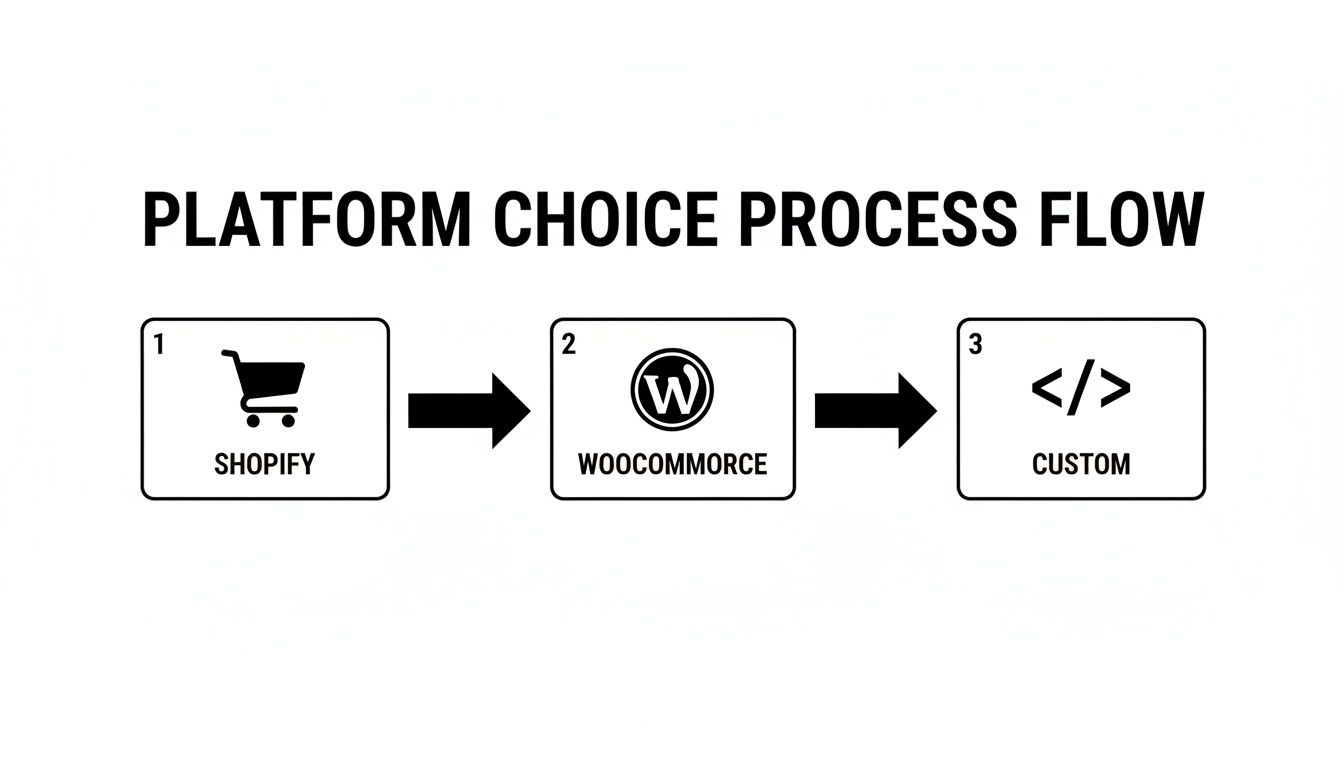
The path from a straightforward solution like Shopify to a more flexible system like WooCommerce, and finally to a fully custom build, shows how the complexity and control can scale up as your business needs become more sophisticated.
Phases 3 & 4: Development and Quality Assurance
With the blueprint signed off, we roll up our sleeves for the Development and Integration phase. This is where our developers write the clean, efficient code that brings the design to life. It’s also where we connect your store to all the essential systems that make it run.
- Platform Setup: Whether it’s a slick Shopify implementation, a powerful WooCommerce build, or a ground-up custom solution.
- ERP Integration: For many retailers and manufacturers, a flawless Odoo implementation is a non-negotiable. As an experienced Odoo partner in Sydney and Adelaide, we make sure your website, inventory, and accounting systems talk to each other seamlessly.
- Payment & Shipping: We integrate trusted Australian payment gateways and set up real-time shipping calculators so there are no surprises at checkout.
Once the build is complete, we move into the painstaking Quality Assurance (QA) phase. Our team becomes your first customer, rigorously testing every link, button, and function across countless devices and browsers. We hunt down and squash any bugs to ensure a perfect experience from day one.
Phases 5, 6 & 7: Launch, Maintenance, and Support
The Launch is the moment we’ve all been working towards. We manage the entire technical deployment, pushing your brand-new website live for the world to see. But our job is far from over.
An e-commerce website is not a “set it and forget it” project. It’s a living asset that requires continuous attention to perform at its peak, adapt to market changes, and remain secure.
This brings us to the final, ongoing phases: Maintenance and Support. We provide continuous technical support, apply regular security patches, and monitor performance to keep your store running like a well-oiled machine. This proactive approach, fundamental to our software development in Sydney and Adelaide, ensures your investment keeps paying dividends long after launch day.
Ready to start your journey with a partner who understands every phase of development? Let’s build your roadmap to success—contact Wistec for a consultation.
Essential Features That Drive Sales and Trust
In today’s market, just having an “add to cart” button and a checkout page is the bare minimum. A truly successful e-commerce site is packed with features that don’t just process transactions—they actively build trust, smooth out the buying journey, and keep customers coming back. Think of these features less as expenses and more as crucial investments that turn casual browsers into loyal fans.
Your website needs to anticipate what your customers want at every single step. It’s not a digital catalogue; it’s your most switched-on, helpful salesperson. From the moment someone lands on your homepage to the second they hit “confirm purchase,” every feature should work together to create an experience that feels seamless, reassuring, and even enjoyable.
Crafting a Frictionless Checkout Experience
The checkout is the final hurdle, and it’s where most sales are won or lost. The slightest hint of confusion or hassle here can send a customer running. In fact, a staggering 21% of users abandon their carts simply because the checkout process is too long or complicated. The goal here is absolute simplicity.
To get your checkout converting like a charm, you need:
- A Guest Checkout Option: Forcing someone to create an account is one of the fastest ways to kill a sale. Always offer a quick and easy guest checkout path.
- Progress Indicators: A simple visual bar showing customers where they are (e.g., Shipping > Payment > Confirm) reduces anxiety and keeps them moving forward.
- Multiple Payment Gateways: People trust what they know. Offering familiar options like Stripe, PayPal, and “Buy Now, Pay Later” services like Afterpay caters to different preferences and instantly boosts your credibility.
The Power of Transparent Shipping and Personalisation
Here in Australia, delivery is everything. An incredible 85% of shoppers say reliable delivery builds their trust in a brand, and 8 in 10 directly link it to their overall satisfaction. This makes transparent and flexible shipping options completely non-negotiable.
Real-time shipping calculations are your best friend for building trust. By showing accurate costs from carriers based on a customer’s postcode, you eliminate any nasty surprises at the final step. And considering that 56% of Australian shoppers prefer free delivery, using it as a strategic incentive can give your conversion rates a serious boost.
A customer’s trust isn’t just won with a secure payment page. It’s earned through clear communication, predictable costs, and the confidence that you will deliver on your promises.
Beyond just getting the parcel to their door, younger consumers are looking for a more tailored experience. A huge 61% of Gen Z and 62% of Millennials want personalised offers. This is your cue to use customer data to recommend products they’ll actually love, send them targeted discounts, and create a shopping journey that feels like it was designed just for them.
Building Loyalty Beyond the First Sale
Getting a customer to make one purchase is good. Getting them to come back again and again is how you build a real, sustainable business. This is where retention-focused features come into play, which are just as vital as the ones that drive the initial sale. Beyond a seamless checkout, implementing well-structured customer loyalty reward programs can transform one-time buyers into genuine brand advocates.
Here’s how you can encourage that loyalty:
- Customer Accounts: Give people an easy way to save their details, check their order history, and create wishlists. It makes their next visit that much easier.
- Email and SMS Integration: Smart tools can automate follow-ups, send abandoned cart reminders, and deliver exclusive offers to past customers, keeping your brand top-of-mind.
- Hassle-Free Returns: With 65% of shoppers saying easy returns are important, a clear and simple returns policy gives them the confidence they need to click “buy” in the first place.
Ultimately, the best features are the ones that solve a customer’s problem or remove a point of friction. Whether it’s a streamlined Shopify implementation for a new retail brand or a complex WooCommerce build for a content-heavy business, prioritising these trust-building elements is the key to success. As experts in software development in Sydney and Adelaide, we help businesses integrate these crucial features to not only make sales but also foster lasting customer relationships.
Integrating Systems for Total Business Efficiency
Think of your e-commerce website as the heart of your business. For it to truly pump life into your operations, it needs arteries connecting it to every other part of the company. It can’t be an isolated island of data; it has to be the central, connected hub. This is where strategic integration moves you from just having a website to running a genuinely efficient business machine.
The real magic in modern e-commerce website development happens when you connect your storefront to an Enterprise Resource Planning (ERP) system. This link automates the endless flow of information between what your customers see and what your team does behind the scenes—from managing inventory and orders right through to accounting and customer support.
The Real-World Impact of ERP Integration
Let’s get practical. Imagine a world where you never have to manually enter data again. A customer buys a product on your Shopify or WooCommerce store. Instantly, that sale is logged in your accounts, your inventory count updates across the board, and a picking slip prints out in the warehouse. This isn’t a far-off dream; it’s the everyday reality of a well-executed ERP integration.
The benefits are immediate and tangible:
- Wipe Out Costly Errors: Manual data entry is prone to human error. Automatic syncing puts an end to issues like selling out-of-stock products or dealing with inaccurate financial reports.
- Create a Single Source of Truth: Everyone in your organisation, from the sales desk to the warehouse floor, is working from the same live, accurate data. This clarity kills confusion and fuels smarter decisions.
- Free Up Your People: When you automate the tedious, repetitive tasks, you empower your team to focus on what actually grows the business—like brilliant customer service, clever marketing, and strategic planning.
A Practical Case for Integration
Consider a manufacturing firm in Sydney selling its products through a Shopify implementation. Without integration, their workflow is a mess. The sales team manually punches online orders into a separate system. The warehouse team has to check stock levels on a clunky spreadsheet. And at the end of the month, the accounts department is left to try and reconcile it all.
An integrated system creates a digital nervous system for your business, where every part communicates instantly and works in perfect harmony. It’s the difference between a collection of separate tools and a single, efficient operation.
Now, let’s picture that same firm after they’ve partnered with an experienced Odoo partner in Sydney. Their new Odoo implementation is wired directly into their Shopify store. An order comes in, and Odoo instantly checks the inventory, allocates the stock, and can even trigger a new manufacturing order if levels are running low. The entire journey, from online purchase to the production line, is now one seamless, automated process.
This is the kind of sophisticated integration that sets market leaders apart. It gives you a complete, 360-degree view of your business, making your entire operation smoother and far more profitable. To get a better handle on the nuts and bolts, you can learn more about system integration and its fundamental principles.
As a leading agency for software development in Sydney and Adelaide, building these powerful connections is what we do best. Whether you’re on WooCommerce, Shopify, or a custom platform, linking it to a powerful ERP like Odoo is the single biggest step you can take towards scalability and efficiency.
How to Choose the Right Development Partner
Picking the right development partner is arguably the most important decision you’ll make in this entire process. Get this right, and everything else falls into place. Get it wrong, and you’re in for a world of headaches, budget blowouts, and missed deadlines. The aim isn’t just to find a team with a flashy portfolio, but one that genuinely gets what you’re trying to achieve with your business.
Think of them less as a group of coders and more as strategic partners. They should be the ones who can take your vision and turn it into a high-performing online store that actually makes you money.
Look for Proven Technical and Business Acumen
A slick website is one thing, but it tells you very little about the engine running under the bonnet. You need a partner with solid, verifiable experience in the specific platforms and systems your business relies on. This means you need to do a bit of digging and ask some pointed questions.
- Platform Specialisation: Have they successfully delivered complex Shopify implementation projects or custom WooCommerce builds? Don’t just take their word for it—ask to see live examples.
- Integration Experience: Can they show you successful ERP integrations? This is a big one, especially if you’re looking at an Odoo implementation. It’s a highly specialised skill, and not everyone can do it well.
- Local Presence: Are they an established firm for software development in Sydney or Adelaide? A local partner has a better feel for the Australian market and is right there when you need support.
A true development partner invests their time in understanding your business model, your operational headaches, and your goals for the future. The solution they propose should solve your actual problems, not just be a list of features they can build.
This consultative mindset is the real difference-maker. It separates a one-off transaction from a long-term partnership with a team that’s genuinely invested in seeing you succeed.
Demand Case Studies with Measurable Results
Vague promises don’t drive sales, but hard data does. Any agency worth its salt will be excited to share case studies that demonstrate a clear return on investment.
Don’t be shy about digging into their past work. Ask them to talk you through a project that was similar to yours. What were the roadblocks? How did their solution directly improve key metrics like conversion rates, average order value, or operational efficiency? This is how you’ll quickly separate the pros from the pretenders.
Scrutinise Their Development Process
The Australian online shopping market is projected to reach a massive $60.8 billion by 2025, with a household penetration of 80%. In such a crowded space, your partner needs to understand the local nuances—like the fact that 65% of younger shoppers are actively seeking more sustainable brands. You can dive deeper into these trends with insights on the Australian online shopping market.
A transparent, well-structured development process is non-negotiable for building a site that can compete. A professional team, like a dedicated Odoo partner in Sydney, will have a clear methodology covering discovery, design, development, rigorous testing, and ongoing support. This is what keeps your project on track and on budget. For a better idea of what’s involved, have a look at our guide on what to expect from a custom software development company.
Ultimately, choosing the right agency is about finding a team you trust to build the engine that will power your business’s future growth.
Ready to build a platform for real growth with a partner that delivers? Contact Wistec for a no-obligation consultation.
Still Have Questions? Let’s Get Them Answered
Diving into the world of e-commerce website development often brings up a few questions. We get it. Here are some straightforward answers to the things we hear most often from businesses just like yours.
What’s the Real Cost of Building an E-commerce Website in Australia?
Honestly, it depends on what you’re trying to achieve. A simple and clean Shopify setup or a basic WooCommerce site for a small business can get you started for a few thousand dollars.
But if you’re aiming for something more specific—think custom features, a truly unique design, or complex integrations with systems like Odoo—you’re looking at a bigger investment, typically anywhere from $25,000 to over $100,000. We don’t just give you a number; we provide a detailed proposal that maps out the long-term value and return for your business, whether you’re based in Sydney, Adelaide, or anywhere else in Australia.
How Long Until We Can Start Selling?
This all comes down to the complexity of your project. For a standard build on a platform like Shopify or WooCommerce, we can often move from design to launch within 6 to 12 weeks. It’s a well-trodden path.
However, a fully custom build is a different beast. These projects are far more involved and usually take 4 to 6 months or even longer. The timeline is shaped by the intricacy of the design, the number of third-party systems we need to connect, and the amount of data we have to migrate. The one thing we promise is a realistic and transparent timeline from day one.
The most accurate timeline estimate always comes after a thorough discovery phase. This is where we sit down together to map out every technical and business requirement, ensuring the solution we build meets your needs today and scales for tomorrow without any nasty surprises.
Do We Really Need an Odoo Partner?
If your business juggles physical inventory, has a manufacturing arm, or deals with complex supply chains, integrating an ERP like Odoo isn’t just a good idea—it’s a massive competitive advantage. It bridges the gap between your customer-facing website and your back-end operations.
As an official Odoo partner in Sydney and Adelaide, we make that connection seamless. Practical case: a furniture maker using WooCommerce gets an online order, and that order automatically kicks off a production request in Odoo, updating inventory and accounting in real-time. That’s the kind of automation that drives huge efficiency gains and gets rid of costly human error.
What’s the Main Difference Between Shopify and WooCommerce?
Let’s use an analogy. Think of Shopify as moving into a luxury, fully-serviced apartment. Everything is taken care of for you—security, maintenance, all the core amenities. It’s prized for its simplicity and speed, making it perfect for brands that want to get online quickly and with minimal fuss.
WooCommerce, on the other hand, is like buying a block of land to build your dream home. It’s an incredibly powerful, open-source plugin for WordPress that gives you the freedom to build anything. This makes it the go-to for businesses with very specific needs or a big focus on content marketing. Not sure which is right? We can help you weigh the pros and cons for your specific goals.
Ready to build an online store that actually delivers results? Wistec is all about creating solution-driven technology that fits your business perfectly. Contact us today for a personalised consultation.