

Let’s be clear: modern web development has moved far beyond building a simple digital brochure. It’s about engineering the central nervous system for your entire business. We’re talking about crafting the custom applications, high-performance platforms, and integrated systems that become powerful engines for your growth and operational efficiency. Ready to see how? Contact us today for a free, no-obligation consultation!
Why Modern Web Development Is More Than Just a Website
It’s time to ditch the outdated idea that a website is just a static online presence. These days, your website should be the interactive core of your business operations, customer engagement, and sales channels.
Think of it like a high-end retail store. The stunning window display, the welcoming interior, and the seamless checkout experience? That’s all front-end development. It’s what delights your customers and makes them want to stick around.
But the real magic happens behind the scenes. The back-end development is your entire operational backbone—the stockroom, inventory management, logistics, and point-of-sale systems all humming along in perfect harmony. When the front-end and back-end are expertly connected, your business runs smoothly, scales effortlessly, and delivers an exceptional customer experience.
From Digital Brochure to Business Engine
This shift in perspective is everything. A simple brochure website might tell people you exist, but a strategically developed web application actively helps you run your business. It automates tedious tasks, gathers valuable data, and plugs directly into the other tools you rely on. This is where strategic software development in Sydney and Adelaide gives you a genuine competitive edge.
A practical case is an ecommerce store, which is so much more than a product gallery. A professional Shopify implementation or a custom WooCommerce site integrates directly with your inventory, shipping carriers, and marketing automation platforms.
A modern web platform should solve a business problem. Whether it’s cutting down on manual data entry, automating customer support, or serving up deep sales analytics, its primary job is to create tangible value and efficiency.
Security and Scalability: The New Standard
Two critical factors elevate modern web development far beyond basic website creation: robust security and built-in scalability.
Implementing security best practices for web applications isn’t optional; it’s essential for protecting user data and maintaining the trust you’ve worked so hard to build. A basic site might not handle sensitive information, but a true business application must be fortified against threats from day one.
Likewise, a modern platform has to be built to grow with you. An Odoo implementation in Sydney or Adelaide, for instance, connects your website directly to your Enterprise Resource Planning (ERP) system. A practical case is a Sydney-based wholesaler whose Odoo system automatically updates web stock levels as warehouse inventory changes, preventing overselling during peak periods. This means that as your sales, inventory, and customer base expand, your web platform scales right alongside you without buckling under the pressure.
Grasping this is the key to seeing how a targeted development web strategy can truly transform your business from the ground up.
Ready to build a powerful digital engine for your business? Contact Wistec today for a free consultation and discover how our expert software development services can drive your growth.
Understanding the Building Blocks of Your Website
Every website or application you use, from a slick e-commerce store to a powerful internal business tool, is built on the same fundamental principles. Getting your head around these core pillars is the first step in any web development project. It’s like learning the basic anatomy of the digital asset you’re about to create.
First up, you have the Front-End. This is everything your visitors see and interact with. It’s the layout, the colours, the buttons they click, and the forms they fill out. A great front-end is all about creating an intuitive, engaging experience that builds trust and guides users to take action.
Then there’s the Back-End. Think of this as the engine room. It’s the powerful, unseen machinery that makes everything actually work. The back-end handles all the heavy lifting: processing payments, managing user accounts, running complex business logic, and making sure data gets where it needs to go. It’s the invisible powerhouse of your digital presence.
The Three Pillars of Web Architecture
These pieces don’t operate in a vacuum; they’re part of a tightly connected system. The third pillar is the database, which acts as the organised and secure library for all your critical information.
- Front-End (The “Client-Side”): This is what runs in your customer’s web browser. Its main job is to present information clearly and capture user input. For a Shopify site, this is the beautiful storefront customers browse.
- Back-End (The “Server-Side”): This is the code that runs on a powerful computer (a server). It takes requests from the front-end, processes information, and talks to the database. For a service business, this is what powers your online booking system.
- Database (The “Data Storage”): This is where everything is stored—customer profiles, order histories, product details, you name it. A fast, reliable database is absolutely essential for a responsive website.
This diagram shows how the front-end and back-end work together to bring your website to life.
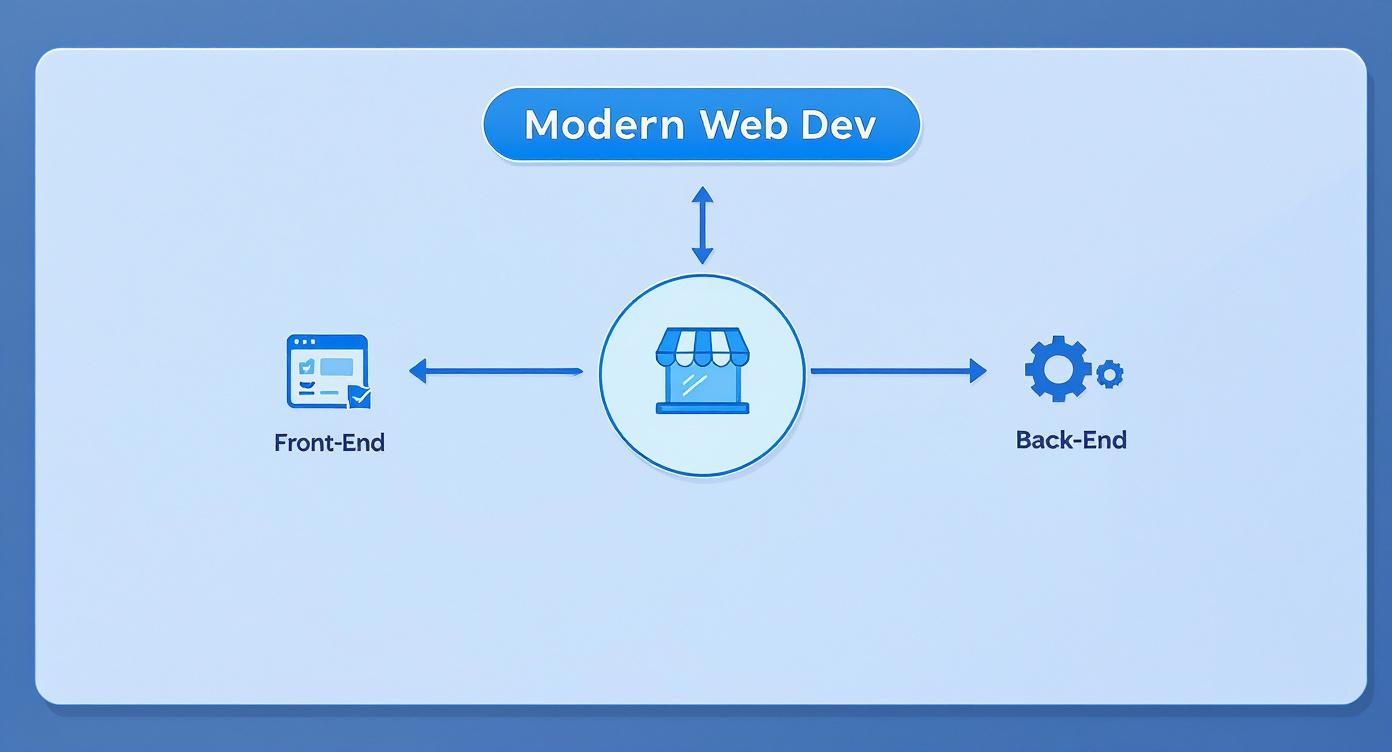
It’s a great visual reminder that while your customers only ever see the front-end, it’s the seamless communication with the back-end that delivers a complete, functional experience.
To make this even clearer, let’s break down the distinct roles of the front-end and back-end.
Front-End vs Back-End Development: A Quick Comparison
The table below gives you a simplified snapshot of what each side of the development coin is responsible for.
| Aspect | Front-End Development (The Client-Side) | Back-End Development (The Server-Side) |
|---|---|---|
| What Is It? | Everything the user sees and interacts with in their browser. The “look and feel.” | The hidden engine that powers the website. The “brains” of the operation. |
| Key Goal | Create a seamless, intuitive, and engaging User Experience (UX) and User Interface (UI). | Ensure the site is fast, secure, scalable, and that all data is managed correctly. |
| Common Tasks | Building layouts, styling elements (fonts, colours), making the site responsive for mobile. | Writing business logic, managing databases, building APIs, handling user authentication. |
| Example | The beautiful product page on an e-commerce site with interactive image galleries. | The system that processes a credit card payment securely and updates inventory levels. |
| Technologies | HTML, CSS, JavaScript, React, Vue.js | PHP, Python, Node.js, SQL, a web server (like Apache or Nginx) |
Understanding this distinction helps you appreciate why both are essential for a successful project. One simply can’t function without the other.
How They Work Together in Practice
Let’s walk through a real-world scenario. Imagine a customer placing an order on your WooCommerce website.
They find a product they love and click “Add to Cart.” That click happens on the front-end, which immediately sends a message to the back-end. The back-end then updates the database to add that item to the customer’s cart.
When they check out, the front-end provides a secure form to collect their shipping and payment details. That information is sent securely to the back-end, which talks to the payment gateway to process the transaction. Once approved, the back-end updates the order status in the database and sends a “success” message back to the front-end, which then displays the “Thank You” page. This all happens in a matter of seconds, thanks to the perfectly choreographed dance between all three parts.
Knowing how this works is a game-changer when you’re planning a project. It helps you understand where specific features live and why some changes are more complex than others. This is key to setting clear expectations for any software development in Sydney or Adelaide.
A practical case: think of a logistics company in Adelaide wanting a customer portal. The front-end is the clean, simple interface where clients log in and see their shipment status. The back-end, perhaps integrated via an Odoo implementation in Adelaide, is what connects to internal inventory systems to pull that real-time tracking data and feed it to the front-end. Without that robust back-end, the beautiful portal would be an empty shell.
Grasping these fundamentals empowers you to have much more productive conversations about your project. It helps turn vague ideas into a structured plan, ensuring the final product does exactly what your business needs it to do.
Ready to build a powerful digital presence on a rock-solid foundation? Contact Wistec for a no-obligation consultation to discuss your front-end and back-end development needs.
Choosing the Right Project Blueprint: Agile vs. Waterfall
Every great web project needs a solid game plan. The way you manage the process from start to finish has a massive impact on efficiency, flexibility, and whether you hit the mark. Two dominant methodologies, Agile and Waterfall, offer completely different blueprints for building your vision.
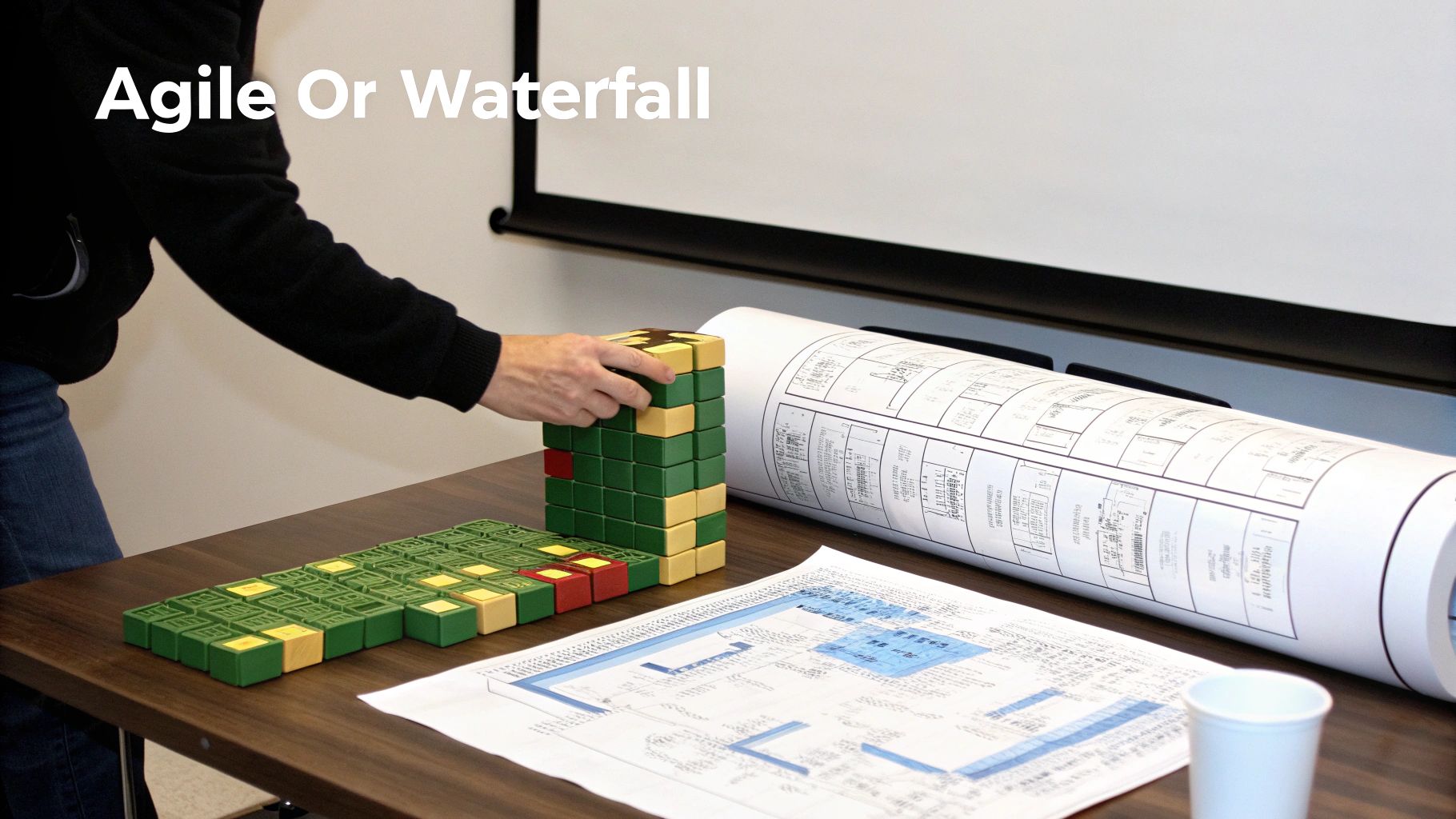
Think of the Waterfall method like building a house from a detailed, locked-in architectural plan. Each phase—from gathering requirements and design to development and testing—flows sequentially into the next. You can’t start framing the walls until the foundation is poured and completely set.
This approach is highly structured and predictable. It’s perfect for projects where the requirements are rock-solid from day one and aren’t expected to change.
The Predictable Path: Waterfall
Waterfall is the champion of certainty. Its step-by-step nature means every stage has a clear start and finish, making it straightforward to track progress against the original timeline and budget.
As a practical case, imagine you need a simple business website or a standard WooCommerce store with familiar features. The scope is well-defined, the end goal is clear, and there’s little room for interpretation. For this kind of project, Waterfall provides a reliable, direct path from A to B.
But its greatest strength is also its biggest weakness. The rigid structure offers very little room to pivot if your business needs or market conditions change mid-project. A brilliant new idea that surfaces during development can be incredibly difficult and expensive to incorporate.
The Waterfall model is all about “measure twice, cut once.” It demands exhaustive upfront planning and documentation, leaving little room for surprises—good or bad—once development kicks off.
In the fast-paced world of digital projects, that inflexibility can be a major handicap.
The Flexible Journey: Agile
In complete contrast, the Agile method is like building with LEGOs. You start with a core idea and a general vision, but you build, test, and adapt in short, rapid cycles called “sprints.” This iterative approach is tailor-made for complex projects like custom software development in Sydney, where requirements are expected to evolve.
Agile doesn’t just tolerate change; it welcomes it. Instead of locking everything down at the start, the project is broken into small, manageable pieces. At the end of each sprint—usually about two weeks—the team delivers a working slice of the product. This creates a constant feedback loop with stakeholders, ensuring the final product is exactly what the business needs now, not just what was planned months ago.
Agile shines in situations like these practical cases:
- Custom Software: Building a unique business management tool for a company in Adelaide where real user feedback is crucial for shaping the final feature set.
- Odoo Implementation Sydney: A phased Odoo implementation in Sydney where core modules go live first, with advanced customisations added later based on how the team uses the system.
- Shopify Implementation: An advanced Shopify implementation for a growing Sydney retailer who wants to test and roll out new marketing features and integrations one by one.
This adaptive model dramatically lowers the risk of building the wrong thing. By course-correcting along the way, the project stays perfectly aligned with business goals, even when they shift. Picking the right approach from day one sets up your partnership with a development agency for success.
Unsure which methodology fits your project? Contact Wistec today. We’ll help you map out the perfect blueprint for your web development goals.
Selecting the Technology That Powers Your Ambitions
Choosing your technology stack is a bit like picking the right engine for a vehicle. The decision you make here will dictate how fast you can go, how much you can carry, and what kind of terrain you can handle. This collection of tools and platforms is what will ultimately bring your digital vision to life, making it one of the most crucial decisions in the entire web development process.
Get it right, and you’re building on a solid foundation for future growth. Get it wrong, and you could be creating frustrating roadblocks before you’ve even left the starting line. There’s no single “best” option—only the one that’s best for your business goals, budget, and operational needs.
Ecommerce Platforms for Speed and Flexibility
For most retail businesses, the journey into the digital world starts with an ecommerce platform. These solutions give you a powerful, pre-built framework to get you selling online, fast. But they aren’t all created equal; they cater to very different needs and levels of customisation.
A Shopify implementation is often the quickest path from idea to first sale. It’s a fully hosted platform known for its incredibly user-friendly interface and a massive ecosystem of apps. This makes it a fantastic choice for businesses that want to pour their energy into marketing and sales without getting bogged down in server management or security patches.
On the other hand, a custom WooCommerce solution offers almost limitless flexibility for businesses already comfortable with the WordPress content management system. Because it’s open-source, you have complete control over the code, which opens the door to deep customisation and truly unique functionality. It’s the perfect fit for businesses with specific requirements that off-the-shelf platforms just can’t meet.
Your choice between Shopify and WooCommerce often boils down to a classic trade-off: convenience versus control. One offers a guided, all-in-one experience, while the other provides a blank canvas for building something entirely your own.
Enterprise Solutions for Integrated Operations
As a business scales, its needs almost always outgrow a simple public-facing website. Trying to manage inventory, customer relationships, manufacturing, and accounting in separate, disconnected systems is a recipe for inefficiency and data chaos. This is where a more holistic solution becomes not just a nice-to-have, but a necessity.
An Odoo implementation in Sydney or Adelaide can unify your entire operation. Odoo is an Enterprise Resource Planning (ERP) system that integrates everything from your CRM and inventory to your accounting and project management tools. When you connect this central nervous system to your web presence, the results are incredible.
A practical case: a customer places an order on your website. That single action can instantly trigger a chain reaction across your business:
- Inventory: The stock level for that product is automatically adjusted.
- Accounting: An invoice is generated, and the books are updated.
- Shipping: The logistics team gets a notification to prepare the package for dispatch.
- CRM: The customer’s purchase history is logged, ready for future marketing efforts.
For businesses in Adelaide looking to scale without the growing pains, this level of seamless integration is a total game-changer.
When to Choose Custom Software Development
Sometimes, even the most flexible platforms won’t do. If your business runs on a truly unique operational model, or you’re aiming to create a service that the world hasn’t seen yet, you’re going to need a custom solution.
This is the world of bespoke software development in Sydney. Building a custom application from the ground up gives you absolute freedom to design every single feature and workflow to your exact specifications. This path is ideal for businesses that see technology not just as a tool, but as their core competitive advantage. It’s a bigger investment upfront, but the payoff is a perfectly tailored solution that no competitor can simply copy.
Ultimately, the key is to have an honest, informed discussion about your specific challenges and long-term ambitions. By understanding the strengths of each technology, you can choose the right tool to fuel your growth—not just for today, but for many years to come.
Ready to select the technology that will power your business ambitions? Contact Wistec today for a free consultation. Our experts in Sydney and Adelaide can guide you through choosing the perfect platform, whether it’s Shopify, WooCommerce, Odoo, or a fully custom solution.
Putting It All Into Practice: Success Stories from Sydney and Adelaide
Theory is one thing, but the real test of any web development project is the impact it makes on a business. It’s about solving genuine problems and delivering results you can actually measure. Seeing how a smart investment in technology pays off in the real world is where it all comes together.
These practical cases from local Aussie businesses show just how powerful the right digital solution can be as an engine for growth, efficiency, and profit.
Adelaide Retailer Sees Revenue Skyrocket with WooCommerce
An up-and-coming retailer in Adelaide was hitting a wall. Their old website just couldn’t handle their growing product range, which meant constant inventory headaches, a clunky checkout, and unhappy customers. All that friction was costing them sales, day in and day out.
They decided to go all-in on a custom WooCommerce solution. The project zeroed in on two critical pain points:
- Smarter Inventory Management: We built a custom back-end that synchronised their online store with their physical stock in real-time. Overselling became a thing of the past.
- A Smoother Customer Journey: The front-end got a complete overhaul, designed for mobile users first with a dead-simple, three-step checkout.
The results didn’t take long to show up. Within just six months of the new site going live, the retailer saw a massive 40% jump in online revenue. Better yet, the automated inventory system saved their staff hours of tedious data entry every single week, freeing them up to focus on what matters: serving customers. It’s a perfect case study of how targeted software development in Adelaide can directly fuel your bottom line.
Sydney Firm Slashes Overheads with Odoo
A service-based company in Sydney was battling a different kind of beast: operational chaos. Their booking system, client management, and invoicing platforms didn’t talk to each other. Staff were burning precious time manually copying data from one system to another, which inevitably led to mistakes and delays.
The answer was a custom Odoo implementation in Sydney. The mission was to build one unified system that could manage the entire client journey, from the first hello to the final invoice. Our team wired their website’s booking portal directly into the Odoo CRM and accounting modules, creating a seamless workflow.
By automating the flow of information, the firm broke down data silos and created a single source of truth for every client and project.
This integration completely changed how they worked. The company managed to cut its administrative overheads by nearly half. Now, when a booking comes in online, it automatically creates a client record, schedules the appointment, and generates an invoice—all without a single click from a staff member. This shows how clever software development in Sydney goes beyond websites; it’s about redesigning your business processes for peak efficiency. While a Shopify implementation is fantastic for retail, custom integrations like this are game-changers for service businesses.
These examples really drive home a simple truth: the right technology, implemented with expertise, solves problems and creates incredible value.
Ready to write your own success story? Get in touch with Wistec today to see how our development services in Sydney and Adelaide can deliver real results for your business.
Finding Your Ideal Web Development Partner
Kicking off a new web development project is a huge step for any business, and let’s be honest, choosing the right partner is probably the single most important decision you’ll make. This isn’t just about hiring a few coders. It’s about finding a team that becomes a genuine extension of your own—one that’s truly invested in seeing you succeed long after the project launch. The best partnerships are always built on clear communication, technical chops, and a shared vision.
So, how do you find that perfect match? You need to look past the shiny portfolio and dig a little deeper. The right agency won’t just build what you tell them to; they’ll know how to turn your business challenges into smart, effective technology.
Key Criteria for Selecting Your Agency
When you start looking, focus on agencies that bring both technical skill and real business sense to the table. Here’s what you should be asking:
- Proven Technical Expertise: Have they done this before? Ask to see successful examples of projects similar to yours. Whether you need a complex Shopify implementation or are building custom software from the ground up, their past work is the best predictor of what they can do for you.
- Deep Industry Understanding: A partner who gets your industry’s specific quirks, challenges, and customer behaviours will deliver a much better result. They’ll be able to anticipate needs you haven’t even thought of yet.
- Transparent Processes: How do they work? They should be able to clearly walk you through their project management style, how often they’ll communicate, and how they handle feedback or changes. You should never be left in the dark.
- Long-Term Support: The job isn’t finished at launch. What happens next? Ask about their plans for ongoing maintenance, security, and support to make sure your investment is protected down the road.
A great development partner doesn’t just build what you ask for; they challenge your assumptions and bring new ideas to the table, ensuring the final product delivers maximum business value.
For Australian businesses, local expertise can be a massive advantage. A team that understands the nuances of the local market, whether for an Odoo implementation in Sydney or a WooCommerce store for an Adelaide retailer, provides an edge that’s hard to replicate. When you need expert guidance for your digital projects, it’s worth looking into companies that offer specialised software consulting services.
Beyond the Code: Strategic Collaboration
At the end of the day, the best software development in Sydney Adelaide partnerships are truly collaborative. You want a team that’s genuinely curious about your business goals, asks smart questions, and is laser-focused on delivering a real return on your investment. They should feel less like a vendor and more like your dedicated technology advisor, guiding you through every step with confidence.
Your digital presence is the future of your business. Finding a partner who is as committed to building that future as you are is the key to unlocking your full potential.
Ready to transform your digital presence? If you’re planning a custom application, a high-performance eCommerce store, or a fully integrated ERP system, our team is here to help you build a solution that drives real growth.
Let’s start the conversation. Contact Wistec today for a free, no-obligation consultation.
Web Development FAQs: Your Questions Answered
Starting a new web project always kicks up a lot of questions. Getting straight answers is the first step towards setting a realistic budget, understanding the process, and knowing what to expect. Here are the most common things business owners ask us.
How Much Does a Custom Web Development Project Cost?
This is usually the first question on everyone’s mind, and the most honest answer is: it really depends on what you need to build. The cost is a direct reflection of the project’s complexity.
A straightforward marketing website, for example, might only be a few thousand dollars. But if you’re looking for a custom e-commerce powerhouse on a platform like Shopify or WooCommerce, you could be looking at a range from $10,000 to over $50,000. The final figure comes down to the level of custom design, the number of third-party tools we need to connect, and any unique features your online store needs to succeed.
For bigger, more complex systems that tie into your core operations, the investment is naturally larger. A full-scale custom software development in Sydney Adelaide or a comprehensive Odoo implementation in Sydney is a major undertaking designed to streamline how you do business. The only way to get a firm price is to sit down together, map out your specific needs, and build a detailed quote from there.
What’s a Typical Timeline for a Project?
Just like the cost, the timeline is tied directly to the size and complexity of the build. As a general guide, you can expect a standard business website to take about 4–8 weeks from our first conversation to launch day.
A more sophisticated e-commerce project, like a custom Shopify implementation, will usually take 3–6 months. For large-scale software projects or a full Odoo implementation across an entire business, we’re often looking at 6–12 months or more. We often use an Agile approach, which means we can launch a core version of the product much faster. This lets you start seeing a return on your investment sooner while we continue to build out more advanced features in later phases.
A solid project plan is about more than just writing code. It includes vital stages like discovery, design, testing, and getting your feedback to make sure the final product is polished and works perfectly.
Do I Need Ongoing Maintenance After My Site Goes Live?
Yes, absolutely. One of the biggest mistakes you can make is thinking of your website as a “set it and forget it” task. To keep it secure, fast, and running smoothly, ongoing maintenance is non-negotiable. This involves everything from regular software updates and security scans to performance tweaks and data backups.
For platforms like WooCommerce, Shopify, and Odoo, staying on top of updates is critical. It protects you from new security threats and ensures all your integrated tools keep playing nicely together. We offer tailored maintenance plans for our clients in Sydney and Adelaide to safeguard their digital assets. It’s a proactive way to make sure your development web investment keeps performing for years to come.
Ready to build a digital solution that solves real-world business problems and fuels your growth? The experts at Wistec are here to guide you. Whether it’s a high-converting e-commerce store, a custom app, or a fully integrated ERP system, we build technology that delivers results.