

Building a mobile app is about much more than just code. It’s the entire journey of bringing an idea to life—from that first spark of inspiration and careful planning, all the way through to design, development of mobile apps, testing, and finally, launching it on the Apple App Store or Google Play. Think of it as a detailed blueprint for creating a polished, user-friendly tool that people will actually want to use.
Your Blueprint for Digital Success in Australia
This guide is your roadmap to turning a great idea into a real-world product that connects with Australian users and helps your business grow. We’re here to cut through the jargon and give you a clear, step-by-step plan, whether you’re a startup founder or part of an established company.
Consider this your strategic partner in the app world. Whether your project involves a complex Odoo implementation Sydney Adelaide businesses can depend on, or you’re launching a new online store with a Shopify implementation, mastering this process is non-negotiable.
Why Mobile App Development Matters Now
Let’s be clear: Australia’s mobile app development industry is a major force in our tech economy. It’s on track to hit $2.8 billion in revenue by 2024-25. The Android market here is particularly strong, with Aussie developers releasing apps that average over 323,000 downloads each. That’s a huge, engaged audience ready for great new products. You can dive deeper into these Australian market statistics to see the scale of the opportunity.
This guide will walk you through the key stages every successful app must navigate:
- Strategy and Discovery: This is where we lay the groundwork for success before a single line of code is written.
- Design and User Experience (UX): It’s all about creating a seamless and beautiful interface that people genuinely enjoy using.
- Development and Coding: The engine room, where we build the functional core of your app.
- Testing and Quality Assurance: We meticulously hunt for bugs to ensure your app is stable, secure, and reliable.
- Launch and Marketing: The final push to get your app into the hands of your target audience.
Our aim is to give you the insights needed to build an app that doesn’t just work perfectly, but also carves out a real place for itself in the market. This applies whether it’s for a custom software development Sydney Adelaide project or a nationwide WooCommerce platform.
Ready to see your vision become a high-impact mobile app? Let’s build something brilliant together. Contact Wistec today for a consultation and let’s get your journey started.
Building Your Foundation with Strategy and Discovery
Every great app starts not with a line of code, but with a solid idea and a clear plan. Think of this initial strategy and discovery phase as drawing up the architectural blueprints for a house. You wouldn’t just start building without them, would you? The same goes for app development; skipping this step is a surefire way to end up with costly rework and an app that misses the mark.
This is where we get down to brass tacks and ask the tough questions. Who are we actually building this for? What problem are we solving that they genuinely care about? It’s a classic mistake to try and build an app for everyone. The real wins come from finding your niche and serving it brilliantly.
Defining Your Audience and Value
First things first, let’s get specific about your users. We need to go beyond vague descriptions and create detailed user personas. Are you building for time-poor professionals in Sydney who need to streamline their workday, or for savvy shoppers in Adelaide after a more engaging way to buy online? Getting inside their heads to understand their daily frustrations and goals is absolutely crucial.
Once you know who you’re building for, you need to define your app’s unique value proposition (UVP). With millions of apps vying for attention, yours has to have a compelling reason to exist. Maybe it’s a game-changing feature, an incredibly intuitive design, or it just solves an old problem in a much smarter way.
A strong UVP clearly answers the user’s core question: “Why should I use this app instead of all the others?” If that answer isn’t immediately obvious, it’s time to head back to the drawing board.
For example, a business with a WooCommerce or Shopify implementation could create an app that offers more than just a mobile storefront. Think exclusive in-app deals or an augmented reality feature that lets customers “try on” products from their living room. That’s real, tangible value that a standard mobile website can’t offer.
Charting the Path to Success
With your audience and value proposition locked in, it’s time to map out the journey. A product roadmap isn’t just a wish list of features; it’s a strategic guide that prioritises what gets built and when. The smart way to start is with a Minimum Viable Product (MVP). This is the simplest, most core version of your app that solves at least one key problem for your earliest users. It gets your idea into the real world quickly so you can gather feedback and build what people actually want.
This is also the point where you decide how your app will make money. Will it be through in-app purchases, a subscription model, ads, or a simple one-time purchase? Your choice here needs to align perfectly with your app’s purpose and what your users will find reasonable.
A thorough strategy ensures that every decision, from a complex technical Odoo implementation Sydney Adelaide businesses might need to a simple consumer-facing app, is pointing toward success. This disciplined thinking is what turns a cool idea into a commercially viable product, setting up your software development Sydney Adelaide project for a strong launch and long-term growth.
Ready to build a strategy that guarantees your app stands out? Contact Wistec today for a strategic consultation and let’s lay the groundwork for your success.
Choosing Your App Development Path
Deciding how to build your app is one of the most crucial calls you’ll make. It’s a decision that will ripple through your entire project, affecting everything from your budget and timeline to the app’s performance and how you’ll maintain it down the track.
Think of it like choosing a vehicle for a cross-country trip. A high-performance sports car is thrilling but impractical for a family. A versatile SUV can handle any terrain, while an economical scooter is perfect for zipping around the city. Your choice depends entirely on where you’re going and what you need to get there. The same logic applies here.
The three main roads you can take are Native, Hybrid, and Progressive Web Apps (PWAs). Each comes with its own set of pros and cons, and getting your head around them is vital for any business diving into a software development Sydney Adelaide project.
Native Apps: The High-Performance Specialists
Native apps are the purists. They’re built from the ground up for a single operating system—think Swift or Objective-C for Apple’s iOS, and Kotlin or Java for Google’s Android. This is like hiring a local guide who knows every shortcut and speaks the language fluently.
The result? Unmatched performance, a buttery-smooth user experience that feels completely natural on the device, and unrestricted access to every feature the phone has to offer, from the camera and GPS to push notifications and the contact list.
If you’re building something that demands flawless performance and a premium feel—like a fast-paced WooCommerce retail app or a complex enterprise tool—native development is the gold standard. The trade-off is cost. You’re essentially building and maintaining two separate apps, which requires more time and resources.
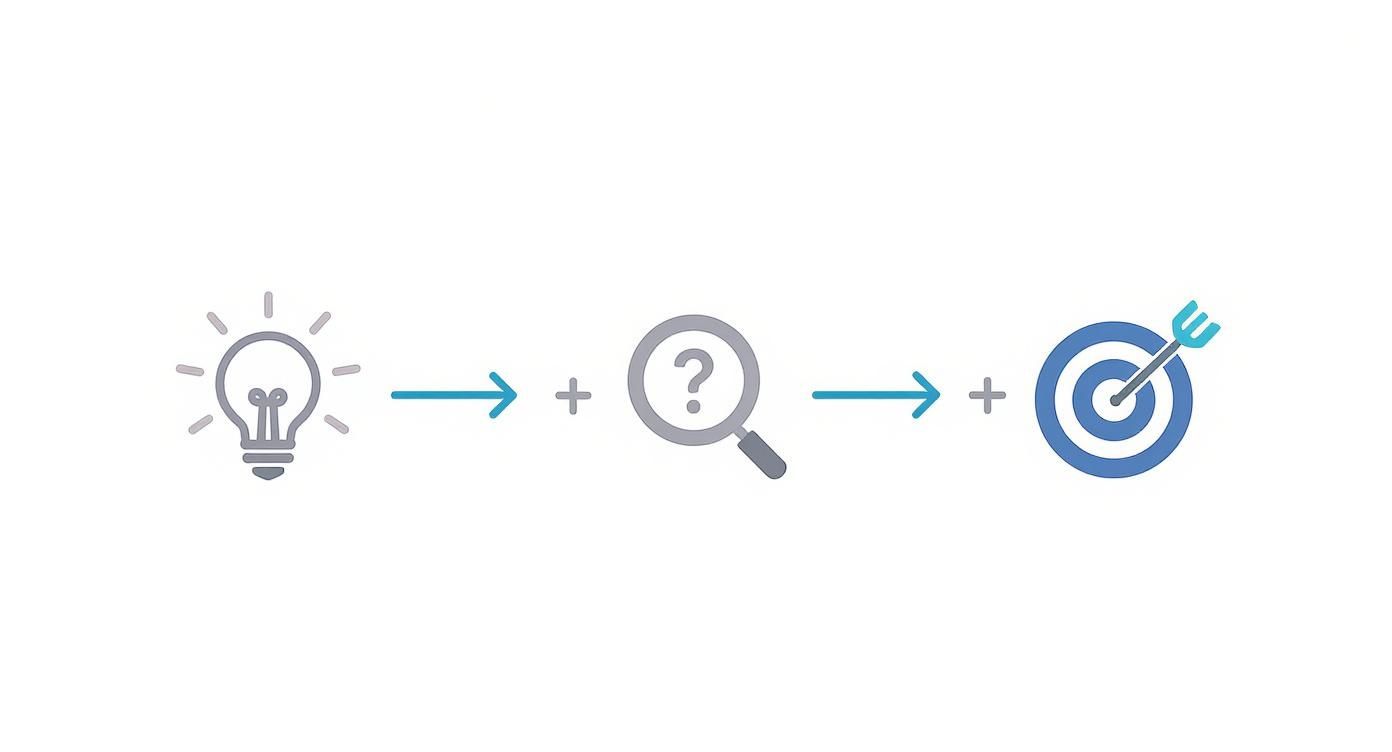
As you can see, the path to a successful app always starts with a rock-solid idea that addresses a real market need. That core strategy is what should guide your technical decisions, not the other way around.
Hybrid and Web Apps: The Flexible All-Rounders
Hybrid apps strike a fantastic balance. Using clever frameworks like React Native or Flutter, developers can write the code once and deploy it on both iOS and Android devices. This “write once, run anywhere” approach can dramatically slash development time and costs.
This makes it an incredibly popular choice for startups or businesses wanting to test an idea without betting the farm. For a Shopify implementation where you need to reach both iPhone and Android users quickly without doubling your development budget, a hybrid app is often the perfect solution.
Then you have Progressive Web Apps (PWAs). These are the most versatile of the bunch. At their core, they’re websites built to look and behave just like a native app. Users can access them through a web browser—no app store download required—but they can still have an icon on the home screen and even work offline.
A PWA can be a game-changer for something like a new Odoo implementation Sydney Adelaide project where you need a mobile-friendly interface for your team. It’s a fast and cost-effective way to get powerful functionality into their hands, wherever they are.
Comparing App Development Approaches
To make the choice clearer, let’s break down how these three approaches stack up against each other.
| Factor | Native App (iOS/Android) | Hybrid App (React Native/Flutter) | Progressive Web App (PWA) |
|---|---|---|---|
| Performance | Highest. Fast, responsive, and fully optimised for the OS. | Very good. Near-native performance for most use cases. | Good. Dependent on the browser, can be slower. |
| Cost | Highest. Requires separate development teams and codebases. | Medium. Shared codebase significantly reduces costs. | Lowest. Leverages existing web development skills. |
| Time to Market | Slowest. Building and testing two separate apps takes time. | Fast. Single codebase means quicker development cycles. | Fastest. No app store approval process required. |
| User Experience | Best. Follows OS-specific design guidelines perfectly. | Good. Can mimic native look and feel, but not always perfect. | Fair. Limited by browser capabilities and UI conventions. |
| Device Access | Full. Unrestricted access to all device hardware and features. | Almost full. Access most features via plugins/APIs. | Limited. Access to camera, geolocation, but not everything. |
| Distribution | Through Apple App Store and Google Play Store. | Through Apple App Store and Google Play Store. | Accessible via a URL, no app store needed. |
Ultimately, there’s no single “best” answer—only what’s best for your project.
Choosing the right path is a strategic balancing act between your ambitions and your resources. A native app might deliver the ultimate user experience, but a hybrid or PWA can get you to market far quicker and more affordably.
Ready to figure out the best development path for your app idea? Contact Wistec for a free consultation to discuss your project goals and find the perfect fit.
Navigating the Agile Development Cycle
Forget the old, rigid ways of building software. Modern mobile app development has thrown out the sequential rulebook and embraced a far more dynamic process: the Agile methodology.
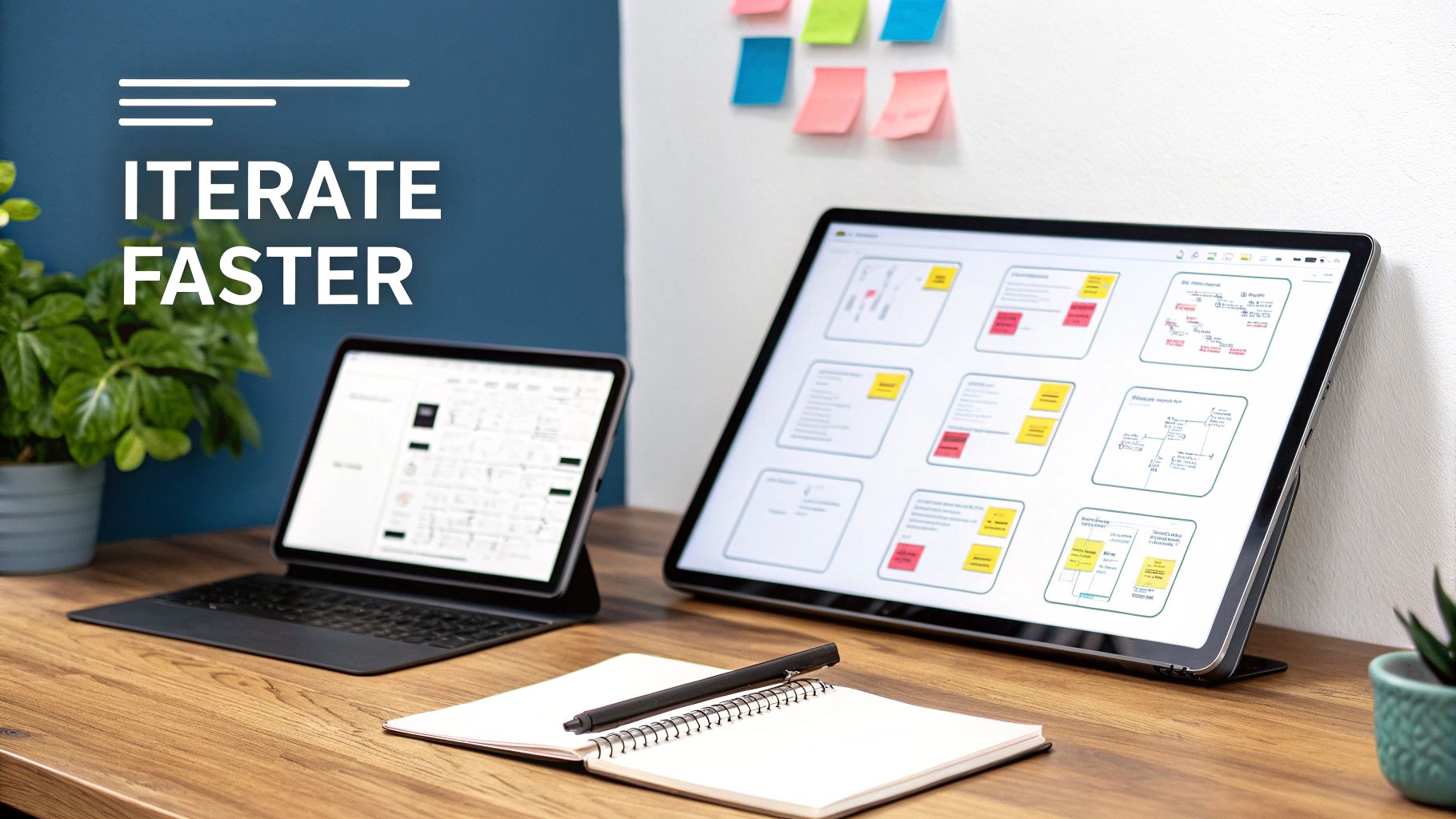
Think of it less like following a strict architectural blueprint and more like sculpting a masterpiece. You start with a core concept and then continuously shape, refine, and adapt it in short cycles based on real feedback. It’s a living, breathing process.
This iterative approach is the secret sauce to ensuring the final product isn’t just functional, but genuinely aligned with what users want and what the business needs. The entire journey becomes a powerful loop of designing, building, testing, and improving. It’s how we tackle everything from a simple WooCommerce store integration to a sophisticated enterprise system for a software development Sydney Adelaide firm.
From Idea to Interactive Prototype
The first critical phase is design, but it’s about so much more than picking pretty colours. It all starts with wireframes—the bare-bones, black-and-white layouts that map out your app’s structure and user journey. This is the skeleton; it ensures every screen, button, and interaction has a clear purpose before we even think about aesthetics.
From that solid foundation, we move on to high-fidelity prototypes. These are the game-changers. We create interactive, full-colour mockups that look and feel just like the final app. It’s a non-negotiable step that lets stakeholders actually click through the app, feel its flow, and catch any design hiccups long before a single line of code is written.
Building the Engine and the Interface
Once everyone is happy with the prototype, development work kicks off on two parallel tracks:
-
Back-End Development: This is the engine room of your app. Our developers build the server-side logic, databases, and Application Programming Interfaces (APIs) that do all the heavy lifting behind the scenes. Think user authentication, data processing, and business rules. A powerful back-end is what makes an app fast, secure, and ready to scale.
-
Front-End Development: This is everything your users will see, touch, and interact with. The front-end team transforms the visual prototypes into a living, breathing interface. They write the code for the responsive layouts, smooth animations, and interactive elements that create a brilliant user experience.
Splitting the work this way keeps the project moving efficiently. For example, the complex Odoo implementation Sydney Adelaide businesses need relies on a rock-solid back-end to handle massive amounts of data, while the front-end team focuses on making the mobile interface a breeze for employees to use.
The Unwavering Focus on Quality Assurance
Let’s be blunt: the mobile app market is brutal. With around 260 billion app downloads in 2023, users have sky-high expectations and zero patience for bugs or glitches. The pressure to deliver a flawless experience is immense, which is why quality assurance (QA) is an absolutely essential part of the development of mobile apps. You can learn more about the staggering growth of the mobile app industry and see why user experience is everything.
A comprehensive testing strategy is the only way to guarantee a stable, secure, and reliable product. It’s the safety net that catches issues before your users do, protecting your brand’s reputation and ensuring a successful launch.
QA isn’t just a final check-up; it’s a continuous process woven throughout the entire project. This includes:
- Functional Testing to make sure every single feature works exactly as it should.
- Performance Testing to ensure the app is lightning-fast and responsive, even under pressure.
- Security Testing to find and patch any potential vulnerabilities.
- Usability Testing to confirm the app is intuitive and dead simple to navigate.
Whether you’re planning a Shopify implementation or a bespoke B2B application, this relentless cycle of building, testing, and refining is what separates the great apps from the forgotten ones.
Ready to build a high-quality app that users will love? Contact Wistec today for a consultation and let’s bring your vision to life through a proven Agile process.
Launching Your App and Driving Growth
Finishing the development of your mobile app is a massive milestone, there’s no doubt about it. But think of it as the starting line, not the finish. A truly successful app doesn’t just materialise on its own; it’s launched with a sharp strategy and nurtured with a smart growth plan. This is where all your hard work finally translates into real-world results.
It’s a bit like a grand opening for a new shop. You wouldn’t just unlock the doors one morning and hope for the best, would you? Of course not. You’d plan the event, advertise it, and create an experience that makes people want to come back. The exact same thinking applies here.
Deploying to the App Stores
Getting your app onto the Apple App Store and Google Play Store is a meticulous process that really demands your full attention. This isn’t just about uploading a file; it’s about presenting your app in the best possible light. A sloppy submission can easily lead to rejection, costing you valuable time and killing your momentum right out of the gate.
Your checklist for a smooth deployment needs to include:
- Compelling Metadata: This covers your app’s title, a description optimised with the right keywords, and a crystal-clear privacy policy.
- High-Quality Visuals: Engaging screenshots and a short video preview are non-negotiable for grabbing a user’s attention.
- Submission Guideline Adherence: Both Apple and Google have strict rules. Following them to the letter is the best way to prevent delays.
The app store is your digital shopfront. Every single element, from your icon to your screenshots, must be designed to convert a casual browser into a loyal user. A great mobile experience is especially vital for a successful Shopify implementation or WooCommerce store, where conversions are everything.
Fuelling Growth After Launch
The moment your app is live, the real work begins. Your focus has to shift immediately from building the product to building an audience. This becomes an ongoing cycle of attracting users, analysing their behaviour, and refining the experience to keep them coming back.
A huge part of this is App Store Optimisation (ASO). You can think of it as SEO for your app. It involves constantly tweaking your keywords, visuals, and description to improve your ranking in search results. Put simply, higher visibility means more organic downloads.
Beyond ASO, you’ll need a solid user acquisition strategy. This could involve targeted social media ads, content marketing, or even influencer partnerships to drive that crucial first wave of users. Data is your best friend here. Tools like Firebase or Mixpanel give you incredible insights into how people are actually using your app, highlighting popular features and shining a light on areas that need improvement. This data-driven approach is fundamental for any serious software development Sydney Adelaide project aiming for long-term success.
This feedback loop of launching, measuring, and learning is what turns a good app into a great one. Whether it’s for a standalone product or part of a larger Odoo implementation Sydney Adelaide businesses rely on, this growth phase defines its ultimate impact.
Ready to create a launch strategy that drives real growth for your app? Contact Wistec for a free consultation and let’s plan your path to success.
Future-Proofing Your Mobile Application

The mobile world moves at a blistering pace. To build an app that lasts, you can’t just think about what users want today; you have to anticipate where the technology is heading tomorrow. The development of mobile apps has shifted gears, moving beyond basic functions into a new realm of intelligent, deeply connected experiences.
Keeping your finger on the pulse of these emerging trends isn’t just about staying competitive—it’s about survival. It’s the difference between an app that meets today’s standards and one that’s ready to grow with your users. This forward-thinking mindset is what truly separates the market leaders from the pack.
Integrating AI and Machine Learning
Let’s be clear: Artificial Intelligence (AI) and Machine Learning (ML) are complete game-changers for mobile apps. They tear up the old one-size-fits-all rulebook. Instead, your app can learn from how people actually use it, delivering hyper-personalised content, smart recommendations, and predictive features that feel almost second nature to the user.
Think about a retail app powered by a Shopify implementation. Instead of just showing a generic catalogue, it could use AI to suggest products based on a user’s browsing habits, past purchases, or even the local weather. That’s not just clever; it’s a direct line to better engagement and more sales. The same goes for a WooCommerce store, where ML algorithms could predict demand spikes to keep inventory perfectly balanced.
Artificial intelligence is one of the most significant trends shaping the industry. Consider this: Australian users check their phones roughly 58 times daily and spend a massive 88% of their digital time inside apps. With the global AI in mobile apps market projected to hit $22.8 billion by 2028, weaving this technology into your app is a clear path to creating a stickier, more compelling experience. You can dive deeper into these Australian mobile app development trends.
Embracing 5G, AR, and IoT
The arrival of 5G is so much more than just faster movie downloads. It’s the key that unlocks a whole new set of app capabilities. The ridiculously low latency of 5G makes immersive tech like Augmented Reality (AR) and the Internet of Things (IoT) genuinely practical for the first time.
Picture a software development Sydney Adelaide firm building an app for an industrial business. With 5G and IoT sensors, technicians in the field could pull up real-time diagnostic data from heavy machinery right on their phones. Or imagine a complex Odoo implementation Sydney Adelaide project where AR provides interactive, step-by-step training overlays for new staff, right in their line of sight.
Getting ahead of these technological shifts is what will keep your app valuable and relevant for years to come.
Are you ready to build a mobile application that’s built for tomorrow? Contact Wistec today for a free consultation, and let’s talk about how we can bring these next-generation technologies to your project.
Got Questions? We’ve Got Answers
Stepping into the world of app development can feel like learning a new language. It’s natural to have questions, so we’ve put together some straight-to-the-point answers for the ones we hear most often.
How Much Will My App Cost to Build?
It’s the million-dollar question, isn’t it? In Australia, a straightforward app might start around $25,000, while a highly complex platform with all the bells and whistles can easily exceed $250,000.
What drives the price? It all comes down to the app’s complexity, the features you need, and whether you’re building for both iOS and Android. For instance, creating an app that needs to sync seamlessly with a sophisticated backend, like the kind of Odoo implementation Sydney Adelaide businesses rely on, will naturally be a larger investment than a simple, standalone tool.
How Long Does It Take to Develop an App?
Just like the cost, the timeline really depends on the scope of the project. If you’re looking to get a Minimum Viable Product (MVP) out the door—that’s a version with just the essential features to get started—you could be looking at a 3-4 month timeframe.
For a more comprehensive app, perhaps something that integrates deeply with a large-scale Shopify implementation, you should budget for 6-9 months, or sometimes even longer. Good things take time.
What’s the Real Difference Between a Mobile App and a Web App?
Think of it this way: a native mobile app is like a specialised tool you keep in your toolbox. You download it from an app store, it lives on your phone, and it can tap into all your device’s hardware—like the camera, GPS, or your contacts. It’s built specifically for that environment.
A web app, on the other hand, is more like a versatile website that’s been expertly designed to work beautifully on your phone’s browser. You don’t install it, you just visit it online. Many businesses test the waters with a web app for their WooCommerce store first, proving there’s an audience before committing to a full native app experience.
Ready to stop wondering and start building? Or maybe you have a few more questions of your own? The team at Wistec lives and breathes custom software and app development that gets results.
Let’s chat about your idea—reach out for a free, no-obligation consultation!