

Before a single line of code is written or a pixel is designed, the journey of every great app starts with a solid strategy. This isn’t just about having a cool idea; it’s about turning that idea into a viable plan that can actually succeed in the real world. Think of it as the foundation of your entire project – get this right, and everything else follows.
Building Your App’s Strategic Blueprint
Jumping straight into the technical side of app creation is a classic rookie mistake. The most successful projects I’ve seen always begin with rigorous, sometimes painstaking, strategic planning. This isn’t just about ticking boxes; it’s the critical process that confirms your app solves a genuine problem and has a fighting chance in an incredibly crowded marketplace. A well-thought-out strategy becomes your North Star, guiding every single decision, from which features to build first to how you’ll eventually market it.
This initial phase is all about deep-diving into market research, sizing up the competition, and pinpointing what makes your app uniquely valuable. You’ve got to understand the “why” before you even think about the “how.” For example, a team focused on software development in Sydney might uncover a gap in the market for a hyper-local logistics app that their bigger competitors have completely ignored. That single insight could shape their entire development roadmap.
Uncovering Market Needs and Opportunities
The first pillar of your strategy is to truly understand the landscape you’re about to enter. This means digging deeper than just surface-level stats to find real user pain points. What headaches do people in your target audience face every day that your app could soothe? Good market research is less about spreadsheets and more about empathy.
Practical Case: A retail business in Adelaide noticed declining foot traffic but a surge in online queries. Instead of guessing, they conducted customer surveys and discovered their audience wanted a way to check stock levels in real-time before visiting. This insight became the core idea for their mobile app, directly solving a customer pain point and linking their physical store to their digital presence, which was managed through a WooCommerce platform.
Get out there and talk to people. Run surveys, conduct interviews, and organise focus groups to get direct feedback. One of my favourite tricks is to scour the app store reviews for competing apps—what are users constantly complaining about? Those complaints are pure gold. They’re your opportunities to swoop in and fill a gap. This groundwork is absolutely crucial, whether you’re building a simple consumer app or planning a complex Odoo implementation in Adelaide that needs a mobile front-end.
To get a sense of how these pieces fit together, this simple flow shows how you move from broad research to a defined concept and, finally, to a concrete plan.
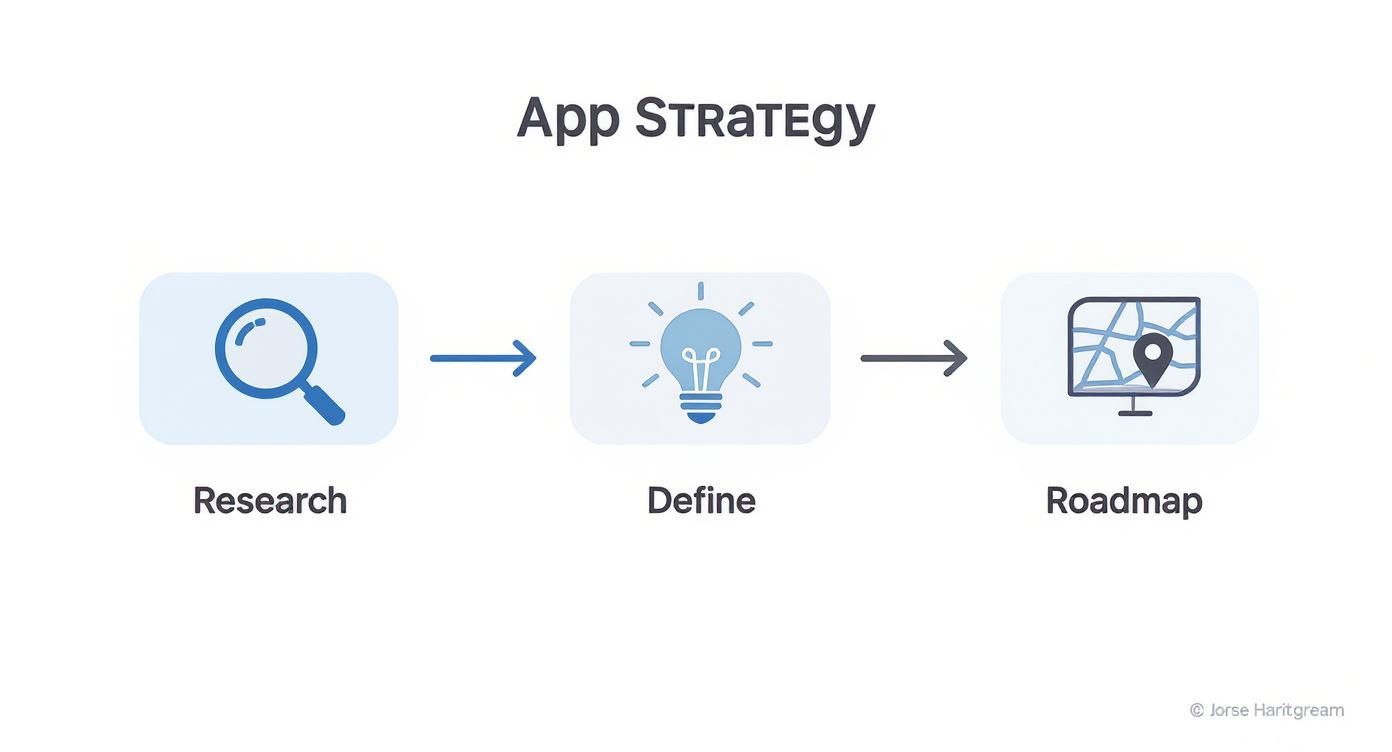
As you can see, a solid roadmap is only possible after you’ve done the hard yards of researching the market and nailing down your app’s core purpose.
Defining Your Unique Value Proposition
Once you have those market insights, it’s time to craft your Unique Value Proposition (UVP). This is a simple, powerful statement explaining the benefit you offer, how you solve your customer’s problem, and what truly sets you apart from the competition. A vague or weak UVP will lead to a forgettable app, plain and simple.
Your UVP isn’t just a marketing slogan; it’s the core promise your app makes to its users. It should be the first thing you define and the last thing you compromise on.
Practical Case: An e-commerce business in Sydney, undergoing a Shopify implementation, wanted to launch a companion app. They noticed their competitors’ apps were slow and frustrating. Their UVP became: “The fastest, easiest way to shop your favourite styles, with one-tap checkout and personalised recommendations.” It immediately shouts speed and convenience as the key differentiators. Similarly, a WooCommerce store owner might make exclusive in-app deals the centrepiece of their UVP. This clear focus guides every feature decision.
Setting Clear Goals and a Realistic Roadmap
The final piece of your strategic puzzle is setting SMART goals—specific, measurable, achievable, relevant, and time-bound. These aren’t just wishful thinking; they are the concrete benchmarks you’ll use to guide development and measure your success after launch.
- User Acquisition: Aim to get 10,000 new users within the first three months.
- Engagement: Hit a daily active user rate of 20% within six months.
- Monetisation: Generate $5,000 in monthly recurring revenue by the end of year one.
These goals then feed directly into your product roadmap, which outlines the features you’ll build and the timeline for their release. For any software development team in Adelaide, this roadmap is the document that keeps everyone aligned and focused on shipping value, one step at a time.
Ready to turn your app idea into a strategic success? A well-planned blueprint is your first step towards a thriving mobile application. Contact us today to discuss your vision and build a roadmap for success.
Cracking the Code of the Australian App Market
If you want to build a successful app down under, you can’t just copy and paste what works overseas. You have to get a real feel for the local scene. The way Aussies use their phones, the platforms they prefer, and what they’re willing to pay for—it’s all a bit different here. Nailing this from the get-go is the difference between a launch that makes waves and one that barely makes a ripple.
The first big question for any team, whether you’re working on software development in Sydney or anywhere else, is which platform to build for first. In Australia, the answer is usually pretty clear.
The local market heavily leans towards Apple. As of early 2024, iOS holds a dominant 55.2% of the mobile operating system market share, with Android sitting at 44.8%. This isn’t just a number; it’s a direct reflection of Australian consumer preference for Apple’s polished ecosystem and strong reputation for security. You can dig deeper into the Australian OS market share data to see the full picture.
This data should be the cornerstone of your launch strategy. For many businesses, especially those on a tight budget, an iOS-first approach just makes good business sense. It lets you target the majority of potential users right away, validate your idea, and gather crucial feedback before you even think about doubling your development costs for a second platform.
A Quick Look at the Numbers
To put it in perspective, choosing your primary platform is the first major fork in the road. Here’s how the market share breaks down and what it means for your development journey.
| Mobile Operating System Market Share in Australia |
| :— | :— | :— |
| Operating System | Market Share (%) | Key Developer Consideration |
| iOS (Apple) | 55.2% | Building for the majority. Access to a user base generally more willing to spend on apps and in-app purchases. |
| Android (Google) | 44.8% | A significant market, but often a secondary priority for an initial launch unless your target demographic specifically skews towards Android. |
This clear iOS preference in Australia guides your entire project, from initial design mock-ups to the final lines of code.
Native vs. Hybrid: The Aussie Angle
The dominance of iOS naturally leads to the next big technical decision: do you go native or hybrid? Building a native iOS app guarantees the best performance and a seamless user experience, but a hybrid framework lets you build for both iOS and Android at the same time.
Here’s how to think about it for the Australian market:
-
Going Native (iOS-First): This is your best bet for apps where performance is everything. Think high-end games, photo editing tools, or anything that needs to tap deep into the phone’s hardware like the camera or GPS. It costs more upfront and takes longer to eventually get onto Android, but it delivers the premium experience that Aussie iPhone users expect.
-
Choosing Hybrid/Cross-Platform: This is a smart move for content-focused apps, Minimum Viable Products (MVPs), or if you absolutely need to reach both iOS and Android users from day one without breaking the bank. Frameworks like React Native or Flutter are perfect for this. The only catch? You might sacrifice a little of that buttery-smooth native feel, and savvy users can sometimes tell the difference.
For businesses focused on e-commerce, maybe through a Shopify implementation or a WooCommerce store, a hybrid app can be a fantastic way to test the market. But if you’re aiming to build a brand that stands shoulder-to-shoulder with the top apps on the App Store, investing in a native build is often a non-negotiable part of the long-term game.
How to Actually Make Money From Your App in Australia
Your monetisation strategy needs to resonate with Aussie spending habits. We’re generally happy to pay for quality, but we have definite preferences.
-
The Freemium Subscription Model: This is the gold standard here. Give users the core features for free so they can see the value for themselves. Once they’re hooked, offer a premium subscription that unlocks powerful new tools or content. Just look at the top fitness, productivity, and media apps—this is their bread and butter.
-
In-App Purchases (IAPs): A huge winner in gaming and lifestyle apps. Think one-off purchases for virtual goods or special features. The secret is to make them feel like a genuine enhancement to the experience, not a frustrating roadblock.
-
The One-Time Purchase: It’s less common these days, but it can still be a perfect fit for utility apps that solve one specific, high-value problem brilliantly. If your app is a “tool” rather than a “service,” users might prefer to just pay once and own it outright.
The biggest mistake I see is teams trying to apply a US or European monetisation model directly to the Australian market. It just doesn’t work. Consumer psychology is different here. Just as any expert handling an Odoo implementation in Adelaide knows you have to adapt to local business culture, your app’s revenue model has to fit local user expectations.
Ultimately, winning in the Australian app market comes down to local knowledge. By prioritising iOS, making a smart call on your development approach, and picking a revenue model that clicks with Aussies, you’re setting yourself up for success from the very beginning.
Ready to build an app that truly connects with the Australian audience? Get in touch with our team of experts in software development in Sydney and Adelaide to start planning your project today.
Crafting an Unforgettable User Experience
Let’s be blunt: a brilliant app idea means absolutely nothing if people can’t figure out how to use it. A clunky, confusing interface is the fastest way to get your app uninstalled. This is where user experience (UX) and user interface (UI) design become the most critical part of the entire development of mobile app. Good design isn’t about slapping on some pretty colours; it’s about engineering a seamless, intuitive journey for your users.
Before anyone writes a single line of code, you need to map out the user’s path. This all starts with wireframing—creating simple, low-fidelity blueprints of each screen. Think of it as the architectural drawing for your app. It shows where buttons go, how information is laid out, and exactly how someone gets from A to B. This stage is all about function, not fashion. It forces you to think through the logic and flow, helping you catch navigational dead ends before they become costly problems.
Once you’ve got a solid blueprint, you can move on to prototyping. This is where the app starts to feel real. A prototype is essentially an interactive, clickable model of your app that simulates the final product. It lets you test the user flow, get a proper feel for the navigation, and iron out usability kinks before spending a dollar on expensive development. Honestly, it’s a game-changer for getting stakeholder buy-in and validating your design choices with actual users.
From Blueprints to Visual Identity
With the core structure locked in, the focus shifts to creating a striking UI and a strong visual brand. This goes way beyond just picking a colour scheme; it’s about crafting an identity that genuinely connects with your target audience and builds trust.
A consistent style guide is non-negotiable here. It defines everything from your font choices and button styles to your logo usage and colour palette. This ensures a cohesive, professional look and feel across every single screen of your app.
Great UI design makes the user feel smart and in control. It anticipates their needs and guides them effortlessly, building trust and encouraging them to come back.
For example, a business going through a Shopify implementation for their online store would need their companion app to mirror that website’s branding perfectly. The fonts, colours, and overall vibe have to be identical to create a unified customer experience. Similarly, if you’re using WooCommerce, the app must feel like a natural extension of your online presence, not some disconnected afterthought.
Practical Design in Action
Let’s look at a real-world scenario. Imagine a manufacturing company in South Australia is planning an Odoo implementation in Adelaide. They need a mobile app for their warehouse staff to manage inventory.
-
Bad UX/UI: The app is designed with tiny buttons that are impossible to tap with gloves on. It uses complex jargon that only the office staff understands, and the barcode scanner is buried three menus deep. The result? Frustrated staff, a spike in errors, and nobody wanting to use it.
-
Good UX/UI: This version features large, high-contrast buttons and uses clear, universal icons instead of text. The scanner function is front and centre on the home screen. The app feels fast and intuitive, making the team’s job easier and more efficient.
This practical, user-centric approach to design is exactly what separates successful projects from failures. It’s a core competency for any serious team handling software development in Sydney or Adelaide. By investing in a thoughtful design process, you’re not just creating a pretty interface; you’re building a foundation for user loyalty and long-term success. A polished design isn’t a luxury—it’s your ticket to competing in a crowded market.
Ready to design an app your users will love? Contact us to discuss how our expert UX/UI design and development team can bring your vision to life.
Bringing Your App to Life: Development and Testing
This is where the magic really happens. All those blueprints, wireframes, and designs are about to become a real, working product. The development phase is where your vision is translated, line by line, into functional code. It can feel like the most complex part of the journey, but getting a handle on the key decisions here will put you firmly in the driver’s seat, making sure the final app is everything you imagined.
One of the first big conversations you’ll have with any development team is about the technical approach. This isn’t just tech-talk; this decision has a massive impact on your budget, your timeline, and how your app actually performs in the wild. There’s no silver bullet here—the right choice is all about your specific goals. A great software development team in Sydney will always start by laying out the trade-offs for you.
Choosing Your Development Path
Picking the right technology stack is a make-or-break moment. Each path has its own pros and cons that can either fast-track your launch or create headaches down the road.
- Native Development: This is the premium option. It means building two separate apps: one for iOS (using Swift or Objective-C) and another for Android (using Kotlin or Java). The result? Unbeatable performance, speed, and a user experience that feels completely seamless and integrated with the phone’s own system.
- Hybrid Development: Want to be smart with your budget and time? Frameworks like React Native or Flutter let you write a single codebase that works on both Apple and Android devices. This is a brilliant strategy for getting a Minimum Viable Product (MVP) out the door quickly or for apps that don’t need heavy graphics or super-specific device features.
- Progressive Web Apps (PWAs): Think of a website that acts just like a native app. Users can “install” it to their home screen right from their browser, no app store needed. This makes them incredibly easy to access and is a fantastic choice for businesses with a solid web presence, like an e-commerce store with a Shopify implementation or a WooCommerce backend.
Practical Case: A logistics company in Adelaide needed a companion app for its drivers, built alongside an Odoo implementation in Adelaide. For them, a native Android app was the clear winner. It guaranteed rock-solid reliability for critical features like GPS tracking and offline data syncing, even when drivers were in areas with patchy reception. Choosing a hybrid app could have risked performance on these core functions.
The Two Sides of Your App
Every mobile app has two parts that work together: the front-end and the back-end.
The front-end is everything your user can see and touch—the buttons they tap, the menus they scroll through, the slick animations that bring your UI/UX designs to life.
The back-end is the powerful, invisible engine running the whole show. This is where the heavy lifting happens. It’s made up of:
- Servers: The computers that run the application’s logic.
- Databases: The secure vaults where all your important data, like user profiles and content, is stored.
- APIs (Application Programming Interfaces): These are the crucial messengers that let the front-end (the app on the phone) communicate with the back-end (the server).
Think of it like a restaurant. The front-end is the beautifully decorated dining room, the menu, and the friendly waiter taking your order. The back-end is the kitchen—the chefs, the ovens, the ingredients—where your meal is actually prepared. A top-tier software development team in Adelaide knows you can’t have a five-star dining experience without a world-class kitchen supporting it.
Testing isn’t just another step; it’s a mindset. Rushing or skipping testing is the single most expensive mistake you can make. It’s a one-way ticket to a buggy launch, a flood of one-star reviews, and losing user trust you may never get back.
You Simply Can’t Skip Testing
Launching an app without thorough testing is like trying to fly a plane you haven’t inspected. It’s a recipe for disaster. A multi-layered testing process is your only real defence against a botched launch. This isn’t just about squashing bugs; it’s about guaranteeing quality, shoring up security, and making sure your app doesn’t crumble under real-world pressure.
Your testing plan has to cover a few key areas:
- Functional Testing: Does every single button, link, and feature do exactly what it’s supposed to do?
- Performance Testing: What happens when lots of people use the app at once? Does it become sluggish, drain the battery, or just crash?
- Security Testing: Is your users’ data locked down tight? We’re talking proper encryption and protection against potential attacks.
- User Acceptance Testing (UAT): This is the final reality check. You put the app in the hands of actual users to make sure it meets their needs and feels intuitive.
Taking this comprehensive approach is how you deliver a polished, reliable product that earns user trust from the very first tap.
Ready to see your concept turn into code? Contact our expert software development team in Sydney today to discuss your project.
Getting Your App into the World: Launch and Beyond
So, you’ve built a fantastic app. That’s a huge achievement, but honestly, it’s only half the job. Now for the exciting part: getting it into people’s hands and making sure they stick around. A powerful launch isn’t just about flicking a switch and hoping for the best. It’s a carefully planned campaign designed to build momentum from the very first day. This is where your focus pivots from code to customers, and the real journey of your mobile app begins.
Your launch plan needs to hit from all angles, combining a strong presence on the app stores with a marketing push that creates genuine excitement. The whole idea is to make sure that when you do go live, there’s already an audience waiting.
Get Found: Mastering App Store Optimisation
Think of App Store Optimisation (ASO) as the SEO for the mobile world. It’s all about making your app stand out on the Apple App Store and Google Play Store. If you ignore ASO, it’s like opening a shop on a quiet backstreet with no sign – no one will ever find you. The goal is simple: rank high for the keywords your target users are actually searching for.
First, you need to get inside your user’s head. What words would they type into the search bar to find a solution like yours? Once you have a list, use those keywords strategically in your:
- App Title: This is prime real estate. Get your most important keyword in here.
- Subtitle/Short Description: A perfect spot for secondary keywords and to state exactly what your app does.
- Keyword Field (iOS) / Long Description (Android): List all your relevant terms here, but keep it natural. No one likes a keyword-stuffed mess.
And please, don’t skimp on the visuals. Eye-catching screenshots and a punchy preview video that quickly shows off your app’s “wow” factor can make a massive difference to your download numbers.
Build the Hype: Your Pre-Launch Marketing Plan
A truly great launch starts long before you hit the app stores. You need to build anticipation and create a buzz across different channels to reach your audience wherever they hang out. This could be a mix of content marketing, social media campaigns, or even reaching out to a few key influencers in your niche.
Practical Case: A business is launching a companion app for its Shopify implementation. They could run a pre-launch social media contest offering exclusive discounts to the first 500 subscribers who pre-register. Or a B2B app tied to an Odoo implementation in Sydney could publish targeted articles on LinkedIn that solve a real problem for their professional audience, with a call-to-action to join the app’s waitlist. The trick is to start the conversation early and give people a compelling reason to care about your launch day.
The moment your app goes live is just the beginning. The real work starts now. A successful launch is the first step in a marathon of continuous improvement, driven entirely by user feedback and data.
Keep Them Coming Back: The Growth and Improvement Loop
Once your app is out in the wild, your focus has to shift to retention. It’s so much cheaper and more effective to keep an existing user happy than to constantly chase new ones. The way you do this is through a relentless cycle of listening, learning, and making your app better.
Actively ask for feedback. Use in-app prompts, send out short surveys, and obsessively read your app store reviews. Every single piece of feedback is a gift—it’s your users telling you exactly what to fix or what to build next. This data-first approach is the bedrock of any serious team focused on software development in Sydney or beyond.
You also need to track the right numbers. Don’t get caught up in vanity metrics like total downloads. Focus on what really tells you if your app is working:
- User Retention Rate: What percentage of people come back after their first day, week, or month? This is gold.
- Session Duration: When people open your app, how long do they actually stick around?
- Daily Active Users (DAU): A crystal-clear indicator of how ‘sticky’ your app is.
Let this data drive your product roadmap. Plan for regular updates that don’t just fix bugs but also add new, valuable features that keep your users engaged and excited to see what’s next. This cycle of continuous improvement is the secret sauce for turning a good launch into long-term, sustainable success.
Feeling a bit overwhelmed by the launch process? Contact us today. Our experts in software development in Adelaide can help you build a growth strategy that actually delivers results.
Choosing the Right Monetisation Model
Let’s be blunt: a brilliant app that doesn’t make money is a hobby, not a business. If you want your app to have a future, you need to think about how it will generate income from day one. Choosing your monetisation strategy is a make-or-break moment in the development of mobile app journey, and it has a huge impact on how users see you and whether you’ll be around in a year’s time.
This isn’t about just slapping on a popular model you’ve seen elsewhere. It’s about creating a fair value exchange. Your revenue stream has to feel right for what your app actually does. The goal is to get to a place where users are genuinely happy to pay for the benefits they’re getting, which in turn lets you keep investing in making the app even better. A poorly chosen model can poison the well, driving away your audience before you even get a chance to grow.
And the stakes are high. Australia’s mobile app market is set to pull in a staggering US$7.42 billion this year alone. That’s a massive pie, but look at how it’s sliced: advertising is the giant, accounting for US$4.91 billion, with in-app purchases trailing at a still-huge US$2.48 billion. Paid apps? They make up a tiny sliver at US$25.28 million. These numbers from Statista really paint a picture of what works here. You can explore the complete breakdown of the Australian app market revenue to dig deeper.
Analysing the Top Monetisation Strategies
The right model for you really depends on what your app is for. What works for a casual game will almost certainly flop for a serious productivity tool.
Here’s a breakdown of the main players:
-
In-App Purchases (IAPs): This is your go-to if you’re offering digital goodies or unlocking extra features. Think buying virtual currency in a game, unlocking a new photo filter pack, or paying for a one-off power-up. It works wonders for gaming and lifestyle apps because you can get a huge number of people through the door with a free download, then entice them with valuable extras.
-
Subscription Models: Subscriptions are booming, especially for apps that provide ongoing content or services. We’re talking fitness apps with workout plans, media streaming, or cloud-based work tools. The trick here is that you have to keep delivering value month after month to convince people it’s worth the recurring fee.
-
One-Time Payment (Paid Apps): It’s a bit old-school, but the paid app model is wonderfully simple. Users pay upfront and own the app forever. This approach is best for high-value utility apps that solve a very specific, important problem. People who pay for an app are often your most loyal users because they appreciate the clear, no-fuss deal—no ads, no subscriptions.
-
Advertising (In-App Ads): The data doesn’t lie; this is the dominant model in Australia for a reason. It lets you offer your app completely free, opening it up to the largest possible audience while you make money from showing ads. The real challenge is a balancing act. You need to make enough from ads without ruining the user experience with annoying, intrusive pop-ups.
Matching Models to Business Needs
Often, your monetisation strategy is tied directly to your wider business goals. Practical Case: A company with a strong Shopify implementation finds its app’s primary purpose is to drive product sales. In that case, filling it with distracting third-party ads would be counterproductive. Instead, they use it to offer exclusive in-app deals or a smoother checkout experience, boosting their core e-commerce business.
Likewise, imagine a company that uses a custom back-end built on an Odoo implementation in Sydney. They might offer a companion app to their clients for free. The app isn’t there to make direct revenue; its value is in improving customer retention and making their own support team more efficient. For a retail brand with a WooCommerce store, the app could follow a freemium model—let everyone browse for free, but offer a subscription for VIP perks like member-only pricing or early access to sales.
Your monetisation model should feel like a natural part of the user experience, not a roadblock. The best strategies actually add value by giving users clear choices that make their interaction with your app better.
Ultimately, you’re looking for that perfect balance between profit and user happiness. This is where getting some expert advice can make all the difference. Working with a team experienced in software development in Sydney and Adelaide gives you an outside perspective to help you analyse your audience and nail down a model that will actually support your growth for the long haul.
Ready to turn your app idea into a profitable reality? Contact us for a consultation on your mobile app development and monetisation strategy.
Got Questions About Building an App? We’ve Got Answers
You’re not alone if you’ve got a few questions swirling around about what it really takes to build a mobile app in Australia. Let’s tackle some of the big ones we hear all the time.
How Long Will My App Take to Build?
This is the classic “how long is a piece of string?” question, and the honest answer is: it completely depends on what you’re building.
For a straightforward app with a core set of features, you could be looking at a 3-4 month timeline. But if your vision involves custom-built features, complex integrations with a backend system (like a custom Shopify implementation), and launching on both iOS and Android, it’s more realistic to plan for 9-12 months, sometimes even longer. This is why mapping out a detailed project scope from day one is non-negotiable.
So, What’s the Average Cost to Develop an App?
Just like the timeline, the cost is tied directly to the complexity. Here in Australia, getting quality software development in Sydney can range from around $30,000 for a lean Minimum Viable Product (MVP) up to $250,000+ for a sophisticated app loaded with features.
Several things will move that number up or down:
- Platform Choice: Are you building just for iOS, or for both iOS and Android?
- Design Complexity: How intricate are the user interface and user experience elements?
- Backend Integrations: Do you need to connect with third-party systems like an Odoo implementation in Adelaide or sync up with a WooCommerce store? Each integration adds another layer of work.
The best way to think about it is like building a house. You wouldn’t ask for the price of “a house” without providing a blueprint. An app is the same – the final cost comes down to the details in your specific plan.
Ready to get clear, straightforward answers for your specific project? Wistec is all about practical, solution-driven technology. Whether you’re after a new mobile app or expert software development in Sydney or Adelaide, we’re here to deliver results.