

Bringing a mobile app idea to life is about more than just code; it’s a carefully planned journey that turns a great concept into a tangible tool people will actually use. It’s a process of moving from that initial spark of an idea to a polished, high-performing app in the hands of your customers.
We break this journey down into four core phases: Discovery, Design, Development, and Deployment. Each one is absolutely critical to building a product that not only works perfectly but also nails your business goals.
Your Roadmap from App Idea to Market Reality
Think of this as your strategic guide to developing a mobile app, written specifically for Australian entrepreneurs. We’re going to skip the dense technical jargon and give you a clear, high-level flight plan. This roadmap will walk you through the entire process, so you understand the full journey before we get into the nitty-gritty of each stage.
Before anything else, a solid vision and sharp market research are your non-negotiables. They form the bedrock of everything that follows.
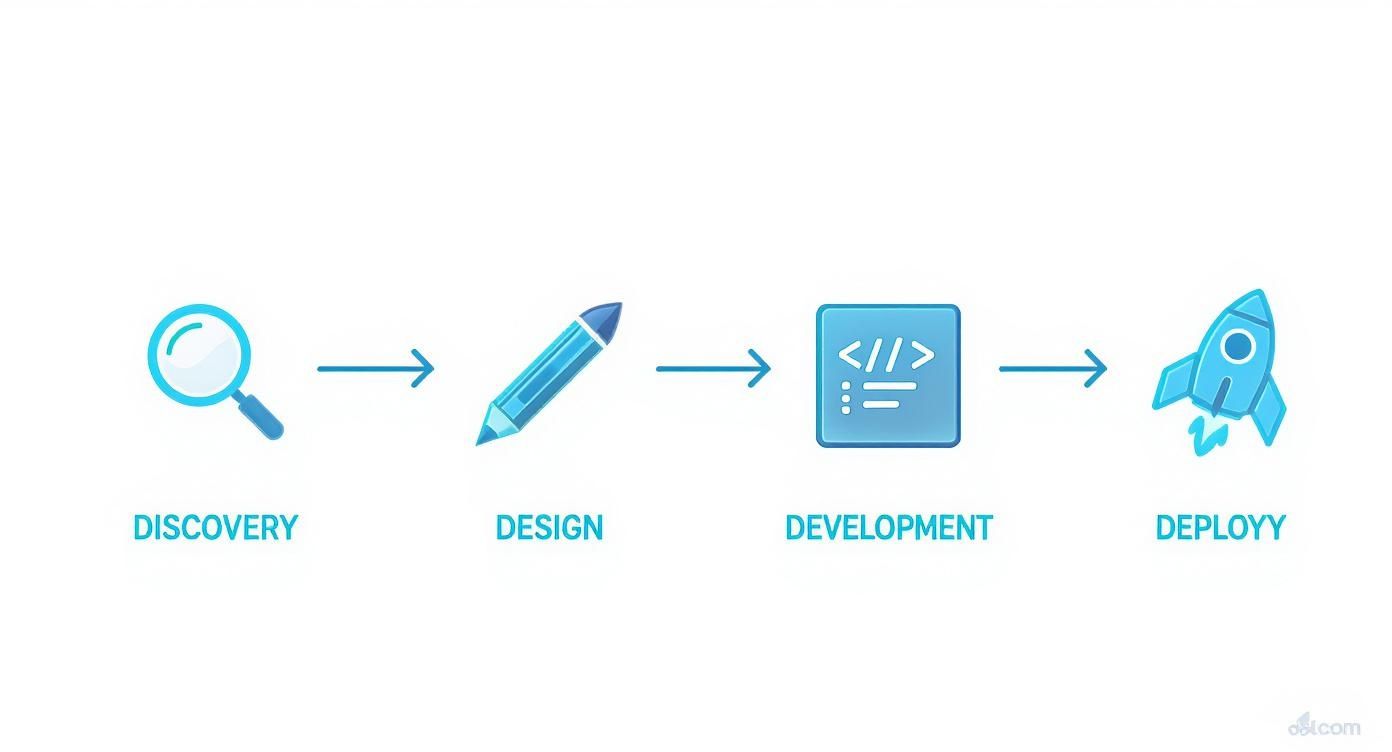
This visual shows that creating a successful app isn’t a single act of coding—it’s a structured, methodical process.
Setting the Foundation for Success
Here in Australia, the mobile app scene is constantly evolving, thanks to tech like the 5G rollout. This opens the door for much richer app experiences, including augmented reality (AR) and flawless streaming. We’re also seeing a massive rise in progressive web apps (PWAs), which can load up to 15 times faster than standard mobile sites—a huge advantage for keeping users engaged.
Of course, security is a massive priority. Biometric authentication and top-tier encryption are becoming standard practice to meet local privacy regulations. You can get a deeper insight into these Australian mobile app development trends on dotsquares.com.
The best apps are born from a clear purpose. Before you even think about code, you need a solid answer to one question: What problem am I solving for my user?
Let’s look at a practical case. Imagine a retail business in Adelaide drowning in manual inventory counts. Their goal isn’t just “to have an app.” It’s to build a tool that kills manual errors by syncing stock levels directly with their WooCommerce store in real-time. By working with a local software development Adelaide team, they can refine this vision and ensure the app is laser-focused on solving that core business problem right from the start.
This kind of initial clarity makes the entire development process more efficient and guarantees a better outcome. The same principle applies whether a manufacturer needs a custom app for their Odoo implementation Sydney businesses use, or a growing brand needs a slick mobile storefront for their Shopify implementation.
Ready to turn your idea into a successful app? Contact Wistec today for a consultation and let our expert team guide you through every stage of the process.
Laying the Groundwork for a Winning App
Every successful app starts with a rock-solid strategy, not just a burst of coding genius. This initial planning phase is what separates the chart-toppers from the apps that get downloaded once and then forgotten. It’s where we turn a great idea into a focused, commercially viable plan.
Before you even think about code, you need to become an expert on your competition. This isn’t just about making a list of similar apps. It’s about getting into the nitty-gritty: dissect their user reviews, find out what frustrates their customers, and pinpoint the features they’ve completely missed. Those gaps? That’s where your opportunity lies.

Just as crucial is defining who you’re building this for. “Everyone” isn’t a target audience. Get specific. Are you creating a tool for busy mums in Melbourne who need a faster way to shop for groceries? Or are you building for warehouse managers in Western Sydney who need to streamline their Odoo implementation? These two groups have entirely different problems, expectations, and definitions of a “good user experience.”
This deep understanding helps you set Key Performance Indicators (KPIs) that actually mean something. Forget vague goals; you need concrete targets to aim for.
- User Acquisition: How many downloads are you targeting in the first 90 days?
- Engagement Rate: What percentage of users do you want to see active daily or weekly?
- Conversion Goal: For an e-commerce app built on WooCommerce, what’s your target for completed checkouts per session?
Getting the Technology Right from Day One
One of the most pivotal decisions you’ll make early on is your development approach. This single choice will ripple through your entire project, affecting your budget, your timeline, and the app’s final performance. Bringing in an expert software development Adelaide team at this stage can be a game-changer, giving you the clarity needed to navigate these technical decisions.
The financial stakes are high. The Australian app market is projected to pull in around AUD 2.8 billion by the end of the 2024-25 financial year. This boom is fuelled by massive smartphone penetration, with iOS commanding a significant 55-60% market share. Understanding this from the get-go helps you decide where to focus your efforts. For a deeper dive, you can explore more about the Australian mobile app economy and its trends on statista.com.
Your technology stack isn’t just about getting to launch day. It’s a long-term commitment. A scalable foundation means you can grow and add new features without having to tear everything down and start over.
To help you decide, let’s look at the three main paths you can take. Each has its own strengths, so the “right” choice really depends on what you’re trying to achieve.
Choosing Your App Development Approach
| Development Approach | Best For | Performance | Cost | Key Advantage |
|---|---|---|---|---|
| Native Development | High-performance apps, complex animations, and full device integration (e.g., GPS, camera). | Highest possible performance and responsiveness. | Highest upfront cost due to separate codebases for iOS and Android. | Unmatched user experience and access to all native device features. |
| Hybrid Development | Startups and businesses needing a faster market entry on both iOS and Android with a single codebase. | Good, but can be slightly less smooth than native for intensive tasks. | More budget-friendly and faster to develop than two native apps. | Code once, deploy everywhere. A huge time and cost saver. |
| Progressive Web App (PWA) | Businesses wanting an app-like experience without the app store, ideal for e-commerce and content platforms. | Fast loading and works offline, but with limited device feature access. | Generally the lowest cost, as it’s an extension of a website. | Bypasses app stores for instant access via a web browser. |
Ultimately, the best approach is the one that aligns perfectly with your business goals, budget, and timeline.
A Practical Case Study
Let’s imagine a growing Sydney e-commerce business running on a Shopify implementation. Their main goal is to boost customer loyalty and encourage repeat business.
They could go for a native app. It would provide the slickest, fastest shopping experience imaginable and allow for powerful push notifications to announce sales. The catch? The cost of building and maintaining two separate apps (one for iOS, one for Android) is a significant barrier.
On the other end of the spectrum, a PWA offers a quick, cost-effective way to get an app-like icon on their customers’ home screens. But it can’t offer the deep device integration or the discoverability that comes with being listed in the official app stores.
This is where a hybrid app hits the sweet spot. It allows their software development Sydney team to build a single app that runs beautifully on both iPhones and Android devices. They get to market faster, stay within budget, and still deliver key features like push notifications to drive sales. It’s a strategic decision that directly ties the technology to their core business objective of increasing customer loyalty.
Ready to define a winning strategy for your mobile app? Contact Wistec for a free consultation, and let’s choose the right technology to build your success story.
Designing an Unforgettable User Experience
In the ridiculously crowded world of mobile apps, a slick design and an intuitive feel aren’t just nice-to-haves; they’re your biggest weapons. Sure, great code makes an app work. But an incredible User Experience (UX) and User Interface (UI) are what make people fall in love with it. A staggering 88% of users will ditch an app if it’s buggy or just plain confusing to use.
This is where we get our hands dirty, moving beyond ideas on a whiteboard and into the craft of building something that feels completely natural. The aim is to create an app that people don’t just tolerate but actually enjoy using. Every tap, every swipe, every interaction needs to feel effortless.
Mapping the User Journey
Before you even think about picking colours or fancy fonts, you have to get inside your user’s head. You need to map out exactly how they’ll move through your app to get something done. We call these user flows, and they’re basically treasure maps that chart every possible path a person can take.
Practical Case: Think about a customer using a retail app we’ve built on a Shopify implementation. They don’t just magically “buy a product.” Their real journey looks more like this:
- They open the app to the home screen.
- They search for an item or browse a category.
- They tap a product to see the details.
- They add it to their cart.
- They head to the checkout.
- They punch in their payment and shipping info.
- Finally, they get that satisfying purchase confirmation.
Laying it all out like this is crucial. It immediately exposes potential roadblocks before you’ve written a single line of code. Where might they get stuck? Is that “Add to Cart” button easy to spot? Is the checkout process a dozen steps too long? Nailing this groundwork is fundamental to developing mobile apps that feel logical and smooth.
From Blueprints to Prototypes
With your user flows sorted, it’s time to create wireframes. Wireframes are the architectural blueprints for the app. They’re simple, black-and-white layouts focused purely on structure—the placement of buttons, the spacing of text, the hierarchy of information. No colours, no logos, no distractions.
Their simplicity is their strength. It forces everyone to focus on pure usability without getting sidetracked by aesthetics. For instance, if we’re building a custom app for a business in Adelaide to manage their Odoo implementation, a wireframe of the inventory screen would show precisely where the barcode scanner button sits, how stock levels are displayed, and where the “update quantity” field lives. Nothing more, nothing less.
Once the wireframes get the green light, we move on to prototypes. These are interactive, clickable mockups that look and feel just like the final app.
A prototype brings a static design to life. It lets you put the app in front of real people, watch how they use it, and gather priceless feedback before you sink a dollar into the expensive development phase.
This is your golden opportunity to fine-tune the little things that make a massive difference. Does a button feel responsive enough? Is the navigation menu intuitive? Catching these hiccups now is infinitely cheaper and faster than fixing them after the app has been built. It’s an iterative loop of testing and refining that all the top software development firms in Sydney live by.
Designing for a Seamless E-commerce Experience
Nowhere is brilliant UI/UX more vital than in e-commerce. A clunky checkout is the number one killer of online sales, period. This is where sharp design directly translates to more money in your bank account.
Let’s take an app built on WooCommerce. The entire game is to make the path from discovery to purchase as frictionless as humanly possible.
- One-Click Payments: Integrating tools like Apple Pay and Google Pay is a no-brainer. It slashes the time and effort needed to buy.
- Clear Visual Hierarchy: We use size, colour, and placement to guide the user’s eye straight to that all-important “Buy Now” button.
- Progress Indicators: Showing people exactly where they are in the checkout (e.g., “Step 2 of 4”) is a simple psychological trick that reduces anxiety and keeps them moving forward.
A well-designed interface doesn’t just look good; it builds trust. It quietly reassures customers that their transaction is safe and their time is valued. That’s how you turn casual window shoppers into loyal, repeat customers.
Ready to build an app your users will actually love? Get in touch with Wistec today, and let our design experts help you create an unforgettable user experience that gets results.
Turning Your Vision Into Reality with Agile Development
Alright, this is where the magic really happens. All that careful planning and slick design work? It’s time to forge it into a real, functional application. This is the phase where blueprints become reality, and we’re going to pull back the curtain on how it’s done using the Agile methodology—the undisputed modern standard for building top-tier software without the headaches.
Forget those old-school, rigid plans that fall apart the moment something unexpected happens. Agile is all about being nimble and responsive.
The core concept is brilliantly simple. Instead of a marathon push to build the entire app at once, Agile breaks the project into small, manageable chunks called sprints. A sprint is a short, focused burst of activity, usually two weeks, where the team commits to building a specific set of features. At the end of each sprint, you get a tangible, working piece of the product to see and touch.
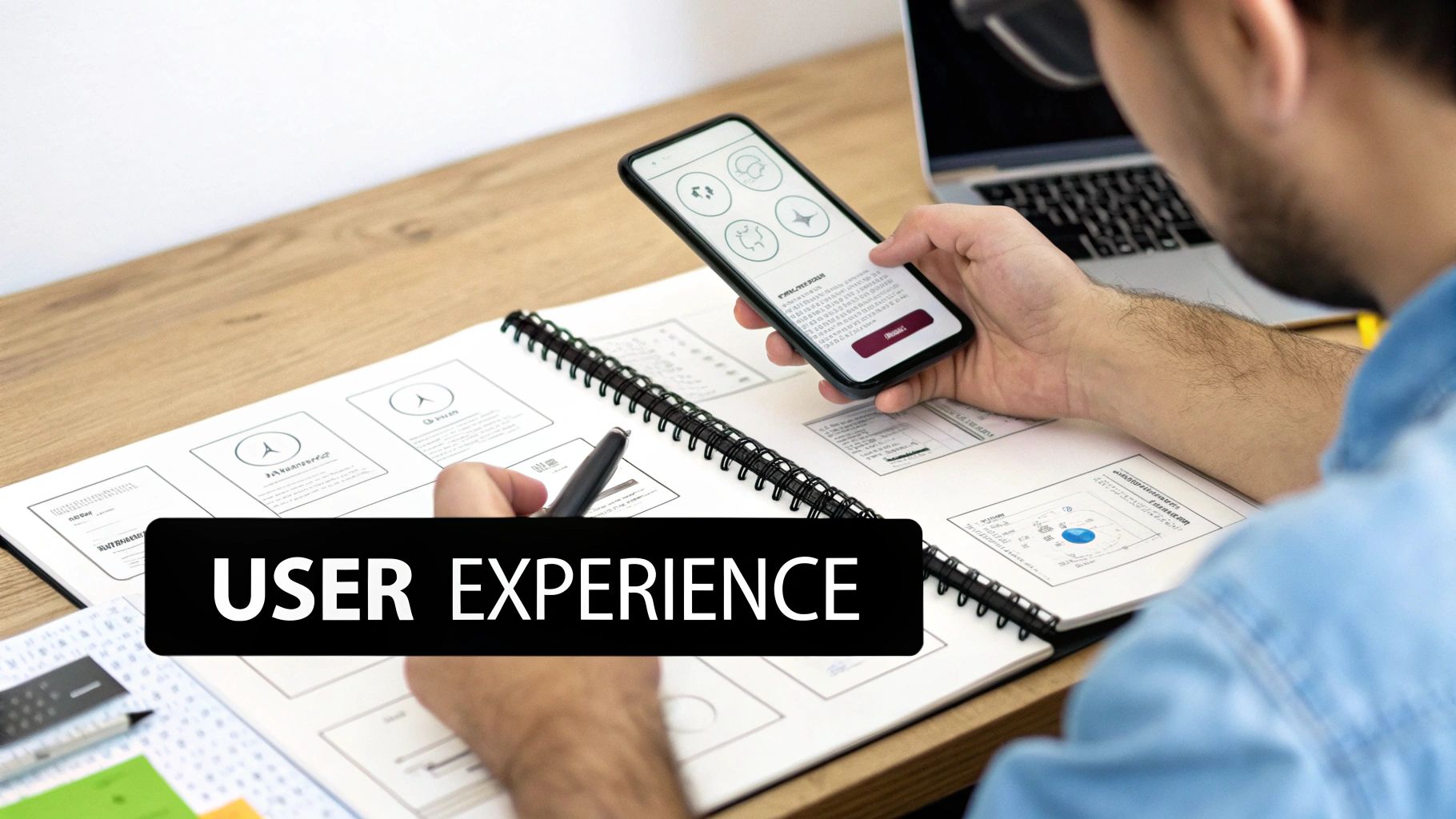
This iterative cycle is a genuine game-changer. It means you get to see your app evolve, providing constant feedback that steers the project in the right direction. Frankly, it’s a non-negotiable for success because it catches costly mistakes early and ensures the final product is precisely what your users actually want.
Front-End and Back-End: The Two Halves of the Whole
When you’re developing mobile apps, the work is always split into two distinct but interconnected areas. I like to think of it like a theatre production—you’ve got the actors and sets the audience sees, and then you have all the critical machinery working behind the curtain to make the show run smoothly.
-
Front-End Development: This is everything your user sees, touches, and interacts with. It’s the user interface (UI) you spent so much time perfecting, the buttons they tap, the slick animations, and the overall on-screen experience. The job here is to build a seamless, responsive, and visually engaging interface.
-
Back-End Development: This is the engine room. It’s the server, the database, and all the application logic humming away in the background. When a user logs in, the back-end verifies their details. When they buy something through your Shopify implementation, the back-end is what processes the payment and tells the database to update the inventory.
These two sides have to work together in perfect harmony. A gorgeous front-end is useless if the back-end is slow and unreliable. A great software development Sydney team makes sure this connection is absolutely flawless.
An Agile Approach: A Practical Case
Let’s put this into a practical scenario. Imagine a manufacturing firm in Sydney is wrestling with a clunky, outdated inventory system. They decide to build a custom mobile app that integrates with their new Odoo implementation, Sydney businesses are increasingly adopting.
With a traditional development model, they’d sign off on a massive spec document and then wait six months or even a year to see the final app, hoping it’s what they wanted. But with Agile, it’s a completely different story.
In the very first two-week sprint, the development team focuses on just one core feature: letting a warehouse worker scan a product barcode and see its current stock level. That’s it. Nothing more.
At the end of those two weeks, the team delivers this small but fully functional piece of software. The warehouse staff can test it immediately, on the floor, with real products. Their feedback is instant and invaluable: “The scanner works great, but we really need to see the supplier info on the same screen to save time.”
This feedback is pure gold. It gets baked into the plan for the very next sprint. The team then builds the supplier info feature, followed by reporting, order creation, and so on, sprint by sprint. This process slashes risk, removes the guesswork, and guarantees the final product solves real-world problems because it was shaped by the people who will rely on it every single day.
Making Your Mark in the Australian App Market
This iterative model is especially powerful in a vibrant and competitive market like Australia. As of 2025, the local scene is buzzing, home to 2,574 Australian mobile app developers actively publishing on Google Play. These developers have launched over 7,800 apps, with the average Aussie-made app racking up an impressive 323,830 downloads.
This shows a highly engaged audience, but also a crowded field. You can get a better sense of the Australian app market and its key players on 42matters.com. To stand out, you need a development process that can adapt to user feedback and market shifts on the fly.
Whether you’re in Adelaide needing a streamlined app for your WooCommerce store or a Sydney firm needing bespoke software development, the Agile method ensures your investment goes directly into features that deliver genuine, measurable value.
Ready to see your app come to life with a proven, efficient development process? Contact Wistec for a consultation, and let’s start building your solution, one successful sprint at a time.
Testing For a Flawless Launch and Beyond
So, you’ve built your app. The code is written, and the features are in place. It’s tempting to think you’re at the finish line, but what comes next is arguably the most critical part of the entire process: a deep, methodical testing phase.
This isn’t just a quick check for bugs. It’s about polishing every interaction and guaranteeing a rock-solid, professional experience the moment a user opens your app for the first time.
Let’s be blunt: rushing this stage is a recipe for disaster. A staggering 88% of users will delete an app if it’s glitchy. A buggy launch doesn’t just annoy people; it can sink your reputation before you’ve even had a chance to build one.
The Essential Testing Checklist
To get your app ready for the real world, you need a testing strategy that covers all the bases. Each type of test answers a vital question about your app’s quality and readiness.
-
Functional Testing: Does it actually work? This is the baseline. We confirm that every button, every swipe, and every feature does precisely what it’s meant to do. For example, if we’re building a WooCommerce app, does the ‘Add to Cart’ button work flawlessly every single time, without exception?
-
Performance Testing: How does the app handle pressure? We push it to its limits to check speed, responsiveness, and even how much battery it drains. A great app feels fast and fluid, even on an older phone with a dodgy connection.
-
Usability Testing: Is the experience intuitive? We bring in real people to see how they naturally interact with the app. This isn’t about code; it’s about uncovering confusing navigation or clunky workflows that developers might miss.
-
Compatibility Testing: Does it look and feel right on every device? With countless screen sizes and operating system versions out there, we have to ensure a consistent, polished experience for everyone.
The Final Hurdle: User Acceptance Testing
Once our internal team has hammered away at the app, it’s time for the true litmus test: User Acceptance Testing (UAT). This is where we hand a nearly-finished version over to the people who will actually use it day-to-day.
Practical Case: Imagine a business rolling out a new app for their Odoo implementation in Adelaide. UAT means their warehouse staff is on the floor, using the app to scan inventory in a real, noisy, and fast-paced environment. Their feedback goes beyond just bugs—it confirms whether the app genuinely makes their job easier. It’s the final check to ensure we’ve built the right solution.
Getting an app approved for the Apple App Store and Google Play is its own beast. Both have incredibly strict guidelines covering everything from privacy disclosures to screenshot dimensions. We meticulously prepare every submission to avoid the dreaded rejection notice, which can stall a launch for weeks.
Life After Launch: Your Growth Strategy
The moment your app hits the store isn’t the end; it’s the beginning of a whole new chapter. A solid post-launch plan is what separates a successful app from one that just disappears. Your focus needs to pivot from building to growing.
Right away, your attention should turn to:
- Performance Monitoring: Keep a close eye on analytics. Track crash rates, load times, and stability to proactively find and fix issues before they become widespread problems.
- Gathering User Feedback: Don’t be afraid of reviews. Encourage them. Create simple channels for users to send feedback. This is gold—a direct line to your audience’s wants and needs.
- Planning Your First Update: Aim to push your first update within 4-6 weeks of launch. This shows your app is actively supported and allows you to quickly act on early user feedback, which builds incredible loyalty.
For instance, an Adelaide retailer with a new app for their Shopify implementation can analyse launch-day data to see which products are getting the most taps. With that insight, they can plan their first update around a targeted push notification, offering a special discount on those popular items. It’s this cycle—monitor, listen, improve—that fuels real, sustainable growth.
Ready to make sure your app has a flawless launch and a powerful growth strategy? Contact Wistec for a consultation, and let our expert software development Sydney Adelaide team guide you from final testing to market success.
So, Are You Ready To Build Your App?
You’ve made it through the entire mobile app development lifecycle. From sketching out your initial strategy in Sydney to navigating the agile development process in Adelaide, you now have a solid roadmap to bring your idea to life. We’ve covered it all: the crucial planning stages, user-centric design, solid coding, and a smart launch plan.
These principles hold true no matter what you’re building. Whether it’s a complex Odoo implementation Sydney businesses are crying out for, a slick WooCommerce store, or a completely custom piece of software, this is the framework for success.
Your Most Important Move Is The Next One
The path from a thought bubble to a live app is no longer a mystery. You get the stages, you see the strategy, and you understand the level of commitment needed to create something that genuinely solves a problem for your users. Now it’s time to take the single most critical step: actually doing it.
An amazing idea can easily gather dust if the process seems too daunting. The only real difference between a forgotten concept and a chart-topping app is the decision to start.
Think about what your business truly needs right now:
- Smoother Operations: Could a custom-built tool finally fix that one clunky workflow your team complains about?
- A Better Customer Journey: Imagine how a mobile storefront, maybe built on a Shopify implementation, could drive more sales.
- Shaking Up The Market: Do you have that one idea that could completely change how your industry operates?
Whatever your ambition, finding the right software development Sydney Adelaide team is what turns that vision into a real, functioning app that people can download and use.
Don’t let momentum fade. It’s time to talk to a team of experts who live and breathe this stuff every single day.
Let’s build something extraordinary together. ,Contact Wistec today for a no-obligation consultation and let’s get started.
Frequently Asked Questions
When it comes to building a mobile app in Australia, we get asked a lot of the same questions. Let’s tackle some of the most common ones we hear, covering everything from costs and timelines to picking the right technology for your idea.
How Much Does It Cost to Develop a Mobile App in Australia?
This is the big one, and the honest answer is: it varies wildly. A simple, focused app might start at around $30,000, but a complex platform with custom features and backend integrations can easily climb past $300,000.
What drives that number? It really boils down to a few key things: the complexity of your features, the amount of custom UI/UX design work needed, whether you’re targeting iOS, Android, or both, and the experience level of your chosen software development Sydney Adelaide team.
A straightforward app can often be turned around in 3-4 months. But for something more involved, like a project requiring a deep Odoo implementation for an enterprise client, you could be looking at nine months or even longer. My advice? Always get a detailed quote that breaks down every single cost. No surprises.
Should I Build for iOS or Android First?
While iOS does have a slight edge in market share here in Australia, the real answer depends entirely on who you’re trying to reach. This is where your customer research really pays off.
Look at your data. If your ideal users are almost all on one platform, your decision is already made. For example, an app aimed at creative professionals who live and breathe Apple products should probably start on iOS.
But if you’re aiming for the biggest possible audience right out of the gate, a cross-platform (hybrid) approach is usually the most practical and budget-friendly choice. This strategy lets you launch on both the App Store and Google Play at the same time, using a single codebase.
What Is the Difference Between Native and Hybrid Apps?
Getting your head around this is fundamental to planning your project. They’re two very different paths to the same goal.
- Native Apps: Think of these as custom-built for one specific operating system. We use languages like Swift for iOS or Kotlin for Android. The massive advantage here is performance—it’s the fastest, most responsive experience you can get, with full access to device features like the camera or GPS.
- Hybrid Apps: These are built using web technologies (like React Native) and then packaged inside a native container. The beauty of this is that one set of code works across both iOS and Android, saving time and money.
Hybrid apps are fantastic for getting to market quickly and are often perfect for content-driven apps. A slick Shopify implementation or a custom WooCommerce store, for example, can feel perfectly at home as a hybrid app. However, if your app is graphically intense or relies on split-second performance, the power of a native build often wins out, providing that seamless user experience that’s so crucial for any custom software development Sydney project.
Ready to get clear answers tailored to your specific app idea? The team at Wistec can help you navigate these questions and build a strategy that fits your budget and goals. Let’s talk about your project today.