

When it comes to software, you’re faced with a big decision: build a custom mobile application or buy something off the shelf? Let’s be frank. Custom mobile application development results in an asset that’s a perfect match for your business, shaped around your specific needs. Off-the-shelf software, on the other hand, makes you bend your processes to fit its pre-built, rigid structure. The choice isn’t just about the initial price tag; it’s about investing in a long-term competitive edge.
Why Custom App Development Beats Off-The-Shelf Solutions

Think about it like buying a suit. You can grab one off the rack, and it might fit okay. But it’s made for an “average” person, so it’s probably a bit tight in the shoulders or the sleeves are too long. You’re forced to make do. A tailored suit, however, is made for you. It’s cut to your exact measurements, moves when you move, and looks flawless from every angle.
Off-the-shelf apps are that ready-made suit. They come with a generic bundle of features meant to appeal to everyone, which often means they’re a perfect fit for no one. You’ll find yourself paying for bells and whistles you never touch while still lacking the critical functions you actually need, pushing your team into clunky, inefficient workarounds.
The Power of a Purpose-Built Solution
Custom mobile application development completely changes the game. Instead of contorting your business to fit the software, the software is meticulously crafted to support and enhance your unique operational DNA. This bespoke approach delivers powerful, strategic benefits that generic solutions can only dream of.
Here’s where you really see the difference:
- Unique Features for a Competitive Edge: A custom app can include specific tools that solve your customers’ biggest headaches or automate an internal workflow that’s unique to you. That’s how you get ahead of the competition.
- Seamless Scalability: Your app is built with your future growth baked in from day one. As your user base explodes or your business needs evolve, the application can be scaled and adapted without bumping up against the hard limits of a pre-packaged system.
- Ironclad, Targeted Security: You’re in the driver’s seat when it comes to security. Instead of relying on a vendor’s one-size-fits-all security protocols, you can implement robust safeguards designed to protect your specific, sensitive company and customer data.
A purpose-built application becomes a core business asset, not just another monthly expense. It’s an investment in efficiency, customer loyalty, and long-term growth that pays dividends far beyond its initial development cost.
Practical Cases in Action
Let’s get practical. Imagine an eCommerce business. An off-the-shelf app gives you a basic shopping cart, and that’s about it. But a custom app built with a deep Shopify implementation or WooCommerce integration could launch a unique customer loyalty program, use augmented reality for virtual product try-ons, or link directly to your warehouse for laser-accurate stock levels.
Or think about a manufacturing firm in Adelaide wrestling with a generic inventory app. A custom solution, designed to work hand-in-glove with their Odoo implementation Sydney Adelaide, could automate purchase orders based on production schedules and instantly push real-time updates to the sales team’s devices. You simply can’t achieve that level of deep integration with generic software.
Ultimately, choosing custom software development in Sydney or Adelaide means you’re choosing not to compromise. It’s about commissioning the exact tool you need to solve your specific challenges and smash your most ambitious goals.
Ready to stop trying to fit your business into someone else’s box? Contact Wistec today and let’s talk about building a custom mobile application to your exact specifications.
The App Development Journey: A Step-by-Step Breakdown
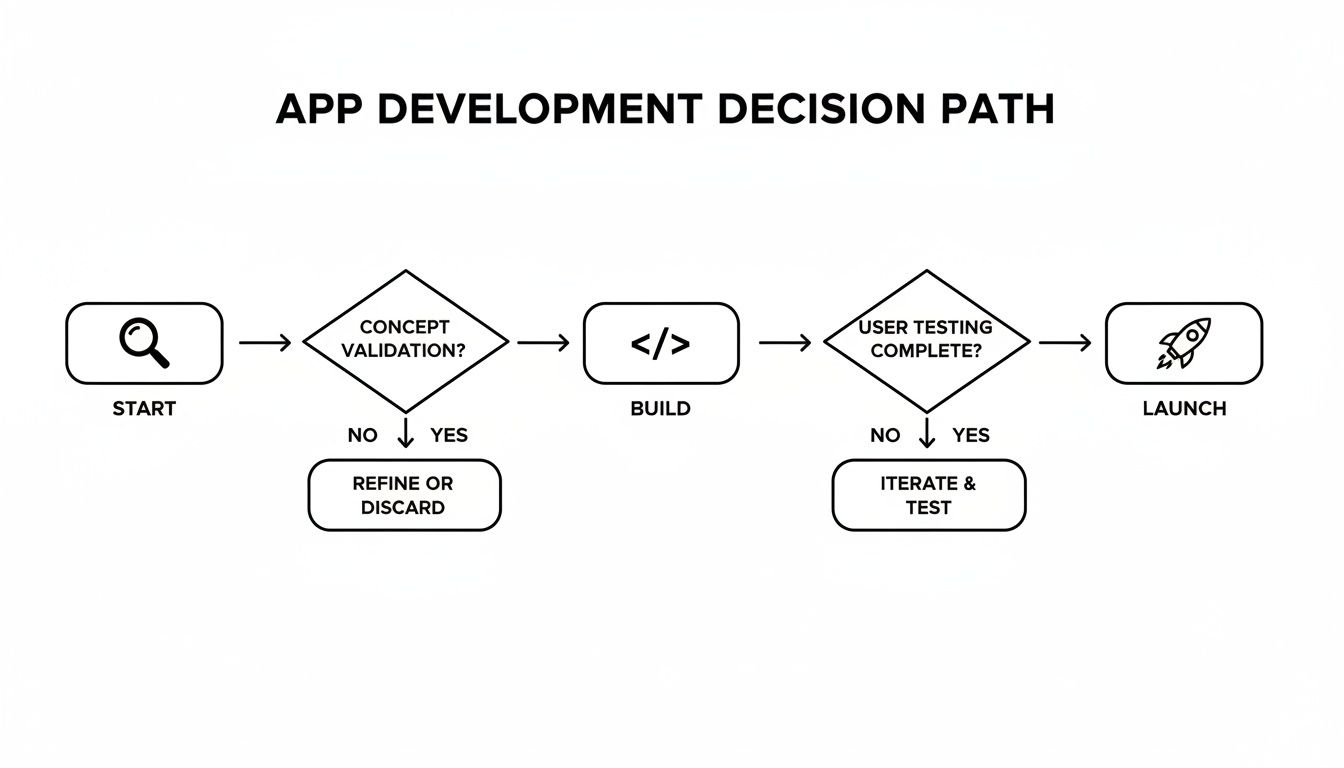
Building a custom mobile app can feel like a massive undertaking, but it’s not a mystery. It’s a structured, predictable process. Think of it like building a custom home: you wouldn’t start pouring the foundation without a detailed blueprint, and the same principle applies here. Every stage has a clear purpose, building on the one before it to turn your initial idea into a polished product ready for your customers.
This lifecycle makes sure nothing is left to chance. From the first conversation to long-term support, following a proven path is the secret to launching a great app on time and on budget. Let’s walk through the six key stages of this journey.
Stage 1: Discovery and Strategy
This is where we lay the groundwork. Before a single line of code is written, we need to get to the heart of your goals, your audience, and the problem your app is going to solve. We ask the big questions: What does success actually look like? Who are we building this for? What are the absolute must-have features for launch? A practical case here is a business in Sydney needing to scope an app to connect with their Odoo implementation Sydney Adelaide, defining API requirements and data flows upfront.
During this discovery phase, we’ll map out the project scope, see what your competitors are doing, and build a strategic roadmap. Getting this right is crucial for making sure everyone is on the same page and preventing expensive changes down the track.
Stage 2: UI and UX Design
Once the strategy is locked in, we turn our focus to the user. User Interface (UI) design is all about the app’s visual identity—the colours, fonts, and icons that create its look. User Experience (UX) design is about how the app feels to use. Is it intuitive? Is it logical? Can people find what they need without getting frustrated?
Our team creates wireframes (the basic skeletal structure) and interactive prototypes, which are essentially a clickable model of your app. This lets you see and feel the user journey for yourself before the heavy lifting of development starts, ensuring the final product is both beautiful and a joy to use.
Stage 3: Development and Coding
This is where the magic really happens and your vision starts to become a reality. Our developers get to work building both the front-end (everything your users see and interact with) and the back-end (the servers, databases, and logic that make it all work). We follow an agile development approach, working in short “sprints” to build and review features piece by piece.
This iterative process gives us regular checkpoints for feedback and allows for flexibility. A practical case for a software development Sydney Adelaide project would be connecting a mobile app to a WooCommerce storefront, ensuring real-time product sync.
Stage 4: Quality Assurance Testing
An app is only as good as its performance. Before launch, it has to go through rigorous testing. The Quality Assurance (QA) phase is all about hunting down and fixing bugs, making sure the app is stable, secure, and works perfectly on different devices and operating systems.
A buggy or slow app can instantly damage your brand’s reputation. In fact, nearly 88% of users will abandon an app if they run into glitches, making this stage absolutely non-negotiable.
Our QA team runs a full suite of tests, checking everything from functionality and performance to usability. As your custom mobile app progresses, integrating dedicated mobile app penetration testing is a critical step to ensure its security and compliance within the development lifecycle.
Stage 5: Deployment
Once the app has passed every test and you’ve given the final green light, it’s time to go live. The deployment stage involves getting the app ready and submitting it to the Apple App Store and Google Play Store.
This isn’t just a simple upload. It involves preparing all the right assets—screenshots, descriptions, privacy policies—and navigating the unique review guidelines for each store to ensure a smooth and successful launch.
Stage 6: Maintenance and Support
The journey doesn’t stop once your app is in the wild. Ongoing maintenance is vital for its long-term success. This means releasing updates to support new operating systems, fixing any bugs that pop up after launch, monitoring performance, and rolling out new features based on real user feedback.
This cycle of continuous improvement keeps your app relevant, secure, and ensures it continues to deliver real value to your users and your business.
A reliable partner for software development Sydney Adelaide will be with you every step of the way, from that first spark of an idea to ongoing support. If you’re ready to start building, schedule a consultation with Wistec today to discuss your project.
Choosing Your Technology: Native, Hybrid, or Web App
With your strategy locked in, the next big call is deciding on the technical foundation for your app. The path you choose – Native, Hybrid, or a Progressive Web App (PWA) – will shape everything from performance and budget to the end-user experience. It’s a crucial decision for any custom mobile application development project.
Think of it this way: a Native app is a finely tuned race car, engineered to perfection for a single track (either iOS or Android). A Hybrid app is more like a versatile all-terrain vehicle, built to handle different environments with confidence. A Progressive Web App, on the other hand, is like an electric scooter – super accessible, lightweight, and perfect for getting people where they need to go through a simple web browser.
Each approach has its own distinct advantages, and the right choice always comes back to your specific business goals.
Native Apps: The Performance Powerhouses
A native app is coded in the specific programming language of the device’s operating system. That means using Swift or Objective-C for Apple’s iOS, and Kotlin or Java for Google’s Android. Yes, this means you’re building two separate applications if you want to cover both major platforms.
So, why do it? Performance. Native apps “speak the mother tongue” of the device, giving them full, unrestricted access to hardware features like the camera, GPS, and fingerprint scanners. This direct line results in an incredibly fast, smooth, and responsive experience for the user.
- Best For: High-security fintech apps, complex enterprise tools, graphically demanding games, or any app where speed and flawless hardware integration are absolute must-haves. A practical case would be a banking app in Adelaide needing top-tier security.
- Drawback: This is the most expensive and time-consuming route, as you are essentially funding two distinct development projects from the ground up.
Hybrid Apps: The Best of Both Worlds
Hybrid apps present a compelling middle ground. They’re built using a single codebase with frameworks like React Native or Flutter, which is then packaged to run beautifully on both iOS and Android. This “write once, run anywhere” philosophy can dramatically cut down on development time and costs.
While they might not hit the absolute peak performance of a native app, modern hybrid frameworks are incredibly powerful. They can access most device features and deliver a user experience that feels virtually identical to a native app for most use cases. As you weigh your options, it’s worth exploring the different cross-platform app development tools available today.
This is a particularly smart choice in Australia. With Android holding about 54.3% of the market and iOS close behind at roughly 45.2%, the platform split is nearly even. A hybrid approach allows businesses to reach their entire audience without doubling their engineering budget, often saving 30–50% on platform-specific work.
Progressive Web Apps: The Accessibility Champions
A Progressive Web App (PWA) isn’t something you download from an app store. It’s essentially a website that has been supercharged to look and behave just like a native app. Users can add it to their home screen, receive push notifications, and even use some features offline.
The biggest win for PWAs is accessibility. Because they run in a browser, there’s zero friction—no app store visit, no download, no installation. A practical case for a PWA is an event app for a conference in Sydney, where attendees can quickly access schedules without an installation.
Comparing App Development Approaches
To help you visualise the trade-offs, here’s a quick comparison of the three main approaches.
| Factor | Native App (iOS/Android) | Hybrid App (React Native/Flutter) | Progressive Web App (PWA) |
|---|---|---|---|
| Performance | Highest possible speed and responsiveness. | Very good, near-native performance. | Good, but dependent on browser capabilities. |
| Development Cost | Highest (requires two separate codebases). | Moderate (single codebase for both platforms). | Lowest (leverages web technologies). |
| Time to Market | Longest (two parallel development streams). | Faster (single development stream). | Fastest (builds on existing web infrastructure). |
| Hardware Access | Full access to all device features (GPS, camera, etc.). | Access to most device features via plugins. | Limited access to hardware features. |
| User Reach | Limited to users of a specific OS (iOS or Android). | Reaches both iOS and Android users with one app. | Reaches anyone with a web browser, on any device. |
| Discoverability | Found through app stores (Apple App Store, Google Play). | Found through app stores. | Found through web search and direct links. |
| Offline Capability | Excellent, designed for offline functionality. | Good, can be designed for offline use. | Limited offline capabilities via caching. |
Ultimately, the best path depends on what you want to achieve. Each one offers a different blend of cost, speed, and user experience.
The right technology choice is a strategic business decision, not just a technical one. It’s about balancing your budget, timeline, performance needs, and long-term vision.
Working through these options requires real-world experience. Our team has the expertise to guide you, whether your project needs deep integration with an Odoo implementation Sydney Adelaide or a seamless connection to your Shopify implementation. As your partner for software development Sydney Adelaide, we’ll help you choose the technology that delivers the best possible return on your investment. Ready to discuss your tech stack? Contact Wistec today for a strategic consultation.
Understanding the Real Costs of Custom App Development

Let’s talk about the big question: what does a custom mobile application actually cost? It’s often the first thing people ask and the one area where vague answers just won’t do. We believe in total transparency. Think of it like building a house – you wouldn’t accept a single, unexplained price. The final cost depends on the size, the materials, and all the custom finishes you choose.
An app is exactly the same. No two projects are identical, so a one-size-fits-all price doesn’t exist. A streamlined Minimum Viable Product (MVP) built to test an idea is a world away from a sprawling enterprise platform that needs to crunch data in real-time. The key is understanding what goes into the quote so there are no surprises down the track.
What Really Influences Your Budget
At its core, the cost comes down to the time and expertise needed to bring your vision to life. The single biggest factor is your project’s scope. The more features you need, and the more complex they are, the more hours our senior developers will spend designing, coding, and testing everything to perfection.
Here are the main components that shape your investment:
- Feature Complexity: A simple user login is one thing. Adding real-time chat, AI-driven suggestions, or secure payment processing adds layers of complexity and, therefore, development time.
- UI/UX Design Detail: A clean, functional interface is relatively straightforward. A highly animated, deeply branded experience with custom icons and fluid transitions requires significantly more design and front-end work.
- Platform Choice: As we touched on earlier, building two separate native apps for iOS and Android will always be a bigger investment than a single-codebase hybrid app.
- Backend Infrastructure: Every app needs an engine. Crafting a powerful, custom-built backend server and database from the ground up costs more than integrating with existing cloud-based services.
A well-defined project scope is your most powerful tool. It eliminates guesswork, provides a clear roadmap for the development team, and ensures your quote is both accurate and reliable.
Australian App Development Cost Brackets
The Australian mobile app development scene is a dynamic AUD 4.5 billion industry. Based on our experience, projects here fall into fairly predictable cost brackets. An end-to-end build typically ranges from AUD 30,000 for a simple MVP up to AUD 300,000+ for complex, enterprise-level solutions.
Apps requiring sophisticated features like real-time data synchronisation or AI integrations often land somewhere between AUD 120,000 and AUD 350,000. These figures reflect local developer rates, which usually sit between AUD 85–250 per hour, with talent hotspots in cities like Sydney and Adelaide. You can discover more about the Australian app development market on A Team Soft Solutions.
Practical Cost Scenarios
Let’s ground this with a couple of practical cases. Imagine a retailer wanting a simple loyalty app that plugs into their existing Shopify implementation. That’s a project that would sit at the lower end of the spectrum.
Now, contrast that with a manufacturing client in Adelaide who needs a custom app to manage their entire production line. This app needs to integrate deeply with a brand new Odoo implementation Sydney Adelaide for live inventory tracking and workflow automation. That’s a far more significant investment because of the intricate integration and backend logic required.
Understanding these variables gives you the power to make smart decisions. As a leading team for software development Sydney Adelaide, our commitment is to provide clear, honest pricing that aligns your goals with your budget.
Ready to get a clear, no-obligation quote for your app idea? Contact Wistec for a detailed project estimate today.
Practical Cases: How Custom Apps Drive Real Results in Australia
It’s one thing to talk about the theory, but seeing custom mobile application development in action is where it really clicks. Across Australia, from busy retail hubs to massive manufacturing plants, businesses are using apps built just for them to solve their unique problems and get a serious leg up on the competition. These aren’t just flashy novelties; they’re workhorse tools designed to fix specific operational headaches and deliver results you can actually measure.
Let’s look at some practical cases. Think about a retailer who’s sick of generic loyalty programs that just don’t resonate with their customers. Or a logistics manager in Adelaide wrestling with an off-the-shelf system that gives wildly inaccurate delivery times. These are precisely the kinds of frustrations that a purpose-built app is designed to eliminate, turning a major pain point into a genuine competitive edge.
Reshaping Retail and eCommerce
In the cut-throat world of Australian retail, you have to find a way to stand out. A custom mobile app gives you a direct line to your customers, letting you create experiences that generic platforms could only dream of.
Take a fashion boutique with a great online store. Their website, built on a strong Shopify implementation, is great for sales, but they want to build a real community. A custom app could roll out an exclusive loyalty program, offer fun style quizzes that give personalised recommendations, and even use augmented reality so customers can “try on” clothes from their living room. That kind of interaction goes so much deeper than just clicking ‘buy now’.
Or imagine a specialty food store that uses WooCommerce. They could build an app that lets people create their own subscription boxes, track the delivery driver to their door in real-time, and get exclusive recipes. Suddenly, a one-off purchase becomes a reliable, recurring relationship that directly boosts that customer’s lifetime value.
Bringing Precision to Manufacturing and Logistics
In the industrial world, it’s all about efficiency. Custom apps are brilliant for untangling complex workflows and giving you a clear, real-time view of what’s happening on the ground.
Here’s a real-world scenario: a manufacturing firm has just finished a major Odoo implementation Sydney Adelaide. The new ERP system is fantastic for centralising data, but the factory floor is still stuck with clipboards and spreadsheets. We could develop a custom tablet app for the team to scan components, update a job’s status, and flag quality control issues on the spot. All that data feeds straight back into Odoo, giving managers a live, completely accurate picture of the entire production line.
A custom application is the perfect handshake between your core business systems and your team on the ground. It puts the power of platforms like Odoo right into the hands of the people who need it most, cutting out delays and human error.
In logistics, think of a delivery company in Adelaide. They could commission an app for their drivers that does more than just show a map. It could optimise routes based on live traffic, allow for instant photo proof-of-delivery, and send customers a precise tracking link they can actually trust. The impact on efficiency and customer happiness is massive.
As a leading partner for software development Sydney Adelaide, our specialty is turning these industry-specific needs into powerful, intuitive mobile solutions.
Ready to explore how a custom app could solve your biggest business challenge? Contact Wistec today for a strategic consultation.
How to Choose Your Ideal App Development Partner
Picking the right team to build your custom mobile application is one of the most important decisions you’ll make. This isn’t just about hiring some coders; it’s about finding a strategic partner who will become an extension of your own team and genuinely care about your success.
Get this choice wrong, and you could be looking at blown budgets, missed deadlines, and an app that simply doesn’t deliver. But the right partner? They’ll guide you through the whole process, ask the tough questions early on to avoid problems later, and turn your vision into a powerful app that achieves real business goals.
Look Beyond the Portfolio
A slick portfolio is nice, but it’s only the start of the story. You need to dig a little deeper. A team that’s great at building gaming apps might not have the chops to create a secure, compliant financial services portal. It’s all about relevant experience.
Look for a proven track record in your specific industry or with projects that faced similar technical hurdles. For instance, have they handled a complex Shopify implementation before? Do they have real-world experience connecting apps to backend systems like an Odoo implementation Sydney Adelaide? That kind of specific, hands-on expertise is worth far more than a gallery of pretty, but irrelevant, projects.
Communication and Transparency are Non-Negotiable
Amazing apps are built on a foundation of brilliant communication. From your very first chat, your ideal partner should be clear, proactive, and open. They need to be able to break down complex tech speak into plain English and have a solid project management process that never leaves you guessing.
Find out how they handle communication:
- How often will we connect? Regular, scheduled check-ins are essential to keep everything moving smoothly.
- Who is my go-to person? A single, dedicated project manager is key to avoiding confusion and crossed wires.
- What happens if the scope changes? A professional partner will have a clear, fair process for handling changes without throwing the timeline or budget into chaos.
Think of it this way: your development partner should feel like they’re part of your company. You’re looking for a team that’s truly invested in your success, not just trying to sign a contract and move on.
The True Value of a Local Partner
While the world is more connected than ever, there’s a powerful case for choosing a local partner for software development Sydney Adelaide. A local team just gets the Australian market. They’re in your time zone, which makes collaboration a breeze, and they’re available for those crucial face-to-face meetings when you need to hash out complex strategies.
This local presence brings an accountability and accessibility that’s nearly impossible to match from overseas. Whether you’re planning a new WooCommerce integration or mapping out a tricky workflow, having an expert you can sit down with in person can make all the difference. It ensures your app isn’t just a technical masterpiece, but also perfectly tuned to what your Australian customers actually want and need.
Ready to find a partner who will truly understand and execute your vision? Contact Wistec today for a no-obligation consultation and discover the difference a dedicated local team can make.
Got Questions? We’ve Got Answers
Stepping into custom app development for the first time? It’s natural to have questions. We get it. To help you out, we’ve put together some straight-talking answers to the questions we hear most often from business owners weighing up their options.
How Long Does It Take to Actually Build an App?
This is the big one, and the honest answer is: it depends entirely on what you want to build.
A simple app with just the essential features – what we call a Minimum Viable Product (MVP) – can often be designed, built, and launched in as little as 3-4 months. It’s a great way to get to market quickly.
If you’re thinking bigger, perhaps an app with more complex features or integrations with other software, you’re likely looking at a 5-9 month journey. For large-scale, enterprise-level applications with sophisticated back-end systems and top-tier security, you should plan for 9 months or more from that first sketch to a successful launch.
How Do Custom Apps Play with Systems like Odoo or Shopify?
This is where the magic really happens. Platforms like Odoo, WooCommerce, and Shopify are brilliant on their own, but a custom app can supercharge them, pushing their capabilities far beyond what comes out of the box.
Think of a custom app as the perfect bridge, connecting your core business platforms directly to your customers or staff in a way no off-the-shelf solution ever could.
For instance, after a Shopify implementation, we might build a unique loyalty program app that taps directly into that store’s data, creating a seamless customer experience. Or, following an Odoo implementation Sydney Adelaide, we could develop a custom inventory management app for the warehouse crew in Adelaide. They get the exact tools they need on their devices, all while staying perfectly in sync with the central system. It’s this level of deep, purposeful integration that sets custom software development Sydney Adelaide apart.
What Happens After the App Goes Live? Do You Stick Around?
Absolutely. Launch day isn’t the finish line; it’s the starting pistol. We believe that ongoing support is crucial for protecting your investment and making sure your app continues to deliver for your users long-term.
Our maintenance and support plans are all about giving you peace of mind. This means we’re constantly on the case, handling things like:
- Keeping a close eye on app performance and server stability.
- Jumping on and squashing any bugs that might pop up.
- Rolling out essential updates to ensure your app works flawlessly on new iOS and Android versions.
- Offering strategic advice on what features to build next as your business grows.
We’re not just here to build you an app. We’re here to be your technology partner for the long haul, ensuring your app stays fast, secure, and remains a valuable asset for years to come.
Ready to see how a custom app could work for your business? Wistec is here to guide you through every step of the journey.