

Are you wrestling with a dashboard that just doesn’t get how your business actually works? You’re not the only one. So many Australian businesses find themselves stuck with off-the-shelf software, forcing them into clunky processes that quietly drain money and create missed opportunities. This is where custom business app development flips the script, getting software to adapt to you, not the other way around.
When ‘Good Enough’ Software Starts Holding You Back
Most businesses kick off with generic software. It’s quick, it’s cheap, and it solves an immediate problem. But as you grow, the very tools that gave you that initial boost can feel like a digital straitjacket, actively slowing down the growth they were meant to help. The rigid nature of pre-built solutions often creates operational bottlenecks that are easy to miss but seriously expensive to ignore.
This friction shows up in a bunch of ways. It might be the hours your team wastes on manual data entry between systems that refuse to talk to each other. Or maybe it’s the frustrating workarounds they’ve cobbled together just to get a simple task done. Over time, these little inefficiencies add up, killing productivity and stopping your business from hitting its full potential.
The True Price of ‘Making Do’
The cracks in off-the-shelf platforms really start to show when a business needs its core functions to work together seamlessly. Picture a growing Sydney-based retailer trying to get its Shopify implementation to sync inventory with a separate CRM. The disconnect means endless manual updates and the constant risk of overselling popular products, which ultimately leads to unhappy customers.
It’s a common story for wholesale distributors, too. A company might be using a standard accounting package that can’t handle its complex, tiered pricing structures for different client groups. Suddenly, the sales team is back to relying on messy spreadsheets, which opens the door to costly errors and slows the entire quoting process to a crawl. These aren’t just minor annoyances; they’re direct roadblocks to scaling your business.
Do any of these pain points sound familiar?
- Data Silos: Your information is locked away in different apps, making a clear, single view of your business impossible.
- Forced Workflows: The software tells you how to work, instead of supporting the unique and efficient way your team already operates.
- Integration Nightmares: Connecting to new tools or partner systems is either a non-starter or relies on expensive, unreliable plugins.
- Hitting a Wall: The application chokes when you add more users, handle more data, or your operations become more complex.
Building Your Unfair Advantage
This is the exact moment when custom business app development stops being a “nice-to-have” and becomes a critical investment. A tailored application is built from the ground up to solve your specific problems and mirror your ideal workflow. Think of it as building a central nervous system for your business that finally works for you, not against you.
For companies that are serious about growth, custom software isn’t about patching problems—it’s about forging a genuine competitive edge. A bespoke app can unlock efficiencies and a level of service that your competitors using generic tools simply can’t touch.
Practical Case: A logistics firm in Adelaide could build a single app that combines driver tracking, warehouse inventory, and customer delivery notifications into one fluid platform. You just can’t get that level of slick integration from a collection of off-the-shelf products. In the same way, a manufacturer with a unique production line could benefit massively from a specialised Odoo implementation in Adelaide, customised for their specific supply chain.
Whether it’s getting e-commerce platforms like WooCommerce to talk perfectly with your back-end systems or creating a one-of-a-kind mobile tool for your field reps, the goal is always the same: build a powerful, unique asset that fuels your growth.
Ready to break free from the limits of generic software? The expert team at Wistec specialises in software development in Sydney and right across Australia. Contact us today for a consultation, and let’s explore what a custom app could do for your business.
Crafting Your App From Idea To Blueprint
Every great app starts with a rock-solid plan, not just a fleeting idea. This is the stage where you take your big-picture business goals and translate them into a detailed, functional blueprint for your development team. Trying to skip this part is like building a house without any architectural drawings – you’re just setting yourself up for chaos, delays, and an end product that doesn’t actually solve your problem.
The first move is to get crystal clear on what you want to achieve. What specific, measurable outcome are you chasing with this custom business app development project? Just saying you want to “improve efficiency” is far too vague.
A much better goal? “Reduce the average time for processing customer orders by 25% within six months.” Now that’s a target. It gives your entire project a sharp focus and a clear benchmark for success once the app goes live.
This journey from wrestling with clunky, generic software to unlocking real potential with a custom-built solution is something we see all the time.
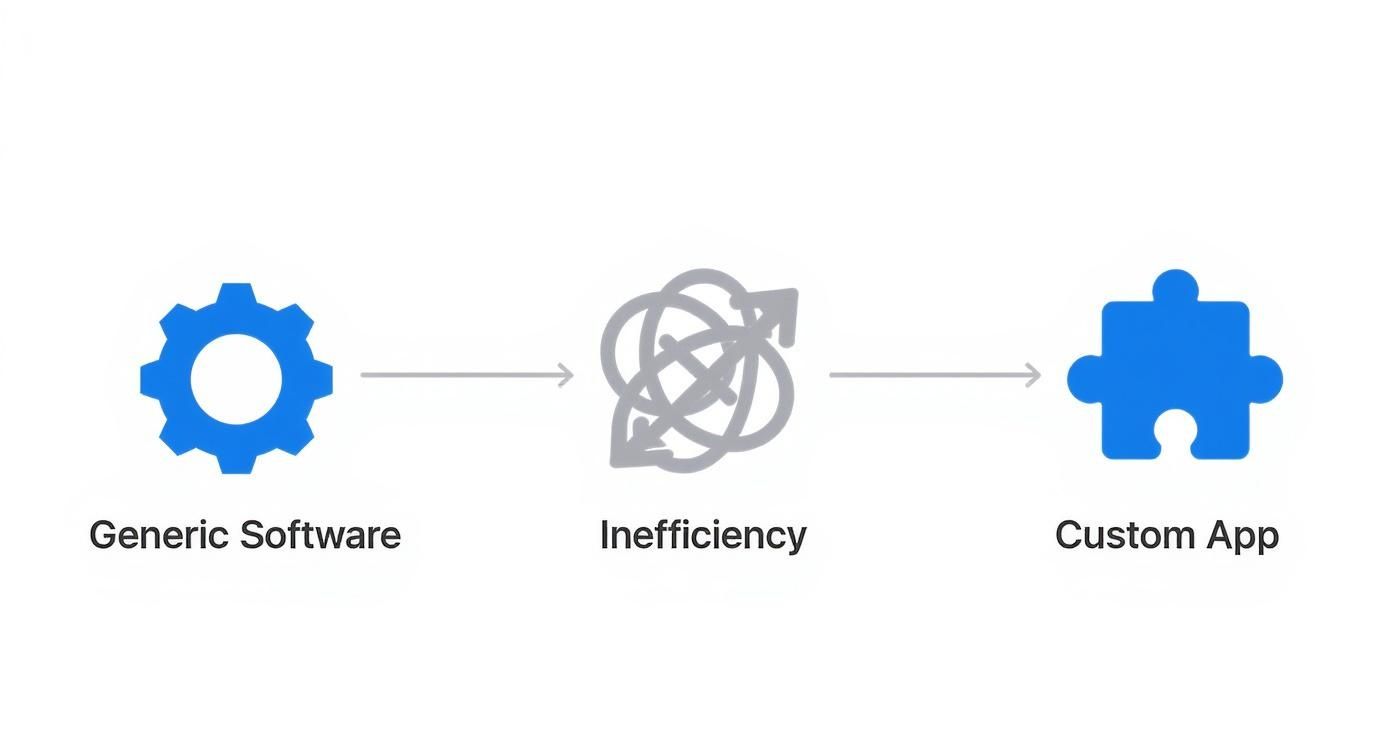
As you can see, off-the-shelf tools often create more knots in your workflow than they untangle. A custom app, on the other hand, is designed to be the missing piece that fits your unique business processes perfectly, smoothing out those very inefficiencies.
Identifying Key People and Processes
Once your objectives are locked in, it’s time to figure out who needs to be involved. I’m not just talking about the executives signing the cheques. The real gold is with the people who will be using the app every single day – your warehouse staff, the sales team, or your customer service reps. These are the people with invaluable, on-the-ground knowledge.
Getting these users into workshops is non-negotiable. They are the ones who can help you map out the user journeys – the step-by-step paths they’ll take inside the app to get their jobs done. This process always uncovers hidden pain points and workflow quirks you’d never have thought of, ensuring the final app is intuitive and genuinely useful.
Practical Case: Imagine a logistics company in Adelaide trying to streamline its delivery tracking. Their key people would be:
- Warehouse Managers: To define exactly how parcels get scanned and logged.
- Delivery Drivers: To spec out the most efficient route planning and proof-of-delivery features.
- Customer Service Reps: To specify what info they need at their fingertips to answer client questions fast.
- Accountants: To make sure the app hooks into the billing and invoicing systems correctly.
By mapping out every single step, from the parcel leaving the Adelaide warehouse to it landing on the customer’s doorstep, the company avoids costly scope creep down the line. It ensures the app is built to solve real-world operational headaches. This detailed mapping is the cornerstone of successful software development in Sydney and right across Australia.
Visualising Success with Wireframes and Prototypes
With your goals set and user journeys mapped, it’s time to start making the app feel real. No, we’re not writing any code yet. Instead, we build wireframes and interactive prototypes.
A wireframe is essentially a digital sketch – a simple, black-and-white layout of the app. It focuses purely on structure and the flow of information, without getting bogged down by colours, fonts, or branding. This is all about getting everyone to agree on the core functionality before a single design element is created.
From there, a prototype takes it to the next level. This is a clickable, interactive model of the app that simulates the actual user experience. Your team can tap through screens, test the navigation, and get a proper feel for how the application will function in their hands.
This visualisation phase is where you save an enormous amount of time and money. It’s infinitely cheaper to find a flaw in a prototype and fix it in a few hours than it is to rewrite hundreds of lines of code well into the development cycle.
This back-and-forth feedback loop is what guarantees the final design hits the mark. It confirms that the app isn’t just powerful, but also logical and simple for your team to use day in, day out. This is especially vital for more complex projects, like a custom Odoo implementation in Sydney or integrating with platforms like Shopify or WooCommerce.
Planning isn’t a barrier to getting started; it’s the foundation for finishing successfully. By taking the time to meticulously craft this blueprint, you put your project on the fast track to delivering real, measurable value to your business.
Ready to turn your idea into a functional blueprint? Contact Wistec for a no-obligation consultation to talk through your project and discover how our expert software development Sydney Adelaide team can bring your vision to life.
Navigating Tech Stacks and Finding Your Development Partner
Alright, you’ve got your blueprint ready. This is where things get real, and a couple of big decisions will shape the entire future of your project: picking the right technology and finding the right people to build it.
These two choices are completely linked. Get them right, and you’re on track to build a powerful business asset. Get them wrong, and you could be looking at a frustrating and expensive do-over far sooner than you’d like.

The technology you choose—often called the “tech stack”—is the very foundation of your application. This isn’t about jumping on the latest, trendiest framework. It’s a strategic decision that needs to be grounded in your specific business goals, performance benchmarks, security standards, and how you see the app growing down the track.
Selecting the Right App Development Approach
One of the first forks in the road is deciding what type of app you’re actually building. Each path comes with its own set of pros and cons around user experience, budget, and development timelines. Nailing this choice is all about aligning the tech with your business objectives.
You generally have three main options on the table:
- Native Apps: These are built from the ground up for a specific operating system, like iOS or Android. They deliver the absolute best performance and security and can tap into all the device’s features, like the camera or GPS. If a slick, lightning-fast user experience is a non-negotiable, this is your go-to.
- Hybrid Apps: Think of these as a blend. They’re built with web technologies and then bundled into a native shell. The big win here is that a single codebase can run on multiple platforms, which can really help the initial budget. The trade-off? They might not feel quite as smooth or perform as well as a true native app.
- Progressive Web Apps (PWAs): At their core, these are websites that behave like mobile apps. They run right in a browser, so there’s no app store download needed, making them incredibly accessible. For many internal business tools or customer portals, PWAs are a brilliant, cost-effective solution.
To make this clearer, let’s break down how these approaches stack up against each other.
Choosing Your App Development Approach
| Approach | Best For | Performance | Development Cost & Time |
|---|---|---|---|
| Native | Demanding apps requiring top-tier performance, security, and full device integration (e.g., gaming, complex business tools). | Excellent. Fast, fluid, and highly responsive. | Highest. Requires separate development teams and codebases for iOS and Android. |
| Hybrid | Apps needing to reach both iOS and Android users quickly on a tighter budget, where top performance isn’t the absolute priority. | Good. Can be slightly slower and less seamless than native apps, but often sufficient for many use cases. | Moderate. “Write once, run anywhere” approach speeds up development and reduces costs. |
| PWA | Broad audience reach, simple internal tools, and situations where avoiding the app store is beneficial. Great for discoverability. | Variable. Performance depends heavily on the browser, but has improved significantly. Can work offline. | Lowest. Leverages existing web development skills and a single codebase for all platforms. |
Ultimately, the right choice comes down to balancing your ambition with your budget and timeline. There’s no single “best” answer, only the best fit for your specific project.
Finding a Partner Who Understands Your Market
Choosing the tech is only half the battle. The team you bring on board to actually build your app is just as critical—if not more so. A great development partner is more than just a team of coders. They’re strategic thinkers who will guide you, challenge you, and help you sidestep those common project-killing mistakes.
When you’re vetting potential teams, look past their technical jargon. You need a partner who gets your local business landscape. For instance, a team offering software development in Sydney, Adelaide brings an incredible amount of on-the-ground insight into Australian market quirks, consumer habits, and regulatory hurdles that an offshore team might simply not understand.
A truly effective development partner doesn’t just build what you ask for; they challenge your assumptions and bring new ideas to the table. Their goal should be to deliver a solution that provides maximum business value, not just to tick off a list of features.
Practical Case: Imagine a retail business wanting a custom Shopify implementation. A local Aussie team will already know the preferred payment gateways, the ins and outs of shipping with providers like Australia Post, and what local customers expect. Likewise, a manufacturing firm in South Australia will get far more value from a partner with real-world experience in Odoo implementation in Adelaide, who can mould the ERP to fit local supply chain logistics and compliance standards.
As you consider your options, a good guide on outsourcing custom software development can be a lifesaver in helping you navigate the selection process. The goal is to find a partner that feels like an extension of your own team. They need a solid track record, clear communication, and a portfolio that proves they can deliver high-quality, scalable solutions, whether that’s integrating WooCommerce or building a new platform from scratch.
Don’t just hire a vendor; find a partner. Ready to talk to a team that combines technical expertise with deep local knowledge? Contact Wistec today for a consultation, and let’s build something great together.
Getting Real About Custom App Development Costs In Australia
Let’s talk numbers. When you start exploring custom business app development, the first question on everyone’s mind is always the same: what’s this actually going to cost? Getting a real answer means looking past ballpark figures and digging into the specific factors that will shape your project’s final price tag.
The truth is, there’s no “one-size-fits-all” price for a custom app, just like there’s no standard price for a house. The investment is tied directly to what you’re trying to build. A simple internal tool for tracking inventory is worlds away from a complex, customer-facing fintech platform that has to meet heavy regulatory standards.
The Key Factors Driving Your App’s Budget
A few core components will always influence the overall cost. Getting clarity on these from the get-go is the first step toward setting a realistic budget and avoiding any nasty surprises down the track. It’s all about seeing the value behind every dollar you spend.
Think of these as the building blocks of your project’s price:
- Feature Complexity: This is the big one. The number of features and how sophisticated they are will be the biggest cost driver. A basic user login and data entry screen is pretty straightforward, but adding real-time analytics, AI-powered recommendations, or complex third-party API integrations will naturally ramp up the development hours.
- Platform Choice: Are you building for iPhone users, Android users, or both? Crafting separate native apps for iOS and Android delivers the best performance, but it’s essentially two separate development efforts, which costs more. A hybrid approach can be easier on the budget upfront but might come with performance trade-offs.
- UI/UX Design: A polished, intuitive user interface isn’t just a nice-to-have; it’s absolutely critical for user adoption. The investment in professional UI/UX design—including wireframing, prototyping, and user testing—directly impacts your app’s success and is a key part of the budget.
- Third-Party Integrations: It’s rare for an app to live in a bubble. It almost always needs to talk to other systems. Integrating with payment gateways, CRMs, or a specialised Odoo implementation in Sydney requires careful planning and development to make sure data flows securely and reliably.
Real-World Cost Brackets in the Australian Market
The Aussie custom app market is strong and growing fast. In fact, projected industry revenue is expected to hit around AUD 2.8 billion by the end of the 2024-25 fiscal year. This thriving market gives us pretty clear benchmarks for what businesses can expect to invest.
Simple apps usually start in the AUD 30,000 to 80,000 range. Mid-complexity apps tend to land between AUD 80,000 and 200,000, while enterprise-grade platforms can easily climb past AUD 600,000. For more details on what’s happening in the local market, you can check out data on app development trends in Australia.
It’s so important to see custom app development not as a cost, but as an investment in a long-term business asset. The initial outlay is often quickly balanced out by a huge ROI from boosted efficiency, fewer manual errors, and new scalability—helping you dodge expensive technical debt.
To put this into perspective, here are a couple of practical scenarios:
- Practical Case: An internal logistics app for a company in Adelaide with GPS tracking and proof-of-delivery features would likely fall into that mid-complexity bracket.
- A custom e-commerce solution with deep Shopify implementation or WooCommerce integration and personalised customer journeys would probably be at the upper end of that mid-range, or even higher.
- A fintech app that needs multi-layered security and has to meet strict compliance checks represents a significant, enterprise-level investment.
On top of the local Aussie costs, getting a handle on general mobile app development costs can give you some valuable wider context for your budgeting.
Beyond the Launch: Don’t Forget Ongoing Maintenance
Finally, remember that the budget doesn’t just stop once the app goes live. Ongoing maintenance is vital for keeping your app secure, running smoothly, and compatible with new operating system updates.
This usually costs around 15-20% of the initial development budget each year, and you absolutely need to factor it into your long-term financial planning. This is what ensures your investment continues to deliver real value for years to come.
Ready to get a clear, transparent quote for your project? The Wistec team specialises in software development in Sydney and Adelaide and can provide a detailed breakdown based on your unique needs. Contact us today for a personalised consultation.
Getting Past Generic: Why Your Industry Demands a Specialist App Developer
An app built for a bustling retail business in Sydney is a world away from one designed for a healthcare clinic in Adelaide. That might seem obvious, but it’s a point where so many development projects go off the rails. Every industry has its own rhythm, its own pressures, and its own unspoken rules. This is exactly why generic, one-size-fits-all development approaches just don’t work.
Building a truly effective app is about so much more than clean code. It’s about deeply understanding the world your app will live in. When you partner with a developer who already speaks your industry’s language, they can anticipate challenges you haven’t even thought of, navigate complex regulations with ease, and build features that solve real problems from the get-go. Without that insider knowledge, you risk ending up with an app that technically works but practically fails.
You Can’t Afford to Ignore the Rules
In certain industries, compliance isn’t a feature you add on—it’s the bedrock of the entire application. Take a fintech app, for instance. It has to be built from the ground up to meet the iron-clad security and reporting standards set by bodies like the Australian Prudential Regulation Authority (APRA). This goes way beyond secure logins; it’s about architecting the entire system to handle data with provable integrity.
The same goes for a healthcare app managing patient information, which must rigidly adhere to the Australian Privacy Principles (APP). This dictates everything from how data is collected and stored to who can access it and when. A development team without hands-on experience in these fields could easily miss a critical requirement, opening you up to serious legal and financial trouble down the track.
A developer who truly gets industry compliance isn’t just following a checklist. They’re a strategic partner, actively protecting your digital asset from risk before it even launches. That kind of proactive thinking is priceless.
Real-World Scenarios from Sydney to Adelaide
You can see the need for this specialised knowledge in projects happening all across Australia. Here are some practical cases:
- Manufacturing: A factory in Adelaide is drowning in spreadsheets and needs to bring its entire operation—from supply chain to the production floor—into one system. A standard CRM just won’t do the job. What they really need is a customised Odoo implementation Adelaide businesses can count on, one that’s been configured by a team that actually understands manufacturing workflows.
- E-commerce: A growing online retailer based in Sydney needs to deliver a shopping experience that’s absolutely seamless. This isn’t just about having a pretty website. It demands a flawless Shopify implementation or a smart WooCommerce integration that ties inventory, payment gateways, and shipping logistics together without a single hiccup.
- Logistics: A transport company needs an app for real-time tracking and proof-of-delivery. That app has to be tough—it must work in areas with spotty reception and integrate perfectly with the warehouse management system. This calls for a team that has real experience building robust field-service applications.
These examples make it clear: successful software development Sydney Adelaide projects are built on a foundation of solid industry experience. This is something Australian businesses understand well, and it’s reflected in how they budget. For example, a fintech app that meets APRA regulations often carries a price tag between AUD 120,000 and 350,000. A healthcare app built to Australian Privacy Principles? Expect something in the AUD 50,000 to 140,000 range. These numbers show just how much value businesses place on getting it right from the start.
You can dive deeper into a full 2025 Australian mobile app development costs and trends to see how expertise directly shapes investment.
Ultimately, finding a team that understands the unique hurdles of your industry is the secret to building an app that doesn’t just function, but genuinely excels.
Ready to build an app that’s perfectly tuned to your industry’s demands? Contact Wistec today for a consultation, and let’s start a conversation with a team that already speaks your language.
Launch, Learn, and Evolve Your Business App
Getting your app approved and listed on the app stores feels like the finish line, but I’ve seen time and time again that it’s actually the starting gun. The real work in successful custom business app development begins the moment your first user logs in. A static app is a dead app; the goal now is to kick off a cycle of continuous improvement, fuelled by real-world data and not just your initial hunches.
This post-launch phase is all about listening—and I mean really listening. Your app is now out in the wild, interacting with your team and customers in ways you couldn’t possibly predict during the design phase. Every click, every support ticket, every frustrated sigh is a valuable piece of feedback telling you what’s working, what’s not, and where your biggest opportunities are hiding.

This continuous loop of launching, learning, and iterating is what separates a decent business tool from a truly game-changing one. It’s how you ensure your investment keeps paying dividends long after the initial build is complete.
Deploying Your App for Maximum Impact
A smooth rollout is absolutely critical for that all-important first impression. Whether you’re launching to your internal team or the general public, a sloppy start can erode trust and kill adoption before you’ve even had a chance. Getting ready for both the Apple App Store and Google Play Store needs meticulous planning.
Before you even think about hitting ‘publish’, run through this practical checklist:
- Nail Your App Store Listings: Your app’s name, description, screenshots, and preview video need to be polished. Optimise them with the right keywords to attract the right people.
- Confirm You’re Compliant: Double-check that your app meets all of Apple’s and Google’s latest guidelines. A last-minute rejection can completely derail your launch schedule.
- Get Your Support Channels Ready: Make sure your support team is fully trained and ready to field user questions, bug reports, and feedback from day one.
- Set Up Analytics: This is a non-negotiable. Ensure your analytics tools are properly configured to start capturing user behaviour immediately. You can’t improve what you don’t measure.
The initial deployment isn’t just a technical task; it’s a strategic one. For a company offering software development in Sydney and Adelaide, a well-executed launch broadcasts professionalism and a serious commitment to quality.
Turning User Feedback Into Your Next Great Feature
Once your app is live, the focus pivots to collecting and analysing data. This isn’t about being creepy; it’s about understanding the user experience so you can make it better. The goal is to evolve your app based on cold, hard evidence.
You can gather these crucial insights from a few key places:
- In-App Analytics: Keep an eye on key metrics like daily active users, session duration, which features get used most, and crash reports. This quantitative data shows you what users are doing.
- User Surveys and Feedback Forms: Just ask! Simple, targeted surveys can give you the qualitative insights to understand why they behave a certain way.
- Support Tickets and Reviews: Pay close attention to the issues and suggestions coming through your help desk and app store reviews. These often come from your most engaged users—the ones highlighting genuine pain points.
The most valuable updates I’ve ever seen have come directly from listening to users. An idea from a warehouse manager in Adelaide could unlock a massive efficiency gain that the development team in Sydney never would have dreamed of.
Practical Case: A business that has gone through a custom Shopify implementation might launch a companion app for managing loyalty points. By digging into the data, they might discover that customers are struggling to find their points balance. That simple insight could lead to a quick UI tweak in the next update, dramatically improving user experience and engagement.
Likewise, feedback on an internal app built around an Odoo implementation Sydney Adelaide businesses rely on could highlight a clunky data-entry process, paving the way for a much slicker workflow in version 2.0. This iterative process, whether it’s for a WooCommerce-integrated app or a standalone tool, is what drives genuine long-term success.
It’s time to move beyond generic tools and invest in a solution that grows with you. Ready to build an app that truly fits your business and evolves to meet future challenges? At Wistec, we specialise in creating custom applications that deliver real results.
Contact us today for a consultation on your custom software development project.