

In today’s market, having a mobile app isn’t just a nice-to-have for Australian businesses—it’s essential. But let’s be honest, the idea of building, funding, and maintaining two separate apps for Apple and Android can feel daunting. That’s exactly why cross-platform app development in Australia has become the smart play for businesses looking to get ahead without breaking the bank.
Why Smart Australian Businesses Are Going Cross-Platform

Think about building a house. The old-school, native app approach is like needing two entirely different sets of blueprints, two different building crews, and two separate lots of materials—one for a brick house and one for a timber one. It’s double the work and double the cost.
Cross-platform development flips that script. It’s like having a single, clever blueprint that allows you to build a stunning, reliable home that works perfectly, no matter the foundation.
This approach means developers write the code once, and it runs beautifully on both iOS and Android devices. For any Australian business, this translates to huge savings in development time and money, a faster launch, and the ability to connect with every potential customer from the get-go. Before we get into the nuts and bolts, it’s worth understanding what cross-platform app development entails on a deeper level.
Tapping Into the Mobile-First Market
You simply can’t ignore the power of mobile today. In Australia, app usage is through the roof, with penetration rates projected to hit a massive 86.6% in 2024. That’s over 23 million smartphone users right here at home.
This shift makes a solid mobile strategy non-negotiable, particularly for startups and small to medium-sized businesses (SMBs). Cross-platform isn’t just an option; it’s a strategic advantage.
This “write once, run anywhere” philosophy delivers some serious wins:
- Cost-Effectiveness: Building one app instead of two drastically cuts your initial investment and simplifies ongoing maintenance.
- Wider Audience Reach: You can launch on both the Apple App Store and Google Play Store simultaneously, capturing the entire Australian market from day one.
- Consistent Brand Experience: Your app will look, feel, and function the same everywhere, reinforcing your brand identity with every tap and swipe.
- Streamlined Updates: Rolling out new features or fixes becomes a breeze. You push one update, and everyone gets it at the same time.
This strategic efficiency is what makes cross-platform development so compelling. It’s not just about saving money; it’s about being more agile and responsive in a fast-moving market.
Practical Applications Across Industries
The real-world benefits are clear across countless sectors. Imagine a retail business with a Shopify implementation launching an app that creates a fluid, enjoyable shopping experience for every customer. Or a logistics company using an Odoo implementation to give drivers in Sydney and warehouse managers in Adelaide powerful ERP tools right on their devices.
From WooCommerce stores to complex custom software development projects in Sydney or Adelaide, the potential is endless.
Ready to explore how a cross-platform app can elevate your Australian business? Contact Wistec today for a free consultation and let’s build a solution that delivers results.
The Real-World Benefits of a Single Codebase

Let’s get practical and talk about what a single codebase actually means for an Australian business. Forget the technical jargon for a moment.
Imagine you’re a Melbourne startup with a game-changing app idea. By going cross-platform, you can launch on both the App Store and Google Play at the same time. Just like that, you’ve doubled your potential audience from day one.
This isn’t just a minor perk; it’s a massive head start. While your competition is stuck in the slow, expensive grind of building two separate native apps, you’re already out there, capturing the entire market. That’s the power of getting to market faster.
Amplifying Efficiency and Slashing Costs
For any Aussie SME watching the bottom line, the financial case for cross-platform is incredibly strong. You start saving right away. Writing the code once instead of twice means fewer development hours, which translates directly into a lower upfront cost. That’s capital you can pour back into marketing, user acquisition, or other critical parts of your business.
But the real win is in the long run. Think about maintenance. Every time you need a bug fix, a security update, or a cool new feature, you do it once. You manage one codebase, not two. This single, streamlined process slashes your ongoing operational costs.
The “write once, deploy everywhere” approach isn’t just a cost-saving tactic. It’s about being smarter with your resources so you can innovate faster and react to what the market wants without hesitation.
Whether you’re looking for custom software development in Sydney or Adelaide, the ability to serve both Apple and Android users with one team and one project is a huge operational advantage.
Creating a Unified Brand Experience
Your app is often the main way customers interact with your brand, and consistency is everything. Cross-platform development ensures your app looks, feels, and works the same for everyone, no matter what phone they have in their pocket.
A customer in regional Queensland using an Android should have the exact same slick, intuitive experience as someone in Sydney’s CBD on the latest iPhone. This consistency builds trust and makes your brand feel reliable and professional. You completely avoid the risk of having a “good version” and a “buggy version” of your app, which is a surefire way to alienate half your audience.
A Practical Case Study in Retail
Let’s look at a real-world example. A national retailer wanted to give their customers a brilliant mobile shopping experience. Their website was a powerful Shopify implementation, and they needed an app that would sync perfectly with their existing products, inventory, and customer data.
By choosing cross-platform app development in Australia, they hit all their targets:
- Rapid Deployment: They got their app live on both iOS and Android just in time for the crucial Christmas shopping season.
- Seamless Integration: The app connected flawlessly with their Shopify backend, keeping stock levels and orders updated in real-time. This works just as well with other platforms like WooCommerce, too.
- Consistent User Journey: The app’s design and flow felt familiar to their website customers, creating a smooth and trustworthy experience across the board.
The result? A huge lift in mobile sales and a noticeable increase in customer loyalty. It’s a classic example of how a smart, unified digital strategy—from an e-commerce site to a cross-platform app—fuels real, measurable business growth.
Whether you’re planning a sophisticated Odoo implementation in Sydney or launching a new retail app in Adelaide, the single-codebase model gives you a powerful advantage.
Ready to see how a cross-platform app can unify your brand and accelerate your growth? Get in touch with Wistec for a no-obligation strategy session.
Choosing the Right Engine for Your App
Picking the right framework for your app is a lot like choosing the engine for a car. It’s a decision that will dictate its speed, performance, and how easily you can upgrade it down the track. This is arguably one of the most crucial steps in any cross-platform app development Australia strategy.
Let’s cut through the technical jargon and focus on what really matters to you as a business owner. Here in Australia, two frameworks are consistently leading the pack: React Native and Flutter. Getting your head around their core differences will set you up for much more productive conversations with your development partner.
React Native: The Practical Powerhouse
Think of React Native as the versatile, reliable workhorse. It was built by Meta (you know, Facebook), and it uses JavaScript—one of the most common programming languages on the planet. This is its secret weapon.
If your business already has a web development team, there’s a good chance they can jump into building mobile apps with React Native without a massive learning curve. This existing pool of talent is a huge reason it’s such a popular choice for software development in Sydney and other Aussie tech hubs. It just makes things faster.
- Best for: Businesses with in-house web developers, projects that need strong community support, and apps that have to connect seamlessly with existing web systems.
- Practical Example: Imagine you have a powerful online portal built with standard web tech. You can use React Native to build a mobile app that shares a lot of the same logic and resources, creating a consistent experience for your users without starting from scratch.
For those wanting a deeper dive, a practical guide on how to build React Native apps from scratch can give you a real feel for the process. Its familiarity and massive support network make it a safe, powerful bet.
Flutter: The Visual Virtuoso
If React Native is the workhorse, then Flutter is the high-performance race car. Developed by Google, Flutter is all about crafting beautiful, fluid, and highly expressive user interfaces (UIs) that perform like a dream.
Flutter’s magic lies in its ability to control every single pixel on the screen. It doesn’t rely on the standard, built-in UI elements of iOS or Android. This gives developers total creative freedom to build stunning, custom designs that look and feel exactly the same on every single device.
Flutter is the go-to when user experience is everything. If your app’s success hinges on a visually stunning design, slick animations, and buttery-smooth performance, Flutter has a clear edge.
It’s a fantastic option for consumer-facing apps where brand identity and a premium feel are what set you apart from the competition.
React Native vs Flutter: A Comparison for Australian Businesses
So, how do you decide between the two? It’s a common question for businesses right across Australia. While both are excellent, they shine in different areas. Here’s a quick side-by-side look to help you weigh them up.
| Feature | React Native | Flutter |
|---|---|---|
| Programming Language | JavaScript/TypeScript. A massive talent pool already exists, especially in Aussie tech hubs. | Dart. A modern, fast language from Google. It’s easy to learn but has a smaller developer community. |
| User Interface (UI) | Uses native UI components. Your app will look and feel exactly like a native app on iOS and Android. | Uses its own rendering engine. This means total design freedom and identical UIs on all platforms. |
| Performance | Excellent. Very close to native performance, but complex animations can sometimes be a challenge. | Exceptional. Known for its smooth, 60fps animations and high performance, even with complex visual designs. |
| Developer Ecosystem | Mature and Huge. Countless libraries, tools, and a massive community mean you can find help for anything. | Growing Rapidly. Backed by Google, its ecosystem is expanding fast, but it’s not as extensive as React Native’s yet. |
| Ideal For… | Apps that need to feel native, projects with existing web developers, and getting to market quickly. | Apps where a unique, branded design is critical, and for projects demanding high-performance animations and graphics. |
Ultimately, the choice isn’t about which one is “better” in a vacuum, but which one is the better fit for your specific project, team, and business goals.
Making the Right Choice for Your Australian Business
The Australian market really mirrors global trends, with both frameworks having a strong foothold. Flutter is often a favourite for Android development thanks to its rich UI tools, while React Native holds a powerful position on iOS. It’s a balanced market that allows developers to build incredible apps with a high degree of code reuse.
When you’re making your call, think about these points:
- Project Goals: Is your app’s main value in its solid functionality or its stunning visual design?
- Existing Team Skills: Do you have JavaScript developers who could hit the ground running with React Native?
- Backend System: Will your app connect with an existing platform like a Shopify implementation or WooCommerce? Or a complex ERP like an Odoo implementation in Sydney or Adelaide? Both frameworks handle these integrations well, but your developer’s experience might lean one way.
- Time to Market: React Native’s massive library of pre-built components can often speed up development for more standard apps.
There’s no single “best” answer—only the best fit for your project. The real key is to partner with a software development team in Sydney or Adelaide that has genuine, hands-on experience with both frameworks.
Ready to discuss which engine is perfect for your app idea? Contact Wistec for a free, no-obligation consultation, and we’ll help you make the right choice for your business.
Your App Development Journey, From Idea to Launch
Turning a great idea into a real, successful app isn’t about taking a wild guess; it’s a journey with a clear roadmap. When it comes to cross-platform app development in Australia, we follow a proven, methodical path that’s designed to give your project the best possible chance of success. Each stage logically builds on the last, carefully transforming your concept into a polished, market-ready app.
This is what that journey looks like, from the first conversation all the way to a successful launch.
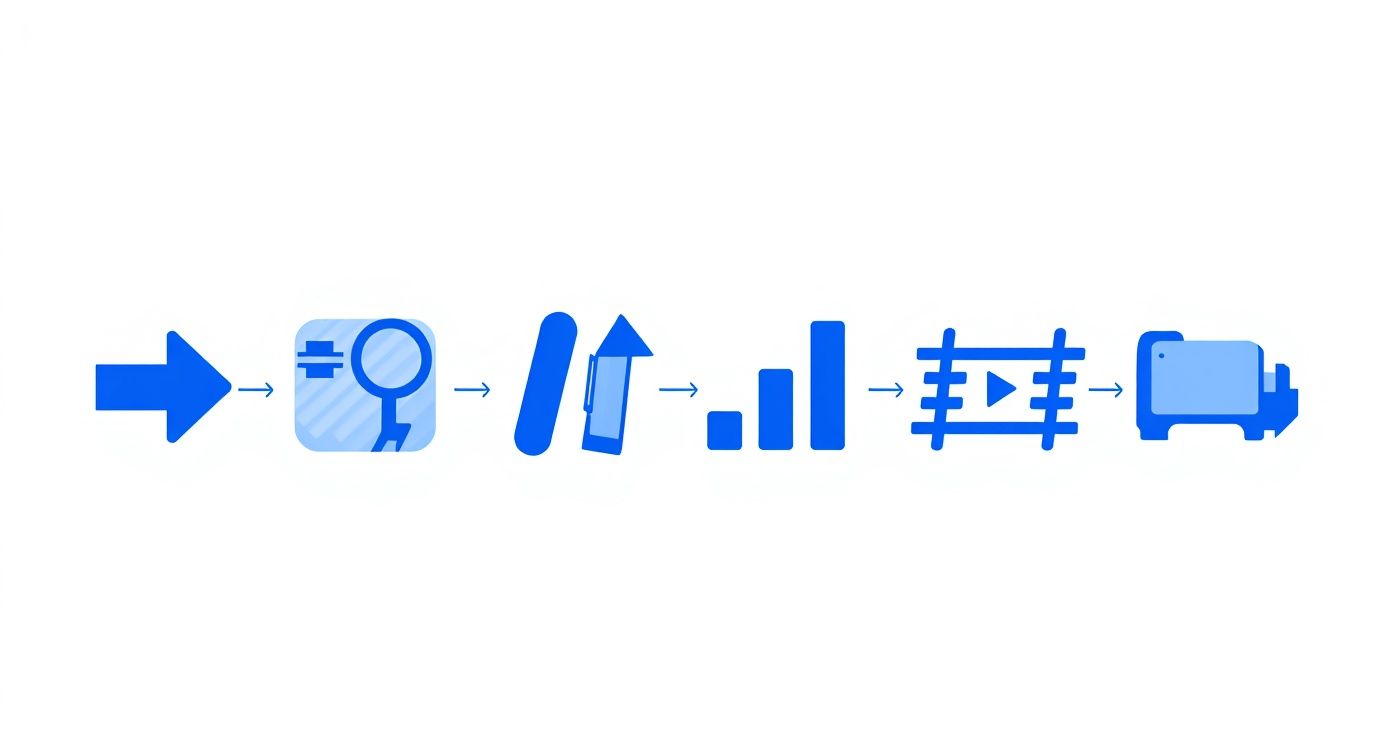
By sticking to this four-step process—Discovery, Design, Development, and Launch—we make sure no detail gets missed. More importantly, it keeps the project tightly aligned with your business goals right from the start.
Stage 1: Discovery and Strategy
Long before we write a single line of code, we get stuck into the discovery phase. Think of this as the foundation for the entire project. We kick things off with deep market research to see how your idea stacks up against the actual needs of your Aussie target audience. We’ll pinpoint your main competitors, figure out what makes your app special, and map out the core features that will make people want to download it.
Getting this strategic groundwork right is absolutely critical. It’s the difference between just building an app and building a solution that solves a genuine problem, with a clear plan for getting users on board and making money.
Stage 2: UI/UX Design
Once the strategy is locked in, our attention turns to crafting an amazing user experience (UX) and a beautiful, intuitive user interface (UI). We design specifically for Australian user expectations, which means creating detailed wireframes and interactive prototypes that let you see exactly how every screen and user journey will work.
This is a really collaborative phase. You get to see, feel, and play with a working model of your app before the proper build begins. It’s the best way to ensure the final product isn’t just good-looking but also dead simple to use.
An app can have the most powerful features in the world, but if users find it confusing or frustrating, they will simply delete it. A seamless UI/UX isn’t a luxury; it’s essential for user retention and success.
Stage 3: Development and Quality Assurance
This is where the magic happens and your vision truly comes to life. Our developers get to work using the chosen framework, like React Native or Flutter, to build out all the app’s features. Whether that involves a complex Odoo implementation in Sydney or a seamless integration with your Shopify implementation for e-commerce, our team makes sure every single piece works perfectly.
Running alongside the development is our uncompromising Quality Assurance (QA) process. We test every corner of the app on local Aussie networks like Telstra and Optus to make sure it performs well, even in places with patchy reception. This is a vital step that’s often overlooked, but it’s the key to delivering a reliable experience for users right across the country. Our software development teams in Sydney and Adelaide are absolute pros at this.
Stage 4: Deployment and Maintenance
The final hurdle is the launch. We manage the entire submission process for both the Apple App Store and Google Play Store, making sure your app ticks all their boxes for a smooth approval. But our partnership doesn’t stop once the app is live.
We provide ongoing maintenance and support to keep your app updated, secure, and running smoothly long after its release. This proactive care ensures your app stays compatible with new operating systems and continues to be a valuable tool for your users.
A WooCommerce Case Study
A national e-commerce business using WooCommerce was looking to break into the mobile market. By following this exact four-step process, we helped them launch a cross-platform app that synchronised flawlessly with their online store. The discovery phase pinpointed key customer needs, the design focused on a ridiculously simple checkout, and our QA process ensured it worked every time. The result? A massive 25% increase in mobile sales within just three months of going live.
Ready to start your app development journey? Contact Wistec today for a free consultation, and let’s map out your path from idea to a successful launch.
Decoding App Development Costs in Australia
Alright, let’s talk about the big question: “How much is this actually going to cost?” When it comes to cross-platform app development in Australia, there’s no single price tag. The final cost is a spectrum, and where your project lands depends entirely on your ambition, the features you need, and your overall vision.
Think of it less like buying a product off the shelf and more like building a custom home. The final cost isn’t just about the developer’s hourly rate; it’s a direct reflection of what you want your app to do for your customers and your business.
The complexity of your app is easily the biggest factor driving the budget. Are you looking for a simple, brochure-style app? Or are you aiming for a sophisticated platform with secure payment gateways, personalised user accounts, and real-time data syncing? Each feature, big or small, adds to the development timeline and, naturally, the cost.
Key Factors Influencing Your Budget
Getting a firm grasp of the moving parts that make up your app’s price tag is crucial. It helps you plan your finances and sets you up for much more productive conversations with your development partner.
- App Complexity: A basic app with a few informational screens and static content sits at the lower end. A moderate app might introduce things like API integrations and user profiles. A truly complex app could involve AI features, intricate backend systems, or seamless connections to an Odoo implementation in Sydney or Adelaide.
- Custom Design (UI/UX): A unique, highly polished user interface will always require more design and development hours than a solution built from a template. But a stellar user experience is often worth every cent, as it has a massive impact on keeping your users engaged and coming back.
- Platform Integrations: Does your app need to talk to other systems? Connecting it to an existing platform, like a Shopify implementation for e-commerce or a WooCommerce store, requires specialised work to make sure all that data flows seamlessly and securely.
Developer Rates and Engagement Models
The Australian mobile app development market is booming and is projected to be worth over AUD 4.5 billion by 2025. Local developers bring a huge advantage to the table with their strong English skills and cultural alignment, which cuts down on the communication friction that can derail a project. In Australia, you can expect developer hourly rates to fall somewhere between AUD 85 and 250, depending on their experience and where they’re based. You can explore the Australian mobile app development landscape in more detail here.
Engaging a local team for software development in Sydney or Adelaide means you’re not just paying for lines of code. You’re investing in a partner who genuinely understands the local market, Aussie user expectations, and the business environment you operate in.
To make this all a bit more tangible, let’s look at some realistic cost estimates based on an app’s complexity.
Estimated Cross-Platform App Development Costs in Australia
The table below offers a general forecast to help you start budgeting. Just remember, these are ballpark figures. A detailed quote will always depend on your specific feature list and requirements.
| App Complexity | Key Features | Estimated Cost (AUD) |
|---|---|---|
| Simple | Basic UI, informational content, no backend server, 3-5 screens. | $25,000 – $45,000 |
| Moderate | Custom UI, user accounts, API integrations, push notifications. | $45,000 – $80,000 |
| Complex | Advanced features (AI, AR), secure payments, extensive backend, real-time data. | $80,000+ |
These figures should give you a solid starting point for your financial planning. Whether you’re a fresh startup or an established business, knowing these cost brackets empowers you to invest wisely and build an app that delivers a real, measurable return.
Ready to get a precise figure for your project?
Get a detailed, no-obligation quote from Wistec today and let’s turn your app idea into a reality.
Ready to Build Your Winning App?
You’ve got the inside knowledge. You see the power of a single codebase, you know what to look for in a framework, and you’ve got a clear roadmap for the development journey. The final piece of the puzzle is turning that plan into a reality, and that’s where we come in. We’re not just another dev shop; we’re strategic partners invested in your success right here in the Australian market.
Our team has proven, hands-on experience building high-performance apps that get real, measurable results. We live and breathe cross-platform app development in Australia, taking ambitious ideas and shaping them into polished, market-ready products that users genuinely enjoy.
From Complex Systems to Seamless E-commerce
Our portfolio covers a huge range of business needs. We’ve delivered powerful, custom software development in Sydney for enterprises needing intricate, one-of-a-kind solutions. We’ve also handled specialised Odoo implementation in Adelaide for businesses looking to get their entire operation running like a well-oiled machine. We get both the technical challenges and the business goals driving them.
That deep technical know-how is something we bring to the e-commerce world, too. We have a solid track record of successful projects, including:
- Shopify implementation: We build mobile apps that sync perfectly with Shopify stores, keeping products, inventory, and orders aligned in real-time to boost your sales.
- WooCommerce integration: We create custom apps that plug straight into your WooCommerce backend, giving your customers a smooth and reliable shopping experience.
We don’t just build apps; we build crucial parts of your business. Our focus is on creating solutions that slot perfectly into your existing systems, boosting your capabilities and driving growth from day one.
Your Vision is Our Blueprint
You’ve done the hard yards with the research, and you know what’s possible. Now it’s time to make it happen. Don’t let that brilliant idea stay on the drawing board, waiting for a “perfect” moment that never comes. The market moves fast, and the chance to connect with your customers on their favourite devices is right now.
We work with you, not just for you. Our process is collaborative and transparent every step of the way, from the first sketch to the final launch and beyond. This ensures the app we build is a perfect match for your vision and your business goals. Whether you’re based in Sydney or Adelaide, our team has the technical skill and local market insight you need to win.
The next step is simple: let’s have a chat.
Ready to turn your vision into a high-performance app? Schedule your free, no-pressure consultation with our expert team today and let’s figure out how we can help you succeed.
Got Questions? We’ve Got Answers.
Diving into the world of cross-platform app development in Australia naturally brings up a few questions. We get asked these all the time, so let’s tackle the most common ones and give you the straight answers you need to feel confident about your next steps.
Is Cross-Platform Really Cheaper Than Native Development?
For the initial build, the short answer is almost always yes. If you need to be on both iOS and Android, building one app instead of two is a huge cost-saver right out of the gate. You’re paying one team to write one set of code, which dramatically reduces development hours.
But it’s not always black and white. If you’re building something incredibly specialised that pushes the limits of a phone’s hardware—think a high-performance gaming app or one with very specific, native-only features—the long-term optimisation costs might start to edge closer to native. For the vast majority of apps though, especially for businesses, e-commerce, and everyday utilities, cross-platform offers a much better bang for your buck.
Which Framework Should I Choose: React Native or Flutter?
This is the big question, and the best choice always comes down to what you’re trying to achieve. It’s a common query we hear from clients looking for software development in Sydney and right across the country.
Here’s a simple way to think about it: if your team already lives and breathes JavaScript, jumping into React Native is often the most logical and efficient path. It’s brilliant for integrating with existing web technologies. On the other hand, if a slick, highly customised, and beautifully branded user interface is your number one priority, then Flutter is often the front-runner.
A quick chat is the best way to figure this out. We can look at your specific project and give you a clear recommendation.
How Do You Make Sure an App Works Well in Regional Australia?
Great question. This is absolutely critical for any app with a truly national audience. An app that flakes out the moment you leave a major city is a failed app.
Our solution is to build with an “offline-first” mindset from day one. This means the app is designed to save data on the device when the signal is weak or non-existent, then intelligently sync everything back to the server as soon as a stable connection returns.
We also put our apps through their paces with rigorous testing on Australia’s different mobile networks. This ensures a consistent, reliable experience for everyone, whether they’re in a Melbourne CBD laneway or a remote town in the outback.
An app that only works in the city is an app that has failed half its audience. We build for the real Australia, ensuring consistent performance everywhere, from a bustling Sydney street to the quiet outback.
Can a Cross-Platform App Connect to My Shopify or Odoo System?
Of course. This is actually a massive advantage of modern cross-platform frameworks. They are built to handle powerful, secure connections to all kinds of third-party systems.
We specialise in creating the digital glue—the APIs—that makes everything work together as one cohesive system. Whether it’s a seamless Shopify implementation to keep your products and orders in sync, a link to your WooCommerce store, or a more complex Odoo implementation in Sydney or Adelaide for your entire business management, we make sure it all just works.
Ready to build an app that truly delivers? Wistec has the expertise to bring your cross-platform vision to life. Contact us today for a free, no-obligation consultation.