

The core difference between a CRM and an ERP is actually quite simple. CRM (Customer Relationship Management) is all about your customers—it’s a front-facing system designed to help you sell more and build stronger relationships. On the other hand, ERP (Enterprise Resource Planning) is an internal system built to make your business run smoother and more efficiently.
So, the choice really comes down to where your biggest business pains are right now. Is it about nurturing leads and delighting clients, or is it about getting your core operational processes in order?
CRM vs ERP: The Fundamental Business Focus
When you're weighing up a CRM against an ERP, you need to ask yourself one critical question: what is our primary goal? Are we trying to find, win, and keep more customers? Or is our main priority to get the internal engine of the company running like a well-oiled machine—from finance and inventory to human resources?
That single question is the heart of the CRM vs ERP debate.
Think of a CRM as your front-office champion. Its entire purpose is to track and manage every single touchpoint you have with a prospect or customer. It becomes the central command for your sales, marketing, and customer service teams, making sure no lead falls through the cracks and every client feels seen. A practical case would be an Adelaide-based marketing agency using a CRM to track client projects, manage communication history, and automate follow-ups, ensuring no billable hour is missed and client satisfaction remains high.
An ERP, in contrast, is the backbone of your back-office. It’s the system that pulls together all the disparate functions—accounting, supply chain, manufacturing, HR—into one unified platform. This integration creates a single source of truth, cutting down on manual data entry, minimising costly errors, and giving you a crystal-clear picture of your company’s operational and financial health. For example, a manufacturing business in Sydney might use an ERP to manage inventory, production scheduling, and shipping logistics from a single dashboard.
CRM vs ERP At A Glance
To help you see the difference clearly, here's a quick side-by-side breakdown. This table cuts through the noise and gets straight to the core purpose of each system.
| Aspect | CRM (Customer Relationship Management) | ERP (Enterprise Resource Planning) |
|---|---|---|
| Primary Goal | Increase sales revenue and improve customer relationships. | Reduce operational costs and increase business efficiency. |
| Business Focus | Front-office activities like sales, marketing, and support. | Back-office processes like finance, inventory, and HR. |
| Typical Users | Sales representatives, marketing teams, customer service agents. | Accountants, operations managers, supply chain planners. |
| Core Functions | Lead management, sales pipeline tracking, marketing automation. | Financial management, order processing, inventory control. |
This table highlights the fundamental divide: one is for growing revenue, the other is for optimising resources.
The market data in Australia reflects just how critical both systems are. While the Australian CRM market is valued at a massive USD 2 billion, the ERP market is also a significant segment at USD 930.18 million. This tells us that Australian businesses are investing heavily in both customer-facing and operational technologies to get a competitive edge. You can find out more about CRM market share and trends in this detailed report.
The simplest way to frame the CRM vs ERP choice is to ask: Is my primary goal to sell more effectively, or to operate more efficiently? The former points to a CRM, while the latter signals the need for an ERP.
Getting this fundamental focus right is the first, most important step. Whether you need a full Odoo implementation to manage your entire business or expert software development in Sydney or Adelaide to integrate your Shopify or WooCommerce store with a CRM, clarity on your core needs is absolutely crucial.
Ready to figure out which system aligns with your business goals? Contact Wistec today for a personalised consultation. As your expert Odoo partner in Sydney and Adelaide, we can help you build the right technology foundation for your future.
How a CRM Actually Grows Your Business
It's easy to get lost in the technical jargon, but the difference between a CRM and an ERP is simple: one is built for your customers, the other for your business operations. Think of a CRM as the engine for everything customer-facing. It’s the tool that directly fuels your revenue growth by managing every single interaction you have with the people who keep your lights on.
A good CRM isn't just a digital address book; it’s the conductor of your sales, marketing, and customer service orchestra. It makes sure everyone is playing from the same sheet music, creating a harmony that builds not just sales, but genuine, lasting customer loyalty.
Seeing Your Customer in Full Colour
Let’s picture a classic Australian eCommerce business running on Shopify or WooCommerce. Without a CRM, their customer data is all over the place. Purchase history lives in one system, email engagement stats are in another, and support tickets are piling up in a separate helpdesk. It's organised chaos.
A CRM steps in and pulls all these scattered threads into a single, cohesive customer story. Suddenly, your teams have a complete picture of every person they interact with.
- Smarter Sales: Your sales team can see a lead's entire journey—which marketing emails they opened, what products they’ve been eyeing, and if they’ve ever needed support. This context leads to far more relevant conversations that are 82% more likely to close.
- Marketing That Clicks: With rich, unified data, your marketing team can finally ditch the generic email blasts. They can craft highly specific campaigns, like sending a tempting offer to customers who haven't bought in six months but recently browsed a particular product category.
- Top-Notch Customer Service: When a customer calls with an issue, your support agent can instantly see their entire order history and past conversations. This means no more frustrating, repetitive questions—just fast, personalised help that makes people feel valued.
This kind of clarity changes everything. It's no surprise that Australia's CRM market has swelled to a value of around USD 2 billion. It shows a clear trend: Aussie businesses realise that managing customer relationships well isn't just a nice-to-have; it's a competitive necessity. You can read more on the Australian CRM market trends here.
A CRM turns scattered data points into a coherent customer story. This narrative gives your team the power to anticipate needs, personalise interactions, and build relationships that directly boost your bottom line.
Turning Insights into Real Results
The true magic of a CRM isn't just in how it organises data, but in what it helps you do with it. For our eCommerce example, this unified view means sales opportunities no longer fall through the cracks. An automated follow-up can be sent the moment a high-value cart is abandoned, or a sales rep can get a notification to call a lead who has visited the pricing page three times this week.
This is how you get a real edge. When you understand your customers on a deeper level, you can serve them better, which naturally leads to them sticking around longer and buying more. The insights from a CRM don't just help you manage relationships; they give you a strategic roadmap for growth.
Whether you need a full Odoo implementation to link your customer-facing and operational teams, or custom software development in Sydney or Adelaide to integrate your eCommerce platform, it all starts with a powerful CRM. As an expert Odoo partner in Sydney and Adelaide, we specialise in building these kinds of connected, seamless systems.
Ready to turn casual buyers into loyal fans and drive more revenue? Contact Wistec today for a consultation and let's figure out the right solution for your business.
How an ERP Unifies Your Entire Business Operation
While a CRM is focused on perfecting your customer relationships, an Enterprise Resource Planning (ERP) system is the central nervous system of your business. Think of it as the powerful engine running behind the scenes, connecting every single department—from finance to the warehouse floor—into one cohesive unit. It creates a single, reliable source of truth that completely changes how you manage your core operations.
Instead of teams working in isolated silos with mismatched data, an ERP brings them all onto the same platform. This integration is the fundamental difference when you compare CRM vs ERP. Where a CRM looks outward to build relationships, an ERP looks inward to optimise your internal processes for peak efficiency.
This operational unity delivers tangible benefits, driving serious growth across the Australian market. The local ERP software sector was valued at USD 930.18 million and is projected to grow by 12.7% year-on-year. This isn't just a trend; it's a clear signal of the demand for these powerful systems. You can discover more about the expanding Australian ERP market to see the full picture.
Weaving Core Business Functions Together
At its heart, an ERP is built on core modules that each manage a critical piece of your business. The real magic happens when these modules work together, eliminating redundant data entry, slashing human error, and giving you real-time visibility across the entire organisation.
- Finance and Accounting: This is your general ledger on steroids. It automates everything from invoicing and accounts payable to financial reporting and compliance, giving you an immediate and accurate snapshot of your company's financial health.
- Supply Chain Management (SCM): If you deal with physical goods, this module is your lifeline. It handles procurement, tracks inventory levels, manages order fulfilment, and coordinates logistics to ensure you have the right products in the right place at exactly the right time.
- Manufacturing and Production: For makers and producers, this module oversees the entire production lifecycle. It tracks raw materials, manages work orders, schedules shop floor activities, and maintains quality control from start to finish.
Because these functions are integrated, an action in one department instantly updates information everywhere else. This creates seamless workflows that save an incredible amount of time and money.
An ERP doesn't just manage individual tasks; it connects them. When a sales order is entered, the system automatically checks inventory, alerts the warehouse, and generates an invoice, creating a fluid, automated chain of events.
A Real-World Example: A Manufacturer’s Turnaround
Let's look at a practical case: an Australian manufacturing firm that was tangled up in disconnected systems. They used one software for inventory, a collection of spreadsheets for production scheduling, and a completely separate accounting program. The result? Frequent stockouts, frustrating production delays, and countless hours wasted trying to reconcile their financial data.
They decided an Odoo implementation was the answer to unify their operations. As their expert Odoo partner in Sydney and Adelaide, we worked with them to configure the system for their specific, real-world needs.
The impact was immediate and profound. With their new ERP in place:
- Raw material tracking became fully automated. The system now places purchase orders the moment stock drops below a pre-set level.
- Production schedules were optimised based on live data on material availability and machine capacity—no more guesswork.
- Invoicing was automatically triggered the moment a product was shipped, directly linking their production output to their financial records.
This single platform didn't just cut their operational costs and improve data accuracy for reporting; it gave them the scalable foundation they needed to grow without the chaos. Whether you need an ERP for manufacturing, a Shopify implementation for e-commerce, or custom software development in Sydney or Adelaide, the goal is always the same: to build a connected, efficient operational backbone for your business.
If operational bottlenecks are holding you back, it’s time to explore a better way. Contact Wistec for a free consultation to see how an ERP can truly transform your business.
Choosing The Right System For Your Industry
The CRM vs ERP debate isn't one you solve with a generic checklist. The right answer for your Australian business comes down to where your biggest pain points are right now. Are you struggling more with finding and keeping customers, or is the chaos in your internal operations holding you back?
Every industry has its own unique pressures. A retailer’s world revolves around the customer experience, while a manufacturer’s success is built on a flawlessly efficient production line. Getting this choice right from the start is about correctly identifying your core business driver.
For Retail and eCommerce Businesses
If you're in Australian retail, particularly using platforms like Shopify or WooCommerce, your success is directly tied to your customers. The entire game is about attracting new buyers, nurturing them into repeat customers, and keeping your brand top-of-mind.
For this reason, a CRM is almost always the first and most critical investment. It’s where you get to know your audience, automate your marketing, and deliver exceptional service. It helps you find the answers to crucial questions: who are our best customers, which marketing channels are actually working, and how do we re-engage people who have drifted away?
Of course, as your business grows, the back-end operations become more complex. That’s when an ERP steps in to provide essential control. It’s what you need to manage stock levels across all your stores, process orders without a hitch, handle purchasing, and keep the books balanced. A practical case is a growing WooCommerce store that needs to integrate its sales data with an ERP to automate stock reordering and streamline shipping, preventing overselling popular items.
Think of it this way: a retailer starts with a CRM to build a loyal customer base. They bring in an ERP later to make sure they can profitably fulfil the promises made to that growing base.
For Manufacturing and Production Firms
For any manufacturing business in Australia, everything hinges on operational integrity. Your entire business is a complex dance of managing raw materials, tight production schedules, and a demanding supply chain. If one part of that process falters, the whole operation can grind to a halt.
This makes an ERP the undeniable first choice. It acts as the single source of truth for everything from tracking raw materials to managing shop floor capacity and ensuring quality control. It’s the digital backbone that lets you produce goods on time and within budget.
A CRM, however, is often a close second. It becomes vital for managing long and complex B2B sales cycles. When you're dealing with multiple decision-makers over several months, a CRM is essential for tracking every conversation and nurturing those critical relationships until the deal is closed.
For Professional Services Firms
If your business sells expertise—think accountants, lawyers, or consultants—then your focus is on managing projects and client relationships. The daily grind involves tracking billable hours, keeping projects on schedule, and ensuring client communication is seamless.
In this world, the CRM often takes the lead. It becomes the central repository for every client email, proposal, and project update. It’s the safety net that ensures nothing falls through the cracks. For anyone weighing up their options, comparisons like HubSpot vs. Salesforce can be useful for understanding the different philosophies behind leading platforms.
An ERP, or at least a powerful financial module, is the natural next step. It handles the tricky financial side of things, like complex billing, resource allocation, and reporting on project profitability. For a business like a construction company, the operational power of an ERP is absolutely mission-critical. You can explore a detailed breakdown of how an ERP is applied in the construction industry in our guide.
System Priority By Industry Sector
To make this decision a bit clearer, we've put together a simple table that shows the typical starting point for different Australian industries and the main reason behind that choice.
| Industry Sector | Primary System Priority | Key Business Driver |
|---|---|---|
| Retail & eCommerce | CRM | Customer acquisition, marketing automation, and loyalty. |
| Manufacturing | ERP | Production scheduling, inventory control, and supply chain. |
| Professional Services | CRM | Client relationship management and project tracking. |
| Logistics & Supply Chain | ERP | Warehouse management, freight coordination, and inventory. |
| Healthcare & Clinics | CRM | Patient relationship management and appointment scheduling. |
Eventually, most growing businesses find they need both systems working in harmony. The trick is to start with the one that solves your most urgent problem today. As an expert Odoo partner in Sydney and Adelaide, we can deliver a full Odoo implementation that unifies both CRM and ERP from day one, or provide custom software development in Sydney or Adelaide to integrate with the tools you already use.
Ready to figure out the right path for your business? Contact Wistec for a free consultation and let's map out a technology strategy that actually fits your goals.
Unlocking Total Visibility with Integrated CRM and ERP
For most growing businesses, the debate over CRM vs ERP eventually lands on a powerful truth: you don't just need one or the other. You need them working together. A standalone CRM is fantastic for managing your customer relationships, and a standalone ERP is vital for operational control. But when they're disconnected, you’re essentially operating with a massive blind spot.
True operational excellence happens when your front-office and back-office teams can speak the same language in real-time. This is where system integration completely changes the game. It creates a single, unbroken flow of information, from the very first marketing touchpoint right through to final delivery and payment.

From a Closed Deal to a Fulfilled Order
Let’s walk through a real-world scenario. A sales rep in Sydney closes a big deal in your CRM. In a disconnected world, this is where the manual slog begins. The rep has to email finance to get an invoice raised, ping the warehouse to check stock levels, and maybe even let the production team know a new order is coming. Every single step is a potential point of failure—human error, delays, and miscommunication are almost inevitable.
Now, imagine that same scenario with an integrated system.
- The Deal is Won: The sales rep simply marks the opportunity as "Closed-Won" in the CRM.
- Automation Takes Over: That one click instantly triggers a domino effect across the business, all handled by the ERP.
- The System Responds: The ERP checks inventory, reserves the products, queues a production order if stock is low, and generates a sales order ready for finance to invoice.
This seamless handover smashes data silos and kills manual data entry. Your teams stop wasting time chasing information because they already have exactly what they need, the moment they need it. For any business trying to reach this level of efficiency, understanding CRM integration is the crucial first move.
An integrated system provides a single source of truth. It gives every department—from the sales desk to the warehouse floor—a complete and accurate picture of the business at any given moment. This total visibility is the foundation for making smarter, faster decisions.
Empowering Your Teams with Complete Context
The payoff from integration goes well beyond just the sales process. Think about a practical case: a customer service agent in Adelaide handling a support query. With a unified system, they can see the client’s entire history right inside the support ticket: every purchase, their payment status, and all past interactions. That context is gold. It empowers them to provide faster, better, and genuinely personal service, turning a potential complaint into a chance to build real loyalty.
This is where platforms like Odoo really shine, because they offer this integration right out of the box. An Odoo implementation gives you an all-in-one solution where the CRM, inventory, accounting, and manufacturing modules are built from the ground up to work together. It simplifies the whole process, making total business visibility far more accessible. We dive deeper into this in our guide on what system integration is and the real-world advantages it delivers.
Whether you need an expert Odoo partner in Sydney or Adelaide for a full implementation, or custom software development in Sydney or Adelaide to link your existing Shopify or WooCommerce store to an ERP, the objective is the same: create a connected business ecosystem.
Don't let disconnected systems dictate your growth. Reach out to Wistec for a consultation and let's explore how an integrated solution can give you the total visibility you need to scale effectively.
Your Software Implementation Roadmap
So, you've got the theory down. You understand the difference between a CRM and an ERP, but let's be honest, the real question is what to do next. How do you take this knowledge and turn it into a smart decision for your business? This roadmap will help you move from simply thinking about software to building a clear, practical plan.
First things first, you need to take a good, hard look at your biggest business bottlenecks. Where does the most friction happen in your day-to-day operations? Forget the tech jargon for a moment; this is about the real-world headaches your team deals with every single day.
Diagnosing Your Core Business Need
To make the right call, you need to get brutally honest about your most pressing problem. Read through the following questions and see which list feels like it was written just for you.
Is your main struggle about revenue and customer growth?
- Are you losing track of potential leads in a chaotic spreadsheet?
- Is your sales forecasting more of a wild guess than a data-backed prediction?
- Do your marketing campaigns feel generic and out of touch with what customers are actually doing?
- Is your team scrambling to provide consistent, high-quality customer service?
If you're nodding along, your immediate priority is almost certainly a CRM. These are classic front-office problems that a solid customer-focused platform is designed to fix.
Or is your main struggle about operational efficiency and controlling costs?
- Are you constantly running out of your best-selling products while others gather dust?
- Is manual data entry between your accounting, inventory, and ordering systems causing expensive mistakes?
- Do you lack a clear, real-time picture of your company’s financial health?
- Is getting an order from A to B a chaotic, slow scramble between departments?
If these challenges hit a little too close to home, your focus should be on an ERP. These are the back-office issues that are quietly eating into your profits and holding back your growth.
The path forward becomes clear when you stop thinking about software features and start focusing on solving your biggest business headache. Don't choose a system; choose a solution to a problem.
Partnering for a Successful Implementation
Once you know which problem you're solving, the next step is actually doing it. A successful software project isn't just about picking the right tool; it's about making that tool fit your specific way of working. This is where having an expert partner is a game-changer.
As a leading Odoo partner in Sydney and Adelaide, this is exactly what we do. We don't just install software; we build solutions tailored to the unique needs of Australian businesses.
For instance, many of our clients need more than just an out-of-the-box setup. A practical case is a client needing to connect their Shopify or WooCommerce store directly to their inventory and accounting systems. That’s a common scenario where a deep understanding of both eCommerce and ERP systems is critical. Our software development Sydney Adelaide teams are experts at bridging those gaps.
Instead of trying to figure it all out yourself, let's build a clear technology strategy together. A well-planned Odoo implementation can give you the best of both worlds—all the CRM and ERP functionality you need in one powerful platform. To see what that process looks like, you can learn more about our approach to a successful ERP system implementation and how we align technology with your business goals.
The right software foundation isn't just a purchase; it's the key to your future growth. Don’t leave it to chance.
Contact Wistec today for a no-obligation consultation, and let's map out a solution that fuels your business growth.
Frequently Asked Questions
Choosing between a CRM and an ERP can feel overwhelming, and it’s natural to have questions. We’ve been there. Here are some straight-talking answers to the most common queries we hear from businesses just like yours.
This decision tree helps frame the central question: are you trying to solve a revenue problem, an operations problem, or both?
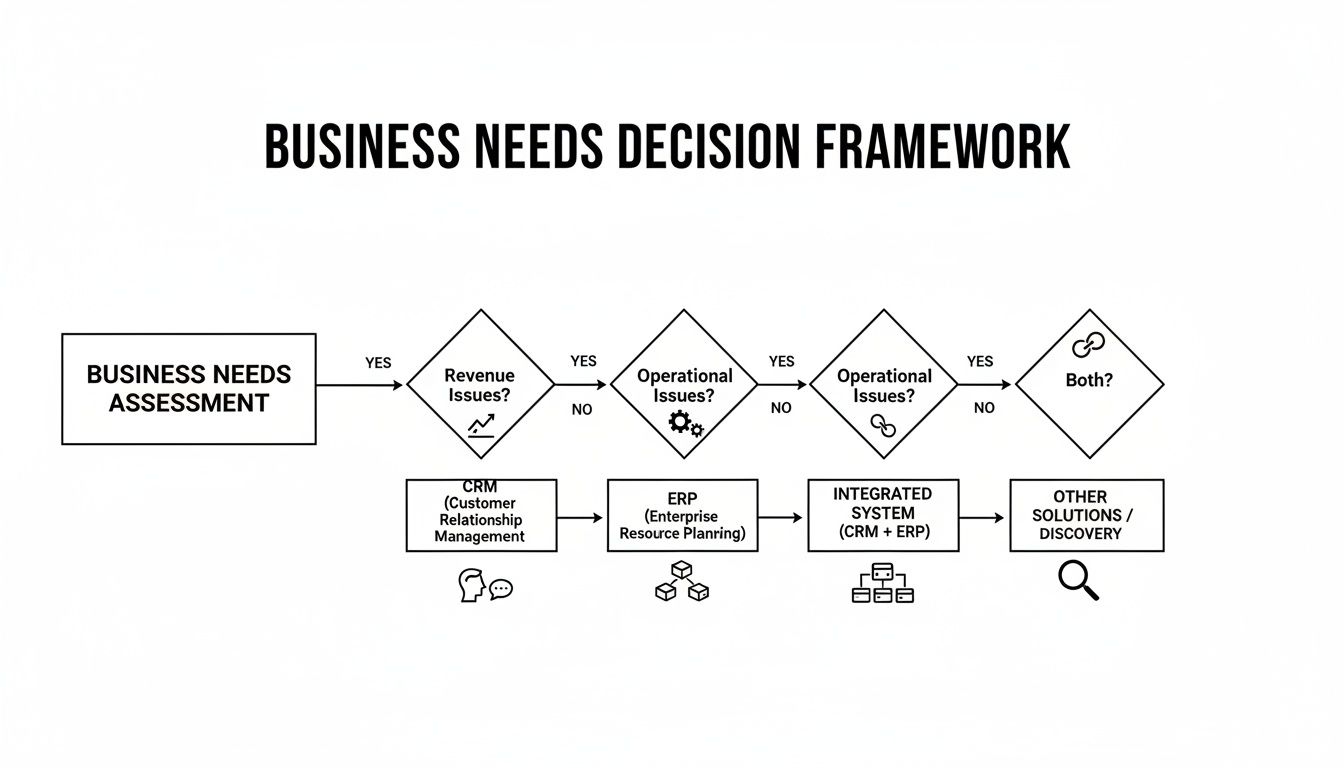
Think of this flowchart as your starting point. It cuts through the complexity by forcing you to identify your single biggest business headache, pointing you toward the investment that will deliver the most immediate impact.
Can a Small Business Use an ERP System?
Absolutely. The idea that ERPs are only for corporate giants is a thing of the past. Modern, cloud-based systems like Odoo are built to scale, making them both affordable and accessible for small and medium-sized Australian businesses.
You can start lean with just the essential modules, like accounting and inventory, and then bolt on more functionality as you grow.
Do I Really Need Both a CRM and an ERP?
It really comes down to business complexity. If your world involves managing physical products, juggling a multi-step supply chain, and trying to build lasting customer relationships, then an integrated solution is a game-changer.
On the other hand, if you’re a service-based business, you might find that a powerful CRM is all you need to get started and thrive.
How Long Does an Odoo Implementation Take?
That entirely depends on what you need. A straightforward setup for a small team can be up and running in a matter of weeks. However, a full-scale rollout across multiple departments with custom requirements will naturally take several months to get right.
As your Odoo partner in Sydney and Adelaide, our first step is always to map out a crystal-clear project scope and timeline, so you know exactly what to expect.
Is CRM Software Just For the Sales Team?
Not even close. While the sales team lives in it day-to-day, a CRM is the central nervous system for all customer-facing activity.
Marketing uses it to run targeted campaigns, customer service leans on it to track and resolve issues, and your leadership team uses its data for crucial forecasting. It creates that single source of truth about your customer, which benefits the entire organisation.
Ready to build a technology strategy that actually solves your biggest challenges? Wistec offers expert Odoo implementation, custom software development in Sydney and Adelaide, and specialised Shopify and WooCommerce integration designed to fuel your growth.