

Finding the best accounting software for small business australia isn't just about ticking boxes. You need a system that handles GST, BAS, and Single Touch Payroll (STP) without a fuss. While the big names like Xero, MYOB, and QuickBooks are solid choices, the right one for you really comes down to your industry and where you plan to take your business. A well-chosen system, possibly integrated with your Shopify implementation or WooCommerce store, can be a huge competitive advantage. If you're looking for a more tailored solution, an Odoo implementation with an expert ODOO partner Sydney Adelaide might be the answer.
Choosing Your Financial Engine for Australian Small Business
As a small business owner in Australia, you know that managing your finances and staying compliant can feel like a constant battle. It pulls you away from what you should be doing: growing your business. Picking the right software isn't just about making bookkeeping easier; it's a strategic move to build a solid foundation that can grow with you.
This decision is about more than just sending invoices and tracking expenses. You're choosing the central engine for your entire operation. A great system automates the tedious stuff and gives you a crystal-clear view of your financial health, letting you make smarter decisions, faster. Let's explore how to find the right fit for your business and when you might need expert software development Sydney Adelaide to create a truly customised solution.
Aligning Software with Your Business Model
There's no single "best" software for everyone. The right choice depends entirely on how your business actually works. A retail shop running on a Shopify implementation has completely different needs from a professional services firm that bills by the hour. For a great overview, you can explore this guide on the top small business accounting software platforms.
Think about how different business models demand different features:
- Retail & eCommerce: You need live inventory management that syncs perfectly with your online store, whether it’s Shopify or WooCommerce, to avoid overselling.
- Service-Based Businesses: It's all about project billing, accurate time tracking, and knowing which jobs are actually profitable.
- Manufacturing: Your needs are far more complex, from tracking raw materials and managing bills of materials to calculating production costs.
Here’s a practical case we see all the time: a growing online store starts with basic accounting software. As orders pick up, they’re spending hours trying to manually reconcile inventory between their WooCommerce site and their books. This inevitably leads to stockouts and unhappy customers—a clear sign they've outgrown their system. A custom Odoo implementation can solve this by unifying inventory, sales, and accounting in one platform.
Beyond Basic Accounting: A Comparison Framework
When off-the-shelf software starts holding you back, it's time to look at a more integrated approach. While Xero and MYOB are fantastic starting points, many growing businesses end up juggling a messy web of disconnected apps. This is exactly where a unified ERP (Enterprise Resource Planning) system becomes a game-changer.
| Feature Area | Off-the-Shelf Software (e.g., Xero, MYOB) | Integrated ERP (e.g., Odoo) |
|---|---|---|
| Core Function | Focuses squarely on accounting, payroll, and tax compliance. | Brings accounting, CRM, inventory, and even manufacturing under one roof. |
| Integration | Depends on third-party apps and plugins for extra features. | All modules are built to work together, creating a single source of truth. |
| Scalability | Can become restrictive as your operations get more complex. | Built to scale and can be customised for your specific workflows. |
| Customisation | You're limited to standard features and approved add-ons. | Can be fully tailored with expert software development Sydney Adelaide. |
A practical case: For a business with truly unique needs, like a manufacturer in Adelaide, a custom Odoo implementation can connect every single step of the process—from buying raw materials to shipping the final product. An ODOO partner Sydney Adelaide like Wistec can shape the system to fit your business like a glove.
Ready to find a financial solution that actually helps you grow instead of holding you back? **Book a no-obligation consultation with Wistec** to talk about what your business really needs.
The Absolute Must-Have Features in Australian Accounting Software
When you're hunting for the right accounting software for your small business, it's easy to get distracted by flashy dashboards and long feature lists. But before you get into the nitty-gritty comparisons, we need to talk about the absolute non-negotiables. These are the core functions that will either make your life easier or become a constant source of headaches.
Getting these fundamentals right isn't just a "nice-to-have." For any Australian business, it's about survival. Without them, you're signing up for hours of manual data entry, risking compliance breaches, and flying blind when it comes to your own numbers.
ATO Compliance: BAS and STP Reporting
Let's be blunt: keeping the Australian Taxation Office (ATO) happy is your number one financial priority. Any software worth its salt must have seamless, direct-to-ATO reporting for your Business Activity Statement (BAS) and Single Touch Payroll (STP).
Modern platforms are built to do this automatically. They connect the dots between your sales, expenses, and payroll, pre-filling your reports so you can lodge them with a few clicks. Trying to calculate GST and report payroll manually is just asking for trouble—it's a recipe for mistakes and the kind of penalties no small business needs.
A practical case: Think about a small café in Sydney we worked with. The owner used to lose two full days every quarter, hunched over spreadsheets to work out their BAS. After we moved them to a modern system, that same BAS report now takes minutes to generate, pulling directly from their daily sales data. That's time they now spend on the floor, not in the back office.
Payroll Management and Superannuation
Australian payroll is a minefield. With modern awards, complex leave entitlements, and strict superannuation guarantee rules, it’s one of the easiest places to make a costly mistake. Your software needs to handle this complexity for you, no excuses.
At a minimum, you should be looking for a system that can:
- Interpret Modern Awards: Automatically apply the correct pay rates, overtime, and penalty rates based on your industry's specific award.
- Track Leave Balances: Effortlessly manage accruals for annual leave, personal leave, and long service leave.
- Handle Superannuation: Calculate every employee's super contribution and pay it through a SuperStream-compliant clearing house.
Getting payroll wrong doesn’t just hurt morale; it can attract hefty fines from the Fair Work Ombudsman. Automation is your best defence here.
GST and Tax Tracking
For most Aussie businesses, managing the Goods and Services Tax (GST) is a daily task. The right software turns this from a chore into an automatic background process.
Every time you send an invoice or log an expense, the system should correctly code the GST component. This builds a real-time ledger that feeds directly into your BAS, ensuring you claim every credit you're entitled to and remit the correct amount to the ATO. This level of automation is a key part of what makes for the best accounting software for small business australia.
This shift to digital-first operations is a clear trend. A recent CPA Australia survey revealed that 33.2% of Australian businesses are making accounting software a top investment priority. It's especially crucial for retailers using a Shopify implementation or a WooCommerce store, where real-time data is everything. With over 75% of businesses now getting more than 10% of their sales through digital payments, you can't afford to be disconnected. You can read more about these trends in the full report on the Australian small business landscape.
The Strategic Power of Integrations
Your accounting software shouldn't be an island. Its real power comes from its ability to connect with the other tools you use every day, creating a central hub for your entire operation. This is how you eliminate double-handling of data.
For example, connecting your accounting platform to your WooCommerce store means sales, customer info, and inventory levels are always in sync. A consulting firm could link its project management tool to automate timesheets and invoicing. Simple connections like these save hours of admin work.
A custom Odoo implementation goes even further by bringing accounting, sales, inventory, and project management into one unified system. A dedicated ODOO partner Sydney Adelaide can build a solution around your specific workflows, making sure every part of your business talks to each other seamlessly. If you're tired of juggling multiple apps, a single platform built by a software development Sydney Adelaide expert like Wistec is the answer.
Is your current software setup creating more problems than it solves? Book a no-obligation consultation with Wistec and let's talk about what a truly connected system could do for your business.
Xero vs MYOB vs QuickBooks: A Real-World Showdown
Choosing the right accounting software for your small business in Australia usually boils down to the big three: Xero, MYOB, and QuickBooks. But just looking at a feature list on a website won't tell you what you really need to know. The true test is how they perform under the pressure of your daily operations.
Let’s get practical and put these platforms head-to-head in scenarios that Australian businesses face every single day. We'll see which one actually comes out on top for different business models, from a busy eCommerce store to a specialised consulting firm.
This decision tree helps frame the conversation around the core pillars that should guide your choice: compliance, payroll, and how well the software plays with the other tools you rely on.
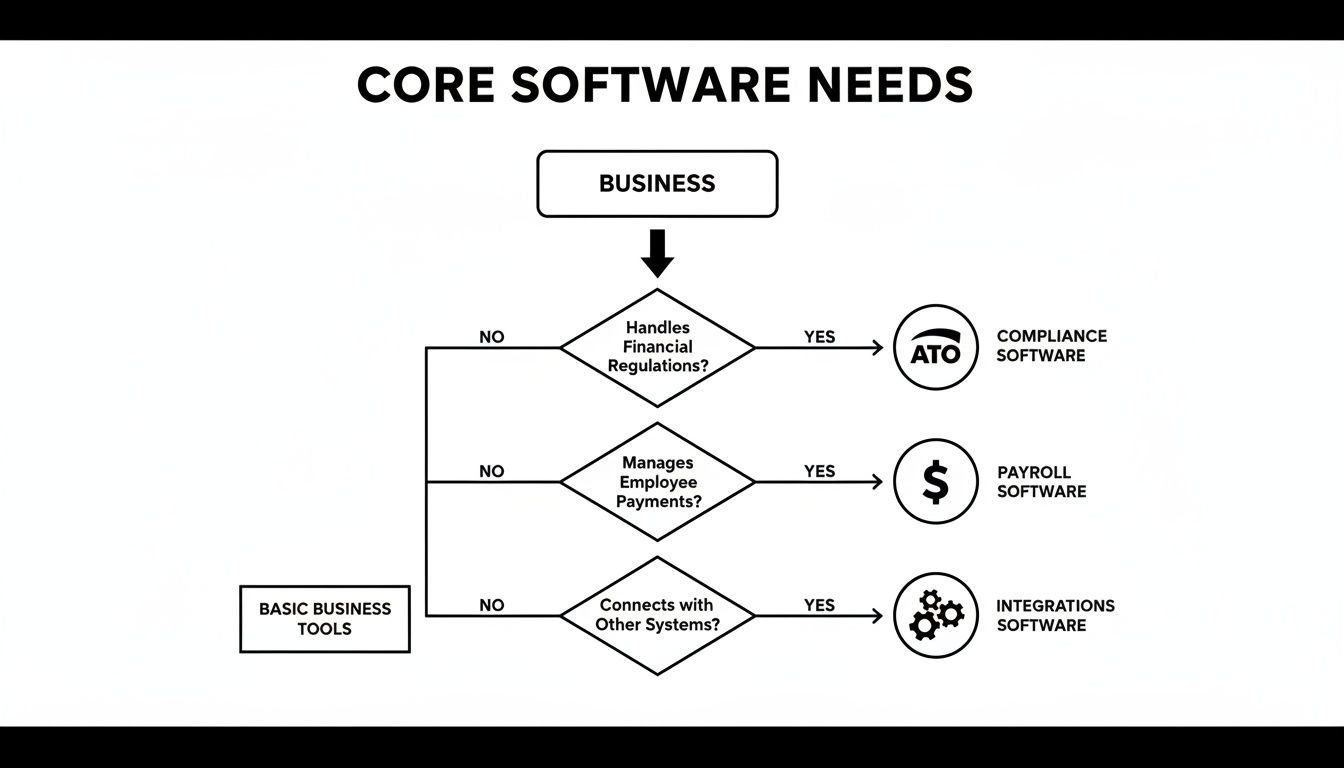
As you can see, what you do heavily dictates which features move from 'nice-to-have' to 'absolutely critical'.
Scenario 1: The eCommerce Retailer
Practical Case: Picture a growing Melbourne retail business. They have a brick-and-mortar shop but their online store is really taking off. Their biggest headache? Keeping inventory, sales, and financials in perfect sync between their physical POS and their Shopify implementation.
Xero is the natural frontrunner here, and its strength lies in its enormous app marketplace. The sheer volume of quality integrations for platforms like Shopify and WooCommerce is second to none. Connecting your store is usually a breeze, and it allows for real-time syncing of sales and stock levels. This massively cuts down on manual data entry and, more importantly, prevents you from overselling stock you don't have. If you're just starting, learning how to use Xero accounting software is quite intuitive thanks to its clean design.
QuickBooks Online, however, shouldn't be overlooked. It also has strong integrations, especially with Shopify. Where it often gets the nod is its more robust inventory management features, which are available at lower price points compared to Xero. If you're dealing with multiple currencies or have lots of product variations, QuickBooks can be a seriously compelling and cost-effective option.
MYOB has deep roots in more complex inventory for wholesalers or businesses with multiple warehouses. While it certainly offers eCommerce integrations, a business with a straightforward online store might find its interface feels a bit less intuitive for this specific need when compared to its cloud-native competitors.
The Verdict: For most eCommerce businesses that live and die by their Shopify implementation or WooCommerce connection, Xero is hard to beat. Its user-friendliness and plug-and-play ecosystem make it the go-to. That said, QuickBooks is an excellent, budget-friendly contender with fantastic inventory tools right out of the box.
Scenario 2: The Professional Services Firm
Practical Case: Now let’s pivot to a completely different business—a Sydney-based consulting firm. They bill clients for their time and manage multiple projects at once. Their world revolves around accurate time tracking, project profitability reporting, and sending out clean, professional invoices.
With Xero, the integrated Xero Projects tool is a game-changer. It lets staff track time and expenses directly against specific jobs. That data then flows straight into invoicing, so you can bill clients accurately and, crucially, see at a glance which projects are actually making you money. The clean interface also means your team will actually use it.
This is where QuickBooks Online really flexes its muscles, especially the Advanced plan. It offers incredibly sophisticated project profitability tracking and customisable reports that give service-based businesses deep strategic insights. It excels at breaking down revenue and costs by project, client, or even by team member, which is vital for making smart decisions.
MYOB has a long and respected history in job costing, particularly in its more powerful desktop-based versions like AccountRight. For businesses in trades or construction that need to track detailed costs against a strict budget, MYOB can offer a level of granularity that cloud-only platforms sometimes struggle to match.
The Verdict: For most professional services firms, QuickBooks Online strikes a powerful balance between user-friendliness and deep reporting capabilities. Xero is a very close second, particularly for businesses that prioritise its overall ease of use and wider app ecosystem.
Software Showdown: Xero vs MYOB vs QuickBooks at a Glance
To make sense of the key differences, it helps to see the core features side-by-side. This table gives a quick snapshot of how Australia's leading small business accounting platforms stack up for 2026.
| Feature | Xero | MYOB | QuickBooks Online |
|---|---|---|---|
| Ideal User | Startups, eCommerce, service firms that value a large app ecosystem | Established businesses, trades, complex inventory, multi-location | Small businesses, service firms, and retailers wanting strong features |
| User Experience | Modern, intuitive, and widely praised for its clean interface | Can feel dated, especially desktop versions; cloud version is better | Clean, easy to navigate, and considered very user-friendly |
| Payroll (Single Touch Payroll) | Excellent, fully integrated, and easy to manage | Very robust and reliable, a traditional strength | Strong and fully compliant, well-integrated into the platform |
| App Marketplace | 1,000+ apps, the largest and most diverse | Growing marketplace, but smaller and less diverse than Xero's | 750+ apps, strong in key areas like eCommerce and payments |
| Inventory Management | Basic on lower plans; needs add-ons for advanced features | Powerful and detailed, especially in AccountRight and Advanced | Surprisingly robust, even on lower-tier plans |
| Pricing (Entry Level) | Starts around $32/month | Starts around $35/month | Starts around $25/month |
While feature lists are a great starting point, the best choice always comes back to your specific daily workflow and which platform makes those tasks easiest.
When You've Outgrown 'Off-the-Shelf'
For some businesses, the choice isn't between Xero, MYOB, or QuickBooks. If you're a manufacturer in Adelaide or a national logistics company, you'll quickly find that even the best accounting software for small business in Australia can't keep up. You're trying to force a square peg into a round hole.
This is the point where you don't just need accounting software; you need a unified business management system.
A custom Odoo implementation is the next step. It goes beyond finance to bring every part of your operation—inventory, manufacturing, CRM, sales, and accounting—into a single source of truth. An expert ODOO partner Sydney Adelaide, like Wistec, can build a solution that maps to your unique processes, eliminating data silos for good. This kind of specialised software development Sydney Adelaide delivers a system that grows with you, instead of holding you back.
Are you constantly fighting with your software to make it fit your business? It might be time to consider a system built just for you. **Book a no-obligation consultation with Wistec** to see how a custom Odoo solution can solve your biggest operational headaches.
When Your Accounting Software Starts Holding You Back: The Odoo ERP Alternative
For so many growing Australian businesses, there’s a familiar story. The accounting software that was a lifesaver in the early days—think Xero or MYOB—starts to feel less like a tool and more like a roadblock. They're brilliant for core financials, but as you add more staff, more products, or more services, the cracks begin to show.
Suddenly, you're juggling a mess of disconnected apps. You’ve got one for inventory, another for your customer database (CRM), and maybe a separate project management tool, all clumsily feeding data back into your accounting system. This patchwork approach creates data silos, trapping critical information in different programs. Your team burns hours manually copying sales data, trying to figure out why your website’s stock count doesn’t match the warehouse, and struggling to get a single, honest picture of how the business is actually performing. It's a recipe for errors, frustration, and stalled growth.
From Patchwork Apps to a Truly Unified Business System
This is the point where you need a fundamental shift in thinking. The solution isn't just another app; it's graduating from basic accounting software to an Enterprise Resource Planning (ERP) system. An ERP isn’t just a bigger accounting package—it’s a single, integrated platform designed to run your entire business.
Imagine having one source of truth for everything. That’s the promise of a powerful, open-source ERP like Odoo. It dismantles the walls between your departments by offering a comprehensive suite of business apps, all built to communicate seamlessly from the get-go.
Instead of separate tools, you get one system with modules for:
- Accounting & Finance: A full-featured suite handling everything from invoicing and bank reconciliation to ATO compliance.
- Inventory & Warehouse: Real-time stock control across multiple locations with automated reordering rules.
- Manufacturing (MRP): End-to-end production planning, from bills of materials and work orders to quality control.
- Sales & CRM: A complete customer relationship tool to track leads, manage your sales pipeline, and deliver better service.
- eCommerce & Website: A fully integrated platform to build and run your online store, directly connected to your inventory and sales data.
By bringing these functions under one roof, you kill off duplicate data entry, automate workflows between departments, and finally gain the deep insights you need to make smart decisions. To see how this works in detail, you can learn more about how Odoo ERP software can centralise your operations.
How Odoo Solves Real-World Problems for Aussie Businesses
The real impact of an ERP comes to life when you see it solve tangible problems. Let's look at a couple of practical cases we’ve seen firsthand with our clients.
Practical Case 1: The Adelaide Manufacturer
We worked with a manufacturer in Adelaide who was trapped in a cycle of guesswork. They used one system for quoting, a collection of spreadsheets to track raw materials, and a standard accounting package for the books. The result? They never had an accurate, real-time cost for any production run, which made their profit margins a complete mystery.
With a custom Odoo implementation, we unified their entire workflow. Now, when a sales order is confirmed, the system automatically checks stock, generates a manufacturing order if needed, and allocates the raw materials. As the job moves through the factory, every cost is tracked and flows directly into the accounting module. They now have a crystal-clear view of profitability on every single job—a level of control that's simply impossible with separate systems.
Practical Case 2: The National eCommerce Brand
An ambitious eCommerce brand running on WooCommerce was drowning in admin. Every sale meant someone had to manually punch the details into their accounting software, and inventory was a constant headache, leading to overselling during promotions and unhappy customers.
As an experienced ODOO partner Sydney Adelaide, we delivered a seamless integration between Odoo and WooCommerce. Now, every online sale is instantly recorded in Odoo’s inventory and accounting. When stock for a popular item runs low, Odoo automatically generates a purchase order to the supplier. This automation freed the team to focus on what they do best: marketing and growing the business, not mind-numbing data entry.
While local favourites like MYOB have a strong foothold, especially for specific features like job costing, businesses with more complex operations eventually hit a ceiling. Recent analysis shows that while over 60% of businesses are embracing automation, a telling 45% point to steep learning curves as a major hurdle. This is where a guided Odoo implementation from a specialist partner like Wistec really proves its worth. A partner smooths out that transition and ensures the system is built not just for today, but for where your business is headed.
Why a Custom Odoo Implementation is the Smarter Path Forward
Unlike rigid, off-the-shelf software, Odoo's open-source nature means it’s incredibly adaptable. It can be moulded to fit your unique business processes, not the other way around. Whether you need a sophisticated Shopify integration that links directly to your manufacturing workflow or highly specialised reports for your service business, it’s all achievable with expert software development Sydney Adelaide.
Working with an expert partner ensures your Odoo implementation is a genuine success. At Wistec, we don't just install software. We dive deep into your workflows, pinpoint the bottlenecks holding you back, and build a system that solves your specific challenges—setting you up for sustainable, long-term growth. Take the next step and let's discuss your project.
Managing a Smooth Software Implementation and Migration
You’ve done the hard yards and picked your new accounting software. That’s a huge step, but the job isn't done yet. The real challenge—and where the true value is won or lost—is in the implementation and migration.
A rushed or poorly planned switch can cause chaos. Think data errors, costly operational downtime, and a frustrating experience for your team. Getting this transition right from the very beginning is absolutely critical to seeing a return on your investment. It’s your chance to clean house, sharpen your processes, and build a solid foundation for growth.
Preparing for a Seamless Switch
A smooth migration doesn't happen by chance; it’s the result of careful, methodical preparation. This is where you lay the groundwork for success, and skipping these steps almost guarantees you’ll run into trouble later.
Here’s what you need to nail down before you move a single piece of data:
- Data Cleansing: This is the perfect opportunity for a fresh start. Don't just copy over a messy database. Take the time to review your customer and supplier lists, archive old contacts, and standardise your chart of accounts. Migrating messy data only moves the problem into your shiny new system.
- Choosing a Cut-Off Date: Pick a firm date to make the switch. This is typically the end of a financial quarter or, even better, the end of the financial year. From this date forward, all new transactions go into the new software. This creates a clean break and makes reconciliation much simpler.
- Planning Historical Data Import: How much old data do you really need? While it's possible to import years of transaction history, it makes the process far more complex. A more practical approach is often to import your opening balances and just the current financial year's data.
A practical case: We’ve seen countless businesses try to cram years of disorganised data from an old system into a new Odoo implementation. It not only complicates the migration but also pollutes the new platform with old problems. A clean break is almost always the better strategy.
The Value of Professional Guidance
While moving from one simple cloud accounting tool to another can sometimes be a DIY project, anything more complex really needs an expert hand. This is especially true when you're moving from an old, clunky system to a full-blown ERP like Odoo, or when you need to integrate multiple platforms, like connecting Shopify to your new finance hub.
You can learn more about what’s involved in a properly structured ERP system implementation.
A skilled partner brings discipline and a proven process to the table. As an ODOO partner Sydney Adelaide, we manage these transitions methodically to keep your business running smoothly. For a complex Odoo implementation, for instance, our process involves phased rollouts and rigorous testing. We make sure every single module, from accounting to inventory, is working perfectly before you go live.
That level of project management, built on years of experience in software development Sydney Adelaide, is what separates a chaotic, stressful switch from a predictable, successful one. It ensures your data is clean, your team is confident, and your business doesn’t miss a beat.
Don’t risk a messy migration. **Book a no-obligation consultation with Wistec** and let our experts design a seamless implementation strategy for your business.
Choosing the Right Partner to Build Your Growth Engine
So, after weighing up all the options, what’s the real takeaway when searching for the "best accounting software for small business Australia"? It’s this: the ‘best’ system is simply the one that actually fits how your business runs day-to-day. Off-the-shelf software can get you started, but real growth kicks in when your technology bends to your workflows, not the other way around.
This is the point where choosing the right implementation partner becomes just as critical as the software itself. At Wistec, we’re not just vendors reselling a product. We’re problem-solvers, focused on understanding your specific headaches and building a system that genuinely makes them go away.
From Simple Setups to Fully Custom Systems
Whether you need a clean Shopify implementation that talks perfectly to Xero or a sophisticated, custom-built ERP to run your entire operation, we’ve been there and done that.
Think of this practical case: A retail business might just need a great-looking eCommerce site, and a straightforward Shopify implementation is the perfect fit. But what if that same retailer also manufactures their own goods? Suddenly, a custom Odoo implementation makes far more sense, tying together sales, inventory, and the production line into a single, cohesive system. We match the solution to the problem. You can get a better sense of our process by reading about what makes for effective Odoo implementers.
Our work is all geared towards helping you scale, without the growing pains. We specialise in:
- Odoo Implementation: As expert ODOO partners in Sydney and Adelaide, we design and roll out powerful, all-in-one ERP systems.
- eCommerce Development: We build high-performing online stores on both Shopify and WooCommerce.
- Custom Software Development: If you need a unique tool built from the ground up, our teams in software development Sydney and Adelaide can create it.
Your software should be an asset, not a daily frustration. The right partner builds a solution that smashes through bottlenecks, automates the boring stuff, and gives you the clarity you need to grow with confidence.
Ready to stop fighting with your software and get back to business? Book a no-obligation consultation with Wistec today. Let's talk about your challenges and map out a technology plan that delivers real results.
Frequently Asked Questions
Choosing the right financial software throws up a lot of questions. We get it. Here are some honest answers to the most common things we hear from Australian business owners trying to find the best accounting software for their small business.
How Much Should I Budget for Accounting Software in Australia?
It’s tempting to just look at the monthly fee, but the real question is about value. What are you getting for your money?
Basic plans from providers like Xero or QuickBooks can get you started for around $30 AUD per month. But as soon as you need proper payroll, multi-currency features, or project tracking, you’re realistically looking at $70 to $150+ every month.
A custom Odoo implementation is a different way of thinking about cost. It’s a bigger investment upfront, but it often works out cheaper in the long run because it stops you from paying for five different apps. Practical case: Think of a retailer paying for accounting software, a separate inventory app, and a CRM tool. An Odoo system brings all of that together, giving you one platform and one cost.
Can I Switch Accounting Software If My Current One Is Not Working?
Absolutely. Plenty of businesses outgrow their first accounting package. But making the switch requires a solid plan to move your financial data without causing a complete mess. You’ll need to transfer your chart of accounts, customer and supplier details, and all your historical transactions correctly.
Practical Case: Moving from a simple system to a fully integrated one like Odoo is more than just exporting and importing a CSV file. You have to carefully map old data to the new system and make sure your workflows are rebuilt properly. We’ve seen this go wrong, which is why we always suggest working with an ODOO partner Sydney Adelaide. They can manage the migration professionally, protect your data, and ensure you don’t lose a single day of business.
Do I Need an ERP or Is Accounting Software Enough?
This is the big strategic question. For many businesses, standard accounting software like Xero or MYOB is perfectly fine. If your world revolves around invoicing, tracking expenses, running payroll, and lodging your BAS, these tools are powerful and do the job well.
But you’ll know it’s time to think about an ERP like Odoo when you start feeling the pain of disconnected systems. Practical case: we see it all the time: a business owner is trying to sync a WooCommerce store with a clunky inventory tool and their basic accounting software. An expert in software development Sydney Adelaide can build a single Odoo solution that connects everything. Suddenly, you have one source of truth for your entire operation, creating a rock-solid foundation for growth.
Ready to find a solution that’s built for your business, not the other way around? Wistec has the hands-on experience to guide you, whether that’s a clean Shopify implementation or a fully integrated Odoo ERP.
Book a no-obligation consultation with Wistec today and let's start building your engine for growth.