

When you start looking into app development, the quotes can be all over the place. In Australia, you might see rates from $80 per hour for a junior developer right up to $250 per hour or more for a seasoned expert. The final cost really comes down to the talent you hire, the complexity of your project, and the technology involved, which is why local expertise from a trusted software development Sydney Adelaide team often comes at a premium compared to offshore teams.
Your Quick Guide to 2026 Australian App Development Rates

Trying to figure out app development rates can feel like you’re trying to hit a moving target. One quote seems suspiciously cheap, the next feels wildly expensive, and you’re left wondering what the “right” price actually is. The truth is, there’s no single magic number; cost is a direct reflection of the team’s calibre and their location.
This becomes especially clear when you look at the Australian market. Local developers in cities like Sydney and Adelaide command higher rates for a good reason—they bring an intimate understanding of the local market, offer real-time collaboration, and provide a level of accountability you just can’t get from a team overseas.
Practical Case: Imagine you’re launching a new online store. A local team experienced with Shopify implementation understands Australian payment gateways, shipping logistics, and consumer expectations out of the box. Similarly, for a manufacturing app, a local Odoo partner in Adelaide knows the specific operational challenges faced by businesses in the region, ensuring the final product solves real-world problems.
A Snapshot of Hourly Costs
To give you a clearer picture, let’s break down the typical hourly rates you can expect. This table provides a quick look at what Australian talent costs compared to offshore alternatives, so you can see the trade-off between price and the undeniable benefits of a local team.
| Quick Look Australian App Developer Hourly Rates (2026 Estimates) | ||
|---|---|---|
| Developer Level | Typical Australian Rate (AUD/hour) | Offshore Rate (AUD/hour) |
| Junior Developer | $80 – $120 | $30 – $50 |
| Mid-Level Developer | $120 – $180 | $50 – $80 |
| Senior Developer/Specialist | $180 – $250+ | $80 – $120 |
As you can see, the numbers tell a story. While offshore rates are lower, working with an experienced local developer ensures you have someone in your corner who can solve problems on the fly and truly understands your business goals.
App development is an investment in your business’s future. The rates reflect not just coding hours, but the strategic thinking, problem-solving, and industry expertise that turn a simple idea into a high-performing business tool.
This pricing structure is shaped by some powerful market dynamics. The Australian software development Sydney Adelaide scene is booming, driven by huge cloud investments and the push for enterprise digitalisation. This growth directly affects app development rates because the demand for skilled developers—especially those with AI, WooCommerce, or Odoo implementation experience—is quickly outpacing supply.
Ready to get a clear, transparent quote for your app idea?
Contact Wistec today for a no-obligation consultation, and let’s map out a budget that delivers real results for your business.
What Actually Drives Your App Development Cost

If you’ve ever seen one app quote come in at $30,000 and another for a seemingly similar project at $300,000, you’re right to be confused. What causes such a huge gap? It all comes down to the “ingredients” that go into your project. These are the core factors that directly shape your final budget and define the difference between a simple tool and a sophisticated digital product.
I find it helps to think of building an app like building a house. A basic, template-driven app is like a pre-designed granny flat—it’s functional, affordable, and quick to put up. But a complex enterprise app? That’s a custom-designed home with smart automation, unique architectural features, and specialised engineering. The scope and complexity are the biggest drivers of your app development rates.
Platform Choice and Its Impact
Right out of the gate, one of the biggest decisions you’ll make is where your app will live. Will it be an iPhone app, an Android app, or available on the web? This choice has a massive knock-on effect on the cost and timeline.
- iOS (Apple): Developing for Apple’s world is often more straightforward. Because you’re only dealing with a handful of iPhone and iPad models, testing is simpler and that can mean fewer development hours.
- Android (Google): The big win with Android is its incredible market share. The challenge? It’s a bit of a wild west. With countless manufacturers creating devices of all shapes, sizes, and capabilities, our team needs to invest more time to ensure your app works perfectly for everyone.
- Cross-Platform: This is a smart approach that uses a single codebase to build for both iOS and Android simultaneously. It can be a brilliant way to control costs without sacrificing reach. To see if it’s the right fit for your project, take a look at our guide to cross-platform app development in Australia.
A good software development Sydney Adelaide team will help you look at your target audience and business goals to make a strategic choice, finding that sweet spot between maximum reach and a sensible budget.
Design, Backend, and Critical Integrations
Beyond the platform, there are a few other technical elements that heavily influence the final price tag. These are the powerful, behind-the-scenes systems that make your app feel intuitive, robust, and connected to the rest of your business.
First, a beautiful and intuitive UI/UX (User Interface/User Experience) design isn’t just about looking good; it’s what makes people want to use your app—and keep using it. A simple design based on a template is the cheaper route, but a fully custom interface that truly reflects your brand takes real design and development skill.
The backend is the engine of your app. It’s the combination of servers, databases, and APIs (Application Programming Interfaces) that powers everything from user logins and data storage to processing payments. A simple app might get by with a lightweight backend, but an app built for growth needs a seriously robust and secure infrastructure.
Finally, third-party integrations are where your app’s true power often lies. This is about connecting your app to other software systems to automate tasks and share data. This is a very common and critical cost factor.
Practical Cases of Integration:
- eCommerce: A Shopify implementation or a connection to a WooCommerce store lets your app sync products, manage inventory, and process customer orders in real-time.
- Business Operations: For a manufacturing or logistics business, a deep Odoo implementation can be a game-changer. Working with an ODOO partner Sydney or Adelaide allows your app to talk directly to your core ERP system, automating workflows and unlocking powerful business insights.
Each one of these factors adds another layer of complexity—and therefore, more time and expertise—to your project. Understanding them from the start helps you have a much smarter, more productive conversation about your budget.
Ready to discuss the specific ingredients for your app? Book a call with Wistec and let’s build a transparent quote together.
Choosing Your Pricing Model: Hourly Versus Fixed Price
Deciding how you’ll pay for your app is just as important as choosing who will build it. This isn’t just a line item on a budget; it shapes your entire project, from flexibility to the final product. You’ll generally come across two main options: paying by the hour (often called Time & Materials) or agreeing on a fixed price. Each has its place, and the right choice really depends on your project.
Practical Case: An R&D project exploring a new AI feature would be a perfect fit for an hourly model, allowing for experimentation. In contrast, building a standard digital menu app for a restaurant, where all features are known, is ideal for a fixed-price contract.
A fixed-price contract, on the other hand, is more like buying an all-inclusive holiday package. You know the exact cost, what’s included, and the duration before you even pack your bags. This gives you fantastic budget certainty and is a great fit for projects where the scope is crystal clear from the get-go. The trade-off? There’s very little room to take a scenic detour without having to renegotiate the entire trip.
The Flexible Path: The Hourly Model
The hourly model is built for collaboration and truly shines on complex or evolving projects. If you’re creating a first-of-its-kind app or need a deep Odoo implementation that will naturally require tweaks along the way, this model lets you stay agile without being boxed in.
Pros of the Hourly Model:
- Maximum Flexibility: You can easily add or change features as your business needs or user feedback dictates.
- Faster Start: Development can kick off almost immediately, without waiting for every last detail to be finalised.
- Total Transparency: With detailed timesheets, you see exactly where every hour goes, which helps build a strong partnership.
The main risk, of course, is the potential for the budget to creep up if the scope isn’t managed well. This is why this approach works best when you have a trusted software development Sydney Adelaide partner who keeps you in the loop with constant communication and regular progress reports.
The Predictable Route: The Fixed-Price Model
For any business that needs absolute budget predictability, a fixed-price contract is the way to go. It’s tailor-made for simpler projects, like a standard marketing app or a straightforward Shopify implementation, where all the requirements are known and aren’t expected to change.
A fixed-price model forces disciplined planning. Because everything must be documented and agreed upon before work begins, it eliminates ambiguity and ensures everyone is aligned on the final goal from day one.
When weighing up hourly versus fixed-price models, it’s helpful to understand the core financial principles at play. For a deeper dive into this, you might find it useful to explore resources on mastering fixed and variable cost concepts.
Pros of the Fixed-Price Model:
- Budget Certainty: The total cost is locked in from the start, making financial planning a breeze.
- Clear Deliverables: The project’s scope is defined down to the last detail, leaving no room for nasty surprises.
- Lower Risk for You: The financial risk of project delays or unexpected hurdles falls largely on the developer.
The major downside is rigidity. Any change, no matter how small, typically needs a formal change request, which can add time and cost. Whether you’re building a new feature for your WooCommerce store or a brand-new business tool, the best pricing model is always the one that matches your project’s clarity and your own appetite for flexibility.
Let’s discuss which model best suits your project. Contact Wistec for a consultation and we’ll help you build a plan that works for your budget and goals.
Alright, let’s talk real numbers. Theory is one thing, but seeing how the dollars and cents stack up on actual projects is what really matters. To give you a clearer picture, we’ve broken down three common types of apps you see in the Australian market.
Think of these as financial benchmarks. Each example lays out a specific set of features and the likely cost, showing you exactly how things like complexity and third-party integrations can drive the price up. It’s all about turning abstract ideas into a concrete budget you can work with.
You’ll generally come across two main ways to price a project, and your choice here really sets the tone for the entire build.
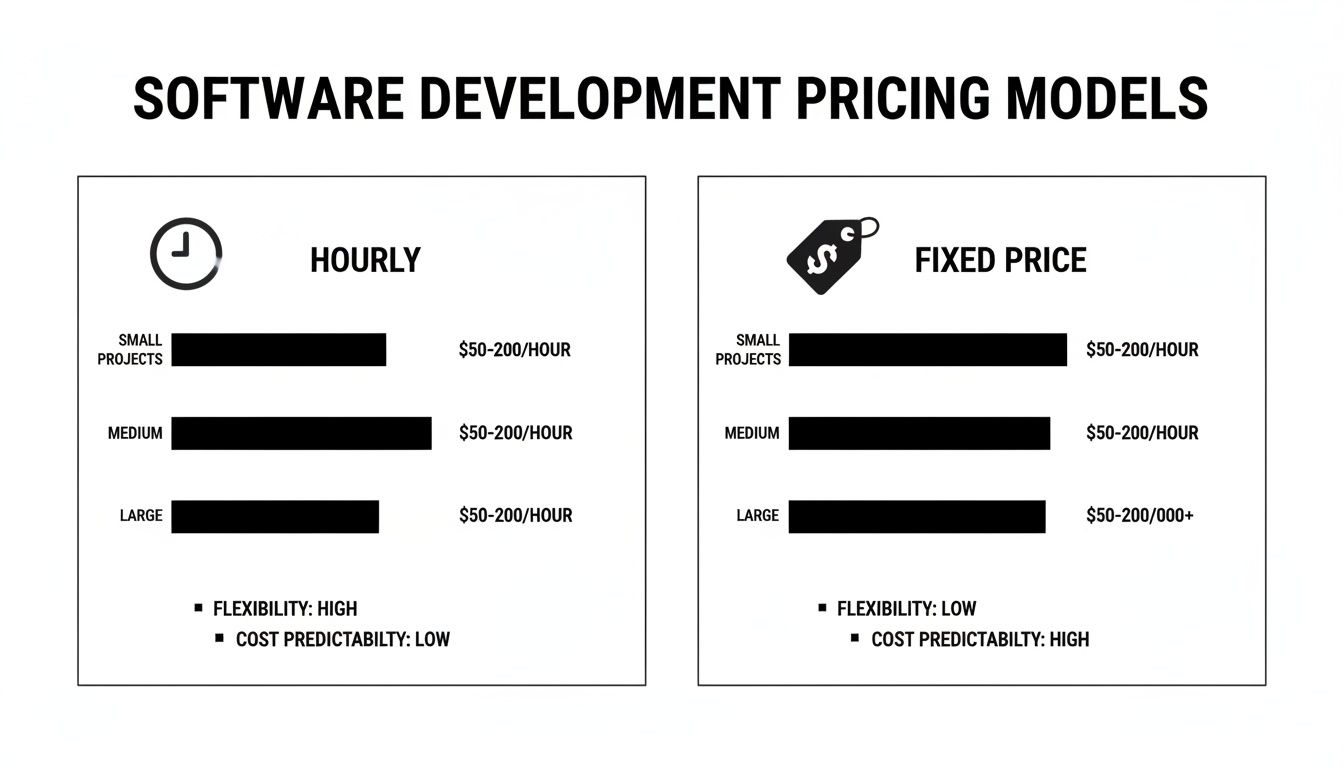
Deciding between the flexibility of an hourly rate and the certainty of a fixed price is a crucial first step.
Example 1: The Simple Service App
Let’s start with a classic scenario: a local tradie in Adelaide—say, a plumber or an electrician—who wants to modernise their business. All they need is a simple, professional app to show what they do and let customers book a job. It’s an entry-level tool built for pure efficiency.
Core Features:
- Service Listings: A clean, simple showcase of the services on offer.
- Simple Booking Form: An easy-to-use form to capture customer and job details.
- Contact & About Us Page: The essential business info and contact methods.
- Standard UI/UX: A professional look and feel, often built from a high-quality template.
Estimated Cost Range: $30,000 – $65,000 AUD
This price point reflects a project with very little backend complexity and a tightly defined scope. It’s a fantastic starting point for any business wanting a mobile presence without a massive upfront investment.
Example 2: The Mid-Complexity eCommerce App
Now, picture a growing retail brand in Sydney. They need a proper eCommerce app that connects seamlessly with their online store, which happens to be a Shopify implementation. This is a much bigger undertaking, requiring user accounts, secure payments, and more.
Core Features:
- Full Product Catalogue: Displays all products with images, descriptions, and pricing.
- User Accounts: Lets customers create profiles, check order history, and save their details.
- Secure Payment Gateway: Integration with a trusted payment processor like Stripe or PayPal.
- Shopify Integration: Keeps products, stock levels, and orders synced in real-time.
Estimated Cost Range: $70,000 – $150,000 AUD
Why the jump in price? It’s all down to the added complexity. Building secure user logins, handling payments, and nailing the API integration with Shopify requires a higher level of software development Sydney Adelaide expertise.
Example 3: The Complex Enterprise App
Finally, imagine a large manufacturing firm that needs a powerful internal tool to manage its entire supply chain. This app must integrate deeply with their core business system—in this case, an Odoo implementation—to pull real-time data on inventory and logistics. For a project like this, an expert ODOO partner Sydney Adelaide isn’t just nice to have; it’s essential.
Looking ahead, the 2026 Australian app development market is seeing rates for skilled developers rise, largely due to a simple supply-and-demand problem. Businesses don’t just want coders; they need proven experts in modern frameworks, secure APIs, and complex data systems. This demand is fuelled by major tech investment and a thriving business scene in hubs like Sydney and Melbourne, particularly in retail and logistics. You can get a deeper dive into the market overview and economic context here.
Core Features:
- Real-Time Inventory Tracking: A live data feed directly from the Odoo ERP.
- Supply Chain Dashboard: A way to visualise logistics, orders, and stock levels at a glance.
- Role-Based User Access: Custom permissions for different user types, like warehouse staff vs. executives.
- Deep Odoo ERP Integration: Two-way data sync that allows staff to manage workflows right from the app.
Estimated Cost Range: $180,000 – $400,000+ AUD
This is a premium, highly specialised project. The sheer complexity of integrating with a core ERP like Odoo, guaranteeing data security, and engineering a bulletproof architecture demands a senior team with specific experience in systems like WooCommerce or other enterprise platforms.
Ready to see where your project fits?
Schedule a free consultation with Wistec today, and we’ll help you define your scope and provide a transparent, detailed quote tailored to your business goals.
How to Control Costs and Maximise Your ROI

Getting a high price tag on an app development quote doesn’t guarantee a smash hit. The real secret to success isn’t just about finding the cheapest option—it’s about making smart, strategic decisions that squeeze every drop of value from your budget.
One of the best ways to do this is by embracing the Minimum Viable Product (MVP) approach. Forget building the app with every feature you’ve ever dreamt of. An MVP is all about discipline. You launch with only the absolute core features needed to solve your user’s main problem, get it into their hands quickly, and use their real-world feedback to guide your next move.
Strategic Ways to Keep Costs in Check
Beyond just starting small, a few key technical and planning choices can dramatically lower your app development rates. Making the right call here can genuinely save you tens of thousands of dollars.
A classic example is choosing your development framework. Building two separate native apps for iOS and Android is the most expensive route. A much smarter play is cross-platform development with frameworks like Flutter or React Native. This lets your team write one codebase that runs beautifully on both platforms, effectively giving you two apps for the effort of one.
Next, you have to get ruthless with your features. We use the MoSCoW method to bring clarity and focus to this process. It’s a simple but powerful way to categorise every potential feature:
- Must-Have: These are non-negotiable. The app simply won’t work without them.
- Should-Have: Important, but not critical for the first launch.
- Could-Have: Nice-to-have features that can easily wait for a future update.
- Won’t-Have: Features you agree are completely out of scope for now.
This simple exercise is your best defence against “scope creep”—that slow, silent killer of budgets and timelines.
Smart Planning and Modern Platforms
You can also find huge savings by looking at newer technologies. Low-code platforms are absolutely booming in Australia for a reason. The market is set to explode from USD 772.9 million in 2023 to an incredible USD 4,202.1 million by 2030. Businesses are using these tools to slash development time by up to 70% for prototypes, internal tools, and simpler apps. You can get a better sense of this rapid market expansion and its drivers.
Your app’s total cost of ownership extends far beyond the initial build. Ongoing expenses for hosting, maintenance, and updates are a significant part of the financial picture.
To really get the best return, you have to think long-term from day one. This means planning for ongoing costs. For example, learning how to achieve efficient cloud computing cost reduction for your back-end can make a massive difference to your yearly expenses.
Finally, never underestimate the power of clear project documentation. It’s your single best tool against costly misunderstandings. When everyone on your software development Sydney Adelaide team is on the same page, the entire project runs smoother. This is especially vital when you’re dealing with complex jobs like a Shopify implementation or connecting a WooCommerce site to an Odoo implementation. And if you’re thinking about going offshore to save money, our guide on mobile application development outsourcing is a must-read.
Ready to discuss a cost-effective strategy for your app? Contact Wistec for a no-obligation consultation and let’s build a smart plan together.
Take the Next Step Toward Your Custom App
Hopefully, you now have a much clearer picture of what goes into app development rates. But knowing the theory is one thing—the real question is, how do these numbers apply to your specific idea? Don’t let the budget questions be the roadblock that stops your vision in its tracks.
At Wistec, we’re not just code-cutters; we’re business partners. We know that a generic quote pulled from a hat is useless. Your project has its own unique goals, challenges, and opportunities, and that’s exactly where we start.
From Vision to a Detailed Quote
Whether you’re searching for an expert in software development Sydney Adelaide to build something from the ground up, or a certified ODOO partner Sydney Adelaide to get your operations humming, our team is here and ready to talk. We’ve built our reputation on creating solutions that fit the specific demands of Australian businesses.
We’ve helped our clients succeed with a range of platforms and technologies, including:
- Shopify implementation for retailers who need a seamless experience across web and mobile.
- WooCommerce development for businesses looking for a truly flexible and scalable e-commerce engine.
- Completely custom software designed to solve complex operational headaches for manufacturers and logistics firms.
The journey from a great idea on a napkin to a real, market-ready product begins with one simple conversation. Having a clear plan is the most valuable asset you can own before a single dollar is spent on code.
We believe in starting every project with total transparency. That’s why we offer a no-obligation call to help you nail down your scope, figure out which features are absolute must-haves, and get a realistic handle on the potential costs. From there, we can develop a detailed, itemised quote that lines up perfectly with your budget and business goals.
Talking through your project with an experienced team brings clarity and removes the guesswork. If you’d like to see how we work, you can learn more about our custom software development company and see the results we’ve delivered for businesses just like yours.
It’s time to turn that idea into impact. Let’s explore what’s possible, together.
Ready to get started? Schedule your free, no-obligation consultation with Wistec today and let’s bring your app vision to life.
Frequently Asked Questions About App Costs
It’s a conversation we have every day with businesses looking to build their next big idea. Understanding the costs involved is the first step in turning that concept into a real-world asset, whether you’re planning a new mobile app or a complete Odoo implementation.
Let’s clear up some of the most common questions we hear about app development rates and budgeting.
Why Are App Development Rates in Australia So High?
It’s a question we get all the time, especially when you see lower hourly rates advertised overseas. The cost of app development in Australia, especially in hubs like Sydney and Adelaide, really boils down to two things: the high cost of living and fierce competition for genuinely elite developers.
We’re not just talking about coders. We’re talking about specialists who can architect complex systems, build secure APIs, or serve as an expert ODOO partner Sydney Adelaide. These are senior professionals with a track record of delivering results, and local companies are all vying for that same small pool of top-tier talent.
While an offshore team might seem cheaper on paper, a local partner gives you something you can’t put a price on: real-time communication, a deep-seated understanding of the Australian market, and accountability. This local insight is crucial for navigating business regulations and ultimately leads to a higher quality product with a much stronger long-term return on investment. For any serious software development Sydney Adelaide project, that’s invaluable.
How Much Does It Cost to Maintain an App?
This is a big one. Your budget doesn’t end when the app goes live. Think of maintenance as the insurance policy on your investment—it keeps your app running smoothly and protects its value over time.
As a solid rule of thumb, you should plan to budget 15-20% of your initial development cost each year for ongoing maintenance and support.
This fund typically covers all the essential background work, including:
- Server and hosting fees.
- Squashing any bugs that pop up after launch.
- Keeping your app compliant with the latest iOS and Android operating system updates.
- Monitoring performance to guarantee a fast, responsive user experience.
- Applying critical security patches to safeguard your app and your users’ data.
Without a consistent maintenance plan, even the best app can become insecure or obsolete in a surprisingly short time. It’s what ensures your app continues to deliver value long after the launch party.
Can I Get a Ballpark Cost for a Simple App?
Absolutely. For a simple app with a focused set of features, we can provide a starting figure. Here in Australia, a basic app—think informational pages, a contact form, and a clean user interface—will generally land somewhere between $30,000 and $65,000.
Of course, this is just a ballpark. That number can move depending on the level of design polish, whether you need it on iOS, Android, or both, and what kind of backend support is required.
The only way to get a firm number is to talk it through. Whether you have a simple app in mind, need a Shopify implementation, or are considering a custom WooCommerce build, a quick chat is all it takes for us to map out your vision and give you a detailed, transparent quote.
Ready to stop guessing and get a clear, actionable plan for your app? The team at Wistec is here to provide a detailed quote based on your specific needs. Let’s build a solution that drives real results for your business.