

Ever wondered how a brilliant app idea actually gets built? It’s a journey, not a sprint. This guide will walk you through the entire process of app development for mobile—from that first lightbulb moment to launching a product that people genuinely want to use. We’ll skip the tech-speak and give you a clear roadmap to follow.
Your App Development Journey Starts Here
Turning an idea into a fully-fledged app that lands on someone’s home screen is a structured process. For any business today, having a smart mobile strategy isn’t just a nice-to-have; it’s essential for connecting with your audience. This methodical approach ensures your final product isn’t just a technical marvel but is also perfectly aligned with what your business actually needs to achieve.
Getting your head around this process is the first step to success. It’s exactly how top-tier software development Sydney Adelaide agencies transform a rough concept into a polished, market-ready app. A solid plan prevents expensive missteps and makes sure the app you build is one that users will love, and that delivers real value.
The Path from Idea to Launch
The entire app lifecycle is broken down into distinct, connected phases. Each stage logically builds on the one before it, creating a clear workflow that reduces risk and stacks the odds of success in your favour.
Here’s a simple look at the core stages involved:
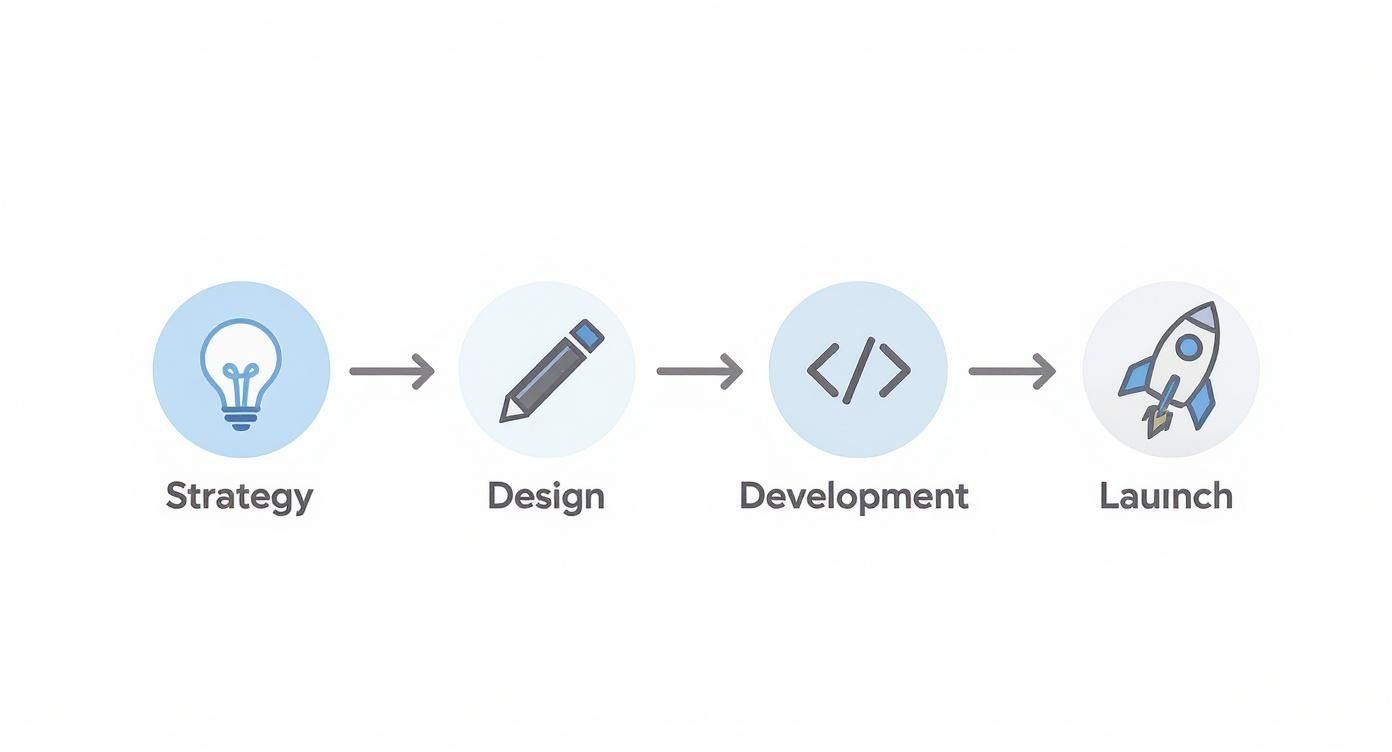
This flow, from initial strategy all the way to launch day, shows the deliberate progression needed to create a high-quality app that truly connects with its intended audience.
The opportunity for a well-built app is massive. In Australia alone, the app market is projected to pull in around AUD 11 billion in revenue, and it’s on track to keep growing right through to 2029. This growth is driven by how many of us have smartphones, creating a fantastic environment for new app ventures. You can dig deeper into Australia’s growing app economy to see what it means for your idea.
A successful app is always more than just clever code. It’s a solution that solves a genuine problem for its users. The technology, whether it’s a seamless Shopify implementation for an online store, a powerful WooCommerce integration, or a custom Odoo implementation Sydney Adelaide businesses depend on, must always serve a clear, user-focused purpose.
To help you visualise the entire journey, here’s a breakdown of the key stages you’ll navigate.
Key Phases of Mobile App Development
| Phase | Primary Goal | Key Activities |
|---|---|---|
| 1. Strategy & Discovery | Define the app’s purpose, audience, and market fit. | Market research, competitor analysis, defining user personas, and creating a product roadmap. |
| 2. Design (UI/UX) | Create a visually appealing and intuitive user experience. | Wireframing, prototyping, user flow mapping, visual design, and creating style guides. |
| 3. Development | Build the functional, working application. | Front-end (client-side) coding, back-end (server-side) development, API integration. |
| 4. Testing (QA) | Ensure the app is bug-free, stable, and performs well. | Functional testing, usability testing, performance testing, security checks. |
| 5. Deployment & Launch | Release the app to the public via app stores. | Submitting to Apple App Store & Google Play Store, creating marketing materials. |
| 6. Maintenance & Growth | Provide ongoing support and add new features over time. | Monitoring app performance, fixing bugs, releasing updates, and gathering user feedback. |
Each of these phases is critical. Rushing or skipping one almost always leads to problems down the track, so giving each stage the attention it deserves is key to a successful launch and a long-lasting app.
Ready to turn your app idea into a reality? Contact Wistec today to discuss your project and get a free consultation. We’ll help you navigate every step of the app development journey.
Crafting a Winning Strategy
Look, anyone can have an idea for an app. The real magic, the thing that separates the runaway successes from the expensive failures, happens long before anyone writes a single line of code. It all comes down to strategy.
This initial planning phase is your blueprint for success. It’s where you get brutally honest about what you’re building, who you’re building it for, and why they should care. Rushing this step is the fastest way to burn through your budget on an app that no one actually uses.

Nail Down Your Audience and Market
First things first: who is this app actually for? Vague ideas like “millennials” or “small business owners” won’t cut it. You need to get specific by creating detailed user personas. Think of these as profiles of your ideal customers, grounded in real data and research.
What keeps them up at night? What are their daily frustrations? What would make their life genuinely easier? An app designed for a time-poor warehouse manager in Adelaide will look and feel completely different to one built for a university student in Sydney. Getting to know them intimately guides every single decision, from the features you prioritise to the colours you choose.
Once you know your user, you need to size up the competition. A thorough competitor analysis is non-negotiable. See who’s already out there. Figure out what they’re doing well, but more importantly, where they’re dropping the ball. This is often where you’ll find your golden opportunity—a gap in the market just waiting for you to fill it with something better.
Map the Journey and Define Your MVP
With a clear picture of your user and the market, you can start sketching out the user journey. This is literally a map of how someone will move through your app, from the moment they open it to the point they achieve their goal. A well-designed journey feels completely natural; every tap and swipe is intuitive, leading the user exactly where they need to go without any confusion.
This is also the perfect time to embrace the Minimum Viable Product (MVP). Now, an MVP isn’t a buggy, half-finished app. It’s the simplest, most streamlined version of your product that solves the core problem for your initial users.
The whole point of an MVP is to get your core idea into the hands of real people as quickly as possible. It’s about learning what users actually want, not just what you think they want, before you sink a fortune into features that might turn out to be dead weight.
This lean approach is a lifesaver for your budget and timeline.
Let’s Make It Real: A Practical Case
Imagine a growing retailer with brick-and-mortar stores in Sydney and Adelaide looking to break into e-commerce. Their big goal is to blend their in-store and online experience seamlessly.
- The Right Tech: They opted for a Shopify implementation because it’s quick to set up and has great e-commerce features out of the box. For a business with more complex logistics, a WooCommerce build or even a custom Odoo implementation in Sydney or Adelaide might have been a better fit to tie together inventory, sales, and customer data.
- A Focused MVP: Their first app version focused on just three things: browsing products, a dead-simple checkout, and a store locator. That’s it. Fancy extras like loyalty programs and personalised recommendations were put on the back burner, waiting for real user feedback.
- The Payoff: By launching a lean MVP, they got to market fast. They could immediately start collecting real-world data on how people were using the app, which gave them a crystal-clear roadmap for what to build next. Every dollar invested from that point on was based on proven demand, not guesswork.
This is what we mean by strategy. It’s the crucial groundwork that turns a simple app idea into a powerful business tool.
Ready to build a winning strategy for your app idea? Let’s talk. Contact Wistec for a no-obligation consultation today!
Designing an Experience People Will Love
If your app strategy is the blueprint, then design is where the soul of your app comes to life. A great app isn’t just functional; it has to feel right. This is the stage where we move beyond raw ideas and start crafting a visual and interactive experience that draws people in and keeps them engaged.
It’s about so much more than picking pretty colours or a cool font. We’re talking about building an intuitive journey for your users, one that feels completely natural from the moment they open the app. We start with simple, hand-drawn-like sketches and wireframes to map out the structure and flow, then build up to high-fidelity mockups that look and feel just like the real thing.
From a Rough Sketch to a Polished Design
Think of wireframing as the architectural plan for your app. It’s a bare-bones layout showing where every button, menu, and piece of content will go. By stripping away all the visual distractions, we can focus entirely on the user’s path and iron out any clunky or confusing steps before a single line of code gets written. It saves a ton of headaches down the track.
Once that structure is rock-solid, we move on to the User Interface (UI) design. This is where we inject your brand’s personality into the app through colour palettes, typography, and custom icons. A well-executed UI doesn’t just look good; it communicates who you are and builds an immediate sense of trust with your users.
A truly great app never makes the user think. Every tap and swipe should feel instinctive. The numbers back this up, too—studies have shown a brilliant user experience can boost conversion rates by an incredible 400%. That’s a serious return on investing in quality design.
This commitment is what separates an app that gets deleted after one use from one that becomes a part of someone’s daily routine.
How This Looks in the Real World: A Practical Case
Let’s imagine a retail business with popular stores in Sydney and Adelaide that wants to build an e-commerce app. Their goal is simple: make online shopping feel just as personal and seamless as walking into one of their physical locations.
- Choosing the Right Tools: For this kind of project, a professional Shopify implementation is often a smart move. It gives you a powerful e-commerce engine right out of the box, so we can focus our energy on creating a stunning, custom front-end experience. For businesses needing deeper customisation, WooCommerce is another fantastic option.
- Mapping the Customer Journey: We’d start by putting ourselves in the customer’s shoes. How do they browse for a product? What does the path to checkout look like? The design needs to make these key actions ridiculously simple, cutting down the number of taps it takes to make a purchase.
- Connecting the Dots: If the business has a complex inventory or customer management system, we might recommend a strategic Odoo implementation that Sydney and Adelaide teams often use. This links the beautiful app front-end to a powerful operational backend, ensuring stock levels and customer data are always perfectly synced between their website, app, and physical stores.
This is how top-tier software development Sydney Adelaide agencies work—it’s not just about a pretty interface, but a powerful, integrated business tool.
The Unspoken Rules of Great Design
To build an app that people genuinely enjoy using, we stick to a few fundamental principles. These aren’t just buzzwords; they’re the bedrock of an interface that simply works.
- Clarity: The user should instantly understand where they are and what they can do next. No guesswork.
- Consistency: Buttons, icons, and menus should look and behave the same way across the entire app. It creates a comfortable, predictable environment.
- Feedback: The app needs to acknowledge the user’s actions. A button should change colour when tapped, and a confirmation message should appear after a purchase. It’s a silent conversation.
When you nail these principles, you create an app that feels both intuitive and trustworthy. It’s that dedication to quality that builds loyalty and keeps people coming back again and again.
Ready to see how we can turn your app idea into a beautifully designed reality? Let’s chat about your project. Contact Wistec for a free design consultation today!
Bringing Your App to Life: The Technical Build
Alright, this is where the magic happens. All those plans, wireframes, and designs are about to become a real, functioning product. It’s easy to get bogged down in technical jargon here, but making the right calls on technology is absolutely crucial. These decisions will shape your app’s performance, your budget, and how easily it can grow in the future. Let’s break down the core choices you’ll face so you can have confident, productive conversations with your development team.

The first major fork in the road on your app development for mobile journey is deciding on the fundamental development approach. This single choice has a ripple effect on everything, from how slick the user experience feels to what your maintenance bills will look like down the track.
Choosing Your Development Path
You’ve essentially got three main routes to consider. There’s no single “best” option here; the right choice is completely tied to your specific goals, who you’re building it for, and the funds you have available.
- Native Development: This is the purist’s approach. You build one app specifically for iOS (using Swift or Objective-C) and a completely separate one for Android (using Kotlin or Java). The result? The absolute best performance and seamless access to all the phone’s hardware, like the camera and GPS. It delivers that polished, lightning-fast user experience everyone craves. The catch is that it’s the most expensive and time-intensive path because you’re bankrolling two distinct projects.
- Hybrid Development: Using powerful frameworks like React Native or Flutter, your developers write one codebase that works beautifully on both iOS and Android. This is a game-changer for speed and cost, often cutting development time significantly. Performance is fantastic—so close to native that most users would never know the difference—but it might not be the top pick for graphically demanding apps, like a high-end 3D game.
- Progressive Web App (PWA): Think of a PWA as a supercharged website that acts like a native app. Users can add it to their home screen, and it can even offer some offline functionality. This is by far the fastest and cheapest way to get to market. However, it comes with trade-offs, especially when it comes to accessing advanced device features and getting discovered in the app stores.
For most businesses, the real debate is between native and hybrid. If you’ve got the budget and top-tier performance is a non-negotiable, native is your champion. But for a huge number of startups and even established companies, the sheer efficiency of a hybrid build strikes the perfect balance between performance, budget, and getting to market quickly.
The Tech Stack Powering It All
Beyond the main approach, your app runs on a “technology stack”—the whole ecosystem of programming languages, frameworks, and databases working in concert. You have the frontend (what the user sees and touches) and the backend (the engine room that handles data, user accounts, and all the heavy lifting).
The Australian app development for the mobile scene is booming, projected to be worth over AUD 4.5 billion. We’re seeing a massive demand for complex business apps, which has pushed local developers towards mature, reliable technologies. For instance, a frontend framework like React now sees an 85% adoption rate in many projects. It’s also becoming standard to see AI-driven features like chatbots baked in, now appearing in over 55% of new builds. You can dig into more of Australia’s app development trends to get a clearer picture of the local market.
A smart tech stack isn’t about chasing the latest shiny object. It’s about choosing proven, reliable tools with strong developer communities behind them. That’s how you build a stable foundation that can support your app for years to come.
Let’s Get Practical: A Sydney Logistics Company
Imagine a logistics company in Sydney. They need a rock-solid app for their warehouse team to track inventory in real-time. The app has to be fast, dependable, and link directly into their core business management system.
For a serious business challenge like this, a robust Odoo implementation Sydney Adelaide businesses trust is the perfect backend. Odoo brings inventory, sales, and accounting under one roof.
The software development Sydney Adelaide team would likely opt for a native Android app to run on the rugged scanners the warehouse crew uses. Why native? Because for scanning barcodes and updating stock levels in a split second, you need that guaranteed speed and reliability. The app then talks to the Odoo system through a secure API, ensuring the data is always perfectly in sync. This is a perfect example of a strategic tech choice directly solving a critical business problem.
In another scenario, a growing e-commerce brand might use a Shopify implementation or a WooCommerce build to run their online store’s backend. They could then commission a custom hybrid app to create a unique shopping experience for their customers. The secret is always in integrating the right tools for the right job.
Remember, building an app isn’t a one-and-done deal. It’s a living process. By using an agile development methodology, your team can build, test, and release features in short, focused sprints. This keeps the project flexible and ensures the final product is truly aligned with what your users want.
Ready to figure out the right tech for your vision? Contact Wistec today for a free technical consultation and let’s build something powerful together.
Taking Your App Live and Making It Thrive
After all those weeks, or even months, of meticulous planning, design, and development, you’re finally on the home stretch. The big launch day is in sight. It’s a massive milestone, for sure, but think of it as the starting line, not the finish. The real journey to creating a successful mobile app begins right now, with a flawless launch and a smart plan for the future.
This is where we shift gears from building to growing. It’s all about making sure your app is absolutely bulletproof before it hits the market, and then nurturing it to build a community of loyal users. Skipping this part is a rookie mistake that can, unfortunately, undo all your incredible work.
The Final Gauntlet: Rigorous Pre-Launch Testing
Before you even dream of hitting that ‘submit’ button, your app needs to be put through its paces. And I mean really put through its paces. This isn’t just about squashing a few obvious bugs; it’s about polishing the entire user experience until it gleams. A single crash can earn you a one-star review, and with 94% of first impressions tied to your app’s design and reliability, you can’t afford any slip-ups.
A solid testing strategy needs to cover a few key battlegrounds.
- Performance Testing: What happens on a dodgy Wi-Fi connection? Is the app a battery hog? We need to test it on a range of devices to make sure it’s snappy and efficient, not sluggish and frustrating.
- Usability Testing: This is where the rubber meets the road. We get real people to use the app and see if it’s genuinely intuitive. Can they figure out how to complete key tasks without a user manual?
- User Acceptance Testing (UAT): This is the dress rehearsal. A hand-picked group of your target users gets to try the finished product. Their feedback is pure gold, often highlighting little quirks or confusing bits that the development team might have missed.
Going through this exhaustive process means that when your app finally lands in the hands of the public, it delivers a smooth, enjoyable experience from the very first tap.
Navigating the App Store Maze
Getting your app approved for the Apple App Store and Google Play Store is a process in itself. Both platforms have their own rulebooks, and they’re notoriously strict. The guidelines cover everything from your privacy policy and data handling to the wording in your app description and the quality of your screenshots. A rejection can be a real headache, leading to frustrating delays.
A common pitfall we see is an incomplete or misleading app description. Both Apple and Google demand total transparency about what your app does, how subscriptions work, and what data you’re collecting. Honesty and clarity are non-negotiable here.
This is where working with an experienced software development Sydney Adelaide team really pays off. We’ve been through this process countless times, know the common reasons for rejection, and can prepare your submission package meticulously to give you the best shot at a first-time approval.
Life After Launch: Your Growth Strategy
Your app is live. Congratulations! Now the real work begins. A successful app isn’t a “set and forget” project; it’s a living, breathing product that has to evolve with its users.
The post-launch phase is all about growth and retention. This is where a partnership with dedicated developers in Adelaide becomes so valuable, ensuring your app stays secure, up-to-date, and ahead of the curve.
Ongoing Support in the Real World: Practical Cases
Let’s look at a couple of practical examples:
- An E-commerce App: A retailer using a Shopify implementation or WooCommerce needs more than just a working app. They need someone constantly monitoring the payment gateway, patching security vulnerabilities, and adding new features to keep up with online shopping trends.
- An Enterprise Operations App: Imagine a manufacturing firm that relies on an Odoo implementation that Sydney and Adelaide teams manage. Their mobile app must stay perfectly in sync with the core ERP system, especially after software updates. Downtime here isn’t just an inconvenience; it’s lost revenue.
Your post-launch game plan should always include:
- Listening to Your Users: Actively read reviews, send out surveys, and keep an eye on social media. Find out what people love and, more importantly, what drives them to their limit.
- Rolling Out Regular Updates: Use that feedback to push out meaningful updates. Fix bugs, improve performance, and add the features your users are clamouring for.
- Providing Top-Notch Support: Make it easy for users to report problems and get help. Fast, friendly support builds incredible trust and turns casual users into brand advocates.
This continuous cycle of feedback, improvement, and support is what powers long-term success. It’s how your app goes from being just another download to an indispensable tool your customers can’t imagine living without.
Are you ready to not just launch an app, but grow it into a success story? Contact Wistec today to discuss a comprehensive launch and support plan for your project.
Keeping Your App Ahead of the Curve
Let’s be honest, launching your app is a massive win, but it’s really just the starting line. The mobile world moves at a blistering pace, and staying relevant means you have to be thinking about what’s next, right now. This isn’t about jumping on every new trend; it’s about making calculated, forward-thinking decisions to protect your investment and keep your users hooked for the long run.
Nowhere is this more true than in Australia’s booming tech scene. Innovation bubbling up in cities like Melbourne and Sydney is driving some serious change, particularly with the rise of ‘super apps’. These all-in-one platforms are designed to combat ‘app fatigue’ by bundling services like messaging, banking, and shopping into a single, seamless experience. Developers are leaning heavily on AI and 5G to make this happen, offering a level of speed and personalisation we’ve never seen before. You can get a deeper look into how these trends are shaping Australia’s app future.
Technologies Defining Tomorrow
Artificial Intelligence (AI) and Machine Learning (ML) aren’t just buzzwords anymore; they are foundational tools in modern app development for mobile. These technologies are the brains behind the hyper-personalised experiences users now demand—think of how Netflix just knows what you want to watch next, or how Spotify crafts the perfect playlist for your mood.
For your own app, this could look like:
- Smarter Recommendations: Proactively suggesting products or content that perfectly match a user’s past behaviour.
- Intuitive Chatbots: Offering instant, 24/7 support that genuinely feels helpful, not robotic.
- Predictive Features: Anticipating what your user needs before they’ve even thought to ask for it.
This is the kind of smart functionality that builds fierce user loyalty.
Integrating future-focused technology isn’t just an upgrade; it’s a strategic move. An app built today must be ready for the user expectations of tomorrow. This is the core principle that guides expert software development Sydney Adelaide agencies when building applications designed to last.
Immersive Experiences on the Horizon
Beyond AI, other game-changers are just around the corner. The widespread rollout of 5G networks will deliver lightning-fast speeds and practically zero lag. This opens the door for stunning, high-definition Augmented Reality (AR) experiences running smoothly on a user’s phone. Just imagine a retail app that lets you use your camera to see exactly how that new sofa would look in your living room.
Whether your backend is powered by a robust Odoo implementation Sydney Adelaide businesses trust, or your front-end is a sleek e-commerce experience built on Shopify implementation or WooCommerce, these future technologies will need to plug in seamlessly.
Future-proofing your app really boils down to building an architecture that can evolve. It’s about creating something that isn’t just great for today, but is primed and ready for whatever comes next.
Let’s partner to build an app that leads the curve, not just follows it. Contact Wistec today for a free consultation on future-proofing your mobile app idea.
Answering Your Big Questions
We get it – diving into app development brings up a lot of questions. Here are some of the most common ones we hear, along with some straight answers to help you plan your next move.
How Long Does It Take to Build an App?
This is the classic “how long is a piece of string?” question. The truth is, it really depends on what you’re building. A straightforward app with a focused set of features can often be brought to life in about 3-4 months.
But if your vision involves complex custom features, deep backend integrations – say, like the Odoo implementation Sydney Adelaide businesses rely on for ERP – or building for multiple platforms, you’re looking at a timeline closer to 9 months or more. The more moving parts, the longer it takes to get them all working together perfectly.
How Much Will My App Cost to Develop?
Just like the timeline, the cost is tied directly to the scope of work. A simple app might start in the low five-figure range, while a sophisticated, enterprise-grade application can easily push well into six figures.
The final budget is influenced by everything from the complexity of the features to the tech stack we use. For example, integrating an e-commerce platform like a Shopify implementation or a WooCommerce store will naturally affect the cost.
It’s crucial to think beyond the initial build. Your total investment should also account for ongoing maintenance, server costs, marketing, and the inevitable updates needed to keep your app fresh and functional.
Can You Build an App for Both iOS and Android?
Of course! In today’s market, it’s almost essential to be on both platforms to maximise your reach. We often achieve this by using cross-platform development frameworks. This approach allows us to build the app from a single codebase, which saves a significant amount of time and money compared to creating two separate native apps from scratch.
Our software development Sydney Adelaide team can walk you through the pros and cons and help decide on the best strategy for your project’s specific goals.
Ready to turn your idea into a powerhouse mobile app? The team at Wistec is here to guide you through every stage, from sketching out the initial strategy to celebrating your post-launch success.