

Getting a great website doesn't have to drain your bank account. The secret isn't about finding the cheapest option; it's about being smart and strategic. You need to launch a lean, powerful first version of your site—what we in the industry call a Minimum Viable Product (MVP).
This approach gets you online quickly with a professional presence that starts working for you immediately. It’s all about focusing your budget on the features that actually make you money, then scaling up as you grow. Ready to build a powerful online presence that fits your budget? Contact us for a free consultation and let's start planning your success.
Launching a Website Without Breaking the Bank
I see it all the time: small business owners in Australia think a professional website is a huge, five-figure project, so they put it off. They rely on social media, hoping it's enough. But the numbers tell a scary story. It's projected that by 2026, a staggering 41% of Australian small businesses still won't have a website, leaving a massive amount of growth on the table.
This isn't a problem; it's a golden opportunity for you. While your competitors are stuck on social media, you can build a powerful asset that generates leads and sales 24/7.
What Is a Minimum Viable Product (MVP) Website?
Forget the idea of a "cheap" site. An MVP website is a clever one. It has one job: to achieve your single most important business goal. That might be generating leads, selling products, or getting appointments booked.
We ruthlessly cut everything else. All the bells and whistles you think you need are shelved for a later phase, after your website has started paying for itself. This stops you from sinking thousands into complex features that customers might not even use. It’s about being lean and data-driven from day one.
A Minimum Viable Product forces you to answer one simple question: "What is the smallest, simplest version of this website I can build that will still provide real value to my customers and my business?" The answer becomes your roadmap to an affordable and effective launch.
Defining Your MVP Core Features
So, what are those core features? It completely depends on your business. You have to be honest with yourself and prioritise what will deliver the biggest and fastest return.
Here are a few practical cases:
- For a service business in Adelaide: Your MVP is all about trust and enquiries. You'd need a sharp homepage, pages detailing your services, a simple contact form, and some customer reviews. That's it. For a plumbing business, this means a potential customer can find you, see you're reputable, and book a job without friction.
- For a new retail brand: The goal is sales. A basic eCommerce store using Shopify or WooCommerce is perfect. A practical case is a local artisan in Sydney launching a candle business; a simple Shopify implementation allows them to start selling online within weeks, focusing on great product photos and a secure checkout.
- For a manufacturing company: Here, it's about showcasing capability. Your MVP would highlight your technical specs, case studies, and a bold "Request a Quote" button on every page. Complex stuff, like a full [Odoo implementation] managed by an Odoo partner in Sydney, can absolutely wait for phase two.
To help you nail this down, here’s a quick checklist to map out your own MVP.
MVP Website Scoping Checklist for Small Businesses
Use this checklist to define the core features for your first affordable website, helping you focus your budget on essentials.
| Business Type | Essential Feature 1 (Must-Have) | Essential Feature 2 (Must-Have) | Optional Feature (Consider for Phase 2) |
|---|---|---|---|
| Local Service (e.g., Plumber, Consultant) | Clear "Services" page with pricing/packages | Highly visible contact form and phone number | Online booking/scheduling system |
| eCommerce Store (e.g., Clothing, Homewares) | High-quality product pages with images | Secure and simple checkout process | Customer accounts and order history |
| Restaurant/Cafe | Online menu with professional photos | Location map, hours, and contact details | Integrated online ordering or reservations |
| B2B/Corporate (e.g., Manufacturer) | "Capabilities" or "Solutions" section | "Request a Quote" or "Get in Touch" form | Client portal or resource library |
Thinking through these must-haves versus nice-to-haves is the most important step you can take. It creates a tight project scope, which is the key to getting a realistic quote and staying on budget.
By nailing down these essential features, you have a clear plan. If you’re curious about how this scope translates into real-world figures, our guide on website design costs in Australia offers a fantastic breakdown.
This MVP method is truly the secret to getting a high-quality, affordable website design for small businesses. It’s not about cutting corners—it’s about making every dollar work for you. Ready to map out the essential features for your business's first website? Our team specialises in software development in Sydney and Adelaide and can help you launch a powerful online presence that fits your budget. Contact Wistec today for a free consultation.
Choosing Your Website Platform: WooCommerce vs Shopify
Picking your website platform is one of those foundational business decisions, not just a tech problem. It’s going to steer everything from your launch budget and ongoing costs to how much freedom you have to grow and, crucially, how well you can rank on Google. For most small businesses, this big decision often comes down to two heavyweights: WordPress with WooCommerce versus Shopify.
Let’s get one thing straight: there's no single "best" platform. The right answer for you hinges entirely on your business model, how comfortable you are with tech, and what your goals are for the future. An affordable website design for small businesses is one that clicks with these needs right from the get-go.
This little flowchart is a great starting point. It helps you zoom in on what your website absolutely needs to do first.
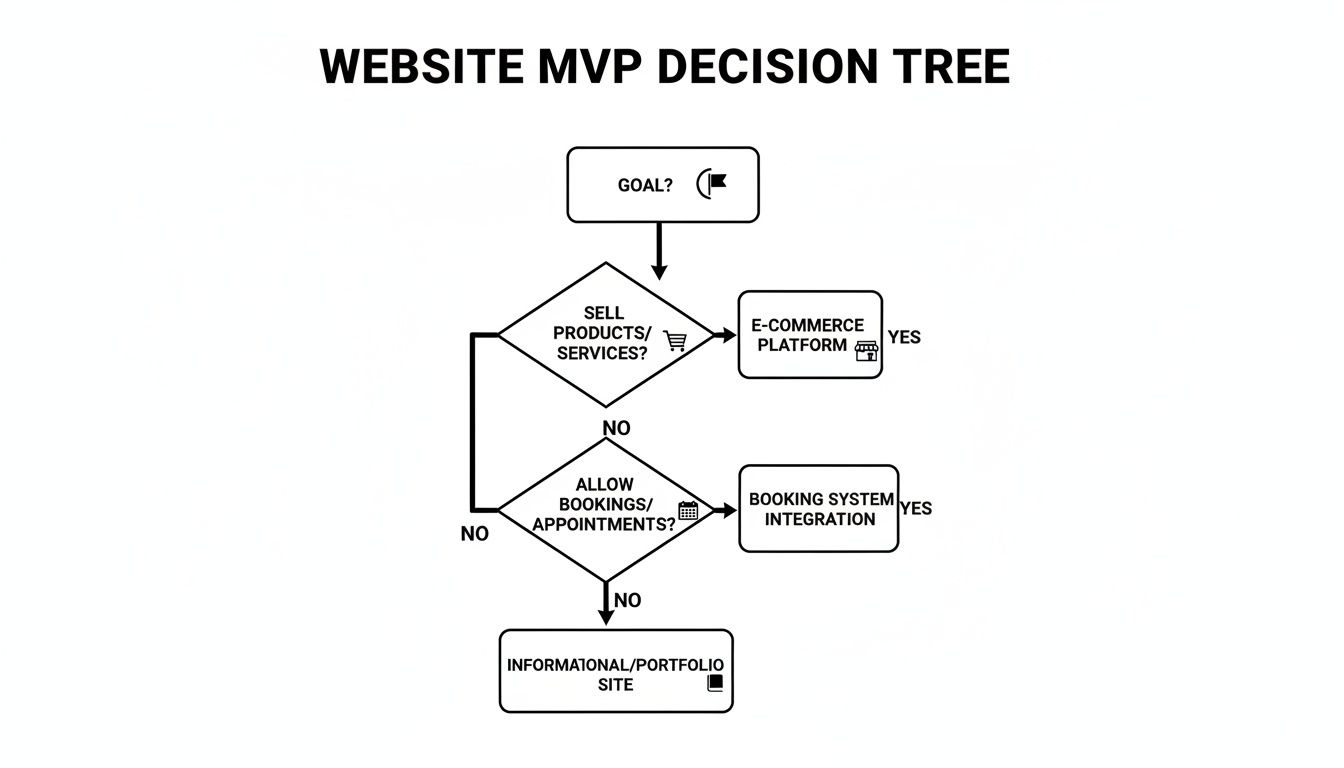
As you can see, whether you're selling products, booking appointments, or just trying to get the phone to ring should point you in the right direction.
When to Choose Shopify
If you want to get online and start selling yesterday, Shopify is your champion. It’s an all-in-one package where you pay a monthly fee, and they take care of all the tricky stuff—hosting, security, and technical updates. This makes it a brilliant choice for product-based businesses that need to launch fast.
A practical case is a new online fashion boutique in Sydney. Their number one priority is a gorgeous, easy-to-use storefront that makes buying simple. A professional Shopify implementation lets them get a mobile-friendly site live in no time, without getting bogged down in code. Everything from taking payments to tracking stock is either ready to go or a quick install away from the Shopify App Store.
Shopify is all about speed. It's built to get you from an idea to your first sale as quickly as humanly possible. This laser focus on eCommerce is its biggest strength—and its main weakness.
But that simplicity does come with strings attached. You're effectively renting your online space, not owning it. Your customisation options are fenced in by the themes and apps on offer, and those transaction fees can start to bite. If your business has really specific or unusual needs, you might find yourself hitting a wall. We actually break this down further in our guide on exploring Shopify limitations and how to solve them.
When to Choose WooCommerce
WooCommerce is a free plugin that bolts a seriously powerful online store onto a WordPress website. This is the complete opposite of Shopify’s closed garden. It's "self-hosted," which is a fancy way of saying you own everything outright and have total freedom. The trade-off? You’re the one in charge of arranging hosting, security, and maintenance.
This makes WooCommerce the go-to for businesses that have more complex needs or for whom content and SEO are just as important as sales. The potential for customisation is practically endless.
Here’s a practical case. We worked with a manufacturing company in Adelaide that needed more than just a simple "buy now" button. They had to sell standard parts, offer a custom quoting tool for bespoke orders, and create a private portal for their wholesale clients. That’s exactly the kind of unique setup where WooCommerce excels. A team offering software development in Adelaide could build a solution that talks directly to their internal inventory systems, something that’s just not possible with an off-the-shelf platform.
And because it's built on WordPress, you get the best content management system on the planet as your foundation. If you do go the WordPress route, knowing the best WordPress plugins for small businesses can give you incredible functionality without breaking the bank.
Beyond eCommerce: The Odoo Integration Case
As a business grows, sometimes neither Shopify nor WooCommerce alone is the full picture. Let's say you're a growing B2B distributor in Adelaide. Your website is just one cog in a much bigger machine. You need your sales, inventory, accounting, and customer data to all speak the same language.
This is where you start looking at something like an Odoo implementation. An Odoo partner in Adelaide can connect a WooCommerce storefront directly into the Odoo ERP (Enterprise Resource Planning) system. This creates one unified powerhouse. An online order can instantly update stock levels, trigger a new purchase order to a supplier, and log all the customer details in your CRM. That’s a level of automation and efficiency that standalone platforms simply can't deliver.
So, choosing your platform isn't just a technical task; it's a strategic one. Are you after the plug-and-play simplicity of Shopify? The infinite flexibility of WooCommerce? Or do you need a deeply integrated system to power your next stage of growth?
If you're still weighing the options, we can help clear things up. Contact Wistec today. Our experts in software development in Sydney and Adelaide will help you choose and build the right foundation for your business's long-term success.
Setting a Realistic Website Budget in Australia
Let’s talk numbers. When you start looking for "affordable website design for small businesses," you’re hit with a dizzying array of prices. So, what’s a realistic budget for a small business in Australia? Let's cut through the noise and get down to what you can actually expect to pay.
There’s no single price tag for a professional website. Forecasts for 2026 show Australian small businesses are investing anywhere from $5,000 to $25,000 on their web projects. For a sharp, custom-built 3-5 page informational site, you’re likely looking at a $3,500-$8,000 investment. If you need a more complex 5-10 page platform with deeper functionality, that budget can climb into the $10,000-$30,000 range.
The budget you set will directly shape the type of website you can build, the platform it sits on, and just how tailored it will be to your brand.
What Your Budget Gets You
Matching your investment to your business goals is everything. Think of your budget not just as a cost, but as a tool that defines the scope and potential of your online presence.
Here’s what you can realistically expect at different price points:
- The Bootstrapper’s Budget (Under $5,000): At this level, you’re in the realm of template-based sites on platforms like WordPress or Squarespace. This is perfect for new businesses needing a clean, professional online brochure with the essentials: Home, About, Services, and a Contact page.
- The Growth-Focused Investment ($5,000 – $15,000): This is where things get more interesting. This budget opens up more customised solutions, like a high-quality, custom-designed WordPress site or a properly implemented Shopify store for e-commerce. It allows for a design that truly reflects your brand, a better user experience, and foundational SEO baked in from day one.
- The Custom Powerhouse ($15,000+): Now you're entering the territory of fully bespoke solutions. This could mean advanced WooCommerce features, a full Odoo implementation, or even a custom platform built by a dedicated software development Sydney team to meet very specific needs.
A key takeaway from my years of experience: the initial quote is just the starting line. Too many business owners get caught out by ongoing costs. Your budget needs to cover the entire first year, not just the launch.
Uncovering the Hidden Costs
The upfront build cost is only one piece of the puzzle. To create a budget that won’t bite you later, you have to plan for the recurring expenses that keep your site live, secure, and working for you.
When mapping out your finances, it's vital to look beyond the initial design fee and consider various pricing models that cover ongoing support and optimisation.
Don’t Forget These Ongoing Expenses:
- Website Hosting: This is the rent you pay for your website's spot on the internet. It can range from $20 to over $100 per month, depending on the traffic you get and the performance you need.
- Domain Name: Your site's address (like yourbusiness.com.au) is a small but necessary cost, usually around $15-$30 per year.
- Premium Plugins/Apps: Many powerful features on Shopify and WordPress come from plugins that require a subscription, adding anywhere from $10 to $200+ to your monthly bill.
- Maintenance & Security: A website isn't a "set and forget" asset. Just like a vehicle, it needs regular servicing. You should budget for a maintenance plan (often $100-$500 per month) to handle software updates, security scans, and crucial backups.
Case Study: A Phased Rollout in Adelaide
A logistics company I worked with in Adelaide is a fantastic practical case of budgeting smartly. They knew they needed a professional website to be taken seriously but couldn't justify a massive upfront spend.
Their solution? A phased approach. We started Phase 1 with an MVP: a clean, highly professional site built for under $10,000. It was designed to do one thing well: establish credibility and capture leads. Once the new site started bringing in business and paying for itself, we moved to Phase 2, which involved a much larger investment in a custom client portal integrated with their logistics software by an Odoo partner in Adelaide.
This staged investment allowed them to get in the game quickly without overextending their finances, then scale up when the time was right.
Ready to build a website that fits your budget and grows with your business? Contact Wistec for a transparent quote and a strategic plan tailored to your goals.
Finding the Right Partner: DIY, Freelancer, or Agency?
Deciding who builds your website is every bit as important as deciding what goes into it. This choice really sets the tone for the quality, cost, and future of your online presence. For most small business owners, it comes down to three main paths: doing it yourself (DIY), hiring a freelancer, or bringing in an agency.
Each option presents a different trade-off between cost, your personal time, and the level of expertise you get. The best fit for you boils down to your budget, how comfortable you are with tech, and how much time you can honestly pull away from your day-to-day operations. An affordable website design for small businesses isn't just about the lowest sticker price; it's about finding a model that truly works for your resources and ambitions.
The DIY Route: Is It Really for You?
Jumping onto a website builder like Squarespace, Wix, or even a basic Shopify setup gives you total control for the lowest upfront cost. If you’re a solopreneur or a tiny business just getting started, it can feel incredibly empowering to get something online fast.
But here’s the catch. This path demands a huge chunk of your most precious resource: your time. You’re on the hook for everything—the design, the writing, the security, and all the little technical hiccups. What seems like a "cheap" website can get very expensive when it steals you away from actually running your business for weeks.
The Freelancer Advantage
Hiring a freelancer is a fantastic way to get professional skills without the price tag of a full agency. A great freelancer can provide a highly personalised service, working with you one-on-one to build a sharp, custom WordPress site with WooCommerce or a more complex Shopify store. This is often the sweet spot for businesses that have moved beyond DIY but aren't quite ready for a bigger team.
The flip side is that you still need to be the project manager. You have to do the legwork to find and vet the right person, keep communication flowing, and make sure they’re aligned with your business goals. If your project needs a mix of skills—like design, copywriting, SEO, and development—you could end up juggling multiple freelancers, which gets complicated quickly.
Your goal isn't just to find someone who can build a website. It's to find a partner who understands your business, sees your vision, and has the technical skill to bring it to life, whether that's a simple storefront or a complex system requiring an Odoo implementation.
When to Partner With an Agency
Investing in an agency like Wistec means you’re not just hiring one person; you’re getting a whole team. You get a project manager, designers, SEO experts, and developers all working together under one roof. This is the go-to option for established businesses that need a powerful, scalable website and want a partner to handle the entire process, from strategy to launch and beyond.
A practical case for this is a growing business in Sydney requiring a complex WooCommerce store integrated with multiple third-party suppliers. This project demands coordinated software development in Sydney, project management, and ongoing support – something an agency is structured to deliver seamlessly. This is especially true for more complex projects requiring a dedicated Odoo partner in Sydney or Adelaide.
Website Partner Comparison: DIY vs. Freelancer vs. Agency
This table gives you a quick, at-a-glance look to help you decide which path makes the most sense for your business, based on your budget, time, and technical needs.
| Factor | DIY (Using Builders) | Freelancer | Agency (like Wistec) |
|---|---|---|---|
| Cost | Lowest upfront cost, but a high investment of your time. | Moderate cost, usually a project-based fee or hourly rate. | Highest initial investment, but delivers comprehensive, long-term value. |
| Expertise | It’s all on you. Expect a steep learning curve. | A specialist in one or two areas (e.g., design or development). | A full team of coordinated experts in design, SEO, copywriting, and code. |
| Time Commitment | Very high. You are the designer, writer, and developer. | Medium. You’ll need to manage the project and provide clear feedback. | Low. The agency manages the entire project for you, from start to finish. |
| Best For | Solopreneurs and micro-businesses on a shoestring budget. | Small businesses needing a professional touch for a well-defined project. | Growing businesses that need a strategic, scalable, and fully managed solution. |
Ultimately, picking the right partner means being honest with yourself about your needs and capacity. If you're a hands-on founder with more time than money, DIY might just work. If you have a specific project and just need the right expert to execute it, a freelancer is an excellent choice.
But if you’re looking for a long-term strategic partner to build and scale a powerful digital asset that drives real growth, an agency is the clear winner.
Ready to find a partner who understands your business goals? Contact Wistec today. We’ll help you navigate these choices and deliver a website solution that powers your growth.
Turning Your Website Into a Customer Magnet
An affordable website is only a smart investment if it actually works for you—attracting new customers and driving sales. I've seen too many businesses launch a site that looks pretty but does nothing to bring in new leads. It just sits there, like an expensive, glossy brochure nobody reads.
Let's talk about the non-negotiable elements that transform that digital brochure into your most powerful customer magnet.
Making Local SEO Your Superpower
For most small businesses in Australia, your customers aren't scattered across the globe; they're right down the road. This is what makes local Search Engine Optimisation (SEO) so critical. When someone in your suburb searches for "electrician near me" or "cafe in Adelaide," you absolutely have to be at the top of that list.
This is where a lightning-fast, mobile-friendly website gives you a serious competitive edge. Google actively prioritises sites that give users a great experience, and a quick-loading site is a huge part of that. These technical details aren't optional anymore—they're the price of entry if you want to rank in local search results.
A practical case is a Sydney client, a local electrician, who launched a targeted site with location-specific pages. The result was a steady, reliable stream of local enquiries for their services, proving the power of local SEO.
Building SEO in From Day One
Here’s a hard truth: you can't just "add on" SEO later. It has to be woven into the fabric of your website from the very first line of code. A good development partner understands this and makes it a core part of their process, not an expensive afterthought.
This means getting the foundations right from the start:
- Keyword-Optimised Titles and Headings: Every single page should target a specific term your ideal customer is actually searching for.
- Google Business Profile Integration: Your website and Google Business Profile must be perfectly linked to dominate those local map packs.
- Mobile-First Design: With over half of all web traffic now coming from mobile devices, your site must look and work flawlessly on a phone. It's not a 'nice-to-have'.
- Fast Page Speed: Slow sites don’t just frustrate people; Google actively penalises them, pushing you further down the rankings.
This is what separates a cheap website from a genuinely affordable, high-performing one. A strategic partner bakes these elements in, ensuring your site is built to be found from the moment it goes live.
An 'affordable' website that's invisible to Google is one of the most expensive mistakes a business can make. True value comes from a site that actively attracts the right customers from day one.
Designing for Conversion, Not Just Looks
Getting visitors to your site is only half the battle. The next, and arguably more important, step is turning those visitors into actual customers. This is called Conversion Rate Optimisation (CRO), and it’s all about guiding your user towards taking a specific, valuable action.
Whether you're looking at a WooCommerce build or a Shopify implementation, every element on the page needs to serve a purpose. Good design makes it incredibly easy for a customer to understand what you do and what you want them to do next. You can get a better handle on these core ideas by exploring our insights on effective user experience design principles.
Put yourself in your customer's shoes. Is your phone number easy to find? Is that "Request a Quote" button obvious? Can they buy your product in just a couple of clicks? These small details make a world of difference.
A Practical Case: A Local Service Business
Imagine a physiotherapy clinic in Adelaide. Their website isn't just a digital business card; it's a tool for booking appointments. A conversion-focused design would feature:
- A prominent "Book Online" button, visible in the top corner of every single page.
- Clear, concise descriptions of their services that answer the common questions patients have.
- Testimonials and practitioner profiles to build immediate trust and credibility.
An expert Odoo partner in Adelaide could even take this a step further, integrating the booking system directly with the clinic's Odoo ERP to automate scheduling and patient management. This is a perfect example of how smart, conversion-focused design, backed by solid software development in Adelaide, turns a simple website into a seamless business machine.
Ready to build a website that doesn’t just look good but actively grows your business? Contact Wistec today. We’ll create an affordable website with SEO and conversion baked in, turning it into your hardest-working employee.
Straight Answers to Your Biggest Web Design Questions
Even with a solid plan in place, it’s completely normal to have a few nagging questions. Getting a professional website is a major step for any small business, and you want to be sure you're making the right moves. We get it. Let's walk through the most common concerns we hear from business owners every day.
How Much Should a Small Business Website Cost in Australia?
There’s no single price tag, but we can definitely give you a realistic idea of what to budget. For a professional 3-5 page informational website in Australia, you’re typically looking at an investment between $3,500 and $8,000. This isn't just for a pretty design; it’s for a high-quality site that builds trust and actually starts generating leads.
Planning to sell online? For a well-built eCommerce store using Shopify or WooCommerce, the starting range is usually $7,000 to $15,000+. The real takeaway here isn't the cost itself, but what you get for it. You're investing in a foundation you can scale as your business grows. Always insist on a transparent, itemised quote from your potential software development Sydney partner to avoid any nasty surprises later.
Can an Affordable Website Still Rank Well on Google?
Absolutely. In fact, it's one of the biggest misconceptions out there. Success on Google has far more to do with smart strategy than a massive budget. A well-structured, mobile-friendly site that loads quickly and offers genuinely helpful content can easily outperform an expensive, bloated website that overlooks these fundamentals.
Solid SEO isn't an optional add-on; it's baked into the very core of a good website. This is non-negotiable, especially for local businesses in cities like Sydney and Adelaide, where showing up in "near me" searches is what gets customers in the door.
Don't ever confuse "affordable" with "cheap." A cheap website is one that costs you money because it's invisible to customers and brings in zero business. An affordable website is a strategic investment that punches well above its weight on Google.
What Is the Difference Between a Template and a Custom Design?
Think of it like buying a suit. A template is the off-the-rack option. It's quick, cost-effective, and does the job. The downside? It might not be a perfect fit, and you’ll inevitably see other businesses with the exact same look. Templates can feel restrictive and make it tough for your brand to truly stand out.
A custom design, on the other hand, is like getting a suit tailored. It’s built from the ground up to perfectly fit your brand, your customers, and your specific business goals. A practical case is a business needing a complex WooCommerce setup integrated with specific shipping carriers, which would require custom development beyond a template's capability. This approach almost always delivers a higher return because the user experience is designed from day one to guide visitors toward taking action.
For an affordable yet professional result, a hybrid approach is often the sweet spot. We start with a high-quality, flexible template and then heavily customise it to reflect your unique brand identity. You get a distinctive look and feel without the price tag of a full custom build.
How Long Does It Take to Build a Small Business Website?
The timeline is tied directly to the project's complexity. A straightforward, simple website with just a few pages can often be designed, built, and launched within 2-4 weeks.
If you need a more custom-designed informational site with around 5-10 pages, a realistic timeframe is closer to 6-10 weeks. For projects involving an eCommerce platform like Shopify or WooCommerce—which includes product setup, payment integrations, and thorough testing—you should plan for about 8-12 weeks.
A good partner, whether for your website or a more involved Odoo implementation, will map out a clear project timeline from the get-go. This transparency ensures the process runs smoothly and you launch on schedule, without any guesswork.
At Wistec, we don’t just build websites; we create strategic assets that fuel your growth. From a smart Shopify implementation to sophisticated software development in Sydney and Adelaide, we focus on transparent, results-driven solutions. Ready to get your questions answered and start building a website that works as hard as you do? Contact us for a free, no-obligation consultation today.