

Growth usually doesn't break a business all at once. It shows up as small failures that start repeating. The warehouse team is waiting on a decision from sales. Finance is chasing approvals in email. The website launch slips because product data still isn't ready. A software vendor says development is “almost done”, but nobody can say what done means.
That's the point where many Australian businesses realise they don't have a capacity problem alone. They have a coordination problem.
Project management fundamentals matter because they turn work that feels messy and political into work that can be defined, scheduled, tracked, and finished. That applies whether you're rolling out Odoo ERP, rebuilding operations after an acquisition, planning a Shopify implementation, or managing a custom platform with a software development Sydney Adelaide team. The tools change. The fundamentals don't.
The commercial value is hard to ignore. According to the Project Management Institute, Australian organisations with certified project managers achieve 60% more projects on time, on budget, and meeting original goals, and project professionals in Australia command a median salary of $115,000 AUD (PMI). Businesses don't pay for project discipline because it sounds good in a board paper. They pay for it because missed projects are expensive.
If your team is trying to bring structure to growth, useful guidance often starts with the basics of planning and managing projects, then gets translated into the systems and operating habits the business uses every day. That's where process, accountability, and technology come together. For organisations going through broader operational change, a clear transformation lens also helps connect projects to the bigger business model through digital business transformation consultancy.
Introduction From Business Chaos to Project Control
A common pattern looks like this. A business grows from founder-led hustle into a multi-team operation. There are more customers, more staff, more systems, and more moving parts. Work is still getting done, but too much of it depends on memory, goodwill, and people chasing each other.
One retailer might be trying to unify inventory, eCommerce, and fulfilment across stores and online channels. A manufacturer might be adding production planning and procurement workflows. A professional services firm might be replacing scattered spreadsheets with a central operating system. On paper, each initiative sounds manageable. In practice, they compete for the same people, budget, and decision-makers.
What chaos usually looks like on the ground
The signs are rarely subtle:
- Deadlines creep: Teams stop believing the original dates because they've already slipped more than once.
- Budgets blur: Labour, rework, change requests, and vendor delays start getting absorbed into “business as usual”.
- Scope expands by conversation: Someone asks for “one extra report” or “a quick integration”, and nobody resets the plan.
- Ownership weakens: Work sits between departments because no one has authority across the whole initiative.
That's why project control isn't bureaucracy. It's operational clarity.
Practical rule: If a project needs more than one team, more than one decision-maker, or more than one month of effort, it needs explicit structure.
Why fundamentals still matter in technology projects
Technology projects are where weak fundamentals show up fastest. An Odoo implementation can fail if requirements aren't defined properly. A WooCommerce rebuild can drift if the content, catalogue, payments, and shipping decisions aren't tied to a real timeline. A custom app can burn budget if the business hasn't decided what problem the software is solving.
Strong project management fundamentals give a business a way to answer a few basic questions early:
| Question | Why it matters |
|---|---|
| What are we trying to achieve? | Prevents activity without business value |
| Who decides? | Avoids circular approvals |
| What's included and excluded? | Reduces uncontrolled scope growth |
| What will it take? | Makes time, budget, and resourcing visible |
| How will we track progress? | Creates a basis for action, not opinion |
Businesses often want a platform fix when what they need first is delivery discipline. The platform still matters. So does the implementation partner. But without a clear project frame, even good software gets buried under confusion.
The Core Building Blocks of Any Project
A project is temporary work designed to produce a defined result. It has a finish line, an owner, and a business reason for existing. Opening a new warehouse, rolling out Odoo ERP, launching a subscription store on Shopify, or replacing spreadsheet approvals with custom software all fit that definition. Payroll, daily dispatch, and customer support do not. They are ongoing operations.
That distinction matters in growing businesses because operational habits often get dragged into project work. Teams keep reacting instead of deciding. Priorities shift without anyone resetting scope, budget, or timing. In Australian businesses dealing with tight labour markets and limited specialist capacity, that drift gets expensive fast. If a skilled implementation lead or senior operations manager is hard to replace, wasted project time hurts twice.
Scope, time, and cost
Most projects are governed by three constraints: scope, time, and cost. The model is simple. The trade-offs are not.

A business might want an ERP live before EOFY, full inventory visibility across warehouses, custom approval rules, and a fixed budget. Those goals can all be reasonable on their own. Put them together, and leadership has to make choices.
- Scope is the output the project must deliver.
- Time is the deadline or delivery window.
- Cost is the money, people, and effort the business will commit.
Change one, and pressure lands on the other two. Add custom workflows to an Odoo implementation, and either the budget rises or the timeline moves. Hold the budget on a Shopify rebuild, and some integrations or design requests may need to wait for phase two. Push a custom app to market faster, and the first release usually has a narrower feature set.
Many projects frequently lose control. The problem is rarely the platform alone. The problem is pretending every constraint can stay fixed while requirements keep changing.
How experienced teams make trade-offs
Strong delivery teams make the trade-off explicit early. They do not leave it buried in meeting notes.
A practical decision pattern looks like this:
- Fix the date when the commercial deadline matters most, such as a retail launch or compliance cutover.
- Fix the budget when investment limits are clear and leadership wants cost certainty.
- Fix the minimum scope when the business must deliver a specific operational outcome, such as order sync, invoice automation, or warehouse scanning.
Everything else becomes negotiable by design.
I see this most often in technology projects. A company starts with a sensible goal, then adds reporting changes, approval logic, data cleanup, staff training, and edge-case workflows into the same delivery window. None of those items are unreasonable. The issue is stacking them without resetting the project constraints.
A project plan becomes credible when decision-makers agree on what can move, what cannot, and what will wait.
Cross-functional delivery is where foundations hold or fail
Most projects that matter cut across departments. Operations wants stability. Finance wants control. Sales wants speed. Technology teams want fewer one-off exceptions that become long-term support problems.
That is usually the primary test of project fundamentals. If the business has not set clear priorities, each function optimises for its own outcome and the project slows down at the hand-off points. This is especially common in ERP and commerce work, where process design matters as much as software configuration.
For leaders handling shared ownership across departments, this practical guide to managing cross-functional teams is useful because it focuses on the friction that appears between teams before delivery slips.
A clean foundation does not remove disagreement. It gives the business a way to resolve disagreement quickly, with the right trade-offs visible. That is how projects stay controlled as complexity rises.
Navigating the Five Phases of the Project Lifecycle
Projects move through recognisable stages whether the work is physical, digital, or operational. The names vary across organisations, but the logic is stable. You decide why the project exists, map how it will work, do the work, track performance, and then close it properly.
That rhythm matters because many struggling projects skip straight from idea to activity. Teams start building before they've agreed on purpose, governance, or what success will look like.

Initiation and planning
Initiation is where a project earns the right to exist. The core output isn't a stack of paperwork. It's a clear business case. What problem are we solving? Why now? Who owns the outcome? What would make this worth the effort?
In a practical setting, this phase usually produces a short charter or decision brief that names the objective, sponsor, key stakeholders, and broad boundaries.
Planning is where intent becomes a workable route. This is the phase that prevents later confusion. Teams define deliverables, dependencies, key risks, owners, approvals, and the working schedule. If the project involves an ERP rollout, website migration, or custom software build, this is also where system decisions and business process decisions have to meet.
A critical planning discipline in Australian projects is baseline control. Using a formal schedule baseline and cost baseline allows the team to calculate schedule variance and cost variance, so deviations become visible early enough for corrective action (ProjectEngineer). Without a baseline, “we're a bit behind” is just opinion.
Execution and monitoring
Execution is where teams often assume the hard work begins. In reality, poor execution usually reflects weak planning. If tasks are unclear, dependencies aren't sequenced, or decision rights are fuzzy, the project will spend this phase in meetings instead of progress.
Execution should produce visible movement:
- Configured systems rather than open requirement debates
- Approved designs rather than endless revisions
- Completed test cycles rather than unresolved ownership questions
- Signed-off deliverables rather than informal verbal acceptance
Monitoring and control runs alongside execution. It isn't the same thing as status reporting. The core task is to compare actual performance to the plan, identify variance, escalate problems, and adjust.
A simple control view often includes:
| Control area | What to check |
|---|---|
| Scope | Has any new work been added without approval? |
| Schedule | Are critical tasks slipping against the baseline? |
| Cost | Are actual hours and external costs tracking to plan? |
| Risk | Have high-impact risks changed or materialised? |
| Decisions | Are unresolved approvals blocking work? |
Closure
Closure is where disciplined teams protect value. This means final acceptance, handover, support arrangements, documentation, and lessons learned. A project that goes live without a proper close often pushes unfinished work into operations and calls it success.
Close the project while the facts are still fresh. Six weeks later, everyone remembers the politics and forgets the causes.
The businesses that improve over time are not the ones that never hit issues. They're the ones that finish with enough discipline to learn from them.
Choosing Your Project Approach Methodologies Explained
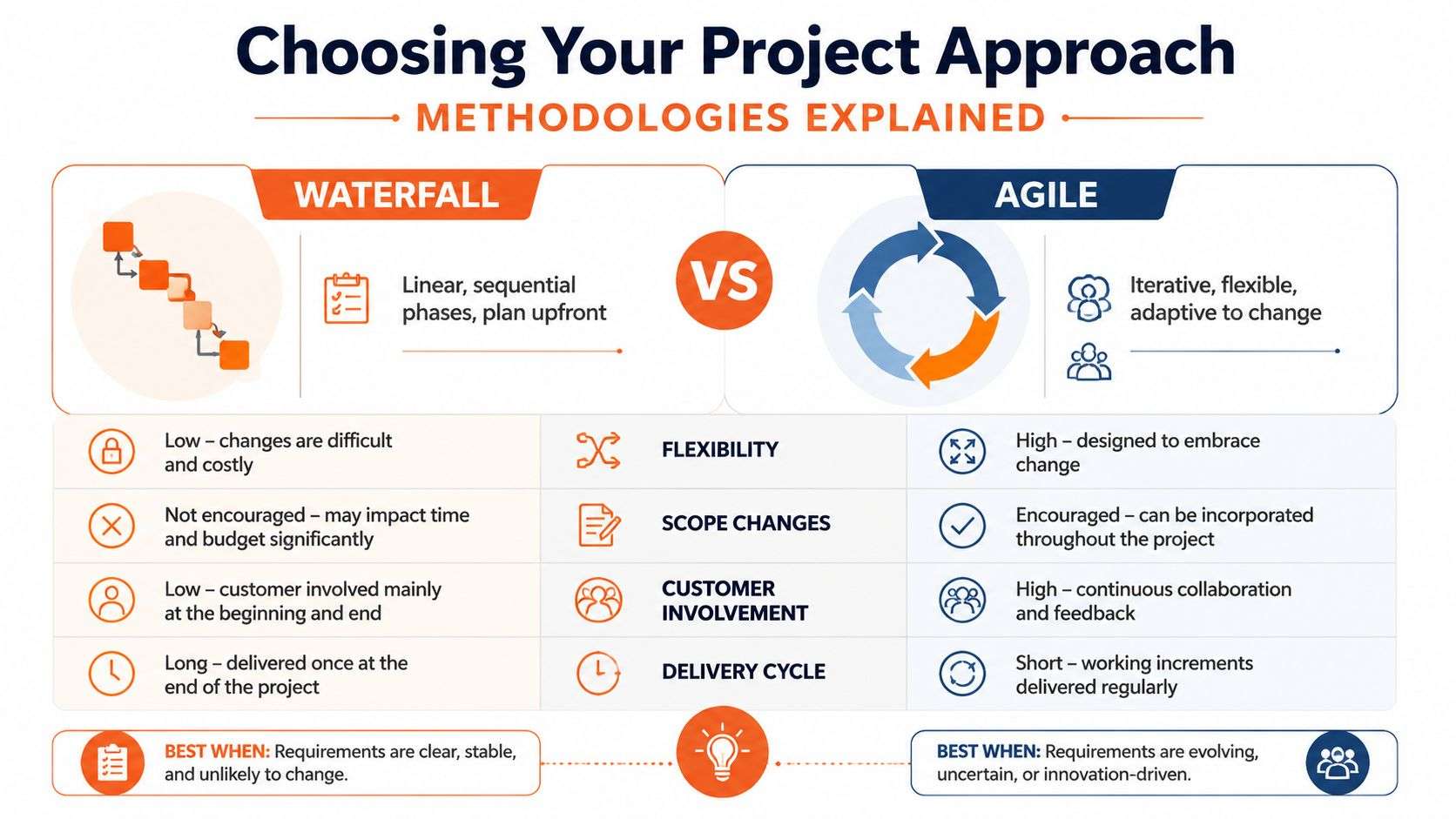
Methodology debates often waste time because they're framed like ideology. Waterfall versus Agile. Process versus flexibility. Governance versus speed. In practice, the right question is simpler. How much certainty do we have, and how much change should we expect?
Australian Government Digital Transformation Agency guidance stresses tailoring the delivery method to the initiative. The practical beginner question is less “what is a project plan?” and more “how do I decide the level of planning, governance, and iteration this project needs?” (Techcanvass summary of the guidance).
When Waterfall fits
Waterfall works when the destination is clear and changes are expensive. Construction is the obvious example, but plenty of business projects have the same profile. If you're migrating finance processes into Odoo ERP with defined approval rules, tax handling, chart of accounts, and reporting requirements, a more sequential model can make sense.
Use Waterfall when:
- Requirements are stable
- Dependencies are fixed
- Compliance or governance matters
- Change late in the project is costly
The main strength is predictability. The main weakness is rigidity if the early assumptions are wrong.
When Agile fits
Agile suits work where user feedback changes the product as it is being built. Custom portals, mobile apps, customer-facing features, and internal workflow tools often benefit from iteration. A team building a booking engine or service app with a software development Sydney Adelaide capability might start with core user journeys, then refine based on testing and actual behaviour.
Agile is strongest when:
- Requirements will evolve
- Users need to see and test working increments
- Speed of learning matters
- The team can make fast decisions
Its weakness isn't lack of discipline. It's fake agility. If the business can't prioritise, won't attend reviews, or keeps changing strategic direction, Agile becomes churn.
Why Hybrid is often the real answer
Most real projects in growing businesses are hybrid. An Odoo implementation may need fixed governance around scope, data migration, accounting controls, and go-live readiness, while still using iterative workshops and phased releases for CRM, inventory, or field service. A Shopify implementation may lock the launch date and payment configuration but iterate on theme details, content structure, and conversion improvements.
This is why methodology choice should sit close to business intent.
| Approach | Best fit | Watch out for |
|---|---|---|
| Waterfall | Defined requirements and formal controls | Late discovery of wrong assumptions |
| Agile | Evolving product or software requirements | Endless iteration without decision discipline |
| Hybrid | Business systems with both governance and learning needs | Confusion if teams don't define what is fixed and what is flexible |
For leadership teams trying to align delivery with business priorities, the OKR framework for strategy execution is a helpful complement because it connects project activity to measurable strategic outcomes instead of treating methodology as the goal.
A more detailed business view of adaptive delivery is also covered in this explanation of Agile methodology. The key takeaway is practical. Choose the method that fits the risk profile, decision speed, and uncertainty of the work. Don't choose the one that sounds modern.
Essential Planning Techniques and Tools
Most failed projects don't collapse because the team lacked effort. They fail because the work stayed too vague for too long. Good planning techniques make the project visible. They break large intentions into manageable pieces, assign ownership, and give the team a way to see trouble before it becomes expensive.
For Australian projects, a strong Work Breakdown Structure and Risk Register are especially practical because they translate scope into measurable work and track threats, owners, and mitigation actions across teams, suppliers, and jurisdictions (Kitchen.co summary).
Start with a Work Breakdown Structure
A Work Breakdown Structure, or WBS, takes a project and decomposes it into work packages that can be estimated, assigned, and tracked. This is one of the most useful project management fundamentals because it forces specificity.
If a business says, “We're implementing Odoo,” that sounds clear until someone asks what that includes. A WBS pushes the answer out into concrete chunks such as finance setup, inventory rules, purchasing workflows, user roles, data migration, testing, training, and go-live support.
A simple WBS does three things well:
- Breaks work down enough to manage it
- Separates major deliverables from minor tasks
- Makes missing scope visible before work starts
What doesn't work is the opposite. Large task lines like “build system”, “set up website”, or “do testing” don't help anyone manage delivery.
If a task can't be assigned clearly, estimated reasonably, or marked complete objectively, it's probably still too broad.
Use a risk register before risk becomes a surprise
A risk register is not a corporate formality. It is where the team captures what could go wrong, how serious it would be, who owns the response, and what actions reduce exposure.
In technology projects, the recurring risks are often familiar:
- Resource risk: Key staff are unavailable during workshops, testing, or sign-off.
- Data risk: Legacy data is incomplete, inconsistent, or poorly structured.
- Dependency risk: Third-party vendors, payment gateways, carriers, or plugins are not ready when needed.
- Decision risk: Executives want progress but delay the decisions that enable it.
- Change risk: Teams continue requesting new features after build work has started.
The value of the register is discipline. It moves a team from vague concern to managed response. “Our operations manager is busy” becomes “critical process owner unavailable during UAT, sponsor to lock workshop dates and backup approver by Friday.”
Add visual planning tools that people will actually use
A plan hidden in a long document won't control much. Teams need visual tools.
A Gantt chart is useful when dependencies matter. It shows what must finish before something else can begin. That's valuable in ERP, eCommerce, and integration work where data, design, testing, and training all affect one another.
A simple responsibility matrix also helps. Even a lightweight grid that distinguishes decision-maker, task owner, reviewer, and informed stakeholder can remove a lot of confusion.
| Tool | Best use |
|---|---|
| WBS | Define and estimate the work |
| Risk Register | Track threats and responses |
| Gantt chart | Sequence work and dependencies |
| Responsibility matrix | Clarify who owns what |
| Change log | Control additions and amendments |
Tie the tools into your systems
The planning tools don't need to live in separate silos. In a mature setup, they connect to the operating systems the business already uses.
In Odoo ERP, project tasks, timesheets, approvals, purchasing, and reporting can support a more controlled delivery environment. In a Shopify implementation or WooCommerce project, task and issue tracking should be tied to content readiness, catalogue setup, shipping rules, and user acceptance. In custom development, backlog items, sprint boards, and release plans should still reflect the business-level WBS and risk view.
That's the practical point. Tools are only useful when they help people make decisions faster and with less ambiguity.
Fundamentals in Action Industry Examples and Tech Solutions
The easiest way to understand project management fundamentals is to watch them under pressure. Theory sounds clean. Real businesses aren't. Teams are busy, systems are imperfect, and projects compete with normal operations every day.
A frequently missed issue in Australia is labour availability. In constrained labour markets, project planning shifts from “who should do this task?” to “how do we build a realistic plan when critical people are scarce or hard to backfill?” (Project Management Academy summary referencing Australian labour constraints). That changes how smart teams scope, sequence, and govern work.

Manufacturing and Odoo ERP
A manufacturer rolling out odoo erp usually isn't buying software alone. They're redesigning how purchasing, production, inventory, quality control, and finance fit together. That's a business change project with system consequences.
A weak delivery approach often starts with broad ambition. “We want everything integrated.” The problems arrive quickly. Bills of materials aren't standardised. Stock rules differ by site. Supervisors can't leave the floor for workshops. Data ownership is unclear. Testing gets delayed because the people who know the process are also the people keeping operations running.
A stronger project approach does a few things differently:
- Limits first-phase scope: Focus on the workflows needed for stable operations first.
- Maps process owners early: Name who defines purchasing, production, inventory, and finance rules.
- Plans around operational peaks: Don't schedule critical workshops during end-of-month, seasonal demand, or production surges.
- Uses staged deployment: Go live by business priority instead of trying to transform everything in one hit.
A disciplined odoo implementation matters. The software can support planning, tasks, approvals, and reporting. But the implementation only lands if the project structure respects production reality.
Retail and eCommerce delivery
A retailer managing a new storefront or replatforming project often underestimates how many moving parts sit behind a clean website launch. A Shopify implementation or WooCommerce rebuild usually involves product data, collections, pricing, promotions, tax settings, shipping logic, payment gateways, customer flows, content, SEO migration, and operational fulfilment.
Projects like this run into trouble when everyone thinks the website is the project. It isn't. The website is the visible output. The project includes all the decisions and dependencies behind it.
A practical way to structure this work is to separate it into streams:
| Workstream | Typical owner |
|---|---|
| Catalogue and product data | Merchandising or operations |
| Theme and UX changes | Design and eCommerce lead |
| Payment and shipping setup | Finance and operations |
| App and integration decisions | Technical lead |
| Content and redirects | Marketing |
| Testing and launch readiness | Project lead with business owners |
The trade-off is clear. Speed improves when decisions are made quickly and the launch scope is disciplined. It slows when stakeholders keep adding “small changes” after testing has started.
Logistics and constrained resources
A logistics business might be upgrading fleet systems, driver workflows, warehouse scanning, or proof-of-delivery tools. These projects often involve field users, third-party hardware, mobile devices, and integration with existing back-office systems.
The labour issue becomes very real here. Drivers, dispatch coordinators, warehouse supervisors, and operations managers often have limited availability for workshops and testing. If the project plan assumes full access to them, the schedule is fiction.
What works better is operationally aware planning:
- Build short, targeted workshop sessions
- Use representative user groups rather than everyone
- Lock testing windows with manager approval
- Nominate backups for every critical reviewer
- Reduce customisation where support capacity is thin
Many businesses turn to a software development Sydney Adelaide team for mobile tools, integrations, or custom workflow apps. The technology can solve genuine field problems, but only if the project plan reflects how little spare bandwidth operational teams really have.
In labour-constrained environments, the scarcest project resource usually isn't budget. It's attention from the people who understand the work.
Professional services and internal systems
Accountants, lawyers, consultants, and healthcare operators often assume project management is mainly for large technical programs. In reality, these firms run complex change projects all the time. Practice management upgrades, client portal launches, document workflow redesign, appointment systems, and reporting improvements all need project discipline.
A common failure pattern is executive sponsorship without operating commitment. Leadership approves the initiative, but the people who must define workflows and test outputs are left to “fit it in”.
The healthier model is modest and disciplined. Keep the scope tight, define mandatory outcomes, use a clear approval path, and automate repeatable work where possible. In many cases, Odoo ERP, WooCommerce, or custom business applications can reduce admin load, but the value comes from pairing the tool with explicit ownership and controlled rollout.
Measuring Success and Taking Your First Step
A project closes. The team signs off. The software goes live. Three months later, staff are still using spreadsheets, managers still cannot see reliable numbers, and customers feel no difference. That project was delivered. It was not successful.
A better test is straightforward. Measure delivery performance, then measure business impact. For a growing Australian business, especially one already stretched by thin specialist capacity and hard-to-replace staff, both matter. A late project can still produce strong returns if the rollout sticks. An on-time project can still waste money if adoption is weak or reporting stays unclear.
Start with the delivery basics. Did the team complete the approved scope? Were risks identified early and handled before they became expensive? Was the handover clean enough that operations could run the new process or system without constant support from the project team?
Then assess whether the business is working better:
- Stakeholder confidence: Do sponsors and operational managers trust the result enough to rely on it?
- User adoption: Are staff using the new system as intended, or reverting to side processes and manual fixes?
- Process performance: Has the change reduced rework, delays, duplication, or avoidable admin?
- Management visibility: Can leaders now track work, costs, service levels, or sales with less guesswork?
Visibility matters more than many businesses expect. If leaders cannot see what changed, they cannot tell whether an Odoo rollout, Shopify rebuild, custom app, or workflow redesign improved the business or just shifted the work around. Clear business dashboard reporting gives management a usable view of adoption, bottlenecks, and operating results after go-live.
If the business feels messy, avoid a full methodology overhaul. Pick one project that matters and put basic control around it.
- Select one active initiative with clear commercial importance.
- Define the outcome in plain language so the team knows what success looks like.
- Record scope boundaries so new requests are visible instead of being absorbed without notice.
- Assign one accountable owner with a realistic timeline and budget view.
- Review a short risk list weekly with decisions attached to each item.
- Track change requests openly so trade-offs are made consciously.
That discipline creates traction quickly.
The point is practical. Project management fundamentals protect margin, capacity, and trust while change is underway. They also make technology implementation more useful. Whether the job is an odoo erp rollout, a shopify implementation, a WooCommerce upgrade, or a custom platform delivered with ODOO partner Sydney Adelaide and software development Sydney Adelaide support, the same principles decide whether the investment produces control or confusion.
If your business is planning an Odoo implementation, upgrading Odoo ERP, launching on Shopify or WooCommerce, or needs practical software development Sydney Adelaide support, Wistec can help turn a complex initiative into a controlled delivery plan. As an ODOO partner Sydney Adelaide, Wistec works with Australian businesses to align systems, processes, and project execution so growth does not create more chaos. Book a no-obligation consultation to map the scope, identify delivery risks, and build a realistic path forward.