

You need a backend that won't fall over when traffic spikes, won't turn a simple integration into a six month rewrite, and won't leave your internal team guessing how anything works after launch. That's usually the moment businesses start searching for the best Node.js development services. The hard part isn't finding agencies that say they build with Node.js. It's finding one that can connect Node.js to the systems you already rely on, whether that's Odoo ERP, Shopify, WooCommerce, booking software, or a tangle of internal APIs.
That decision matters more in Australia than many buyers realise. Node.js remains a mainstream choice, not a niche one. A 2026 industry roundup reports that 48.7% of software developers worldwide actively use Node.js, ranking it as the #1 runtime framework, which is one reason Australian businesses can usually hire, extend, or transition Node-based projects more easily than more specialised stacks (CMARIX Node.js statistics roundup). For a CTO or technical lead, that translates into practical benefits. Handoffs are easier, recruitment is broader, and support risk is lower.
It's not a question of whether Node.js is viable. It is. The question is which partner fits your delivery model. If you need Odoo implementation, an ODOO partner Sydney Adelaide, software development Sydney Adelaide, or shopify implementation tied to operational systems, the shortlist should look very different from a generic staff augmentation list.
1. Wistec (Sydney & Adelaide)
A familiar Australian scenario looks like this. The business needs a Node.js layer for customer accounts, order flows, or partner access, but the project only works if it also connects cleanly to Odoo, Shopify, or WooCommerce. That is where Wistec is a stronger candidate than a generic Node.js shop.
Its value is less about advertising a JavaScript stack and more about handling the messy part of delivery. ERP workflows, stock rules, invoicing triggers, fulfilment states, and data ownership usually decide whether an integration succeeds. Teams that miss those details often ship software that works in demos and creates operational problems in production.
Best fit
Wistec suits organisations that want one provider to cover custom application work and business-system implementation. If you are reviewing custom software development for integrated business systems, the main advantage is shared accountability across backend logic, Odoo processes, and commerce operations.
That shows up clearly in projects such as:
- Odoo-connected portals: Customer, supplier, or staff portals that need live ERP data, approvals, document access, and order visibility.
- Shopify implementation with custom backend rules: Stores that need pricing logic, stock synchronisation, fulfilment events, or B2B account workflows tied to operational systems.
- WooCommerce integration projects: Commerce builds that need to preserve existing finance and operations processes instead of forcing a platform replacement.
Practical rule: Ask who owns the truth for products, pricing, stock, invoices, and customer records. If the vendor cannot answer that clearly, expect rework.
The trade-off is straightforward. Wistec is a better fit as a delivery partner for solution-led projects than as a source of standalone Node.js contractors for an established product engineering team. Scoping also tends to be more consultative, because cost and timeline depend on integration depth, process complexity, and how much change the business can absorb during rollout.
For organisations that want an Odoo partner and software development support in Sydney and Adelaide, that combination is useful. It is also a good match for Australian businesses using this shortlist as a buying guide rather than a generic agency roundup, especially if the decision depends on how well Node.js will connect to core systems already running the business.
2. Airteam (Sydney)
Airteam is the kind of provider I'd shortlist for product builds where engineering discipline matters as much as feature output. Their Node.js practice is paired with a modern JavaScript stack, including Express, TypeScript, GraphQL, Apollo, and PostgreSQL. That usually signals cleaner contracts between front end and back end, and fewer awkward rewrites later.
For Sydney-based teams, the local collaboration model is a genuine advantage. Workshops, roadmap reviews, and design-engineering alignment tend to move faster when the delivery team is close to the business and operating in the same time zone.
Where Airteam fits best
Airteam makes sense for teams building customer-facing platforms, internal tools, or API-first products that need a polished product engineering process. If your team already knows what good software delivery looks like and wants a partner that speaks that language, Airteam is likely to feel familiar.
I'd put them in the running when the brief includes:
- TypeScript-heavy builds: Better fit for teams that care about maintainability and contract clarity.
- GraphQL or API-first products: Useful where multiple clients consume the same backend.
- Cloud delivery: Better suited to teams that want deployment and architecture considered early.
There's also a practical distinction worth making. If your project is closely tied to ERP workflows, heavy Odoo implementation, or a combined website plus operations rollout, you may want to compare Airteam's product focus against a more integration-centric partner such as custom software development specialists at Wistec.
Airteam is stronger when the software product itself is the centre of gravity. It's less obviously positioned around Odoo ERP and commerce-platform operations than some hybrid implementation partners.
One other reality check. Public pricing isn't listed, so you'll need a scoped discussion. That's normal for this level of work. Visit Airteam.
3. Designpluz (Sydney)
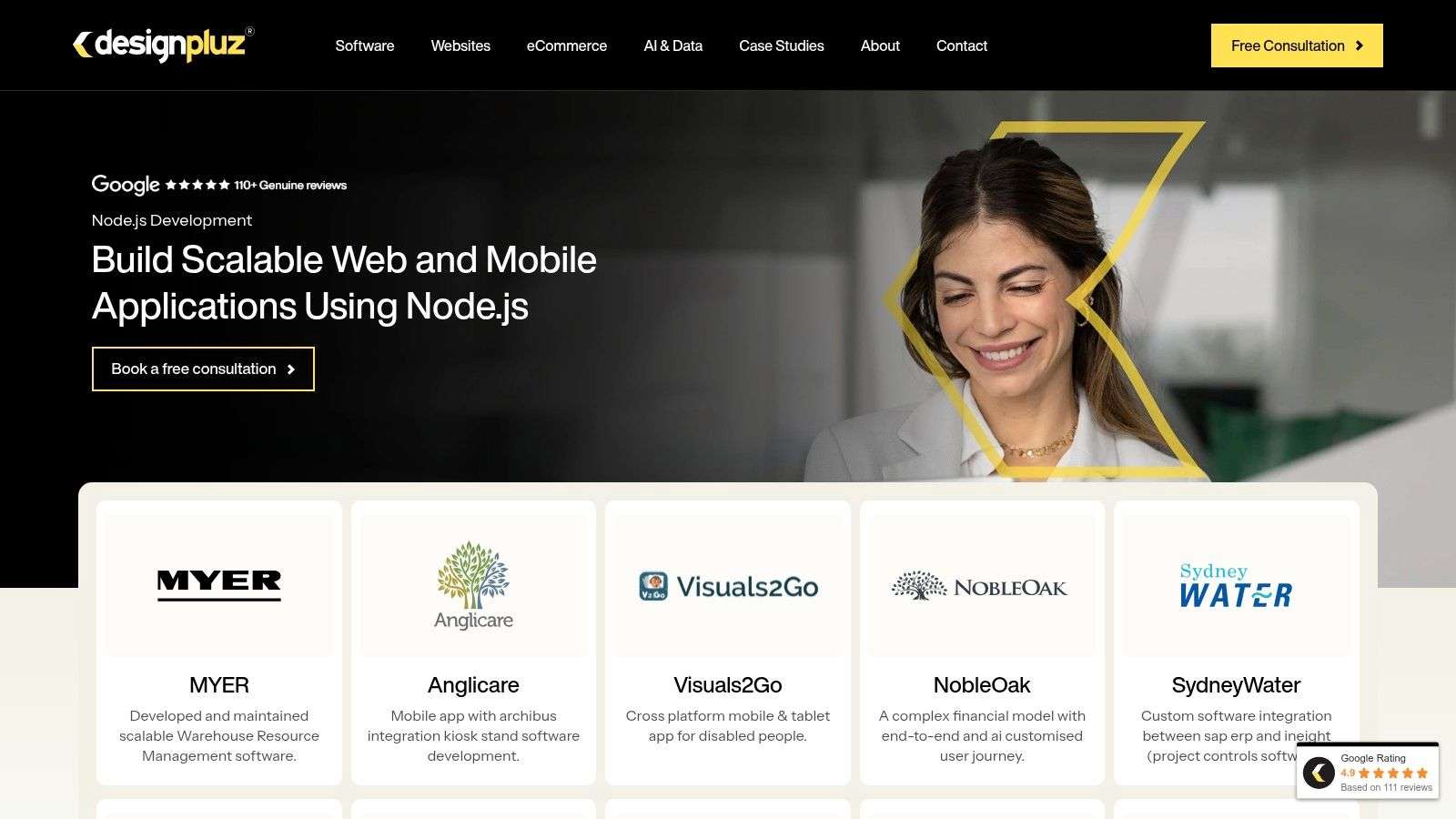
A common Sydney brief looks like this: the website still works, the back office is messy, and no one wants the risk of replacing everything at once. In that situation, a Node.js partner needs to handle staged modernisation, keep operations stable, and leave room for future integrations with systems such as Odoo, Shopify, or WooCommerce. Designpluz appears better suited to that kind of incremental work than to pure greenfield product builds.
Their positioning around Node.js development, microservices, cloud deployment, and ongoing support points to a practical service model for businesses carrying legacy constraints. That matters in the Australian mid-market, where projects often start with one painful workflow, not a blank-sheet rebuild.
Why they're worth considering
I'd look at Designpluz when the problem is architectural drag. Older PHP or monolithic applications often become expensive to change because every release touches too many dependencies. A provider that can separate services, expose cleaner APIs, and support the result after launch can reduce that risk without forcing a full replatform in phase one.
Their fit is stronger in cases like these:
- Legacy modernisation: Useful for teams that need to split older systems into smaller services over time.
- Support after launch: Better for buyers who want build, maintenance, and hosting conversations handled by one vendor.
- Open infrastructure choices: Sensible if your cloud direction is still being decided and you need flexibility.
This is also where technical buyers should get specific. If your roadmap includes ERP or commerce integration, ask how they would structure Node.js around inventory sync, order events, customer data, and admin workflows. A polished marketing site is not enough. You need evidence that the team can design APIs and background jobs that work cleanly with operational systems used by Australian businesses.
If your front end is React-heavy and the project depends on close coordination between UI delivery and backend services, compare their approach with a specialist React JS development company at Wistec.
The main trade-off is depth versus breadth. Designpluz presents a broad service offering, but less public detail on engineering choices than some backend-focused firms. I would probe for examples of service boundaries, deployment workflow, monitoring, and how they handle gradual migrations from older apps. Visit Designpluz.
4. HELLO PEOPLE (Perth; Australia-wide)
A common buying scenario looks like this. The business needs a Node.js team that can ship an API layer quickly, connect it to existing systems, and keep the architecture understandable for an internal team after launch. HELLO PEOPLE is easier to assess in that situation than many agencies because they publish more technical detail than the average design-led firm.
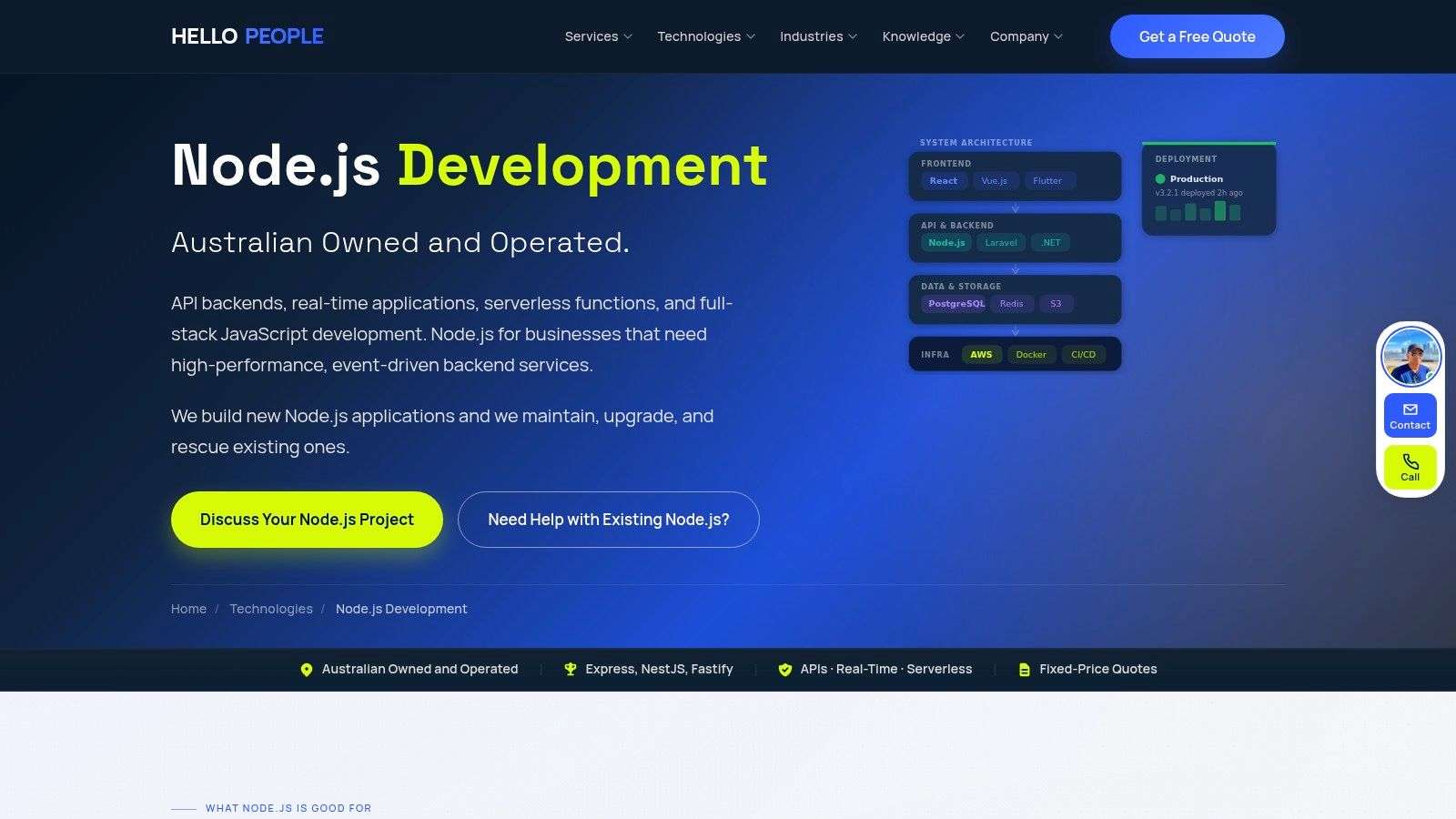
They name the stack clearly: Express, NestJS, Fastify, APIs, real-time apps, WebSockets, Socket.io, and serverless builds. That matters because it gives a CTO or engineering lead something concrete to test in discovery. Instead of sitting through broad full-stack claims, you can ask how they choose between opinionated structure in NestJS and lower-overhead performance in Fastify, or where they would keep background jobs separate from request handling.
Best suited to API products and integration-led builds
HELLO PEOPLE appears strongest on projects where Node.js is the operational layer, not just the web backend. That includes SaaS products, mobile backends, event-driven workflows, and real-time dashboards. For Australian companies running Odoo, Shopify, or WooCommerce, that often means middleware work such as order sync, inventory updates, webhook handling, customer data flow, and admin-facing APIs that sit between commerce and ERP systems.
That is the practical lens I would use here. A polished Node.js service page is less useful than evidence that the team can design queues, retries, webhook consumers, auth boundaries, and monitoring around business-critical integrations. The broader demand signal for JavaScript talent is clear in agency market coverage such as the DesignRush Node.js agency guide, but procurement should stay focused on delivery signals like TypeScript discipline, CI/CD setup, containerisation choices, and how they handle failure states in production.
HELLO PEOPLE is a sensible shortlist candidate if your priorities look like this:
- Real-time features: Notifications, booking changes, live dashboards, tracking updates, or user activity streams.
- Business system integrations: Shopify or WooCommerce storefront events flowing into Odoo or another ERP without forcing a full platform rebuild.
- Defined project scope: Discovery first, then fixed-price delivery for a clearly bounded API or application build.
Ask one hard question early. How would they structure a Node.js service that has to process Shopify webhooks, update Odoo records, and recover cleanly from duplicate events or temporary ERP outages? Strong teams answer with idempotency, queueing, retry policy, and observability. Weak teams stay at the framework level.
The trade-off is proof depth. HELLO PEOPLE gives buyers useful technical signals up front, but there is still limited public case detail on architecture under load, long-term support, or integration complexity. I would ask for examples involving background processing, deployment workflow, handover standards, and post-launch ownership before signing. Visit HELLO PEOPLE.
5. PowerGate Australia
A common buying mistake shows up after go live. The app ships, the first integration works, then the hard part starts. package updates, alert noise, memory issues, failed jobs, and support ownership across time zones. PowerGate Australia is better suited to that phase than firms that focus mainly on launch.
Their positioning points to ongoing support, monitoring, migrations, and version upgrades. That matters if you are inheriting an older Node.js codebase, replacing scattered services with one maintained platform, or trying to connect a storefront stack to back-office systems without creating another support problem.
For Australian companies running Shopify or WooCommerce alongside Odoo ERP, this model deserves a close look. The key question is not only whether they can build the integration. It is whether they can keep webhook processing, sync jobs, and API dependencies stable when upstream systems change. A partner with run-state discipline is usually the safer choice for order flows, inventory sync, and finance-related data handoff.
PowerGate is strongest for teams that need continuity. I would shortlist them for projects such as:
- Backend modernisation: Replacing an older API layer or monolith with maintained Node.js services.
- Migration work: Moving from a fragile integration setup to a cleaner service structure with lower support overhead.
- Support-led engagements: Cases where post-launch monitoring, incident response, and upgrade planning matter as much as initial delivery.
- Business system integration: Node.js services sitting between Shopify, WooCommerce, Odoo, or other operational platforms.
Independent review context is still useful during procurement. The Blackthorn Vision overview of Node.js development companies is one example, but I would treat market roundups as a starting point only. The stronger signal is whether PowerGate can show documented release practice, ownership in production, and a clear support model for Australian clients.
Ask direct operational questions early:
- Monitoring ownership: Do they only set up alerts, or do they also triage and respond?
- Upgrade policy: How do they manage Node version changes, dependency vulnerabilities, and regression risk?
- Integration resilience: How do they handle duplicate Shopify webhooks, delayed Odoo responses, and partial failures across sync jobs?
- Cutover planning: What is their rollback approach during migration if surrounding systems do not behave as expected?
The trade-off is breadth. Their Node.js messaging gives stronger signals on maintenance and lifecycle support than on product design or front-end architecture. If your brief includes a complex React front end, conversion-focused UX work, or a full commerce replatform, verify who owns that part of delivery and how it will integrate with the backend plan. Visit PowerGate Australia.
6. Devstree Australia
Devstree Australia is the flexible option on this list. They offer individual Node developers or complete teams, and they frame delivery around planning, sprint execution, and launch. That can work well if you already have internal product ownership and need to add delivery capacity quickly.
This model is useful, but only if the engagement shape is clear. Staff augmentation solves one problem. It doesn't solve accountability gaps, unclear architecture, or vague acceptance criteria.
Where the model works
Devstree makes the most sense for companies that need either rapid execution support or a broader full-stack JavaScript team without building everything in-house. Their ability to support web, mobile, cloud, and third-party integrations gives them range.
For Australian buyers, I'd separate two scenarios:
- Augmentation: You have architecture leadership internally and need delivery horsepower.
- End-to-end projects: You need a team to plan, build, and launch a complete solution.
- Integration-led work: You need APIs tied to mobile, web, or external systems.
The caution here is straightforward. Flexible resourcing can become fuzzy ownership if governance is weak. If you're using a blended local and offshore setup, verify who writes architecture, who joins workshops, who handles incidents, and who signs off technical decisions.
A staged process only helps if the same people who join discovery still influence build quality. Otherwise, discovery becomes sales theatre and the delivery team inherits assumptions they didn't make.
I wouldn't rule Devstree out for commerce or ERP-adjacent builds, but I'd inspect integration depth carefully if the project includes Odoo ERP, shopify implementation, or WooCommerce custom flows. Visit Devstree Australia.
7. Mavenbird (servicing Melbourne/Sydney/Brisbane)
A retail team launches a new Shopify storefront, keeps Odoo as the system of record, and still expects stock, orders, shipping updates, and finance data to stay aligned in near real time. That is the kind of project where Mavenbird looks relevant.
Their service profile points to integration-led Node.js work: microservices, REST, GraphQL, gRPC, headless commerce, CMS builds, and connectors for business systems such as Xero, MYOB, Odoo, and Salesforce. For a CTO or delivery lead, that mix matters more than a generic “full-stack” claim because it suggests experience in the messy middle layer where commerce platforms, ERP, and operational systems need to exchange data reliably.
Strong fit for multi-system commerce builds
Mavenbird stands out if the project is less about a standalone app and more about connecting revenue operations. I would shortlist them for teams planning Shopify implementation, WooCommerce replatforming, headless commerce, or Odoo-linked workflows where Node.js is expected to handle APIs, sync jobs, event flows, and service boundaries cleanly.
That focus is useful in the Australian market, where mid-sized retailers and logistics businesses often need tighter inventory and order visibility without buying into a large enterprise stack. The practical question is not whether a vendor can code in Node.js. It is whether they can connect Node.js to the systems that already run the business.
Mavenbird looks most relevant for:
- Headless commerce projects: Good fit when frontend freedom, API performance, and back-office integration matter more than theme-level changes.
- ERP and accounting integration work: Relevant if Odoo, Xero, MYOB, or Salesforce need to stay aligned with orders, stock, fulfilment, and finance.
- Ongoing platform change: Useful for teams expecting phased migration, iterative feature releases, and long-term maintenance instead of a one-off build.
The trade-off is delivery clarity. If you are buying from a provider servicing Melbourne, Sydney, and Brisbane through a broader footprint, confirm who owns solution design, where the engineers sit, how time zone coverage works, and who handles production support after launch. Visit Mavenbird.
Top 7 Node.js Development Services Comparison
| Provider | 🔄 Implementation complexity | ⚡ Resource requirements | 📊 Expected outcomes | 💡 Ideal use cases | ⭐ Key advantages |
|---|---|---|---|---|---|
| Wistec (Sydney & Adelaide) | Medium–High: bespoke integrations (Node.js + Odoo/eCommerce) | Local full‑service team; scoped consultancy required | Integrated backends, ERP-connected workflows, custom eCommerce | ERP integrations, retailers needing end‑to‑end builds | Unique Node.js + Odoo expertise; strong local presence |
| Airteam (Sydney) | Medium: enterprise/regulatory builds with cloud delivery | Senior JS engineers (5+ yrs); local collaboration and discovery | Robust, performant enterprise apps and real‑time features | Regulated enterprises, complex real‑time systems | Experienced senior team; clear discovery/quoting pathway |
| Designpluz (Sydney) | Medium: microservices, greenfield and modernization work | Tenured agency team; ongoing maintenance plans available | Modernized architectures with long‑term support | Legacy app modernization; steady care and maintenance | Broad platform experience; cost‑effective JS fullstack |
| HELLO PEOPLE (Perth; Australia‑wide) | Low–Medium: framework‑driven (Express/NestJS/Fastify) with scoped quotes | Framework specialists; fixed‑price quoting after scoping; support options | API, serverless and SaaS backends with audits and support | API backends, serverless projects, industry‑specific solutions | Clear tooling transparency; fixed‑price quoting; support plans |
| PowerGate Australia | Medium–High: migrations, upgrades and 24/7 operations focus | Ops and monitoring staff for continuous support; scoped pricing | Migration/upgrades plus 24/7 monitoring and audits | Legacy migrations, teams needing sustained operational backing | Full lifecycle coverage; explicit migration and support pathways |
| Devstree Australia | Low–Medium: staged delivery process (design → sprints → launch) | Flexible resourcing: individual devs or full teams; global delivery | Faster delivery via unified full‑stack JS and staged sprints | Projects needing flexible staffing or end‑to‑end delivery | Documented process; flexible augmentation and global scale |
| Mavenbird (Melbourne/Sydney/Brisbane) | Medium: microservices, real‑time and many integrations | Integration specialists for ERP/CRM and headless commerce | Headless eCommerce, real‑time features, system integrations | Retail/eCommerce and operations‑heavy businesses | Strong eCommerce/ERP integration focus; published case examples |
Making Your Final Decision Checklist and Next Steps
A shortlist only helps if you pressure-test it against your actual delivery risk. Most Node.js projects don't fail because the runtime is wrong. They fail because the vendor wasn't strong in the one area the business really depended on. That might be Odoo implementation, cloud operations, shopify implementation, API governance, or support after go-live.
If I were evaluating these providers as a CTO, I'd narrow the field by matching each vendor to the shape of the project first. Wistec and Mavenbird are stronger when Node.js needs to connect closely with business systems and commerce operations. Airteam is attractive for product engineering and modern app delivery. Designpluz and PowerGate are useful when legacy modernisation and long-term support matter. HELLO PEOPLE is compelling for API, real-time, and serverless builds. Devstree offers flexibility when you need extra delivery capacity or a complete execution team.
Use this final checklist before you sign anything:
- Technical fit: Do they specialise in the Node.js frameworks, deployment model, and integrations you need?
- Business acumen: Do they understand your industry and the operational details behind projects like odoo erp rollout, software development Sydney Adelaide, or multi-channel commerce?
- Process: Is discovery clear, collaborative, and tied to the delivery team?
- Portfolio: Do their published examples resemble your problem, not just your preferred tech stack?
There's also a specific Australian lens worth applying. If you're in logistics or retail, ask how they handle real-time inventory, ERP sync, and operational resilience without defaulting to enterprise-grade over-engineering. If you're in hospitality or tourism, ask how they'll design for seasonal demand without locking you into unnecessary infrastructure. The article brief behind this piece highlights that generic vendor roundups rarely answer those questions well, and that gap is real in procurement.
The best Node.js development services won't just promise scale. They'll explain how they'll structure data flow, integrations, support, and ownership so the system keeps working when the business changes.
Choose the partner that can solve the whole delivery problem, not just write the backend. Ready to build? Contact a specialist today and start with a scoped technical conversation, not a sales demo.
If you need a partner that can combine Node.js backend development with Odoo implementation, ODOO partner Sydney Adelaide capability, software development Sydney Adelaide, and practical Shopify or WooCommerce delivery, talk to Wistec. They focus on solution-driven technology that connects apps, commerce, and operations in a way your team can effectively run after launch.